Tyr PC System Requirements: Minimum Storage Specs & GB Needed (2026)
If there is one thing I appreciate about a multiplayer tank game, it is not forcing me to delete half of my Steam library just to install it. After seeing modern shooters regularly demand 80, 100, or even 150+ GB, Tyr immediately caught my attention for a completely different reason: its surprisingly tiny PC storage requirement.
Developed by Stoke Games and released on Steam Early Access in late 2026, Tyr is built around tactical multiplayer tank combat rather than massive open-world exploration. That difference matters. Instead of filling your SSD with enormous cinematic sequences and endless environmental assets, the game concentrates its resources on maps, vehicles, physics, weapons, and competitive gameplay.
And yes, the official Tyr PC system requirements list only 4 GB of available storage.
That sounds almost ridiculous in 2026.
But storage isn’t the only thing worth looking at. The CPU requirements are considerably more demanding than I expected, while the GPU requirements are still relatively friendly for anyone gaming on an older mid-range PC.
After going through the specifications and looking at how the game behaves in actual multiplayer scenarios, here is my take on what you really need to play Tyr comfortably.
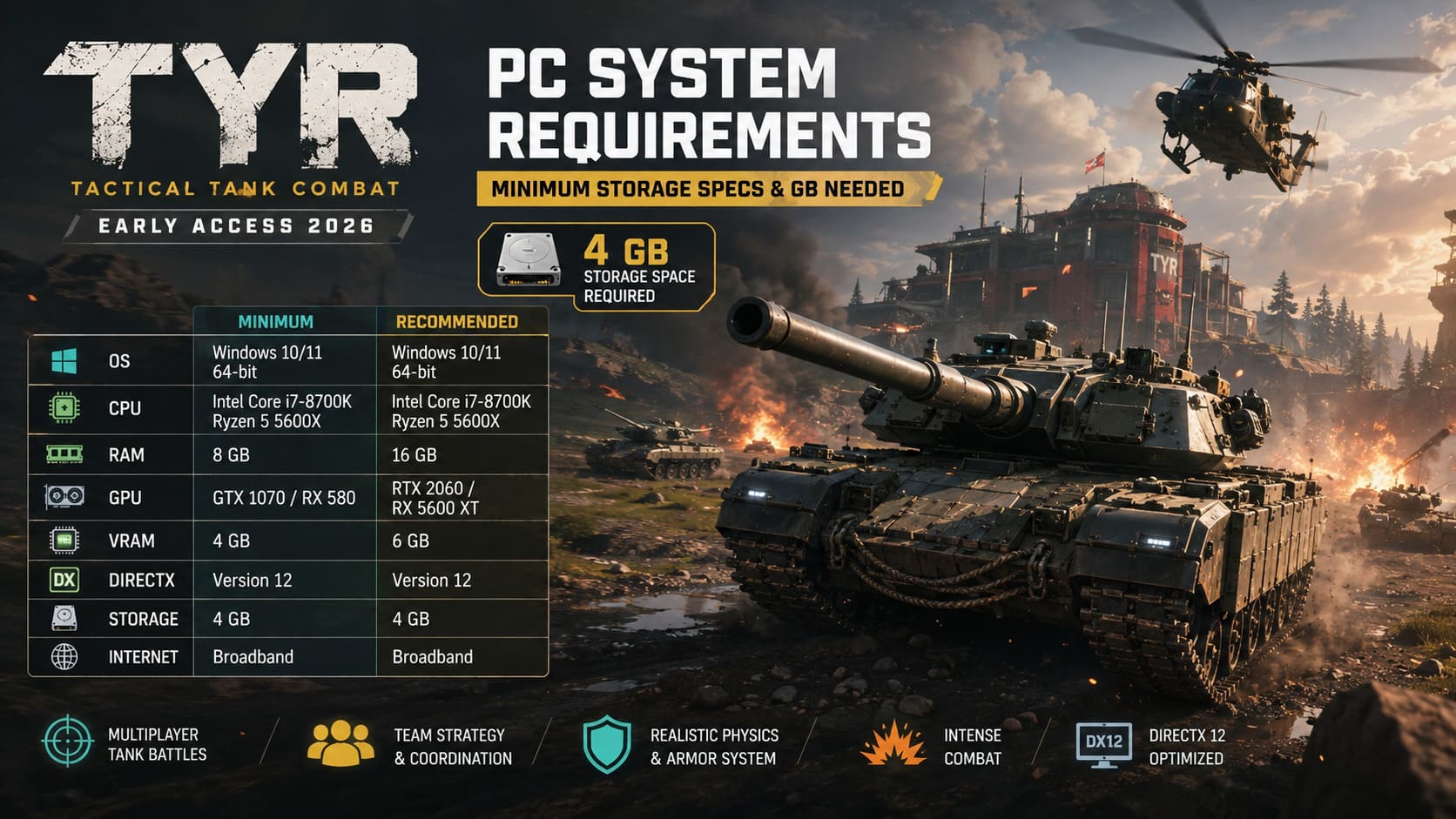
Tyr System Requirements at a Glance
Before getting into the details, here’s the quick version of the official hardware requirements.
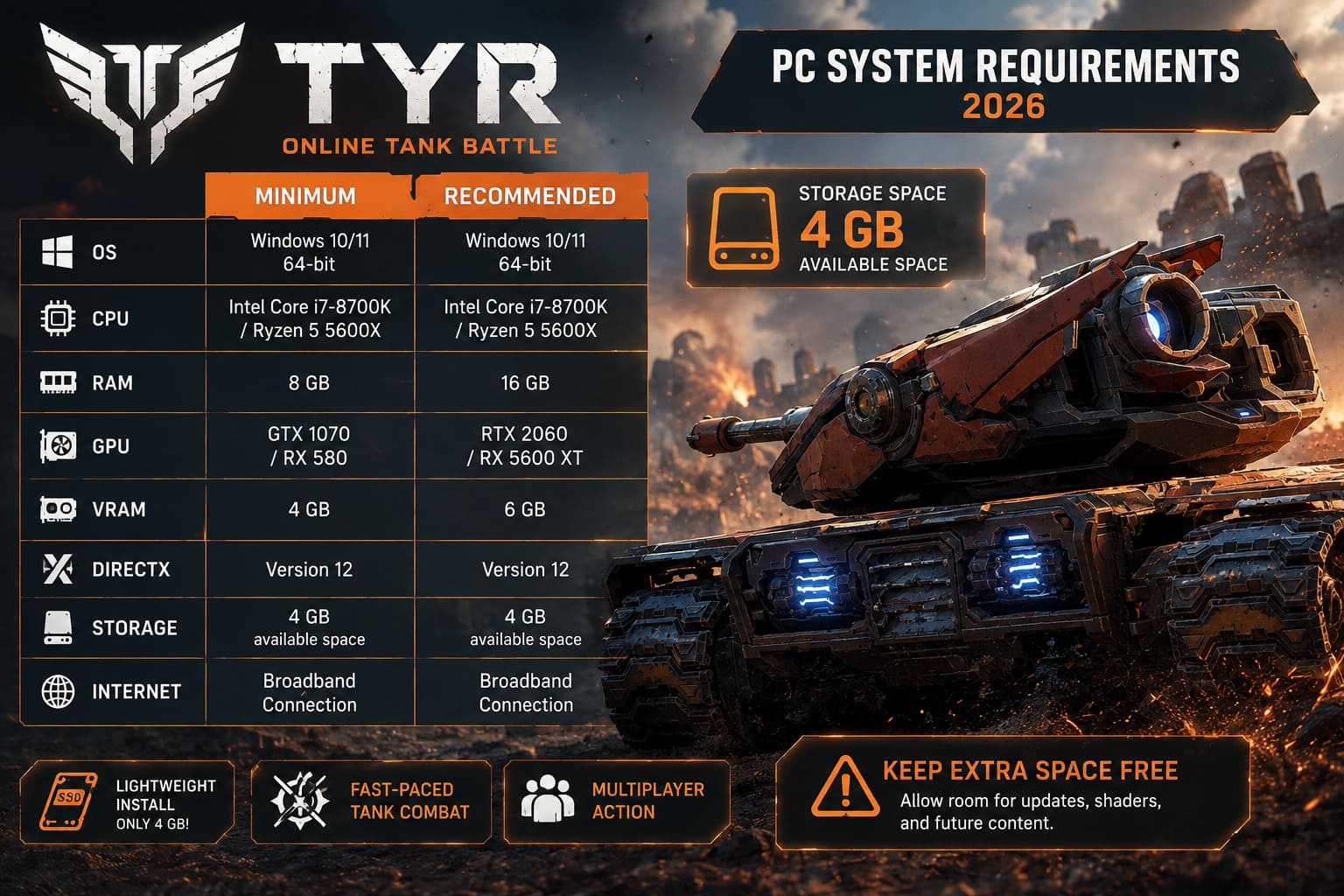
| Component | Minimum | Recommended |
|---|---|---|
| OS | Windows 10/11 64-bit | Windows 10/11 64-bit |
| CPU | Intel Core i7-8700K / Ryzen 5 5600X | Intel Core i7-8700K / Ryzen 5 5600X |
| RAM | 8 GB | 16 GB |
| GPU | GTX 1070 / RX 580 | RTX 2060 / RX 5600 XT |
| VRAM | 4 GB | 6 GB |
| DirectX | Version 12 | Version 12 |
| Storage | 4 GB | 4 GB |
| Internet | Broadband | Broadband |
The first thing that jumps out is the processor.
Usually, recommended requirements move one or two generations above the minimum CPU. Here, Stoke Games lists the same CPU class for both tiers. That tells me the processor is probably more important to the overall experience than simply pushing graphical settings higher.
And for a tank game, that actually makes sense.
The 4 GB Tyr Storage Requirement Is the Big Surprise
Let’s get the obvious question out of the way: how much space does Tyr need on PC?
Officially, you need 4 GB of available storage.
That’s it.
Compared with many modern multiplayer games, that’s practically nothing. I have personally become accustomed to checking whether a game needs 60 GB or 120 GB before clicking that install button. Seeing Tyr at 4 GB feels almost nostalgic.
The small installation size is largely explained by the game’s design philosophy.
Tyr isn’t trying to be a massive cinematic production with gigantic open-world environments. Its focus is competitive tank combat, which means the developers can concentrate the game’s data around relatively compact multiplayer maps, vehicle models, weapons, effects, and audio.
There is also less need for huge collections of character animations, photorealistic environments, pre-rendered cinematics, and other storage-heavy assets.
For players with a smaller SSD, this is one of Tyr’s biggest advantages.
Just remember that 4 GB should be treated as the official requirement, not necessarily as a recommendation to leave your drive completely full. Windows, Steam updates, shader caches, temporary files, and future game patches still need room.
If you ask me, I’d leave at least several additional gigabytes free rather than installing the game onto a drive that’s already completely packed.
Should You Install Tyr on an SSD?
Technically, the listed requirements don’t demand an SSD.
Personally, though, I’d use one without thinking twice.
A modern SATA SSD is already dramatically faster than a mechanical HDD, while an NVMe drive can provide even faster storage performance. You probably don’t need an expensive flagship NVMe just for Tyr, but using an SSD makes sense if it’s available.
Why?
Multiplayer tank battles can involve a lot of activity happening at once. Vehicles spawn, maps load, effects appear, explosions happen, and environmental assets have to be delivered while you’re trying to watch several firing lanes simultaneously.
A slow mechanical drive can become an unnecessary weak point.
If you’ve got an old HDD sitting around with plenty of free space, Tyr may still install and run from it. But if you’re serious about competitive play, I’d put the game on an SSD.
Four gigabytes is so small that there really isn’t much reason not to.
Tyr CPU Requirements: The Part I’d Pay Attention To
Here’s where Tyr gets interesting.
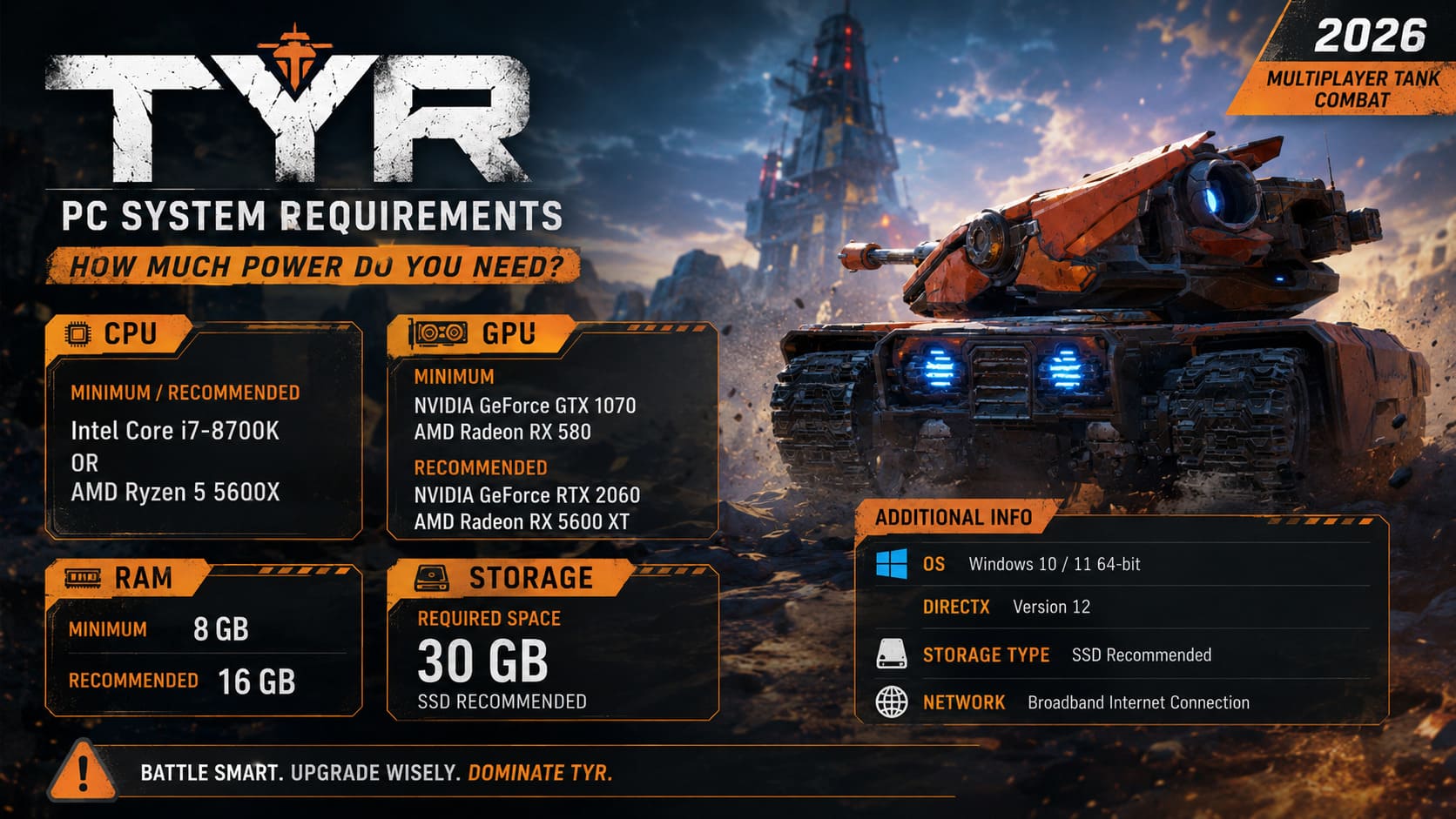
The minimum CPU is listed as either:
- Intel Core i7-8700K
- AMD Ryzen 5 5600X
And those same processors appear in the recommended requirements.
That is unusual.
It suggests that Stoke Games isn’t simply asking for a fast CPU because the graphics are demanding. Instead, the processor likely has to deal with the game’s underlying simulation and multiplayer workload.
Tank combat isn’t exactly a simple point-and-click FPS experience. Projectiles, vehicle movement, collision detection, armor interactions, environmental effects, and network synchronization can all create CPU work.
A six-core/twelve-thread processor such as the i7-8700K or Ryzen 5 5600X provides a much stronger foundation than an old four-core CPU.
This is one of those games where I wouldn’t automatically assume that a powerful graphics card will save an aging processor.
You could theoretically pair an older CPU with a much faster GPU, but if the processor becomes the bottleneck during a busy battle, you’ll still experience frame-time spikes.
And in a tactical multiplayer game, inconsistent frame times can be more annoying than simply having a lower average FPS.
What GPU Do You Need for Tyr?
The GPU requirements are much easier to swallow.
For minimum specifications, Stoke Games lists:
NVIDIA GeForce GTX 1070 or AMD Radeon RX 580
The recommended tier moves up to:
NVIDIA GeForce RTX 2060 or AMD Radeon RX 5600 XT
These aren’t exactly cutting-edge graphics cards in 2026, and that’s good news.
The GTX 1070 and RX 580 are both older generations, but they remain perfectly respectable choices for a relatively lightweight competitive game.
If your target is 1080p gaming with lower graphical settings, the minimum hardware should provide a reasonable starting point.
Moving toward the RTX 2060 or RX 5600 XT gives you more breathing room for higher settings and heavier effects.
The game also uses DirectX 12, so make sure your Windows installation and GPU drivers are up to date. There’s little point troubleshooting mysterious crashes when the problem is simply an outdated driver.
How Much RAM Does Tyr Need?
The minimum RAM requirement is 8 GB, while the recommended specification doubles that to 16 GB.
I would strongly recommend 16 GB if you’re building or upgrading a PC today.
Eight gigabytes may technically satisfy the requirement, but modern Windows installations already consume a meaningful amount of system memory. Add Steam, Discord, browser tabs, recording software, GPU utilities, and other background applications, and that headroom disappears quickly.
With 16 GB RAM, you have much more breathing room.
For a dedicated gaming PC, I’d consider 16 GB the sensible target for Tyr, while 8 GB is better viewed as the minimum entry point.
Can Tyr Run on a Steam Deck?
This is another interesting part of the game’s lightweight design.
Reports from the Linux and Steam Deck community indicate that Tyr can work well through Proton, with Proton 10.0-3 being part of the current compatibility picture.
The compact installation size is especially attractive on a Steam Deck. Four gigabytes doesn’t eat much of the internal storage, leaving more room for larger games.
Of course, Steam Deck performance isn’t determined by storage size alone. Resolution, graphics settings, frame-rate targets, and future Early Access updates can all change the experience.
Still, from a storage perspective, Tyr is almost tailor-made for people who are constantly fighting the Steam Deck’s limited internal space.
My Recommended PC Target for Tyr
If I were putting together a PC specifically to play Tyr, I wouldn’t obsess over buying expensive hardware.
I’d aim for something around this level:
| Hardware | My Target |
|---|---|
| CPU | Ryzen 5 5600X or better |
| GPU | RTX 2060 / RX 5600 XT or better |
| RAM | 16 GB |
| Storage | SSD with 10+ GB free |
| OS | Windows 10/11 64-bit |
| API | DirectX 12 |
This setup gives you considerably more breathing room than the minimum specification without turning Tyr into an expensive PC-building project.
And honestly, that’s exactly how I like competitive games.
I’d rather see developers optimize their engine and keep the hardware requirements sensible than demand a brand-new graphics card for effects I’ll barely notice while I’m trying not to get blown apart by a tank hiding behind a ridge.
Tyr Graphics Settings I’d Change First
If you’re struggling with performance, I wouldn’t immediately start dropping every setting to Low.
That’s usually the lazy solution.
Instead, I’d start with the options most likely to affect GPU performance while preserving visibility.
My first changes would be:
- Reduce shadow quality by one level.
- Disable or lower screen-space reflections.
- Keep texture quality relatively high if VRAM allows it.
- Reduce expensive visual effects before sacrificing overall image clarity.
- Monitor GPU and CPU usage to determine the actual bottleneck.
This is particularly important in a tank game because visual clarity matters.
If reducing a graphical effect gives you significantly more stable frame times without making enemy vehicles harder to spot, that’s a good trade.
Tyr 8v8 Gameplay Guide: Best Tactical Positioning & Tank Combat Strategies
Is 4 GB Really Enough for Tyr in 2026?
For the official installation requirement, yes: Tyr lists 4 GB of available storage.
But I wouldn’t interpret that as “you only need exactly 4 GB free.”
Games receive patches. Early Access games can change substantially over time. Steam also needs temporary space during downloads and updates.
So my practical recommendation is simple:
4 GB = official requirement.
10 GB+ = much more comfortable amount of free space.
If you have an SSD with plenty of room, I’d install Tyr there and forget about the storage issue entirely.
Best Starting Armored Vehicle in Tyr (2026): Beginner Tank Guide
Final Verdict: Tyr Is Surprisingly Lightweight
After looking at the requirements, I think Tyr has a pretty appealing hardware profile.
The 4 GB storage requirement is easily the headline feature, especially in a gaming market where enormous installation sizes have become normal. You don’t need a monster SSD, and you don’t need a current-generation flagship GPU just to get into the game.
The CPU requirement is the part I’d take most seriously. The fact that the minimum and recommended processor specifications are identical suggests that maintaining stable simulation and multiplayer performance is more important than simply increasing graphical fidelity.
For me, the sweet spot is a Ryzen 5 5600X/Core i7-8700K-class CPU, 16 GB RAM, an RTX 2060/RX 5600 XT-class GPU, and an SSD.
That’s a relatively modest setup by 2026 standards.
And if Stoke Games can maintain that level of optimization as Tyr moves through Early Access, that’s something I hope the developers protect. A tactical multiplayer tank game doesn’t need to occupy half of my SSD to look good and play well.
Sometimes, less really is more.