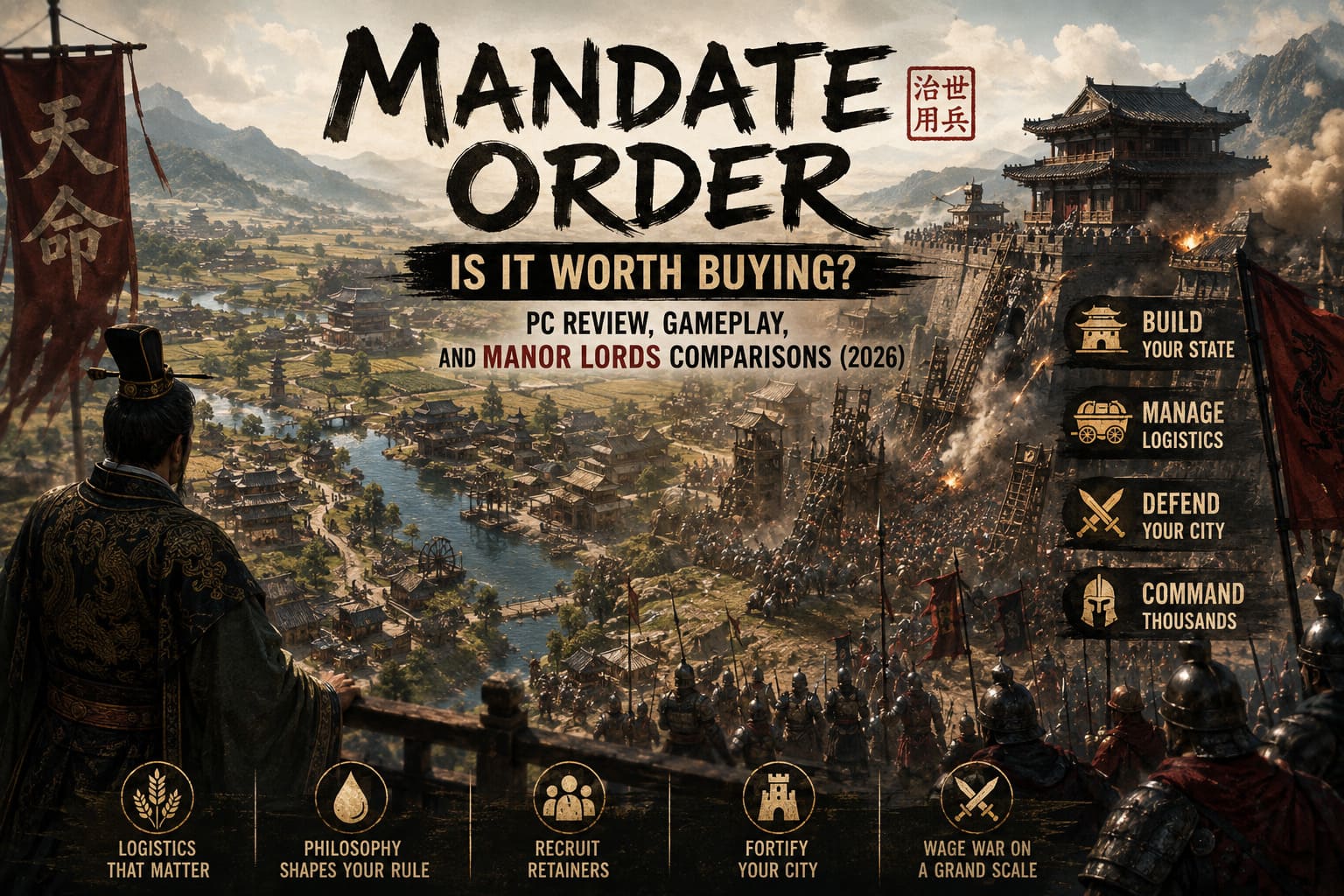
Is Mandate Order Worth Buying? PC Review, Gameplay, and Manor Lords Comparisons (2026)
There is a certain type of strategy game that can completely ruin your plans for the evening.
You start with a few tents, place a couple of buildings, tell yourself you will play for 30 minutes, and suddenly it is 2:00 AM. That was basically my experience with Mandate Order.
Digital Sky’s historical strategy game has been getting a lot of attention throughout August 2026, especially from players who enjoy city builders but want something much more aggressive than the usual peaceful farming-and-trading formula. The easiest comparison is obviously Manor Lords, and I understand why people make it. The camera, organic settlement construction, terrain-focused planning, and medieval-style atmosphere immediately create that association.
But after spending time with Mandate Order, I would not call it a Manor Lords clone.
Honestly, that comparison sells the game a little short.
Mandate Order is trying to combine a historical city builder, a logistics simulator, political strategy game, and large-scale real-time battlefield into one package. It does not always get everything right, especially as an Early Access title, but when its systems start working together, there is a very satisfying sense that you are actually building a functioning ancient Chinese military state rather than simply decorating a virtual village.
So, is Mandate Order worth buying in 2026? For the right kind of strategy player, I think the answer is yes. But there are a few things you should know before jumping in.
What Exactly Is Mandate Order?
Mandate Order is a historical city-building and real-time strategy game set during ancient China, drawing heavily from the Spring and Autumn and Warring States periods.
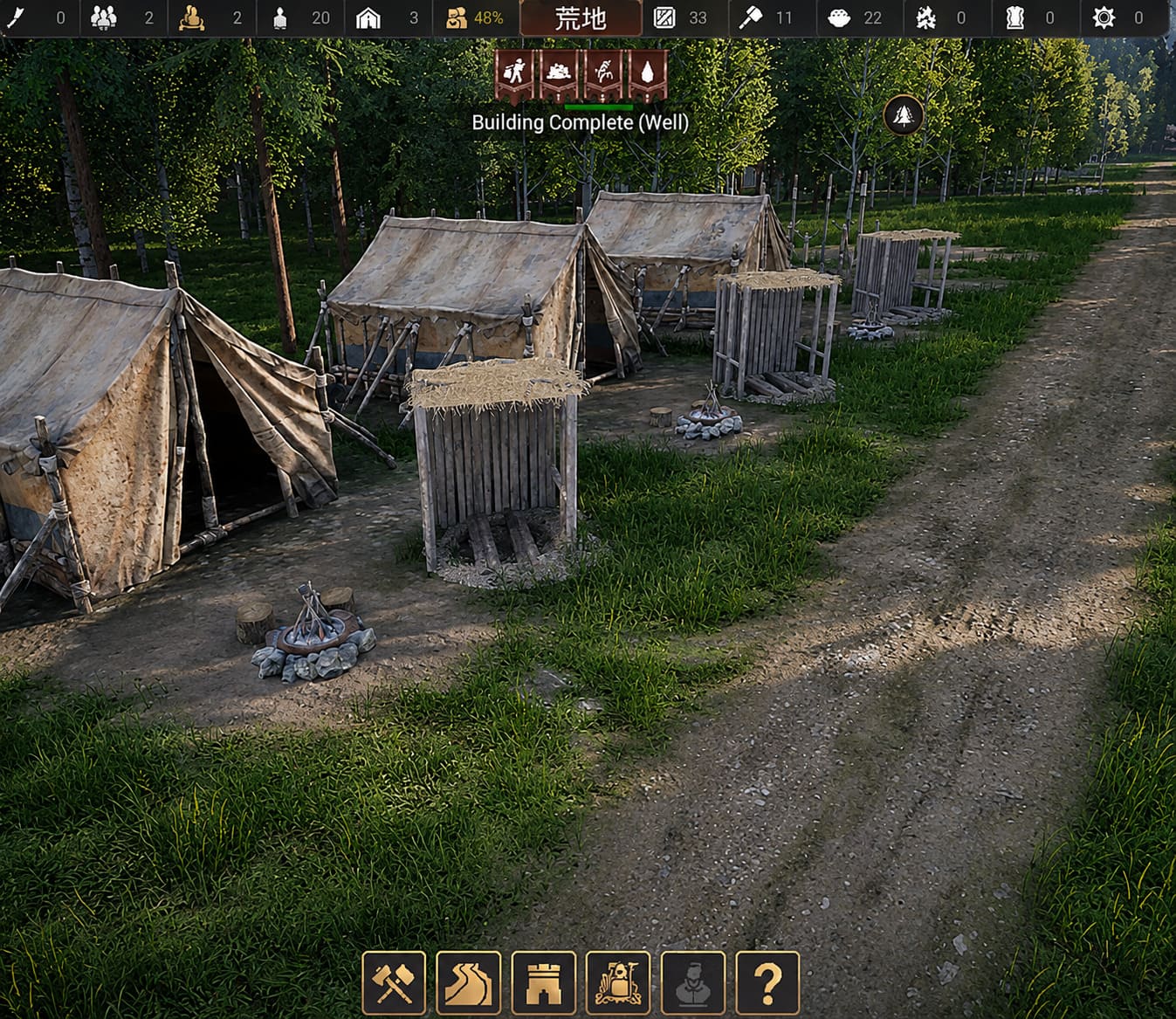
You begin with what feels like almost nothing: limited resources, basic shelter, vulnerable workers, and a piece of land that absolutely does not care about your grand ambitions.
Your objective is to turn that fragile settlement into a self-sufficient stronghold capable of surviving economic pressure, harsh seasons, political complications, and eventually full-scale military attacks.
That last part is important.
This isn’t one of those city builders where your army exists mostly to make the settlement look impressive. Warfare is a major part of the experience. Your economic decisions directly affect your military capabilities, while the location and structure of your settlement can determine whether you survive an invasion.
That connection between city building, logistics, and warfare is probably my favorite thing about Mandate Order.
You aren’t simply building a city.
You’re preparing a machine for war.
The Building System Feels Surprisingly Free
The first thing I noticed when playing Mandate Order was how much freedom the construction system gives you.
There is no rigid grid forcing every road and building into perfect little rectangles. You can curve roads around terrain, build defensive structures along hills, and shape your settlement around rivers and other natural features.
It sounds like a small feature, but it completely changes how your towns look.
Every settlement starts developing its own personality.
One city might stretch along a river with farms surrounding the residential areas. Another could become a heavily fortified mountain settlement with narrow entrances and defensive walls controlling access.
And that’s where I think Mandate Order has a real advantage over many traditional city builders.
The terrain actually matters.
You cannot just throw buildings anywhere and expect the economy to sort itself out.
Logistics Are Not Optional
This is where the game can either become incredibly satisfying or make you want to throw your mouse across the room.
Resources have to move.
Workers need food. They need water. They need fuel. Your buildings need access to supplies, and the distance between production and consumption matters.
For example, building a well is not simply a matter of clicking a button and forgetting about it. The game gives you information about local groundwater, and after constructing your water infrastructure, you still have to think about how that water reaches the people who need it.
Residential areas have operational ranges, and poorly planned logistics can create problems that aren’t immediately obvious.
You might have enough food in your settlement.
You might even have enough water.
But if the distribution network is badly arranged, your population can still suffer.
That is the sort of mechanic I personally love in strategy games because it creates genuine consequences for poor planning.
The Basic Things I Constantly Had to Watch Were:
- Food and water distribution
- Worker travel distances
- Fuel availability during winter
- Production and storage locations
- Road and transport efficiency
- Defensive access around important buildings
The game definitely expects you to think ahead.
If you’re looking for something relaxing where you can casually place buildings until the screen looks pretty, Mandate Order probably isn’t going to be your happy place.
The Retainer System Is One of Its Best Ideas
This is probably the system that makes Mandate Order feel most different from other historical strategy games.
Instead of relying entirely on a conventional technology tree, the game uses a Retainer System influenced by the philosophical schools of ancient China.
You can recruit scholars and retainers associated with different schools of thought, and their philosophies influence how your state operates.
The major approaches include Confucianism, Legalism, Mohism, and Taoism, with each direction offering different strategic advantages.
Legalist choices, for example, are focused heavily on state control, production, taxation, and security. The downside is that pushing the population too hard can hurt happiness.
Mohist influence leans more toward engineering and defensive capabilities, making it particularly attractive if you enjoy turning your settlement into a fortress.
Taoist-oriented bonuses can improve agriculture, health, and seasonal stability, which becomes especially useful if you’re trying to build a sustainable economy instead of constantly pushing military production.
What I like here is that these aren’t just historical names slapped onto a menu.
They actually influence how you play.
Your choice of retainers can change your priorities, your construction decisions, and even your overall strategy.
That gives the game something a lot of city builders desperately need: a reason to play the same map differently more than once.
When the Peaceful City Turns Into a Battlefield
Eventually, all that careful planning gets tested.
Mandate Order features large-scale real-time battles with thousands of units appearing on the battlefield. This is where the game suddenly stops feeling like a city builder and starts looking much closer to a traditional large-scale military strategy game.
You can organize formations, use terrain advantages, attempt flanking maneuvers, and deploy different types of troops depending on the situation.
Infantry, spearmen, archers, and chariots all have different battlefield roles.
And yes, the chariots are one of those things that immediately make you stop whatever you’re doing just to watch the charge.
There is something satisfying about spending an hour preparing your defenses, only to watch an enemy army finally arrive at the walls.
Of course, there is also something extremely painful about watching that same army break through because you forgot to prepare properly.
Sieges Are Where Your City Design Really Matters
Sieges are not simply a separate combat screen.
Your settlement itself becomes the battlefield.
Enemy forces can use siege equipment such as battering rams and siege towers to attack your fortifications. If you designed your defenses badly, the consequences can be brutal.
Poorly positioned walls.
Weak entrances.
Bad firing angles.
Insufficient defensive equipment.
All of those mistakes can come back to haunt you.
I particularly like this because it creates a direct connection between the peaceful and military sides of the game.
The city you build is the city you eventually have to defend.
Mandate Order vs. Manor Lords
Let’s address the obvious comparison.
Yes, there are similarities with Manor Lords. Both games emphasize organic settlement construction, terrain, logistics, historical atmosphere, and a close-up camera that lets you watch your population go about its daily lives.
But the strategic priorities are different.
| Feature | Mandate Order | Manor Lords |
|---|---|---|
| Setting | Ancient China | Medieval Europe |
| City Building | Gridless, terrain-focused | Gridless, terrain-focused |
| Warfare | Large-scale real-time battles | Tactical medieval battles |
| Philosophy System | Hundred Schools of Thought | Feudal development |
| Logistics | Highly demanding | Important but more settlement-focused |
| Military Scale | Thousands of units | Smaller tactical formations |
For me, Manor Lords still has the edge if your priority is watching a medieval settlement organically develop.
Mandate Order, however, feels more ambitious when it comes to combining economic management with large-scale warfare.
If what you wanted from Manor Lords was bigger armies, heavier military strategy, and a completely different historical setting, Mandate Order is absolutely worth checking out.
The Biggest Problem: It Doesn’t Hold Your Hand
This is probably my biggest complaint.
Mandate Order can be confusing.
Not challenging in the good “I need to think” kind of way.
Sometimes it is confusing because the game doesn’t explain itself particularly well.
The interface takes some time to understand, and new players can easily spend their first few hours wondering why a supply chain isn’t working or why workers aren’t reaching something that appears to be right next door.
The game expects you to experiment.
That can be rewarding once you understand the systems, but the first few hours can feel unnecessarily hostile.
I would strongly recommend taking your time instead of trying to optimize everything immediately.
Once the mechanics start clicking, the experience becomes much smoother.
Mandate Order Release Date 2026: Is It Coming to PlayStation 5 and Xbox?
PC Performance and Early Access Problems
This is another area where I would keep expectations realistic.
Mandate Order is an Early Access game, and you can tell.
The combination of detailed environments, dynamic weather, large armies, destruction effects, and complex simulations puts considerable pressure on your PC.
The early stages of a settlement can run reasonably well, but performance becomes more demanding when your city grows and huge armies begin fighting around heavily populated areas.
Winter weather and large fortress battles appear to be particularly stressful scenarios for mid-range hardware.
Mandate Order PC System Requirements
| Specification | Minimum | Recommended |
|---|---|---|
| OS | Windows 10 64-bit | Windows 10/11 64-bit |
| CPU | Intel i7-9700 / Ryzen 5 3600 | Intel i7-12700K / Ryzen 7 5800X |
| RAM | 16 GB | 16 GB |
| GPU | RTX 2060 / RX 5600 XT / Arc A750 | RTX 3070 / RX 6800 |
| Storage | 20 GB | 20 GB+ |
| DirectX | Version 12 | Version 12 |
Digital Sky has acknowledged performance issues and plans to continue optimization during Early Access.
So if you’re playing on a borderline system, I would not expect perfectly stable performance during every massive battle.
Mandate Order Real-Time Tactical Battles Guide: Best Army Formations and Strategic Combat Tips
Is Mandate Order Worth Buying?
After playing it, I think Mandate Order is one of those games that makes the most sense for a very specific audience.
If you love Manor Lords, Total War-style battles, historical strategy, logistics management, and games that punish lazy planning, there is a lot here to enjoy.
If you hate micromanagement, complicated supply networks, confusing interfaces, and Early Access rough edges, I’d probably wait.
Personally, I’m leaning toward recommending it.
The reason isn’t that Mandate Order is perfectly polished. It isn’t.
The reason is that underneath the rough edges, there is a genuinely interesting strategy game here.
The Retainer System is clever. The settlement construction is flexible. The logistics can become wonderfully obsessive once you understand them, and the transition from peaceful city management to huge military conflicts gives the whole experience a sense of scale that many city builders simply don’t have.
And perhaps the biggest compliment I can give it is this:
I kept saying I would stop after one more turn.
Then another invasion happened.
Then I needed more food.
Then winter arrived.
Then I realized my water network was terrible.
Then I had to rebuild half the settlement.
And suddenly another two hours had disappeared.
That’s exactly what I want from a strategy game.
Final Verdict
Mandate Order is not simply “Chinese Manor Lords.”
It borrows some familiar ideas from the modern historical city-builder formula, but its combination of ancient Chinese philosophy, demanding logistics, settlement design, and enormous real-time battles gives it a distinct identity.
It still needs optimization, better onboarding, and additional Early Access polish. Those issues are impossible to ignore.
But if you’re willing to deal with some rough edges, Mandate Order is already one of the more interesting historical strategy games to watch in 2026.
I’d recommend buying it now if you’re the kind of player who enjoys learning complicated systems and doesn’t mind being punished for making bad decisions.
For everyone else, waiting for a few major patches may be the smarter move.
My personal rating: 8/10
Not perfect.
Not finished.
But definitely a game I’m going to keep playing.