Twisted Tower Lore Explained: Dark Secrets of the Past & Ending Explained
I have played a lot of horror games over the years, and one thing I have learned is that the games I remember are rarely the ones with the biggest monsters. They are the ones that make an ordinary place feel wrong.
Twisted Tower gets that idea almost immediately.
At first glance, Thomas Brush’s horror shooter looks like somebody threw Willy Wonka, an old-school boomer shooter, a creepy theme park, and a little BioShock into a blender. The result is bizarre, colorful, violent, and strangely charming. You get toy-like weapons, grotesque mascots, cheerful announcements, and a massive 1950s amusement resort that looks like it should be selling cotton candy rather than hunting you down.
But the further I got into the story, the less I cared about the absurd weapons or the ridiculous enemies. The real hook became Tiny Martin.
There is clearly something broken underneath his obsession with the Twisted Tower, Charlotte, and the fantasy of becoming a hero. The tower feels less like a normal location and more like a gigantic psychological trap.
And that is where Twisted Tower lore becomes much darker than its colorful presentation suggests.
Who Is Tiny Martin?
Tiny Martin is an 18-year-old outsider who begins the story with what seems like a fairly straightforward goal: win the Twisted Tower and get Charlotte back.
Charlotte is Tiny’s childhood sweetheart. They grew up together, shared an obsession with the famous television game show, and apparently once imagined the Tower as something magical and exciting.
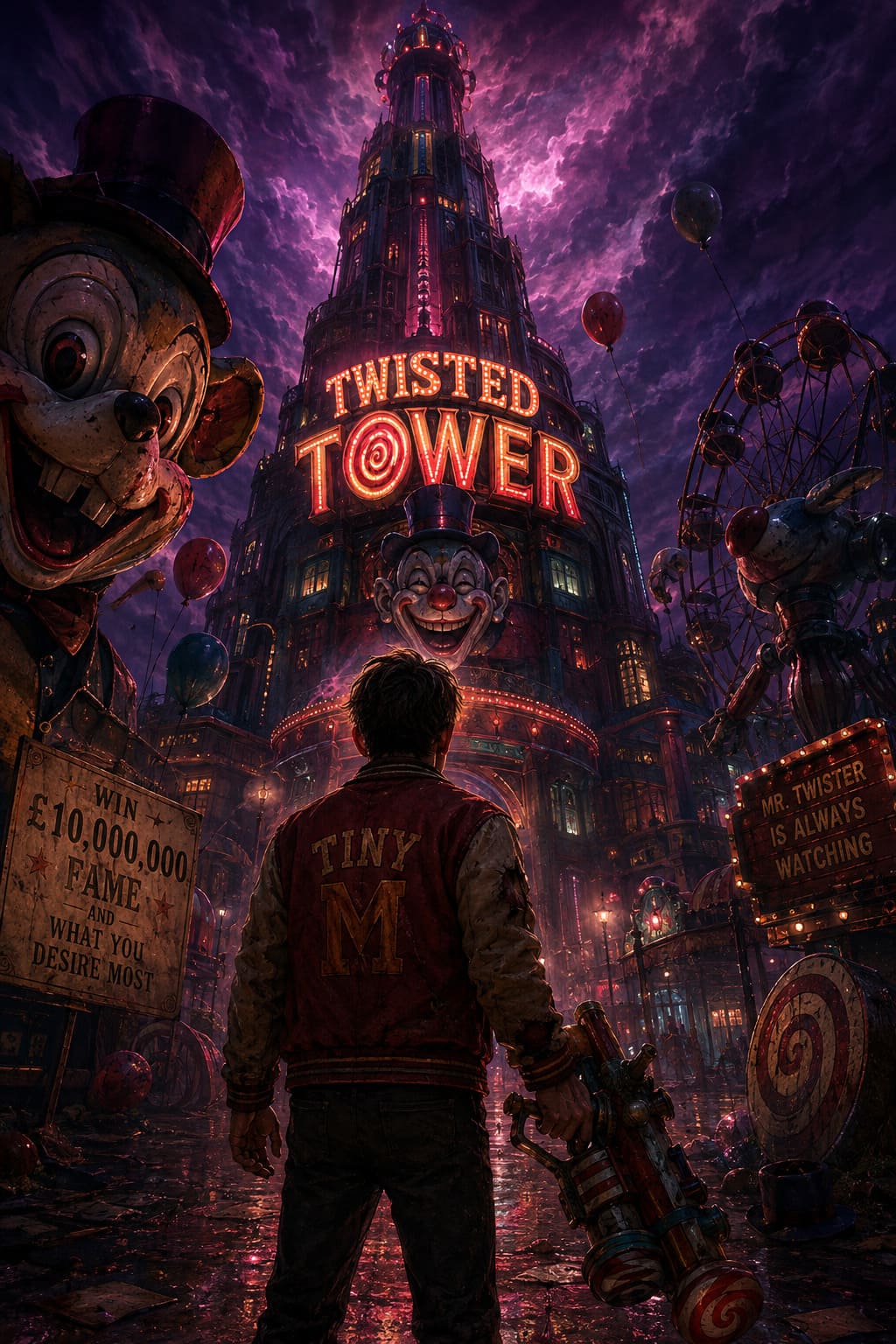
Things change when Charlotte becomes engaged to Preston, a wealthy school bully.
Tiny doesn’t handle the situation particularly well.
Instead of accepting that Charlotte has moved on, he convinces himself that winning the Tower will solve everything. If he can climb to the top, become famous, collect the enormous cash prize, and prove that he is not a loser, then maybe Charlotte will come back to him.
That motivation is important because it tells us a lot about Tiny before the horror even starts.
He isn’t simply trying to survive.
He is trying to rewrite his life.
The Velvet Ticket gives him the opportunity to do exactly that.
The Velvet Ticket and the Deadly Game Show
The Velvet Ticket is Tiny’s invitation into the current season of The Twisted Tower. On paper, it sounds like the greatest opportunity imaginable.
The rules are simple:
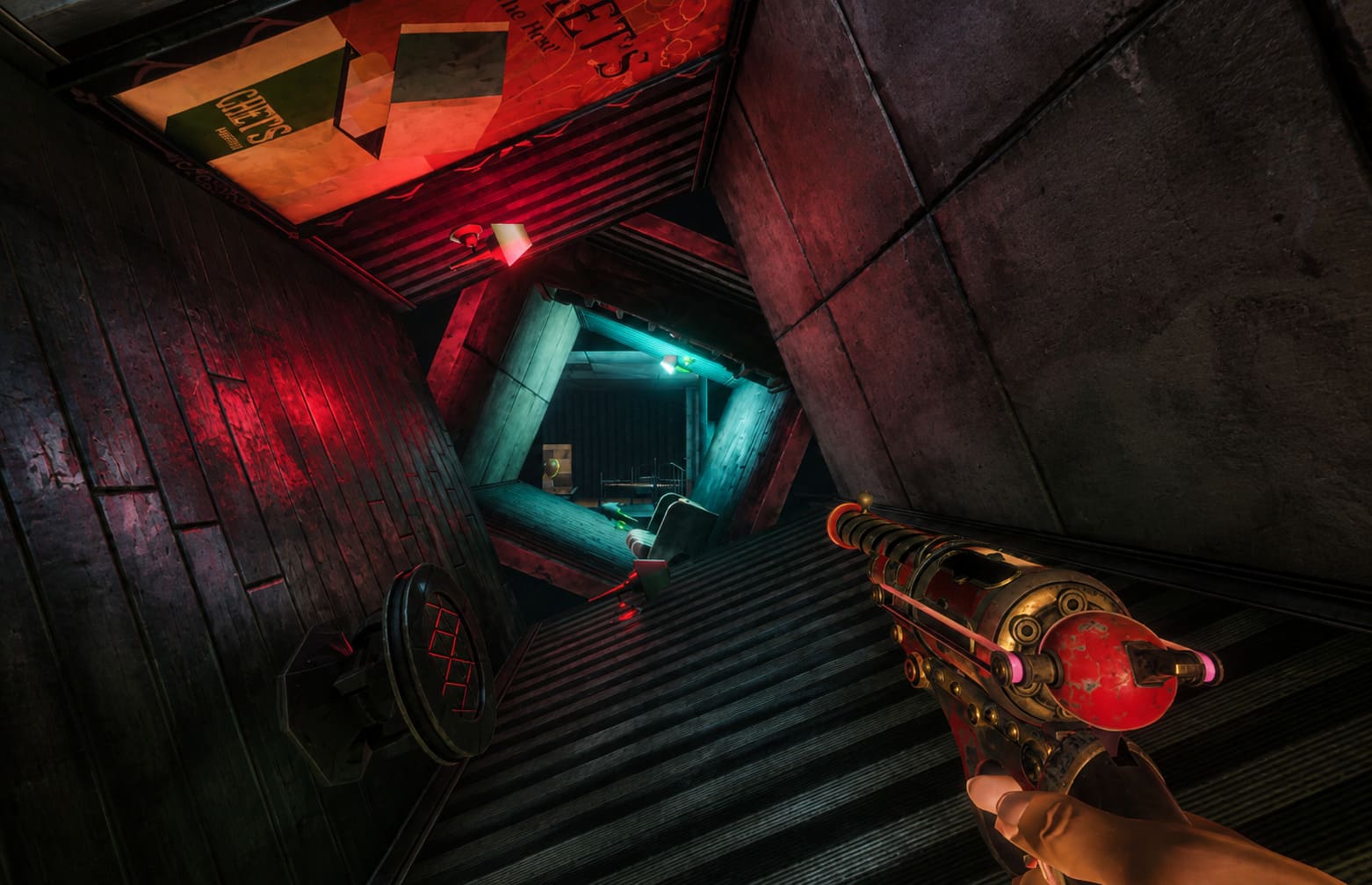
- Enter the Tower.
- Survive its increasingly dangerous floors.
- Defeat the monsters and twisted inhabitants.
- Reach the summit.
- Claim the grand prize.
That prize is reportedly £10 million, along with worldwide fame and the chance to obtain the thing the contestant desires most.
For Tiny, that thing is Charlotte.
This is where I think the story becomes much more interesting than its initial premise suggests. A lesser horror game could have treated the prize as nothing more than an excuse for the protagonist to enter the building.
Twisted Tower makes the prize personal.
The Tower isn’t dangling money in front of Tiny.
It is dangling his fantasy.
What Is the Twisted Tower Really Supposed to Be?
The Tower itself is one of the best parts of the game’s visual storytelling.
It isn’t a single dark corridor or abandoned mansion. It is an enormous amusement resort inspired by the cheerful entertainment culture of the 1950s. Everything is exaggerated, colorful, theatrical, and commercialized.
Then the game starts pulling that world apart.
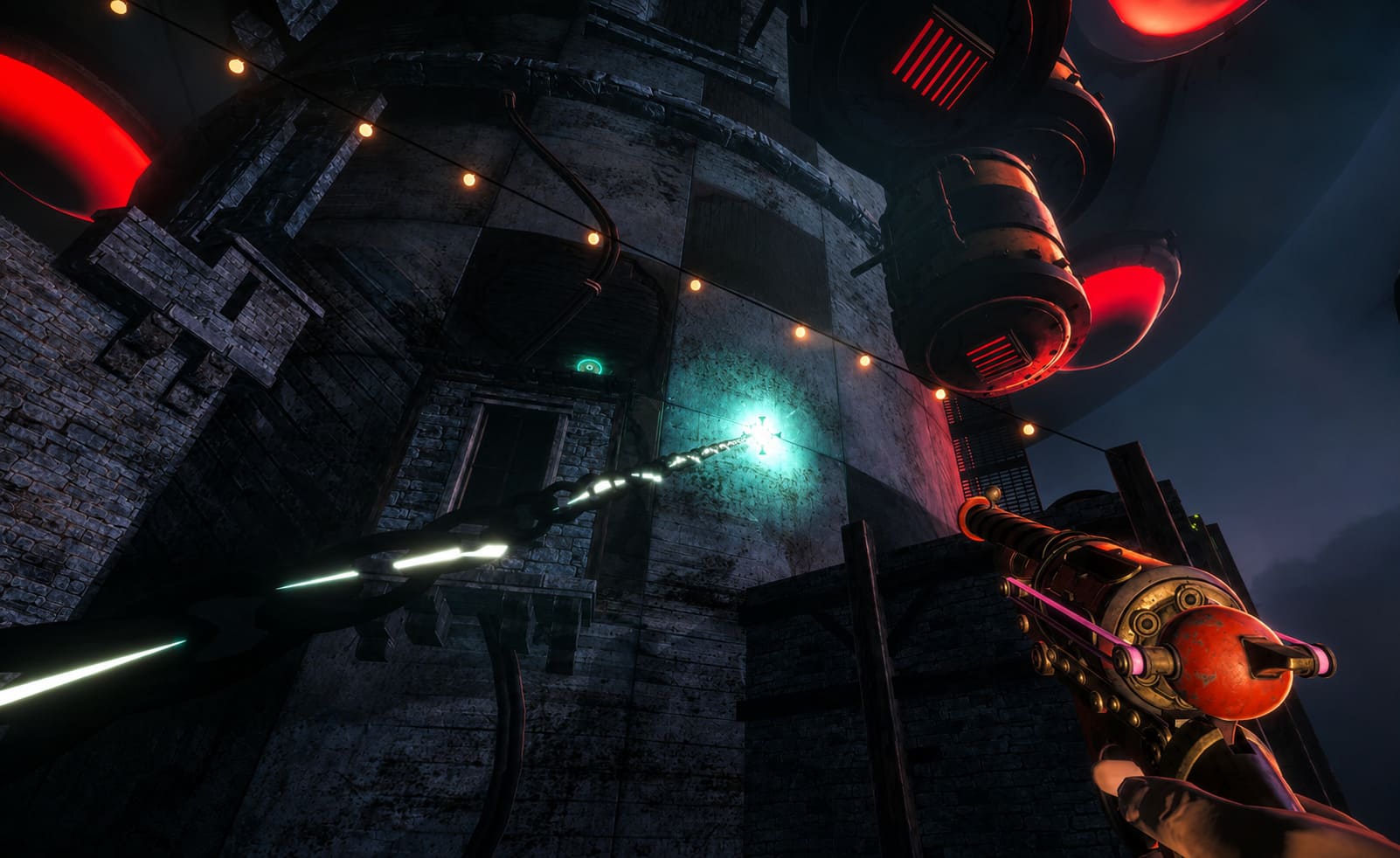
| Area | What It Represents |
|---|---|
| The Hotel | A decaying version of hospitality, comfort, and childhood security |
| The Waterpark | Innocence transformed into something dangerous and uncontrollable |
| The Clown Casino | Gambling, temptation, and the obsession with winning |
| The Carnival Forest | Fairy tales and childhood imagination corrupted into nightmares |
| The Space Station | The final escalation into surreal fantasy and isolation |
I particularly like how these locations feel less like random levels and more like stages in a psychological journey.
The Tower keeps changing its identity, but the underlying idea remains the same: something that once looked safe and exciting has become deeply threatening.
The Dark Secret Behind Tiny’s Journey
This is where the lore starts getting considerably more disturbing.
The most compelling interpretation of Twisted Tower is that the monsters, mascots, environments, and bizarre events are connected to Tiny’s buried childhood trauma.
That would explain why the Tower feels so specifically designed around him.
The game doesn’t simply throw generic horror creatures at the player. Instead, many of its enemies have the exaggerated appearance of twisted children’s characters. They resemble toys, fairy-tale figures, performers, and mascots.
That makes sense if the Tower is essentially Tiny’s childhood imagination turned against him.
The cheerful 1950s setting can then be read as a fake memory.
Everything is bright.
Everything is happy.
Everything is supposed to be perfect.
And underneath it?
Blood, decay, fear, violence, and memories Tiny has tried to suppress.
That contrast is easily one of my favorite ideas in the game’s story.
Is the Tower Real or Is It Inside Tiny’s Head?
This is probably the biggest lore question.
The game deliberately plays with reality, and there is strong evidence that the Tower functions as a physical representation of Tiny’s subconscious.
I wouldn’t necessarily interpret that as “none of this is real.” Horror games have been using that explanation forever, and it can become a lazy way to explain strange events.
Twisted Tower is more interesting when you think of the Tower as a place where Tiny’s memories and psychological problems have been given physical form.
The building becomes a kind of purgatory.
Every floor forces him deeper into himself.
Every monster represents something he doesn’t want to face.
And every strange announcement reminds him that he is being watched.
Every step toward the summit takes him further away from the fantasy that started the journey.
Mr. Twister Is More Than a Villain
Mr. Twister is the man behind the Tower, at least on the surface.
He is presented as an eccentric billionaire toy maker who created the resort and its legendary television show. His public image is cheerful and theatrical, but there is something deeply sinister about the way he controls everything.
To me, Mr. Twister works best as a representation of authority and judgment.
He is always watching.
He knows what Tiny is doing.
He controls the rules.
He decides what counts as success.
And most importantly, he keeps Tiny moving forward by promising that something wonderful is waiting at the top.
That makes Mr. Twister feel less like a traditional horror villain and more like the voice of the system trapping Tiny inside his own delusions.
The Tower tells Tiny:
“Keep going. You can still fix everything.”
And Tiny believes it.
The Game Show May Be the Biggest Lie of All
One of the game’s most disturbing ideas is that the television show itself may not exist in the way Tiny understands it.
The constant announcements and references to viewers create the impression that millions of people are watching him climb the Tower.
But what if there is no audience?
What if “everyone is watching” isn’t about television viewers at all?
It could instead represent Tiny’s own memories, guilt, fears, and insecurities.
He is constantly performing because he has spent his life trying to prove that he matters.
That makes the £10 million prize almost irrelevant.
Tiny doesn’t really need the money.
He needs validation.
He wants Charlotte.
He wants to stop feeling like a loser.
He wants the world to finally see him as somebody important.
The Tower understands that weakness and uses it against him.
Charlotte: The Person Tiny Wants or the Person He Remembers?
Charlotte is arguably the most important character who barely needs to be physically present.
Tiny’s entire adventure is supposedly about getting her back.
But there is a problem.
Charlotte never feels like a normal romantic objective.
She is more like an idealized memory.
Tiny remembers the childhood version of their relationship and treats that version as if it still exists. The fact that she is engaged to Preston should be enough to force him to accept reality.
Instead, Tiny creates a heroic fantasy.
Preston becomes the villain.
Tiny becomes the underdog.
Charlotte becomes the princess waiting to be rescued.
And the Tower becomes the castle.
That is classic fairy-tale thinking, which makes the choice of grotesque fairy-tale imagery throughout the game even more significant.
Tiny isn’t just trapped in a building.
He is trapped inside his own version of the story.
Why the 1950s Aesthetic Matters
The visual style isn’t simply there because it looks cool.
The 1950s-inspired design represents an idealized version of the past: perfect families, cheerful entertainment, clean streets, colorful toys, television personalities, and endless optimism.
Twisted Tower takes that nostalgia and contaminates it.
The result is uncomfortable because the game makes childhood imagery violent.
The toys hurt you.
The mascots hunt you.
The amusement park wants you dead.
The advertisements feel threatening.
The bright colors hide something rotten.
This is why the horror works better than it would in a completely dark environment.
When everything looks miserable from the beginning, you expect danger.
When a smiling mascot is standing beneath a giant colorful sign promising fun, you instinctively want to trust it.
Then it attacks.
That contrast is what gives Twisted Tower its personality.
The Weapons Are Part of the Story Too
I initially saw the toy-inspired weapons as nothing more than a fun joke. Rubber-band guns, oversized mallets, ridiculous firearms and other absurd tools fit perfectly with the game’s chaotic shooter mechanics.
But they also make sense thematically.
Tiny is fighting serious psychological problems with the weapons of childhood.
That is a pretty clever visual metaphor.
He has entered adulthood, but emotionally he remains stuck somewhere much earlier in his life. His surroundings have become horrifying, yet his tools still resemble toys.
The more I think about it, the less random those weapons feel.
The game is basically giving Tiny a childhood fantasy arsenal and asking him to use it against the things he has spent years refusing to confront.
Twisted Tower Optimization Guide: How to Fix Low FPS and Stuttering on PC
What I Think the Ending Is Really About
Without reducing the ending to a simple “it was all in his head” explanation, I think the most important part of Twisted Tower’s conclusion is Tiny finally confronting the illusion he has been chasing.
The Tower promises that reaching the top will fix his life.
It won’t.
Charlotte cannot magically become the person Tiny wants her to be.
The past cannot be restored.
Fame cannot repair childhood trauma.
And winning a competition cannot turn someone into the person they wish they had been.
The summit therefore represents more than the final boss or final level.
It represents the moment when Tiny has nowhere left to run.
Everything he has buried has followed him to the top.
Twisted Tower Walkthrough: How to Beat All Deadly Traps, Mazes, and Mascots
Final Thoughts on Twisted Tower’s Lore
After playing plenty of horror games that rely on complicated timelines, secret documents, and endless exposition, I appreciate what Twisted Tower is attempting here.
Its story is hidden in the environment.
The architecture matters.
The mascots matter.
The nostalgic art direction matters.
Even the ridiculous weapons matter.
Underneath the blood and absurd humor is a story about someone who desperately wants to return to a version of his life that never really existed.
That is why I think Twisted Tower lore works best when you don’t take the game show literally. The Tower feels like a nightmare built from Tiny’s memories, insecurities, childhood fantasies, and refusal to accept that things have changed.
The scariest monster isn’t necessarily hiding around the next corner.
It may be the version of yourself that refuses to let go.
And honestly, that is a much more interesting idea than simply fighting your way through another haunted amusement park.
Twisted Tower isn’t really about climbing a tower to win Charlotte back. It’s about climbing high enough that Tiny can no longer hide from himself.