Red Dead Redemption 2 Hidden Endings Explained: How to Unlock Every Secret Conclusion
There are plenty of games that claim your choices matter. Most of them change a line of dialogue, swap a cutscene, or slightly alter the ending credits before pretending your decisions carried emotional weight. Then there’s Red Dead Redemption 2 — a game that quietly judges every action you make for dozens of hours before delivering one of the most personal finales in gaming history.
I replayed Red Dead Redemption 2 recently after spending years buried in massive RPGs, survival sandboxes, and cinematic story games, and honestly, very few titles still feel this emotionally complete. Even now, players continue discovering hidden scenes, alternate endings, and tiny post-game details that completely reshape Arthur Morgan’s story depending on how you played him.
What makes Rockstar’s masterpiece different is that the game never loudly tells you your morality matters. It watches silently. Then, during the final hours, it cashes in every decision you made.
And yes — there’s far more than one ending.
Why Red Dead Redemption 2’s Endings Feel So Personal
Most people remember the emotional collapse of the Van der Linde gang, but fewer realize how deeply the ending branches based on two core systems:
- Your Honor level
- Your final choice during Chapter 6
Late in the story, Arthur Morgan faces a defining decision:
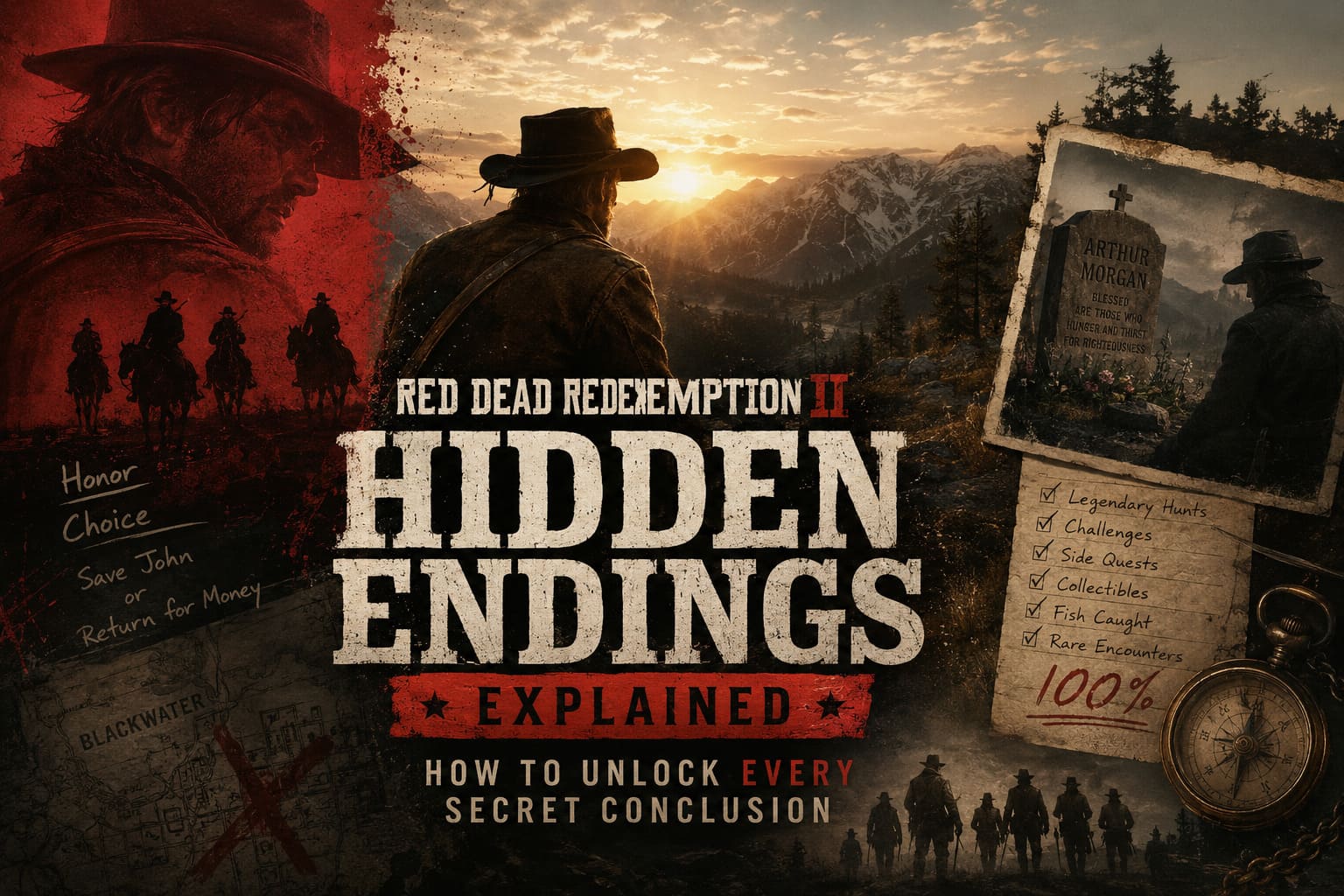
- Help John Marston escape
- Or return for the Blackwater money
That one moment changes everything.
Combined with High or Low Honor, it creates four dramatically different conclusions for Arthur. Some are peaceful. Some are cruel. One of them is honestly still one of the bleakest endings Rockstar has ever written.
The genius is that none of these endings feel random. They feel earned.
The Ending Most Players Consider “The Real One”
If you play Arthur as a man trying to become better — helping strangers, protecting innocents, making honorable choices — and choose to save John instead of chasing money, you unlock what many fans see as the definitive ending.
Arthur’s final ride into the mountains is devastating because the game gives him clarity at the exact moment he knows he’s dying. He understands Dutch is lost. He understands Micah poisoned the gang from within. Most importantly, he realizes John still has a chance at the life Arthur himself can never have.
The final mountain confrontation with Micah is brutal, exhausted, and desperate. When Dutch walks away without helping either side, it feels like the true death of the gang.
But the unforgettable part is Arthur’s final moment.
Instead of dying violently, he crawls toward the sunrise and simply watches the morning light break over the horizon. No speech. No dramatic music overload. Just silence, regret, and acceptance.
After replaying it years later, I still think this is one of the strongest endings in gaming because Rockstar resisted the urge to over-explain the emotion.
Arthur doesn’t “win.”
He just finds peace.
The Low Honor Endings Change the Entire Tone
Here’s where Red Dead Redemption 2 becomes fascinating.
If you spend the game acting like a ruthless outlaw, the story transforms Arthur from a tragic antihero into a cautionary tale.
The biggest tonal difference comes from how Micah treats Arthur in the final moments. In the High Honor routes, there’s still a sense of humanity left in Arthur’s death. In the Low Honor versions, that humanity disappears entirely.
Especially in the “Return for Money” path.
That ending is ugly in a way few AAA games dare to be anymore. Arthur dies in the mud, betrayed, humiliated, and forgotten while Dutch turns his back on him completely. There’s no redemption arc waiting to save him.
And honestly? That’s why it works.
Rockstar committed to the idea that morality in this world has consequences. Your Arthur becomes a reflection of how you treated people throughout the game.
The Hidden 100% Completion Scene Is One of Rockstar’s Best Secrets

A huge number of players never see the game’s true final goodbye because it’s locked behind 100% completion.
And getting there is absolutely brutal.
You need to finish nearly everything:
- Legendary hunts
- Challenges
- Side quests
- Discoveries
- Collectibles
- Fishing objectives
- Rare encounters
It’s the kind of completion grind most players abandon halfway through.
But if you actually reach 100%, Rockstar rewards you with a quiet scene that feels more emotional than half the main campaign.
John Marston visits Arthur’s grave high in the mountains and writes one final journal entry for his old friend. The camera slowly rises as music plays softly in the background, and for a moment the game stops feeling like an outlaw story.
It becomes a story about memory.
Not revenge. Not money. Not survival.
Memory.
After finishing the game again recently, I genuinely think this hidden scene is the emotional closure many players wanted from the base ending itself.
The Credits Hide Massive Story Details
Almost nobody watches the entire credits roll anymore, which is a mistake in Red Dead Redemption 2.
Rockstar hid multiple mini-cutscenes throughout the credits that quietly reveal what happened to surviving gang members after the collapse.
Some of the most memorable include:
| Character | Hidden Outcome |
|---|---|
| Charles Smith | Leaves for Canada searching for peace |
| Sadie Adler | Heads toward South America after bounty hunting |
| Tilly Jackson | Starts a stable family life in Saint Denis |
| Mary Linton | Visits Arthur’s grave in mourning |
| Rains Fall | Reflects on loss and displacement |
But the most important scenes involve Edgar Ross.
If you pay attention, you realize federal agents are already tracking John Marston long before the original Red Dead Redemption begins.
That detail completely changes the tone of the epilogue.
John never truly escaped.
The tragedy was already waiting for him.
The Best Post-Game Encounters Are Easy to Miss

One thing Rockstar did brilliantly was hide emotional epilogues in ordinary locations across the map.
There are no giant quest markers screaming for attention. You simply stumble into people from Arthur’s past while exploring as John.
A few stand out more than others.
Mary-Beth’s Conversation Feels Incredibly Real
Finding Mary-Beth at the Valentine train station hits surprisingly hard. She’s moved on, become a writer, and speaks about Arthur with genuine warmth instead of glorifying the outlaw life.
The conversation feels natural, awkward, nostalgic — like two people trying to process a past neither fully escaped.
Pearson’s Store Is Quietly Heartbreaking
Walking into Pearson’s general store in Rhodes and seeing the old gang photo on the wall genuinely caught me off guard during my replay.
That tiny environmental detail says more than a long speech ever could.
Despite everything that happened, part of him still misses those days.
Rains Fall Gives Arthur’s Choices More Meaning
The final conversation with Rains Fall might actually be one of the most underrated scenes in the game.
Depending on Arthur’s actions earlier in the story, the dialogue changes subtly, giving extra emotional weight to Arthur’s attempts to help people near the end of his life.
It’s one of the clearest examples of Rockstar rewarding players who paid attention to smaller story moments.
One Side Quest Secret Changes the Entire Ending
Out of all the hidden details in Red Dead Redemption 2, the Charlotte Balfour storyline may be the most devastating.
If Arthur helps Charlotte learn how to survive after her husband dies, she’s alive and independent when John later visits her cabin.
If Arthur ignores her?
She dies alone.
No dramatic cutscene. No music. No warning.
Just a body inside an empty cabin.
That’s the moment Red Dead Redemption 2 fully separates itself from most open-world games. Side content isn’t filler here. People remember whether Arthur helped them or not.
And the world keeps moving even when you don’t.
Red Dead Redemption 2 Camp Requests Guide: All Items, Locations, and Rewards
Why Rockstar’s Western Still Feels Untouchable
Years later, Red Dead Redemption 2 still does something most modern blockbuster games struggle to achieve: it trusts the player to feel emotion without constantly forcing it.
The hidden endings, alternate scenes, honor system, and missable encounters don’t exist for shock value. They exist because Rockstar built a world where actions quietly echo long after missions end.
After replaying dozens of story-driven games over the years, I still think Arthur Morgan remains one of gaming’s greatest protagonists precisely because he isn’t perfect. His story changes depending on who you decide he becomes.
That’s why players are still discussing these endings years later across forums, YouTube breakdowns, and replay streams.
Not because Red Dead Redemption 2 has secret endings.
Because those endings genuinely feel personal.