Guild Wars 3 Timeline Explained: How Long Before Guild Wars 1 Is the Prequel Set?
When ArenaNet revealed Guild Wars 3 at Summer Game Fest 2026, the biggest shock wasn’t just that the game existed—it was where it takes place in the timeline. Instead of continuing the story after Guild Wars 2, the studio is pulling players roughly 1,200 years before the original Guild Wars: Prophecies.
s someone who has followed this franchise for years, this decision feels less like a sequel and more like a complete reset of how Tyria is meant to be understood.
This isn’t a nostalgic callback. It’s a reconstruction of the world before it became the version players recognize today. And that alone changes everything about expectations, storytelling, and even gameplay identity.
Guild Wars 3 No Battle Pass Explained: Why Colin Johanson Rejects MMO Player-Hostage Models
A Prehistoric Version of Tyria
Guild Wars 3 is set in an era where Tyria is still forming its identity. There are no established kingdoms as we know them, no modern political structures, and none of the familiar world-state that defines Guild Wars 1 or 2. Instead, the world is described as a raw magical frontier, especially focused on an ancient version of Orr.
This version of Orr is not the sunken undead wasteland from Guild Wars 2. It is a living, breathing ecosystem filled with unstable magic, early spiritual entities, and untamed wilderness. Civilization exists only in fragmented early forms, making survival and exploration central themes rather than background elements.
From a narrative standpoint, this is Tyria before it has been “organized” by history. Everything feels experimental, dangerous, and unpredictable.
Guild Wars 3 Release Date, Beta Timeline, Leaks, and Rumors
Timeline Breakdown: Where GW3 Fits
To understand how extreme this shift is, it helps to visualize the timeline relative to the main games.
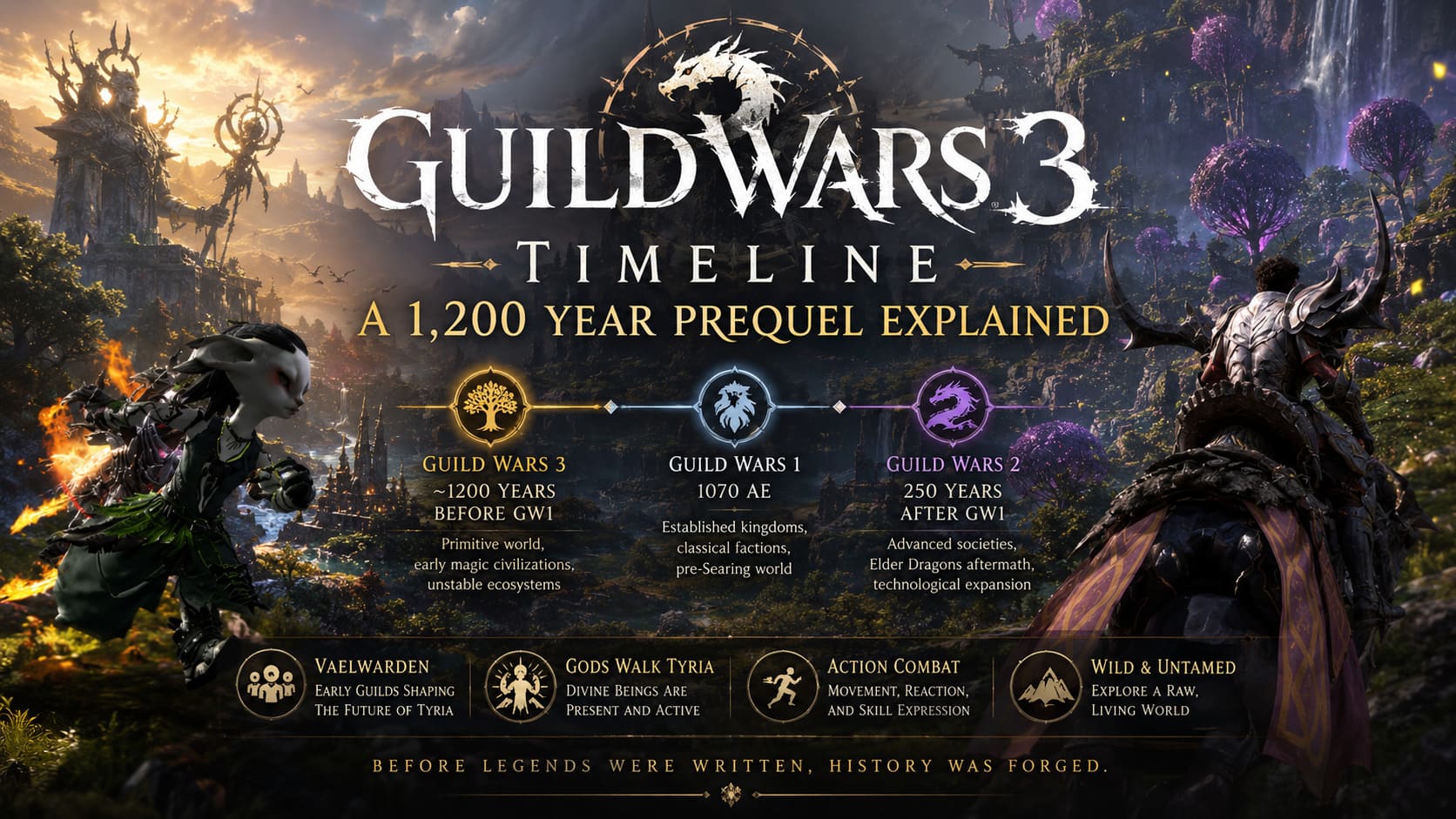
| Era | Time Period | World State |
|---|---|---|
| Guild Wars 3 | ~1200 years before GW1 | Primitive world, early magic civilizations, unstable ecosystems |
| Guild Wars 1 | 1070 AE | Established kingdoms, classical factions, pre-Searing world |
| Guild Wars 2 | 250 years after GW1 | Advanced societies, Elder Dragons aftermath, technological expansion |
This positioning effectively turns Guild Wars 3 into a foundational myth simulator rather than a traditional sequel. Everything players recognize from the original games exists only in early conceptual or ancestral form.
The Role of the Vaelwarden
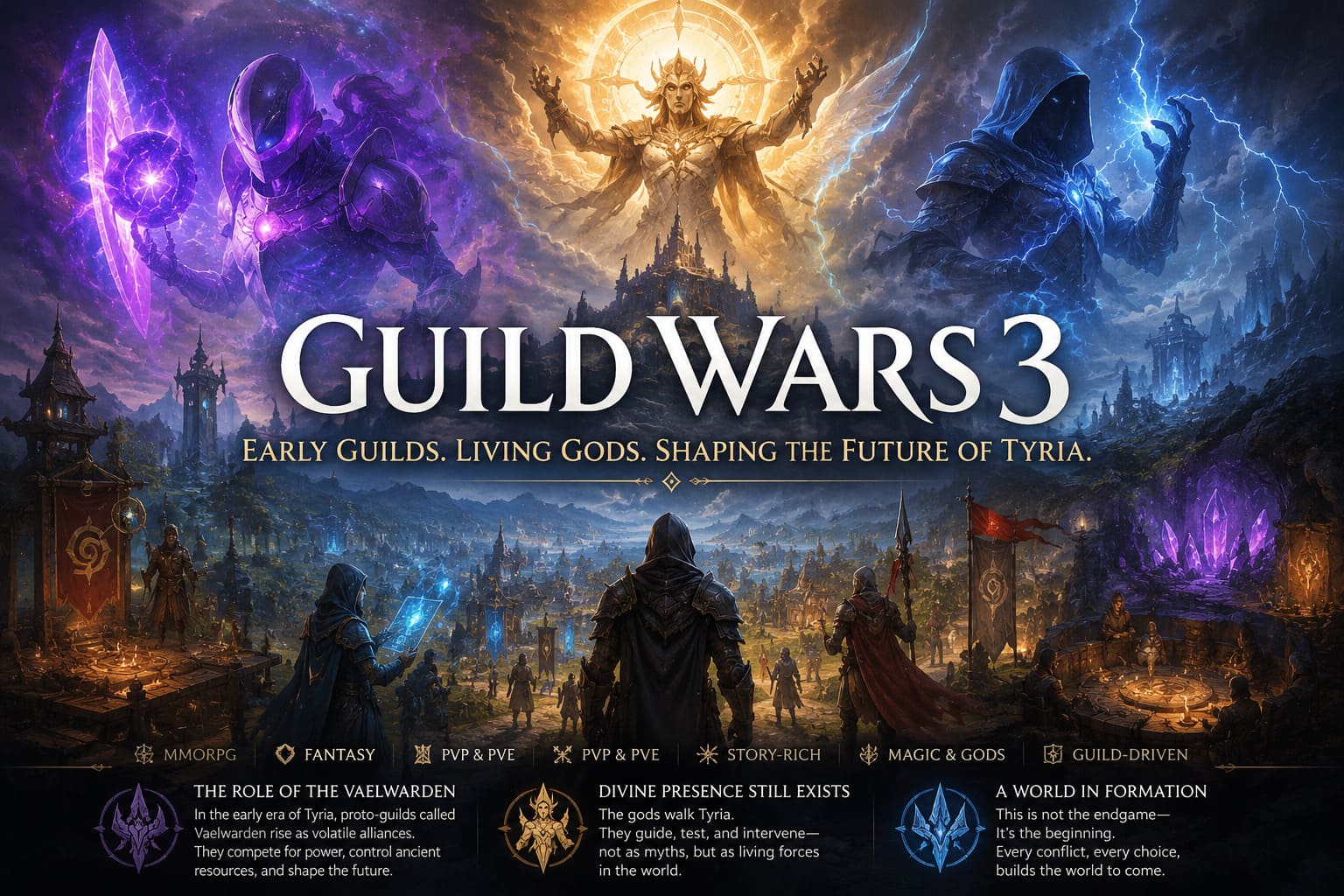
One of the most intriguing concepts introduced in this setting is the idea of the Vaelwarden. Instead of modern guild structures, players are placed into early proto-guild organizations that are still defining their purpose and ideology.
These groups are not stable institutions. They are volatile alliances built around survival, belief systems, and control of magical resources tied to ancient nature forces. This creates a world where guild conflict is not just competitive gameplay—it is a fundamental driver of civilization itself.
Rather than structured factions competing for territory in a predictable endgame loop, these early guilds are shaping what future civilizations will eventually become.
Guild Wars 3 Coming to PS5? Release Date, Rumors, and Console Confirmation Explained
Divine Presence Still Exists
Another major difference in this timeline is the active presence of the gods. In later Guild Wars history, the gods are distant and absent. In this era, they are still directly involved in the world’s development.
This means players are not dealing with mythology as legend, but as living reality. Divine beings influence early civilizations, guide conflicts, and shape the balance of magical forces across Tyria.
The result is a setting where religion is not belief-based—it is observational. Gods are not worshipped as abstract entities but encountered as active participants in world events.
Gameplay Direction and Design Philosophy
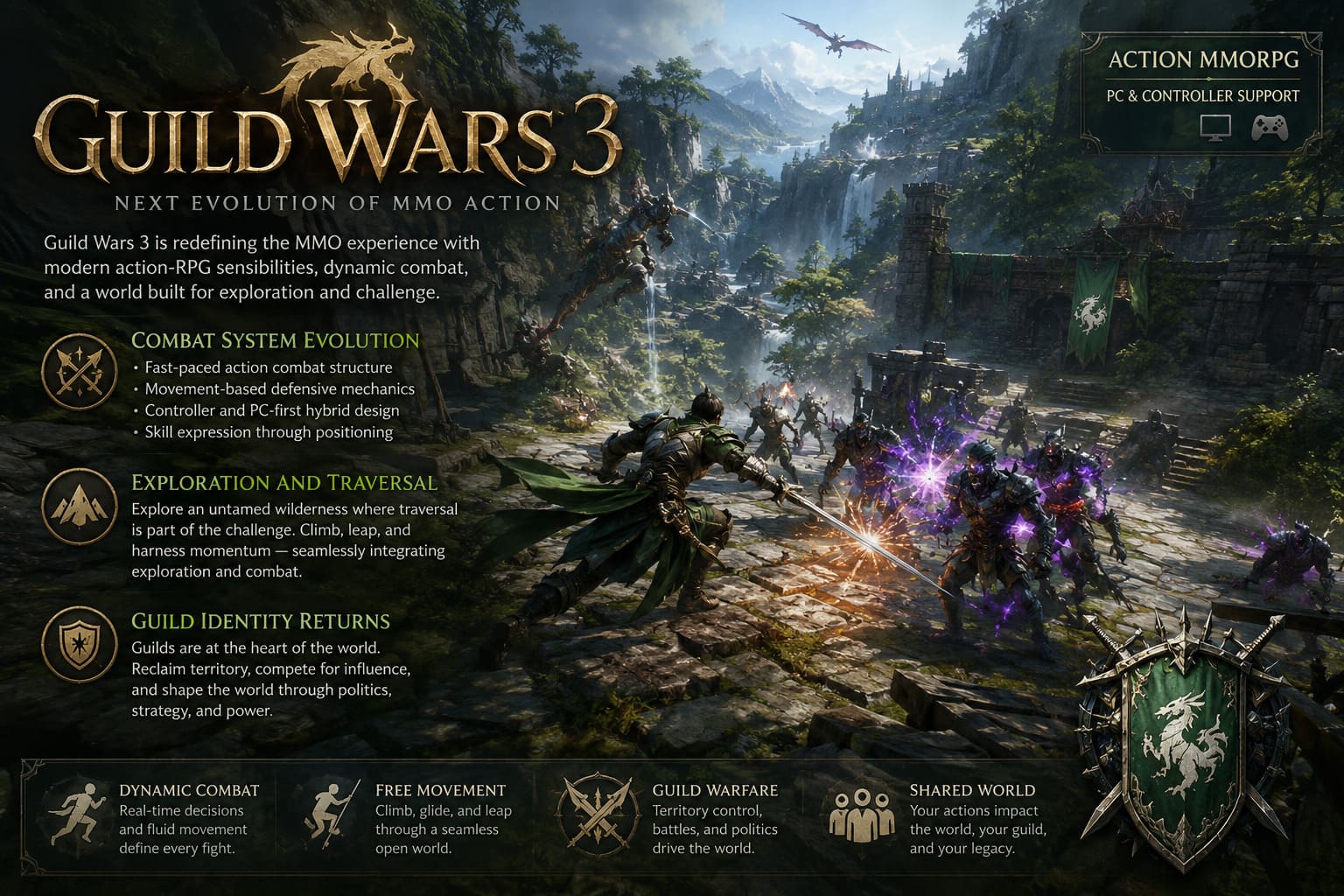
Guild Wars 3 is not only changing its timeline—it is redefining how the MMO plays moment to moment. The design direction appears to focus heavily on modern action-RPG sensibilities rather than traditional tab-target systems.
Combat System Evolution
Combat is designed around movement, positioning, and reaction timing. Instead of static rotations and ability bars, players are expected to engage dynamically with enemies using real-time decision-making.
- Fast-paced action combat structure
- Movement-based defensive mechanics
- Controller and PC-first hybrid design
- Skill expression through positioning
Exploration and Traversal
The world design emphasizes exploration as a core gameplay loop. Because the setting is an untamed wilderness, traversal becomes part of the challenge rather than a simple transition between objectives.
Players can expect climbing, environmental movement systems, and momentum-based navigation that integrates directly into combat and exploration.
Guild Identity Returns
Perhaps the most important shift is the return of guilds as the central identity of the game. Instead of being social features layered onto content, guilds are positioned as the core political and mechanical force driving world interaction.
This brings the franchise closer to its original identity, where guild competition was not optional—it was foundational.
Why a Prequel Works for the Franchise
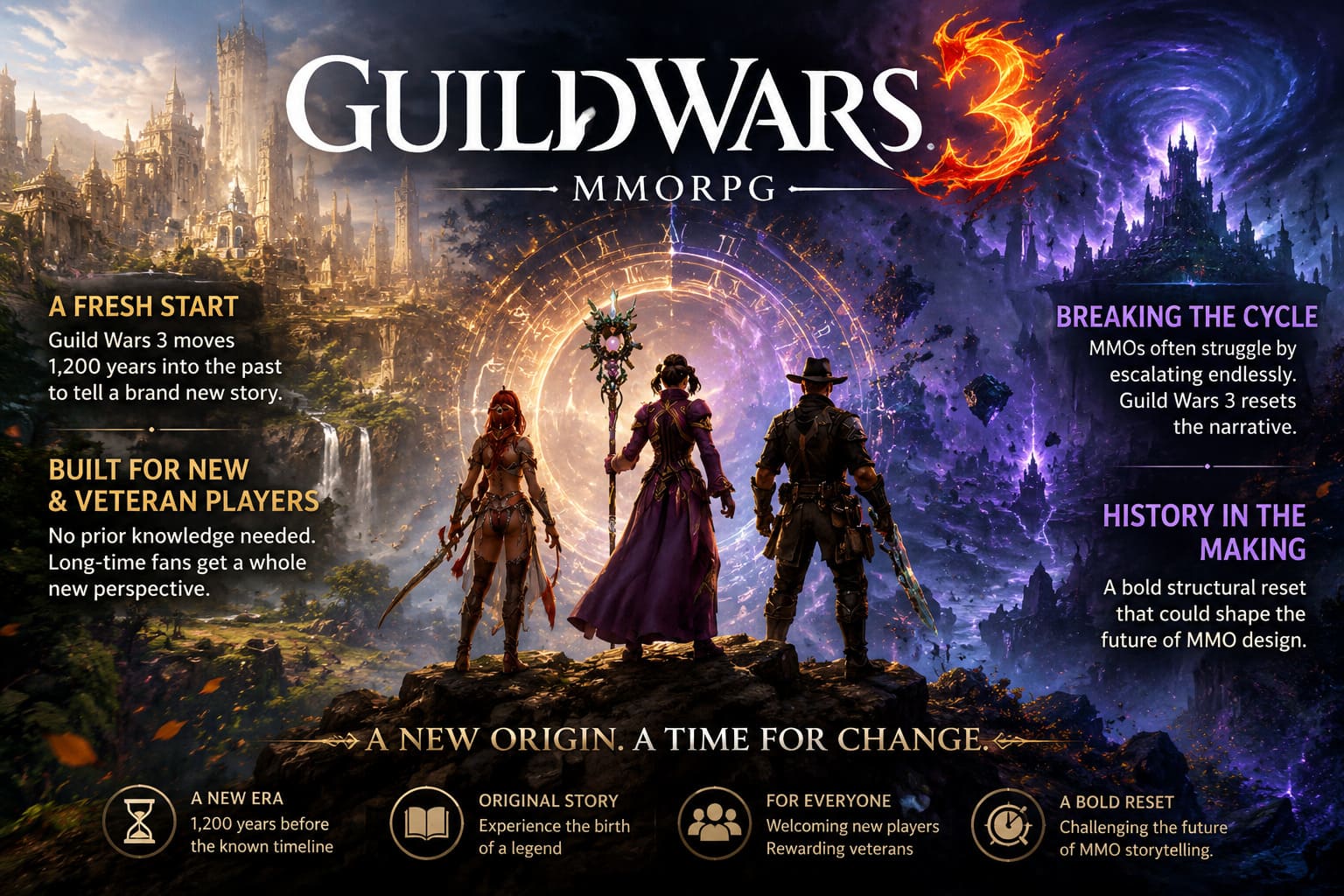
MMORPGs often struggle with long-running narratives because of accumulated lore complexity. New players frequently face overwhelming entry barriers, while veterans demand increasingly larger stakes that are difficult to escalate.
By moving 1,200 years into the past, Guild Wars 3 avoids both problems. It resets narrative expectations while preserving the thematic identity of the franchise.
Instead of continuing an overburdened storyline, ArenaNet is constructing the origin of that storyline. This allows new players to enter without prior knowledge while giving long-term fans a completely fresh perspective on familiar lore.
Personal Perspective as a Long-Time Player
As someone who has spent years in Tyria across both major games, this direction feels unexpected but strangely logical. MMOs rarely succeed when they simply escalate endlessly forward. At some point, the world becomes too defined, too resolved, and too static.
Going backward in time reintroduces uncertainty. It makes the world feel dangerous again. It restores the sense that history is still being written rather than replayed.
If executed well, this could be one of the most important structural resets the MMO genre has seen in years.
Final Thoughts
Guild Wars 3 is not just a sequel—it is a reimagining of Tyria before it became the world players thought they understood. By setting the game 1,200 years before Guild Wars 1, ArenaNet is creating space for discovery, experimentation, and reinterpretation of its own mythology.
Whether this gamble succeeds will depend entirely on execution. But conceptually, it is one of the boldest directions the franchise has ever taken.