Wanderburg Beginner Guide: Top Tips, Tricks, and Strategies to Grow Your Castle
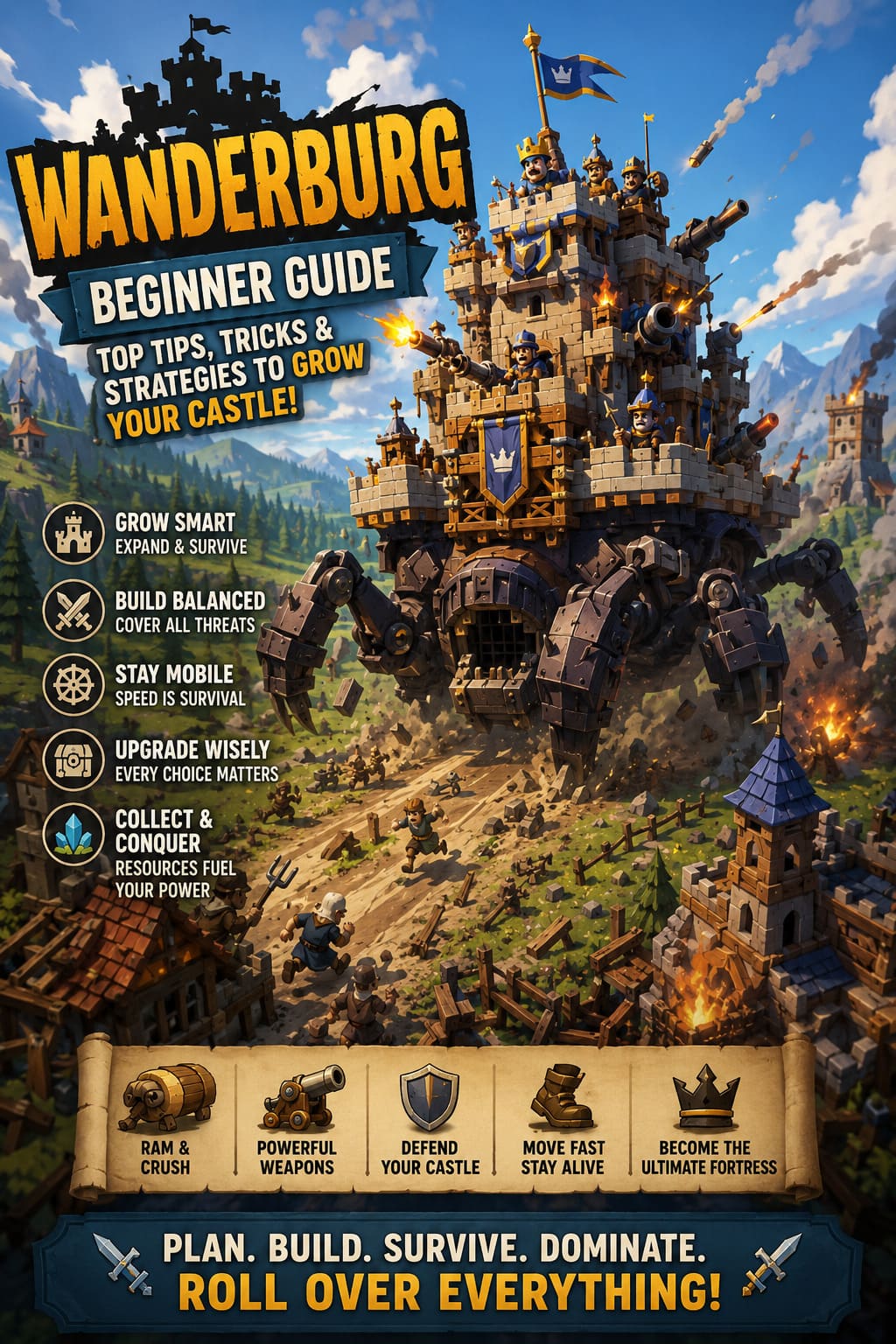
If you have just started playing Wanderburg, there is a good chance your first few runs felt like controlled chaos. You are driving a gigantic medieval castle on wheels, smashing through villages, collecting resources, bolting weapons onto the structure, and trying not to get turned into a pile of burning bricks by enemy fortresses. It sounds ridiculous on paper, but that is exactly why the game works so well.
After spending serious time with the game, one thing becomes obvious: Wanderburg is not simply about getting stronger weapons. Your movement, castle size, module placement, target selection, and ability to read the battlefield all matter. A badly designed fortress with enormous firepower can still get wrecked if it cannot turn quickly enough to escape a barrage.
This Wanderburg beginner guide focuses on the fundamentals that make early runs much more consistent. If you want to grow your castle quickly, survive longer, and eventually turn your rolling fortress into a ridiculous medieval death machine, these are the habits worth developing.
Best Defensive Modules For Castle Walls Wanderburg: Ultimate Synergies and Build Guide
Understand What Makes Wanderburg Different
The first mistake new players make is treating Wanderburg like a conventional bullet-heaven roguelike. You are not controlling a tiny character who can instantly dodge in any direction. You are piloting a massive mechanical fortress, and that changes practically everything.
Your castle has weight and momentum. Turning takes time, acceleration matters, and your growing size directly affects how easy you are to hit. Every piece of land you conquer and every resource you consume can make you stronger, but it can also make your fortress harder to maneuver.
That creates a fantastic risk-reward loop. Becoming enormous feels great because you gain more room for weapons and upgrades, but eventually you realize that being the size of a small neighborhood is not particularly useful if you cannot dodge anything.
The real objective is not simply to become the biggest castle possible. You want to become as powerful as possible while retaining enough mobility to control the battlefield.
Your First Priority Should Be Safe Growth
The opening minutes of a run are incredibly important. You do not have the firepower or durability to casually challenge everything you see, so picking fights intelligently is essential.
Look for fleeing villages, wandering groups, and weaker targets that can be consumed without putting your castle in serious danger. These targets provide the early resources and experience you need to start expanding your fortress.
I strongly recommend resisting the urge to immediately hunt the biggest enemy castle on the map. It might look tempting, especially when your inner gamer starts screaming, ‘I can probably take it.’ You probably cannot.
Instead, use the early phase to build momentum. Move through relatively safe areas, collect resources, and gradually improve your arsenal before taking on serious opposition.
A Strong Opening Gives You More Options
- Early experience for upgrades.
- Resources for expanding your castle.
- Additional weapon slots.
- More defensive options.
- Enough firepower to handle larger enemy groups.
Think of the beginning as your setup phase. You are not trying to win the war in the first five minutes; you are building the machine that can win it later.
Build a Balanced Castle, Not a One-Trick Monster
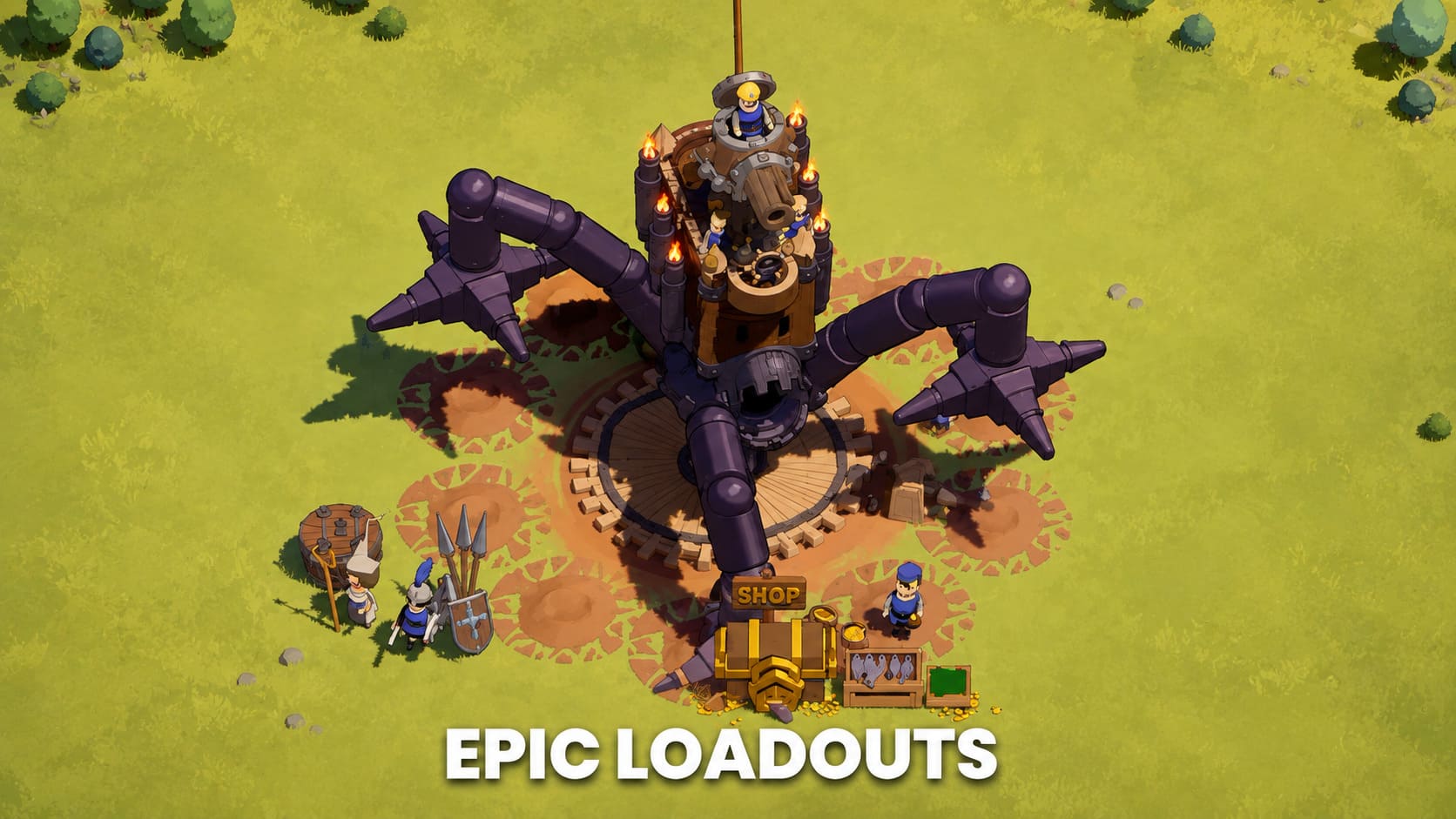
Wanderburg’s modular construction system is one of its most interesting mechanics. Your fortress physically expands as you progress, allowing you to install more weapons and machinery.
It is incredibly easy to fall into the classic beginner trap of choosing whatever weapon currently deals the biggest number. Suddenly your entire castle is covered in the same type of cannon, and everything looks amazing until an enemy swarm attacks from the wrong direction.
Specialization can be powerful, but total specialization is dangerous.
A reliable build should have different tools for different battlefield situations. Rapid-fire weapons are excellent for dealing with smaller threats and clearing groups. Heavy siege weapons provide the punch necessary to damage tougher fortresses. Magical or specialized modules can add crowd control, area damage, or useful status effects.
The exact combination can change depending on what upgrades you find, but the principle remains the same: make your castle capable of answering multiple threats.
Think About Weapon Coverage
Do not only ask, ‘How much damage does this weapon deal?’
Ask yourself:
- What direction can it cover?
- How quickly can it fire?
- Is it useful against groups or single targets?
- Does it compensate for another weakness in my build?
- Can I still use it effectively when the castle becomes larger?
Weapon placement matters because your fortress is constantly moving. A weapon that looks fantastic in isolation can become surprisingly awkward if its firing angle does not cover the situations you regularly encounter.
Your Castle Is Also a Weapon
One of my favorite things about Wanderburg is that your weapons are not the only way to destroy things. The castle itself can become a battering ram.
Smaller enemies and structures can often be smashed simply by positioning your fortress correctly. Ramming is especially useful when you need to clear weaker targets quickly or finish something that has already taken substantial damage.
But there is a big difference between smart ramming and blindly throwing your castle into everything.
Your momentum and mass can turn collisions into devastating attacks, but charging directly into a heavily defended enemy can leave you badly damaged. The bigger the opponent, the more carefully you should consider the collision.
A useful trick is to approach enemies at an angle rather than hitting them perfectly head-on. Glancing impacts can let you deal damage while preserving your momentum and giving yourself a better escape route.
That matters enormously during chaotic fights. If you ram something and end up sitting directly in the middle of an enemy formation, congratulations—you have successfully turned yourself into the world’s largest target.
Do Not Let Your Castle Become Too Big to Control
This is probably the most important lesson for new players.
Getting bigger feels like pure progression. More size means more space for modules, more weapons, and greater overall power. The problem is that your hitbox grows along with your strength.
A giant fortress is harder to maneuver. Its turning radius becomes more noticeable, and dodging concentrated projectile attacks becomes increasingly difficult.
If you keep expanding without improving mobility, you can reach a point where your castle feels less like a powerful war machine and more like a refrigerator being pushed down a staircase.
Keep an eye on movement-related upgrades whenever they appear. Speed, turning ability, traction, propulsion, or similar mobility improvements can be just as valuable as another damage increase.
A slightly weaker castle that can reposition quickly is often far more dangerous than a heavily armed fortress that takes forever to turn.
Upgrade Mobility Before You Regret It
There is a common temptation in roguelikes to choose damage every time. Bigger numbers are satisfying. Watching a giant projectile erase an enemy is satisfying. Mobility upgrades? They do not always produce the same immediate dopamine hit.
Take them anyway when your fortress starts feeling sluggish.
Why Mobility Matters
- Escape projectile patterns.
- Reach valuable targets faster.
- Maintain better firing angles.
- Avoid getting trapped.
- Control the distance between yourself and enemy fortresses.
- Reposition before dangerous attacks arrive.
The more your castle grows, the more important this becomes. Mobility is not a luxury upgrade in Wanderburg; it is part of your defensive system.
Spend Meta-Progression Currency With a Plan
Death is inevitable in a roguelike. The important question is what you gain from it.
Wanderburg’s meta-progression gives you reasons to keep pushing after a failed run. Permanent improvements and additional options can gradually turn a fragile early-game castle into something far more reliable.
For your first upgrades, I would prioritize improvements that strengthen several future runs rather than chasing the flashiest possible weapon.
Permanent survivability, defensive scaling, and better resource collection can provide tremendous value because they make every subsequent attempt stronger.
Resource attraction in particular can make a noticeable difference. Collecting everything manually becomes increasingly awkward when your castle is enormous, so improving your ability to gather resources from nearby defeated targets can save you from making unnecessary movements.
That may sound boring compared with unlocking some absurd siege weapon, but boring upgrades are often the ones that quietly carry your progression.
Learn to Fight in Open Areas
The environment itself can kill a run.
Procedurally generated maps can create open spaces, narrow routes, obstacles, and natural choke points. Enemy formations can become especially dangerous when you are forced into a confined area with nowhere to maneuver.
Whenever possible, fight where you have room to move.
If several enemy fortresses are grouped together, do not automatically drive straight into them. Try pulling enemies toward open terrain where you have enough space to circle, reposition, and dodge incoming attacks.
Map edges are particularly dangerous. Getting pinned against a boundary while multiple enemies fire at you is one of those situations where even a strong build can disappear frighteningly quickly.
If you find yourself trapped in a narrow passage, stop thinking about killing everything. Your first priority should be creating an escape route.
Concentrate your fire on the most vulnerable point in front of you and break through the formation. Once you are back in open space, you can resume the fight on your terms.
Start Reading Enemy Behavior
Wanderburg becomes much easier once you stop reacting to every projectile individually.
Pay attention to how enemies move, where their attacks originate, and how different fortress types approach you. The more familiar you become with enemy behavior, the easier it is to predict where the danger will be a few seconds from now.
That prediction is crucial because your castle does not turn instantly.
If you wait until a projectile is already next to you before trying to dodge, you may simply be too late. Start repositioning before the attack becomes dangerous.
This is one of those skills that does not show up on a character sheet, but it makes an enormous difference between a mediocre run and a monster run.
Chase Synergies Instead of Individual Upgrades
Once you understand the basics, start looking at your arsenal as a collection of interactions rather than separate weapons.
A slow, heavy weapon might be mediocre by itself. Pair it with an ability that slows or immobilizes enemies, however, and suddenly its biggest weakness becomes much less important.
The same principle works with area damage, rapid-fire systems, crowd control, and defensive modules. The strongest build is often the one where every component makes another component better.
For example, imagine combining a slowing magical module with a powerful siege weapon. The first reduces enemy mobility, while the second takes advantage of that reduced movement by landing heavier attacks more consistently.
That is much more interesting than simply stacking five versions of the same cannon.
Experiment during early runs. Some combinations will feel terrible. Others will suddenly click, and when they do, you will know it immediately.
A Simple Beginner Build Philosophy
If you are completely new and do not know what to prioritize, use this general structure:
| Build Element | Main Purpose | What To Look For |
|---|---|---|
| Rapid-Fire Weapons | Crowd Control | Fast attacks and reliable coverage |
| Heavy Weapons | Fortress Damage | High-impact attacks |
| Magic Modules | Utility | Slow, area damage, or status effects |
| Defensive Upgrades | Survival | Armor and durability |
| Mobility Upgrades | Positioning | Speed and turning |
| Resource Upgrades | Economy | Better collection and efficiency |
You do not need to follow this as a rigid formula. Wanderburg is at its best when you experiment, but this gives you a solid foundation while you are still learning what each system does.
The Biggest Beginner Mistakes to Avoid
There are a handful of mistakes that repeatedly make otherwise good runs fall apart.
Growing too quickly is one of them. Bigger is not automatically better when your castle becomes impossible to maneuver.
Ignoring mobility is another. If your fortress feels slow, take that warning seriously before the battlefield punishes you for it.
Fighting everything immediately is also a bad habit. Some enemies are simply not worth the risk early in a run.
Finally, building around damage alone can leave you with a spectacular-looking castle that collapses the moment something attacks from an unexpected direction.
The best Wanderburg players are not necessarily the ones with the biggest guns. They are the ones who understand when to attack, when to retreat, where to fight, and how to build a fortress that can adapt.
Final Thoughts
Wanderburg looks chaotic, but underneath all that medieval destruction is a surprisingly thoughtful strategy game. You are constantly making small decisions about movement, expansion, weapon placement, positioning, and risk, and those decisions become increasingly important as your castle grows.
My biggest piece of advice is simple: do not confuse power with size. A gigantic fortress packed with weapons is useless if it cannot turn, dodge, escape, or reach the targets that matter.
Farm safe targets early, build a versatile arsenal, use your castle’s physical mass intelligently, invest in mobility, and learn to manipulate the battlefield instead of simply charging into it. Once those fundamentals become second nature, Wanderburg stops feeling like random chaos and starts feeling like you’re actually piloting a rolling medieval war machine.
And honestly, that is when the game gets seriously addictive. There is something ridiculously satisfying about watching a fortress that started as a vulnerable little castle transform into a gigantic, weapon-covered monster that rolls across the map and erases anything unfortunate enough to get in its way.