Star Wars Zero Company Respec Guide: How to Change Specialization & The Best Starting Class (2026)
I’ve played enough turn-based tactical games to know one thing: the moment a game gives me a character creator and a giant skill tree, I immediately start wondering if I just ruined my entire squad. Pick the wrong class, spend your points badly, miss an important synergy… suddenly you’re staring at the loadout screen like it personally betrayed you.
Thankfully, Star Wars Zero Company doesn’t work that way.
After getting my hands on Bit Reactor and EA’s new turn-based strategy game, I was pleasantly surprised by how flexible its Specialization system is. You can experiment without constantly worrying about wasting progression, and that makes a huge difference during the campaign.
The game launched on August 27, 2026, putting players in control of former Republic Officer Hawks and a very unconventional crew of mercenaries, ex-stormtroopers, Mandalorians, droids, and other specialists. Your main enemy is the mysterious Infinite Coil, and surviving against them is less about simply having the strongest characters and more about building a squad that actually works together.
So, if you’re wondering how to respec in Star Wars Zero Company, which classes are strongest early on, and what Specialization I would personally recommend, here’s how I see the system after digging into the game’s mechanics.
How Respec Works in Star Wars Zero Company
The good news is that you are not permanently stuck with your first Specialization.
The ability to change classes becomes available around Cycle 3, which is extremely early considering how long the full campaign can take. You don’t need to grind for some rare currency or sacrifice valuable resources just because you decided that your original build isn’t clicking.
I actually think this is one of the smartest choices in Zero Company.
Tactical RPGs are at their best when they encourage experimentation. If I want to turn a character from a defensive Heavy into an aggressive damage dealer, I should be able to try it without feeling like I have to restart a 20-hour save.
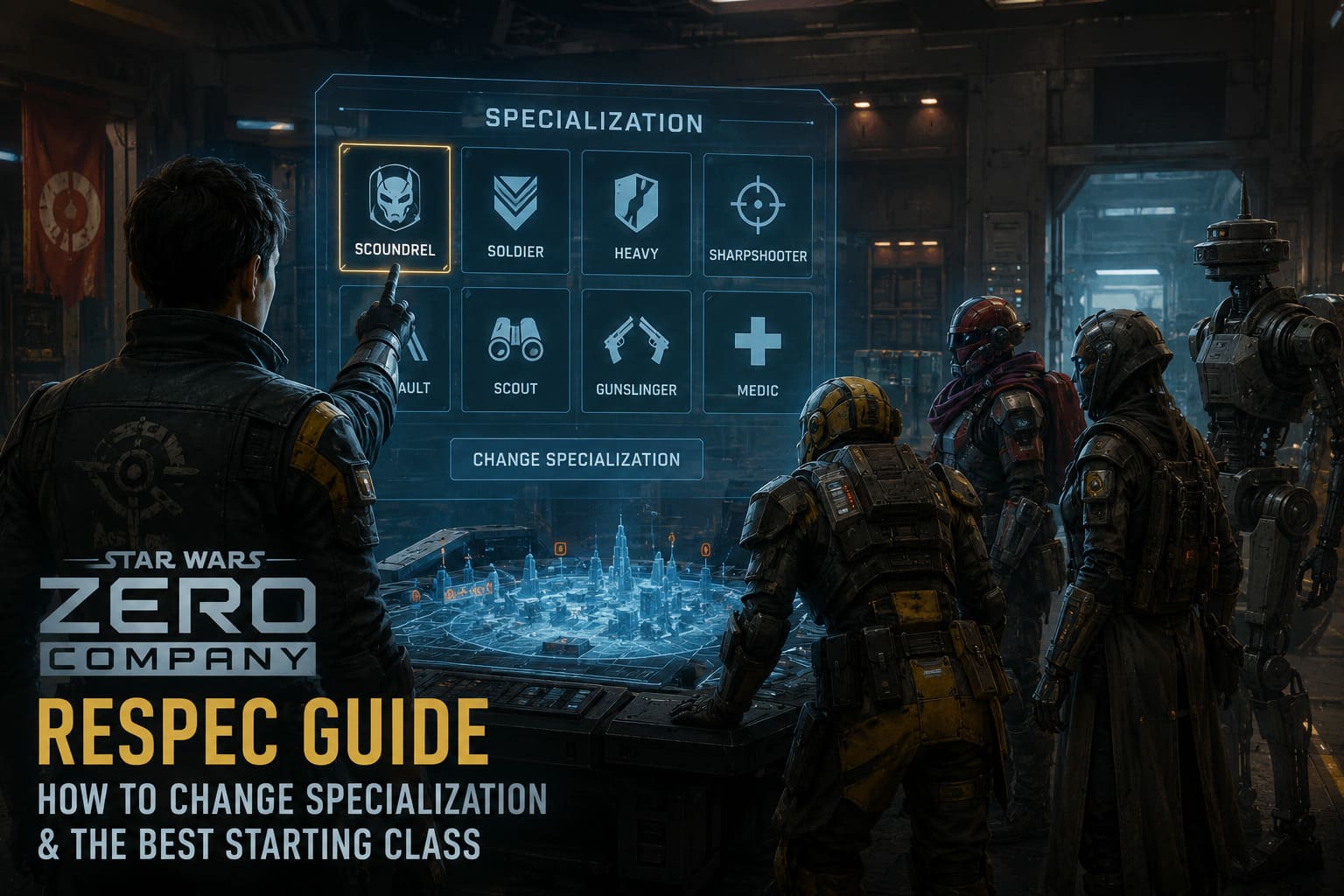
How to Change Your Specialization
Once the respec option is unlocked, head back to the Den, your main headquarters aboard the cargo freighter docked at the Ring of Kafrene.
From there:
- Open the Personnel area and access your roster.
- Select Hawks or another eligible operator.
- Enter their Focus Tree.
- Move across to the Specialization section.
- Select Change Specialization.
- Pick the new class you want to use.
And that’s basically it.
There’s no complicated respec ritual hiding behind a dozen menus. Once you know where the option is, changing a build is surprisingly painless.
Does Respeccing Cost Anything?
This is where Zero Company gets even more player-friendly.
Changing your Specialization doesn’t consume credits, materials, or another respec currency. Your previously invested Focus Points are also refunded when you switch, allowing you to rebuild the character around their new class.
That means you can experiment with different builds depending on the mission.
Need more frontline durability? Bring a Heavy.
Want to delete an important target before it gets close? Try a Sharpshooter.
Need to create ridiculous assist chains? That’s where the Scoundrel starts getting really interesting.
For me, this flexibility is one of the game’s biggest strengths.
There Is One Important Catch
Not every character is a completely blank slate.
Star Wars Zero Company separates its classes into Standard and Exotic Specializations. Standard classes are the flexible options you can use for custom recruits, while Exotic Specializations are tied to particular characters or unit types.
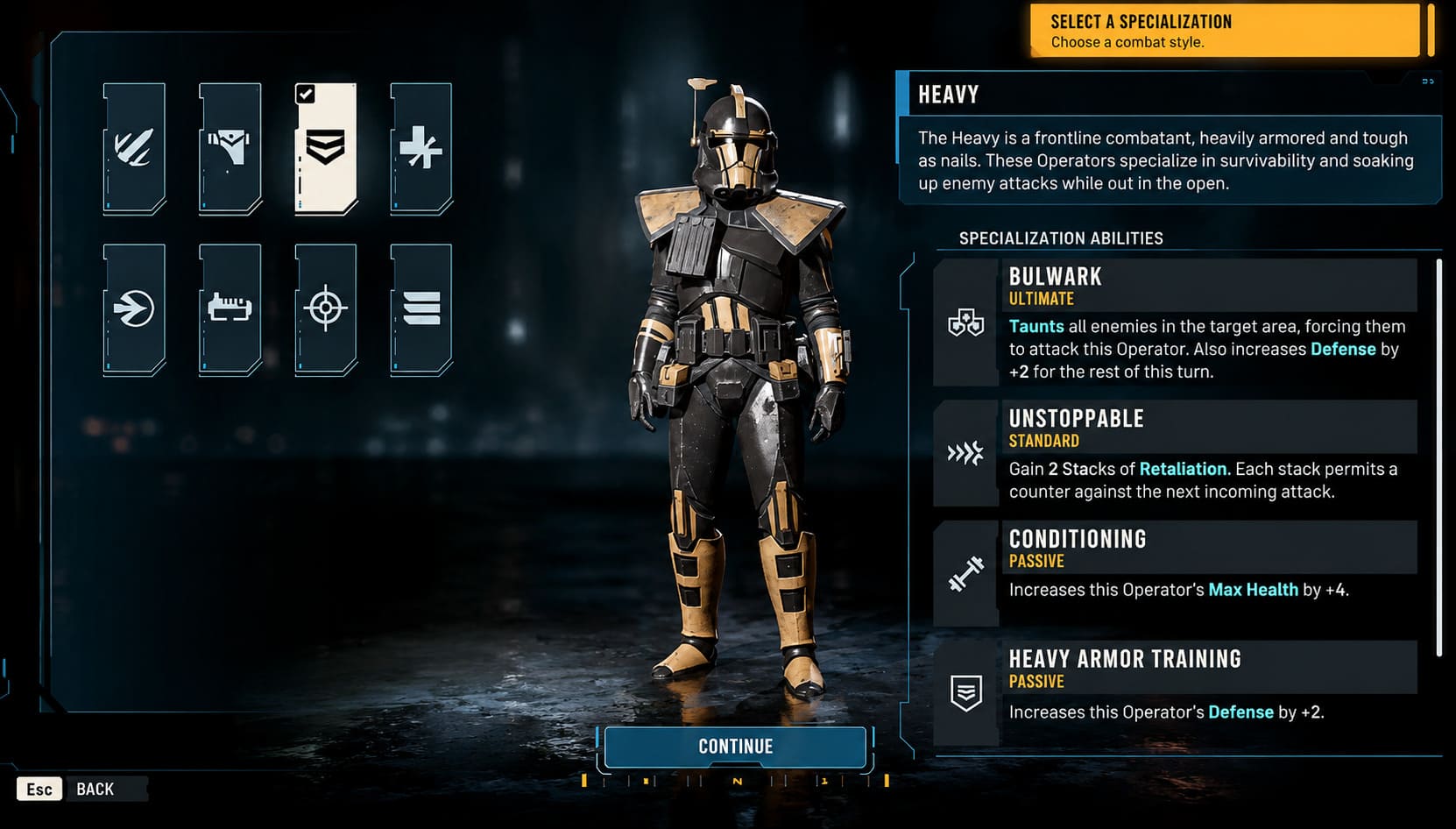
That means certain story companions cannot simply be transformed into whatever class you want.
Characters such as Tel-Rea Vokoss, with her unique Jedi Padawan specialization, have their own locked identity. Cly Kullervo similarly retains her Mandalorian Warrior specialization, while player-created droids have their own specialized role.
This actually makes sense from a narrative perspective. I don’t particularly want every companion to feel like a generic soldier wearing a different hat.
The important takeaway is simple: custom recruits give you the most freedom, while certain authored characters remain mechanically unique.
The Eight Standard Specializations
The standard classes are where most of your experimentation will happen, and each one fills a noticeably different tactical role.
| Specialization | Main Role | Best For |
|---|---|---|
| Scoundrel | Debuff / Support Damage | Assist chains and Vulnerable targets |
| Soldier | Balanced Combat | Beginners and reliable damage |
| Heavy | Tank / Defense | Protecting vulnerable teammates |
| Sharpshooter | Long-Range Damage | High-value target elimination |
| Assault | Mobility / Flanking | Aggressive close-range attacks |
| Scout | Recon / Utility | Vision and target setup |
| Gunslinger | Multi-Target Damage | Rapid pistol attacks |
| Medic | Healing / Sustain | Keeping the squad alive |
There isn’t really a useless class here. The bigger question is which one fits your squad.
And that’s where things get interesting.
My Pick: Scoundrel Is the Best Starting Specialization
If you’re asking me which class I’d personally choose for Hawks, I’m going with Scoundrel.
Not because it’s the easiest class. It isn’t.
I’m picking it because the class seems to understand what Zero Company is fundamentally about: squad synergy.
The Scoundrel focuses heavily on disruption, debuffs, armor penetration, and making enemies Vulnerable. Once you start combining that with attacks from other squad members, the damage can snowball incredibly quickly.
That is exactly the kind of tactical interaction I love in these games.
You don’t just attack an enemy.
You weaken it.
Another character exploits that weakness.
Someone else follows up.
Suddenly your entire squad is chaining attacks together, and the battlefield starts feeling less like a sequence of individual turns and more like one coordinated operation.
That is much more satisfying than simply giving everyone the biggest weapon available.
The Scoundrel also works particularly well with Advantage, which feeds into powerful tactical actions and assist opportunities.
And if you’re running Hawks alongside Kabb, who already occupies the Scoundrel role, you can lean heavily into that playstyle.
It’s aggressive, but it can become ridiculously efficient when everything clicks.
Soldier: The Class I’d Recommend to New Players
If Scoundrel sounds too complicated, pick Soldier.
Honestly, I wouldn’t even hesitate to recommend it to someone playing their first tactical RPG.
The Soldier is straightforward. You have dependable weapons, solid survivability, useful melee options, grenades, and a powerful Rocket Strike ultimate.
There’s something refreshing about having a character whose job description is basically:
Go there. Shoot that. Blow something up.
You don’t need to build a complicated status-effect machine to make the Soldier useful.
This makes the class especially forgiving during the early campaign, when you’re still learning how positioning, cover, assists, and enemy behavior work.
If you don’t know what you want yet, Soldier is probably the safest first choice.
Heavy: Your Squad’s Walking Shield
The Heavy is my favorite choice when a mission starts looking like it’s going to become a complete disaster.
This class is built around durability and battlefield control.
The Heavy gets increased health and defensive capabilities, while abilities such as AoE Taunt allow them to pull enemy attention away from more fragile squad members.
And that’s incredibly valuable in a game where positioning matters so much.
The Heavy isn’t necessarily the character who gets the most exciting damage numbers. Instead, they’re the reason everyone else survives long enough to produce those damage numbers.
If you’re running a Sharpshooter or support-heavy squad, having a durable frontline character can make your entire formation feel safer.
Sharpshooter: For Players Who Love Big Numbers
Then there’s the Sharpshooter.
This is the class for people who see an enemy commander standing on the opposite side of the map and immediately think, yeah, that guy isn’t making it to the next turn.
Sharpshooters use long-range weapons and thrive when you give them good sightlines and elevated positions.
Their greatest strength is single-target burst damage.
The class becomes especially nasty when combined with abilities or talents that guarantee critical hits. A properly positioned Sharpshooter can remove priority targets before they get the chance to become a problem.
The downside?
You actually have to think about positioning.
A badly placed sniper is just an expensive target.
What About Assault, Scout, Gunslinger, and Medic?
The remaining classes are more specialized, but that doesn’t mean they should be ignored.
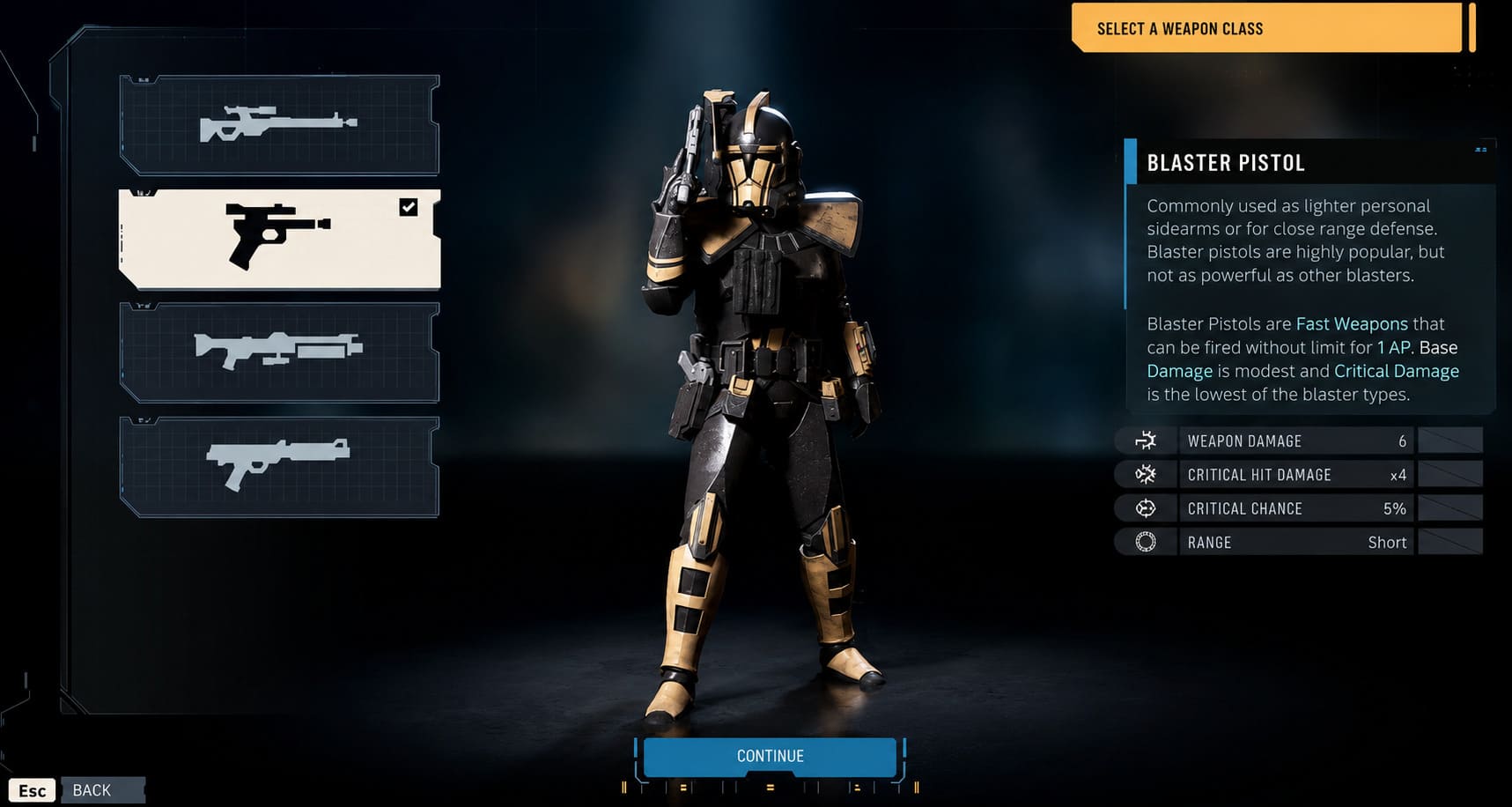
Assault is ideal for aggressive players who love mobility, flanking, and getting into the enemy’s face. If your strategy is basically “we’re going over there and we’re going over there very quickly,” Assault is probably your class.
Scout is more about information and setup. Vision, target marking, and accuracy bonuses can make the entire squad more effective, especially when you’re preparing a major attack.
Gunslinger is one of the most entertaining classes to play. Rapid pistol attacks and multi-target chains give the class a very different rhythm compared with traditional rifle-based characters. The main drawback is that Gunslinger tends to appreciate investment into weapons, upgrades, and modifications before reaching its full potential.
And then there’s Medic.
I wouldn’t rush to make Medic your first custom recruit.
That doesn’t mean healing is bad. Far from it. But during the opening cycles, smart positioning, cover, and consumable stim packs can often keep your team functioning without dedicating a full character to medical support.
Later on, though, the value of sustained healing becomes much more noticeable.
The Multiclassing System Changes Everything
The really fun part comes later.
At around Cycle 18, Zero Company opens up its secondary Specialization system, allowing operators to combine two different class identities.
This is where I think the build system goes from good to genuinely interesting.
Imagine combining a high-damage class with a mobility-focused secondary specialization. Or pairing a defensive Heavy with a support-oriented option.
The possibilities become much broader because you’re no longer asking:
“Which class should this character be?”
You’re asking:
“Which two classes make this character work?”
That’s a much more interesting question.
And because Specializations can be adjusted, you aren’t forced to stick with your first theorycraft forever.
For players who enjoy experimenting with RPG builds, Cycle 18 is where I’d expect the system to become especially addictive.
Star Wars Zero Company Armor Guide: How to Break Enemy Armor Fast
My Recommended Early-Game Squad Philosophy
Personally, I wouldn’t obsess over creating the theoretically perfect team from the beginning.
I’d rather build around complementary roles.
A simple setup could look like this:
- Scoundrel for debuffs, Vulnerable targets, and assist setups.
- Heavy for frontline protection and enemy control.
- Sharpshooter for long-range priority kills.
- Soldier or Assault for reliable additional damage.
That gives you a nice mixture of durability, burst damage, utility, and mobility.
But here’s the important part: don’t be afraid to change it.
If a particular mission constantly destroys your frontline, respec.
If enemies are surviving too long, change your damage profile.
If your team feels too slow, add mobility.
That’s the entire reason the respec system exists.
How to Fix Star Wars Zero Company Nvidia Driver Crashes, Black Screen, and Low FPS on PC
Final Verdict
After spending time looking at how the Specialization system fits into the larger tactical design of Star Wars Zero Company, I think Bit Reactor made the right call by keeping respecs so accessible.
You reach Cycle 3, unlock the ability to change Specializations, and can experiment without throwing away your progression.
That’s exactly how I want a modern tactical RPG to handle character builds.
For my own playthrough, Scoundrel would be my first choice for Hawks because of the incredible synergy with assists, Vulnerable targets, and Advantage. If I wanted something simpler, I’d take Soldier without thinking twice. Heavy is the safety net, while Sharpshooter is the class I’d choose when I want to watch elite enemies disappear from a ridiculous distance.
Then, once Cycle 18 arrives, I’d start experimenting with secondary Specializations and really start breaking the system.
And honestly, that’s probably the part I’m most excited about.
The best tactical games aren’t the ones that tell you exactly how to build your squad. They’re the ones that give you enough tools to create something weird, discover that it somehow works, and then spend the next ten hours trying to make it even more ridiculous.
Zero Company looks very much like that kind of game.