The Blood of Dawnwalker Best Builds Guide: Elite Human and Vampire Combat Meta
There’s something I really like about The Blood of Dawnwalker: it doesn’t let you play Coen like a normal RPG protagonist.
You’re not simply picking a class at the start, grabbing a sword, and then slowly turning into an unstoppable machine. Coen is stuck between two worlds. During the day, he’s still human. At night, the Vrakhiri curse takes over, and suddenly your entire approach to combat changes.
After spending time experimenting with different combinations of Swordmastery, Witchcraft, and Vampirism, I’ve come to one pretty clear conclusion: there isn’t one perfect build for every situation. The strongest setups are the ones that actually respect the game’s day-and-night structure instead of trying to fight against it.
That said, a few combinations stand out.
Some are ridiculous in the best possible way. Others are much more comfortable for normal exploration. And if you’re heading into the later stages of the campaign or planning around New Game Plus, there are some combinations that start feeling borderline unfair.
Here are the builds I’d personally recommend.
How Coen’s Day and Night System Changes Your Build
Before talking about individual builds, you need to understand the most important rule in The Blood of Dawnwalker.
Coen isn’t the same character at noon and midnight.

When the sun is up, you’re primarily working with your human abilities and the Witchcraft tree. Once night arrives, Vampirism becomes available and Coen gains access to his darker abilities.
Swordmastery is the exception.
That tree acts as your constant foundation because sword abilities remain useful regardless of the time of day. This makes Swordmastery incredibly valuable for hybrid builds, since you can invest in it without worrying about losing access to those abilities when the clock moves forward.
There are also several other systems you need to keep an eye on:
| System | Why It Matters | Best Use |
|---|---|---|
| Activation Charges | Powers major abilities | Save them for high-impact moments |
| Health | Can fuel powerful vampire abilities | Maintain high health before burst attacks |
| Corruption | Controls access to vampire progression | Plan your blood consumption carefully |
| Time | Advances the campaign | Don’t waste daytime and nighttime segments |
And honestly, the time mechanic is one of the things I enjoy most. It makes character progression feel like a decision rather than a checklist.
Build #1: Sanguine Juggernaut
If you want my personal pick for the most satisfying all-around combat setup, this is it.
The Sanguine Juggernaut combines defensive swordplay with explosive vampire abilities. The idea isn’t complicated: build resources during human combat, then spend them aggressively once Coen enters his supernatural state.
It’s a very “tank first, monster later” approach.
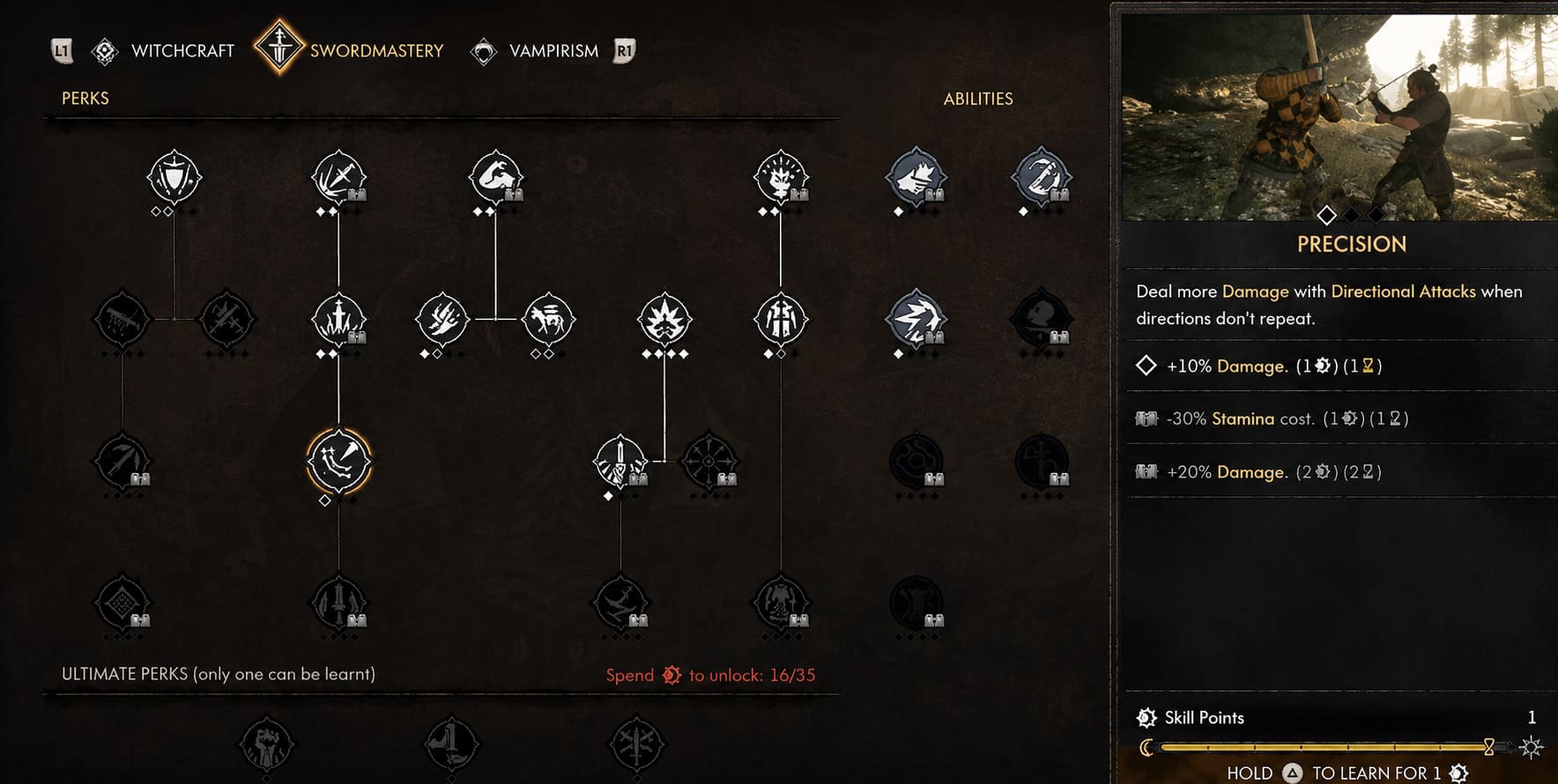
Core Skills
Your main priorities should be:
- Swordmastery: Push toward Walking Fortress and defensive bonuses.
- Vampirism: Invest heavily into Blood Surge and Crimson Rush.
- Armor: Favor heavier equipment with strong defensive properties.
- Mastery: Improve your vampire abilities as early as your progression allows.
Walking Fortress is the heart of the setup. Instead of constantly attacking, you’re encouraged to learn enemy patterns and perform precise directional blocks.
And this is where the build gets fun.
Perfect blocks can generate activation charges, allowing you to enter the next phase of the fight with resources already prepared.
I much prefer this style over simply mashing attacks. There’s a rhythm to it: block, counter, build charges, survive, then explode the entire encounter later.
The Blood Surge Combo
This is where the Juggernaut really earns its name.
The basic sequence is:
- Enter the encounter with high health.
- Use directional perfect blocks to generate charges.
- Reach the three-charge limit.
- Wait for the right group of enemies.
- Trigger Blood Surge.
- Let the resulting area damage do the dirty work.
Blood Surge consumes a portion of Coen’s current health, so firing it randomly isn’t something I’d recommend.
The trick is making sure Crimson Rush is working at maximum effectiveness.
If Coen starts the attack at high health, you get more value from the damage scaling. That turns Blood Surge from a useful ability into the kind of attack that can completely change a crowded encounter.
The risk is obvious, though. You’re literally spending your own health to make the attack stronger.
That’s exactly why this build feels so good when you get it right.
Build #2: Sanguine Dreadlord
If you’re less interested in defensive swordplay and more interested in becoming a terrifying vampire, I’d go with the Sanguine Dreadlord.
This is the build for players who look at the day/night mechanic and say, “Yeah, I’m mostly here for the night.”
The focus is almost entirely on Vampirism, claws, feeding, and keeping Coen alive through aggressive combat.
Recommended Focus
Prioritize:
- Voracious Bite
- Sanguine Renewal
- Nourishing Blood
- Crimson Feast
Swordmastery still has a role, but I’d use it mainly for passive improvements that complement your physical combat rather than turning Coen into a traditional swordsman.
The Dreadlord becomes particularly nasty once you start building momentum during fights.
Claw attacks feel fast and aggressive, and the more enemies you put down, the more pressure you can maintain. This makes the build especially effective against groups where you can constantly move from one target to another.
The Healing Loop
This is probably my favorite part of the build.
Voracious Bite isn’t just an offensive move. It’s your emergency health button.
You can latch onto an enemy, deal heavy damage, drain their blood and recover health. Once you combine it with Sanguine Renewal, successful bites can also refresh other vampire ability cooldowns.
That creates a surprisingly addictive combat loop:
Attack → weaken → bite → heal → reset → attack again.
Nourishing Blood improves the amount of health you recover, while Crimson Feast provides additional benefits when feeding from human enemies.
Against groups of humans, I’d open with mobility tools such as Shadowstep, isolate a dangerous target, tear through nearby enemies and then use Voracious Bite when Coen needs to recover.
It’s aggressive, messy and incredibly satisfying.
If you enjoy playing characters who get stronger the more chaotic the battlefield becomes, this is probably the build I’d choose.
Build #3: Solar Eclipse Warlock
Not everyone wants to spend the night ripping enemies apart with claws.
For players who prefer ranged attacks, crowd control and a more tactical approach, the Solar Eclipse Warlock is probably the better choice.
This build turns Coen’s human daytime state into the main event.
The Witchcraft tree is your priority, while Swordmastery provides the mobility and melee tools necessary when enemies eventually get too close.
How I Play the Warlock
I don’t recommend standing in one place and throwing spells until everything dies.
The better approach is to use Witchcraft to control the battlefield first.
Open with ranged abilities, apply your curses or control effects, slow dangerous enemies and keep groups separated or clustered where your area attacks can hit multiple targets.
Then bring out the sword.
This creates a really nice magic-to-melee transition.
A typical encounter might look like:
Spell → Crowd Control → Dodge → Sword Combo → Retreat → Spell.
The biggest weakness is obvious: Witchcraft is tied to Coen’s human state.
Once night arrives, this entire playstyle changes.
That’s why I’d recommend investing in dodge distance, movement and light armor. You don’t want your daytime build depending on standing still and absorbing hits.
Personally, I think this is the most enjoyable build for players who like experimenting with combat rather than simply chasing maximum damage.
Build #4: Apex Hybrid for New Game Plus
Once you’ve finished the main campaign and start looking toward New Game Plus, the build philosophy changes completely.
At this stage, you’re no longer trying to cover weaknesses with a small selection of abilities. You’re building toward maximum flexibility.
The Apex Hybrid combines all three skill trees.
Swordmastery gives you consistent physical combat. Witchcraft dominates daytime encounters, while Vampirism takes over after sunset.
It’s basically the closest thing to a “complete Coen.”
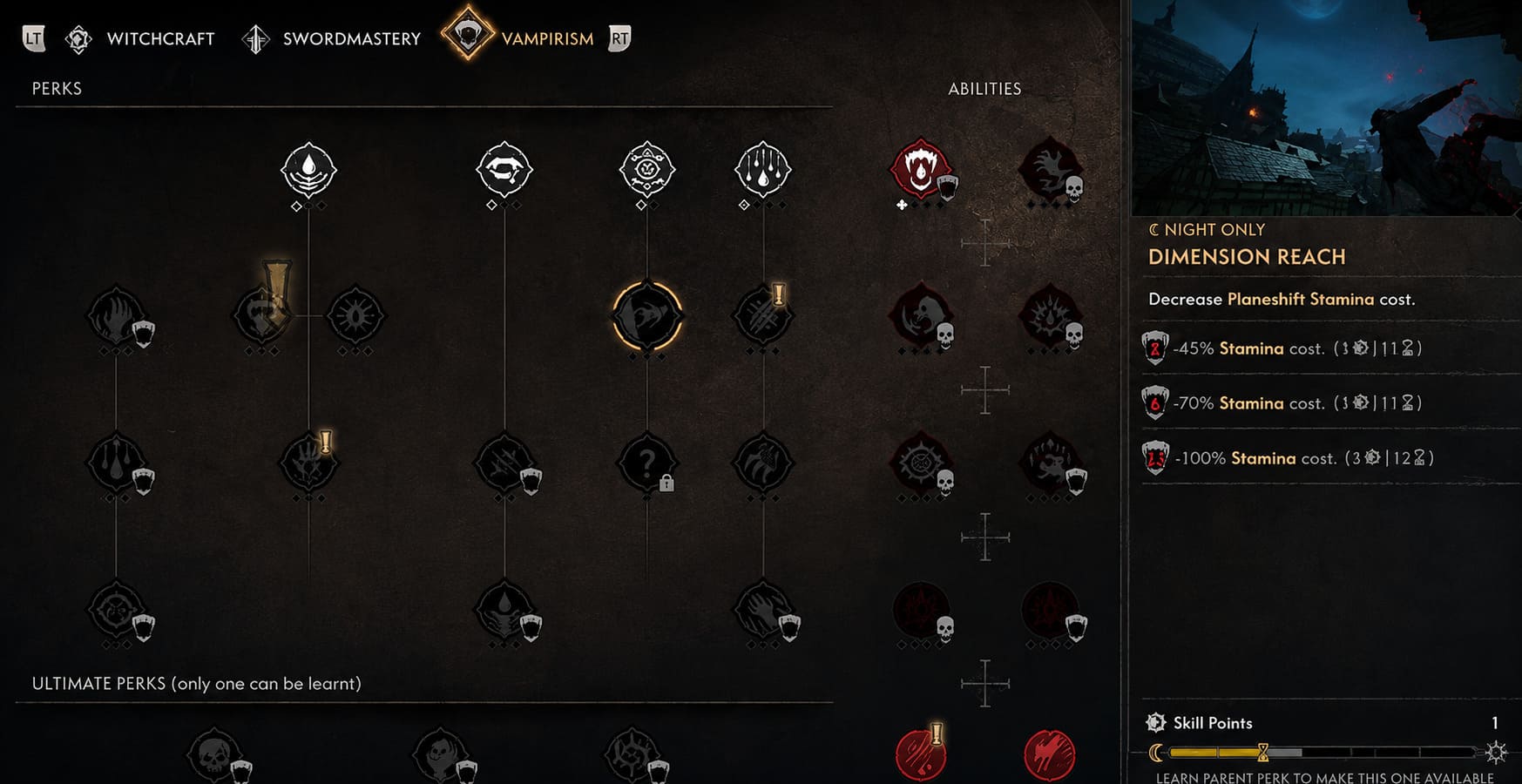
The Three-Part Setup
Your long-term goals should be:
- Swordmastery: Master of Arms
- Witchcraft: Arch Warlock
- Vampirism: Creature of the Night
The idea is simple: never have a bad time of day.
During daylight, you’re a powerful spellsword. You can control groups with Witchcraft and finish targets with sword combos.
At night, you become a mobile vampire with access to your strongest supernatural abilities.
This is also where Wild Blood becomes particularly interesting.
Feeding on wildlife lets you maintain resources without constantly attacking human NPCs. If you’re trying to keep your choices cleaner or simply don’t want every village encounter turning into a bloodbath, this passive can be extremely useful.
For me, that’s one of the smartest details in the whole build concept.
You’re not just optimizing damage. You’re optimizing how Coen exists in the world.
Which Build Is Actually Best?
Here’s how I’d personally rank them depending on what you want from the game:
| Build | Damage | Survivability | Difficulty | Best For |
|---|---|---|---|---|
| Sanguine Juggernaut | ★★★★★ | ★★★★★ | High | Hybrid Combat |
| Sanguine Dreadlord | ★★★★★ | ★★★★☆ | High | Vampire Players |
| Solar Eclipse Warlock | ★★★★☆ | ★★★☆☆ | Medium | Spellcasters |
| Apex Hybrid | ★★★★★ | ★★★★★ | Very High | New Game Plus |
For a first playthrough, I’d pick the Sanguine Juggernaut.
It’s forgiving enough to survive mistakes while still rewarding precise play.
If you’re already comfortable with the combat and want something more aggressive, the Dreadlord is the one I’d try next.
The Warlock is my choice for players who love tactical ranged combat.
And the Apex Hybrid? Save that monster for NG+.
Don’t Ignore Manuals and the Time Limit
One mistake I think players can easily make is treating skill progression like a normal RPG.
It isn’t.
You need to find or acquire combat manuals before unlocking certain abilities. Then you’re spending experience and, importantly, time to actually add those skills to Coen’s progression.
That means every upgrade has an opportunity cost.
The game gives you a limited campaign window, so you can’t casually unlock everything and assume you’ll have plenty of time left.
Before committing to a build, decide what abilities actually matter.
I’d rather have ten highly synergized skills than twenty random upgrades that barely work together.
Plan your progression around the clock, not just your experience bar.
Weapons Matter More Than You Might Expect
Another thing worth experimenting with is weapon handling.
Different swords don’t simply feel like cosmetic variations. Their swing speed, recovery, reach and damage characteristics can change how comfortable a build feels.
For a heavy Juggernaut setup, I prefer slower weapons that complement a defensive playstyle.
For the Warlock, I’d rather have something quicker that lets me capitalize on enemies after they’re affected by Witchcraft.
That difference might look small on paper, but when you’re actually fighting, it becomes noticeable.
The Blood of Dawnwalker NPC Guide: Every Major Character & Faction Explained
Keep Coen Fed
Finally, don’t forget about blood hunger.
This is especially important if you’re leaning heavily into Vampirism.
Running around with an empty hunger meter isn’t just a combat problem. Your condition can affect how Coen behaves and potentially influence important interactions.
So, before heading into major settlements or story-heavy sections, make sure you’ve prepared your blood supply.
Wildlife is particularly useful here if you want to maintain your resources without constantly turning ordinary NPCs into targets.
It also gives the vampire side of the character a little more flexibility than you might expect.
How to Fix The Blood of Dawnwalker Crashing and Not Launching on PC
Final Verdict
What makes The Blood of Dawnwalker builds interesting isn’t simply having three skill trees.
It’s the fact that those trees are tied to who Coen is at different points of the day.
Swordmastery gives you consistency. Witchcraft turns daylight into an opportunity for controlled, tactical combat. Vampirism makes the night dangerous, fast and brutally aggressive.
My personal favorite remains the Sanguine Juggernaut because it makes the day/night transition feel meaningful. You’re not playing the same build for twenty hours and occasionally pressing a vampire ability. You’re actively preparing during the day for what you’re going to do after sunset.
That’s exactly the kind of RPG design I enjoy.
If you’re just starting out, don’t worry about creating the mathematically perfect character from your first skill point. Learn the combat, experiment with manuals, pay attention to the clock and figure out whether you enjoy playing Coen as a disciplined swordsman, a spellcaster or a blood-hungry predator.
Once you understand that rhythm, the builds above become much more than simple skill lists.
They become different ways of playing the same character — and that’s where The Blood of Dawnwalker really starts to shine.