Servant of the Lake Mac Performance Guide: How to Fix Low FPS, Stuttering, and Lag on macOS (2026)
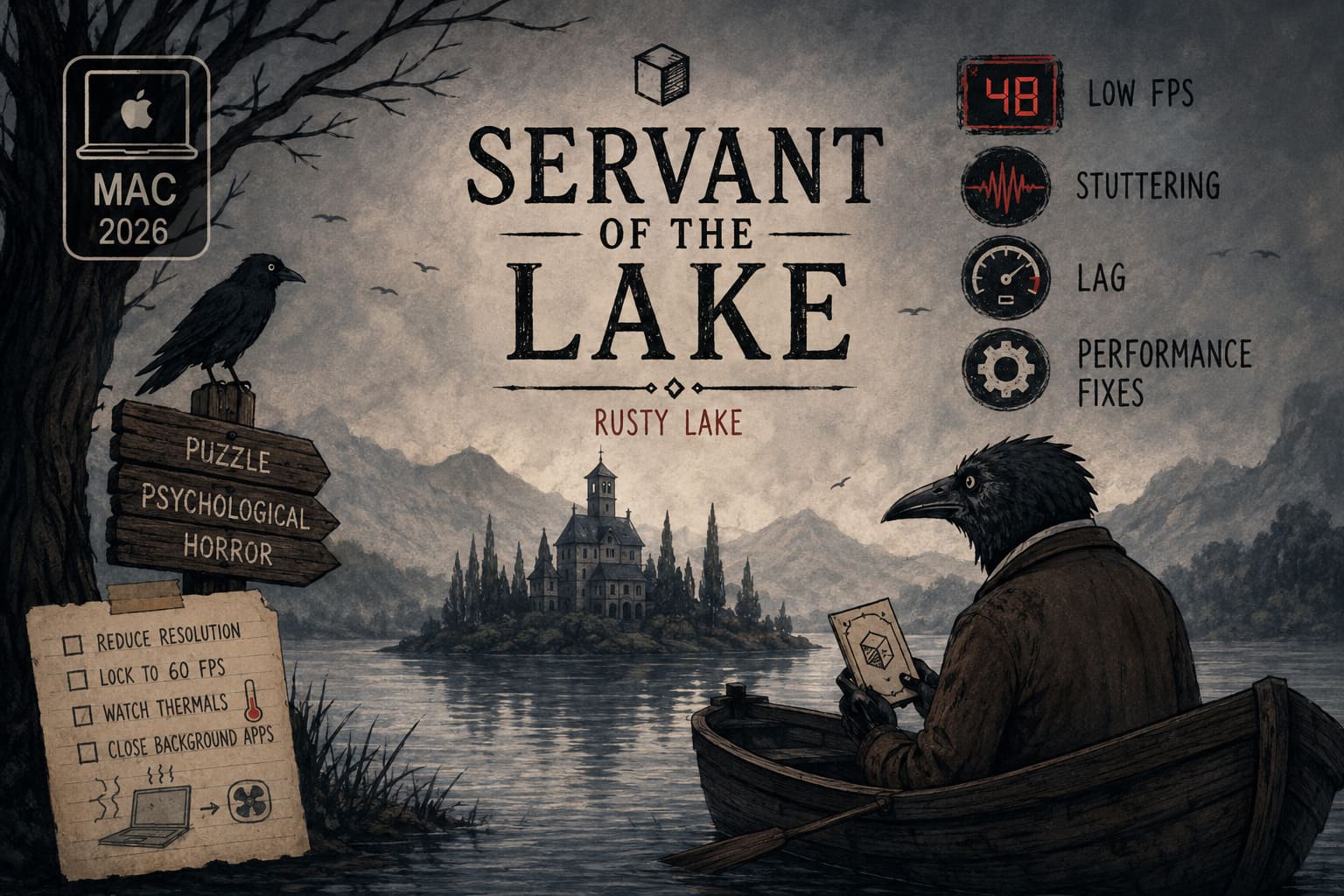
I have played enough games on Mac to know that a game looking simple does not necessarily mean it will run perfectly.
That was my first thought with Servant of the Lake. On paper, this is about as far from a demanding modern AAA game as you can get. It is a hand-drawn psychological horror puzzle game from Rusty Lake, built around exploration, strange characters, atmospheric locations, and classic point-and-click interactions. There are no enormous open-world environments, no armies of enemies, and no ray-traced reflections covering the screen.
So when the game starts feeling sluggish on a MacBook that can comfortably handle much more demanding software, it is understandably frustrating.
The good news is that most of the things I would check first are not complicated. In my experience with Mac gaming, display scaling, frame pacing, background processes, thermals, and the way an individual game handles macOS can matter just as much as the official system requirements.
Here is what I would try if Servant of the Lake is giving you low FPS, micro-stuttering, delayed mouse movement, or random performance drops.
Why Can Servant of the Lake Stutter on a Mac?
Before changing anything, it helps to understand something that I have learned from troubleshooting plenty of games: performance problems are not always caused by weak hardware.
A Mac can be powerful enough to run a game while still producing an inconsistent experience.
One of the first suspects is Retina and high-resolution rendering. A MacBook display has a much higher pixel density than a traditional 1080p monitor. If a game or its underlying framework handles that scaling inefficiently, the GPU may end up rendering considerably more pixels than the game actually needs.
This is especially interesting with a visually simple game. You might assume that a 2D puzzle game should barely use the GPU, but the actual workload can be affected by the way the game window is composited and scaled.
Then there is frame pacing.
A game running at a theoretically high FPS can still feel worse than one locked to a stable 60 FPS. Consistency matters more than a big FPS number for a point-and-click game.
Finally, MacBooks can behave differently depending on whether you are using an Intel processor or Apple Silicon, whether the machine is plugged in, what display is connected, and how warm the system has become.
1. Check the Basics Before Changing Game Files
This is boring advice, but it has saved me more troubleshooting time than almost anything else.
Before modifying Servant of the Lake, restart your Mac and launch the game with as little else running as possible.
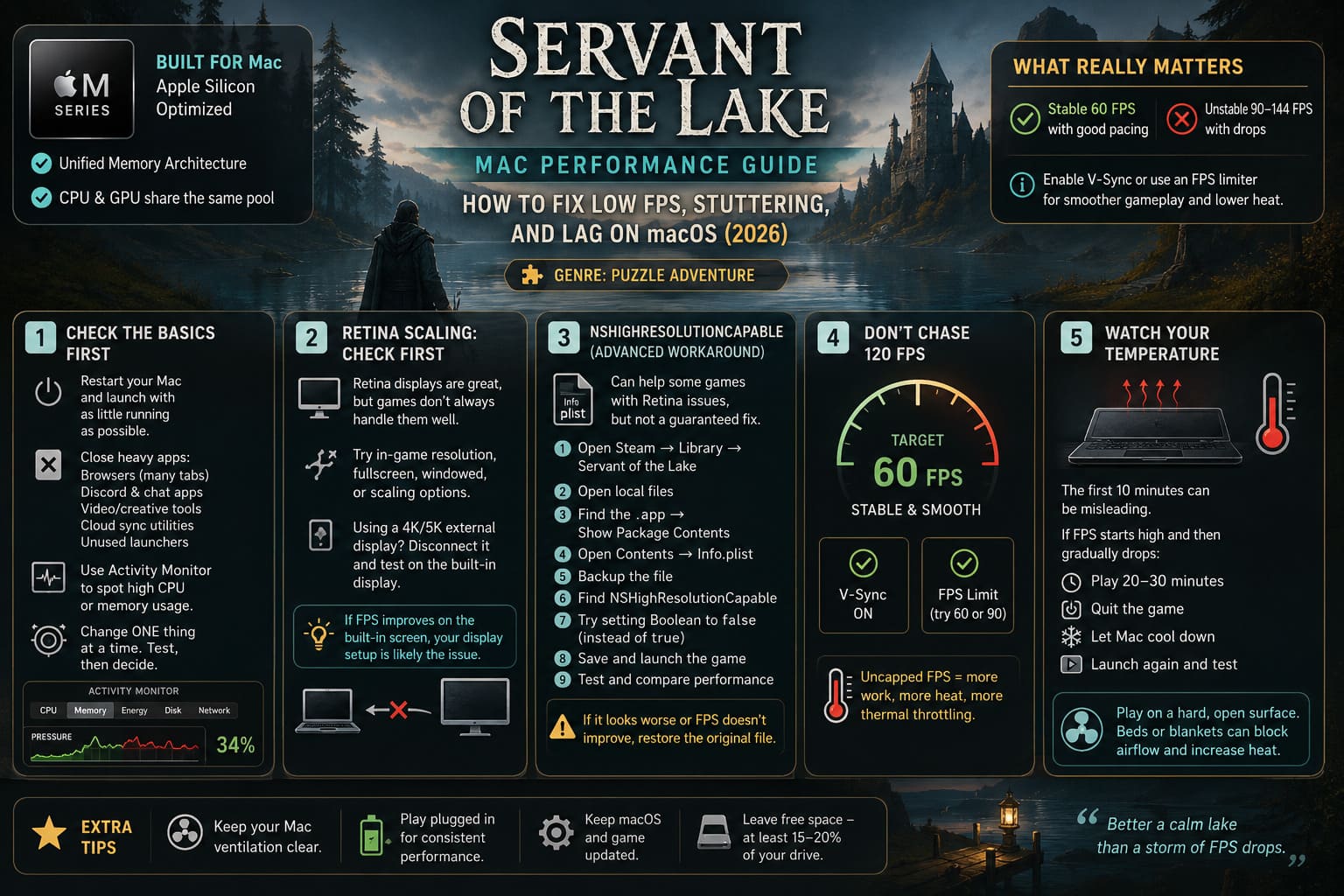
I would particularly close:
- Chrome or Safari windows with lots of tabs
- Discord and other communication apps
- Video-editing or creative software
- Cloud synchronization utilities
- Launchers and applications that you are not actually using
Then open Activity Monitor and take a look at the Memory and CPU tabs.
You don’t need to obsess over every percentage. What you are looking for is an application that is unexpectedly consuming a large amount of CPU or memory.
This is particularly useful on Macs with lower memory configurations. Because Apple Silicon uses unified memory, CPU and GPU workloads share the same pool. That does not mean you should constantly try to empty your memory before gaming, but closing unnecessary heavy applications can eliminate another possible source of stuttering.
My rule: don’t optimize ten things at once. Change one thing, test the game, and then decide whether the next adjustment is necessary.
That makes troubleshooting much easier.
2. Retina Scaling Is One of the First Things I’d Investigate
If Servant of the Lake is running poorly despite your Mac being comfortably above the game’s minimum requirements, display scaling deserves attention.
Retina displays are fantastic for everyday use, but games do not always behave ideally with them.
The important distinction is that the resolution you see in macOS and the actual rendering resolution used by a game are not necessarily the same thing.
If the game is rendering at an unnecessarily high internal resolution, reducing the workload can sometimes improve frame consistency considerably.
What I Would Try First
Start with the game’s own display settings.
If there is a resolution option, fullscreen mode, windowed mode, or scaling option, test them individually. Don’t immediately assume fullscreen is better. On macOS, I have seen different games behave very differently depending on how their windows are presented.
If you are using an external 4K or 5K display, this becomes even more important.
A simple test is to disconnect the external monitor and run the game only on the MacBook’s internal display. If performance suddenly becomes smoother, you have learned something useful: the display configuration is probably part of the problem.
3. Be Careful With the NSHighResolutionCapable Fix
There is another workaround worth knowing about because it has been used with some Mac games that have problems with Retina rendering: changing the application’s NSHighResolutionCapable setting in its Info.plist.
However, I would treat this as an advanced workaround, not a guaranteed fix.
If you want to experiment with it, first make a backup of the original file. A game update can also overwrite your modification, so don’t be surprised if you have to repeat the process later.
The general process is:
- Open Steam and locate Servant of the Lake in your Library.
- Open the game’s local installation folder.
- Find the
.appapplication. - Right-click it and choose Show Package Contents.
- Open the
Contentsfolder. - Locate
Info.plist. - Make a backup before editing anything.
- Look for
NSHighResolutionCapable. - If the entry exists, its Boolean value can be tested as
falseinstead oftrue. - Launch the game again and compare performance.
The important part is testing rather than assuming.
If disabling HiDPI rendering makes the game look worse or doesn’t improve performance, simply restore the original setting. I would not consider this a universal Mac performance fix.
4. Don’t Chase 120 FPS in a Puzzle Game
This is probably my biggest practical recommendation.
You don’t need Servant of the Lake running at 120 or 144 FPS to enjoy it.
For this kind of game, I would much rather have a stable 60 FPS with good frame pacing than see the counter bouncing between 90, 120, and 75 FPS.
If the game has V-Sync, try enabling it.
If it has an FPS limiter, experiment with a sensible limit rather than leaving the game completely uncapped.
Why?
An uncapped game can continuously render frames that your display doesn’t need. On a laptop, that can mean extra CPU/GPU activity, additional heat, and eventually more aggressive thermal management.
And this is where things get interesting.
5. Watch Your MacBook’s Temperature
One thing I have learned from gaming on laptops is that the first ten minutes can be misleading.
A game may run perfectly when you launch it. Twenty or thirty minutes later, the fans are loud, the chassis is hot, and performance starts changing.
The MacBook Air is particularly interesting here because fanless models rely on passive cooling. That is great for silence, but sustained workloads can eventually be limited by temperature.
If your FPS starts high and then gradually falls during a session, don’t immediately blame the game’s graphics settings.
Try this simple experiment:
Play for 20–30 minutes, quit the game, let the Mac cool down, and launch it again.
If performance returns to normal after cooling, thermal behavior may be part of what you are experiencing.
Playing on a hard, open surface also helps. A bed or blanket can restrict airflow around the chassis and make heat management worse.
6. External Monitors Can Change the Equation
If you are playing on a MacBook connected to a 4K or ultrawide monitor, test the game without the external display.
This is one of those troubleshooting steps that costs nothing and can tell you a lot.
If the game suddenly feels smoother on the internal display, try experimenting with the external monitor’s resolution and refresh rate.
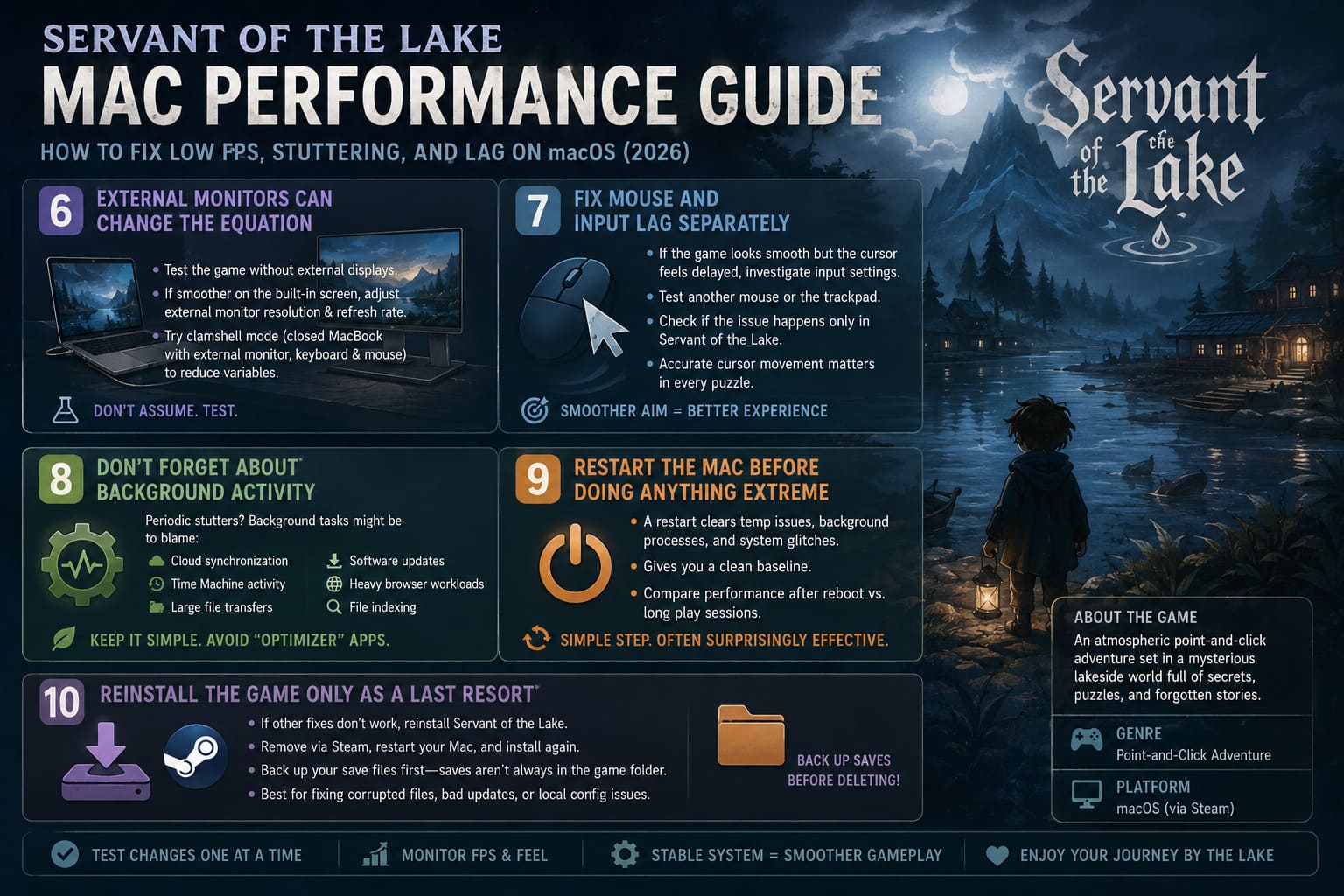
You can also test clamshell mode with the MacBook closed and an external keyboard, mouse, and monitor connected. The goal isn’t that clamshell mode is magically faster on every Mac. It is simply another configuration that can reduce variables involving multiple active displays.
Again, don’t assume. Test.
That’s the approach I prefer with Mac gaming because there are too many combinations of hardware and displays to promise that one setting will work for everybody.
7. Fix Mouse and Input Lag Separately
FPS and mouse responsiveness are related, but they aren’t exactly the same problem.
If the game looks smooth but the cursor feels delayed or strangely sluggish, I would investigate input settings separately.
Start with the mouse itself and macOS settings. If possible, test another mouse or the MacBook trackpad.
Also pay attention to whether the problem exists only inside Servant of the Lake.
If the cursor feels normal everywhere else, I would suspect the game’s input handling or frame pacing before blaming macOS mouse acceleration.
And honestly, for a point-and-click adventure, this matters.
You aren’t trying to perform a 360-degree flick shot, but accurate cursor movement is still a big part of the experience. When the pointer feels like it is dragging behind your hand, even a visually simple puzzle can become irritating.
8. Don’t Forget About Background Activity
macOS is usually very good at managing background processes, but “usually” isn’t the same as “always.”
If you notice periodic stutters rather than continuously low FPS, look for tasks that are running in the background.
Potential culprits include:
- Cloud synchronization
- Time Machine activity
- Large file transfers
- Software updates
- Heavy browser workloads
- File indexing after moving large amounts of data
You don’t need to permanently disable system services just to play a game.
Personally, I would avoid aggressive “Mac optimizer” applications too. They often promise to clean memory or boost performance, but adding another utility to the system isn’t necessarily going to solve a game-specific problem.
Keep the troubleshooting simple.
9. Restart the Mac Before Doing Anything Extreme
This sounds almost ridiculous as a recommendation, but it is worth doing.
If Servant of the Lake gradually becomes less responsive after a long session, quit the game and restart macOS.
A restart can eliminate temporary application problems, background processes behaving badly, and other software-related issues that are difficult to identify manually.
It also gives you a clean baseline.
If the game runs perfectly after a reboot and becomes problematic several hours later, that is useful information. If it stutters immediately after a fresh boot, the cause is probably somewhere else.
10. Reinstall the Game Only as a Last Resort
I wouldn’t start with a reinstall.
It’s one of those classic troubleshooting steps that takes time but doesn’t necessarily tell you anything.
However, if you’ve tried the display, frame-rate, background-process, and system checks and the game is still behaving strangely, reinstalling Servant of the Lake is reasonable.
Remove the game through Steam, restart your Mac, and install it again.
Before doing this, remember that game saves and configuration files don’t always live exclusively inside the game’s installation folder. If you have important progress, make sure your save data is safe before deleting anything.
A clean installation is most useful when you suspect that an update, corrupted file, or local configuration has caused the problem.
Servant of the Lake Lore Summary & Dark Narrative Fully Explained
My Recommended Order of Fixes
If I were sitting down with a MacBook and Servant of the Lake was stuttering, I wouldn’t start editing system files immediately.
I’d work through the problem in this order:
| Priority | What I’d Try | Why |
|---|---|---|
| 1 | Restart Mac and close unnecessary apps | Establishes a clean baseline |
| 2 | Check in-game resolution and display options | Easy potential performance gain |
| 3 | Enable V-Sync or use a sensible FPS cap | Improves frame pacing |
| 4 | Test without an external monitor | Identifies display-related problems |
| 5 | Check for heat buildup | Helps identify thermal throttling |
| 6 | Test mouse/input separately | Distinguishes input lag from FPS issues |
| 7 | Experiment with Retina/HiDPI settings | Advanced workaround |
| 8 | Reinstall the game | Last-resort software troubleshooting |
The biggest mistake is changing everything simultaneously. If you do that, you have no idea which change actually helped.
Servant of the Lake Full Walkthrough Guide and Secret Achievements (100% Completion)
Final Thoughts
The thing I find most annoying about Mac gaming is that official minimum requirements don’t always tell the whole story.
A game can technically support your Mac and still have poor frame pacing, strange Retina behavior, or occasional stuttering because of the way its engine interacts with macOS.
Servant of the Lake is exactly the kind of game where that can feel especially strange. Visually, it isn’t the sort of title that should make a modern Mac struggle. If you’re seeing serious FPS drops, therefore, I wouldn’t immediately assume that your Mac isn’t powerful enough.
Start with the simple stuff.
Close unnecessary applications, test your display configuration, use a sensible frame-rate limit, watch temperatures, and compare internal versus external displays. If those steps don’t help, then it makes sense to experiment with more advanced settings such as the application’s HiDPI configuration.
And most importantly, test one change at a time.
After all, the goal isn’t to spend an evening optimizing macOS instead of playing the game. The goal is to get back into the Vanderboom estate, solve the puzzles, enjoy the wonderfully strange atmosphere, and hopefully stop staring at a stuttering cursor while wondering why a hand-drawn adventure is making your Mac work so hard.