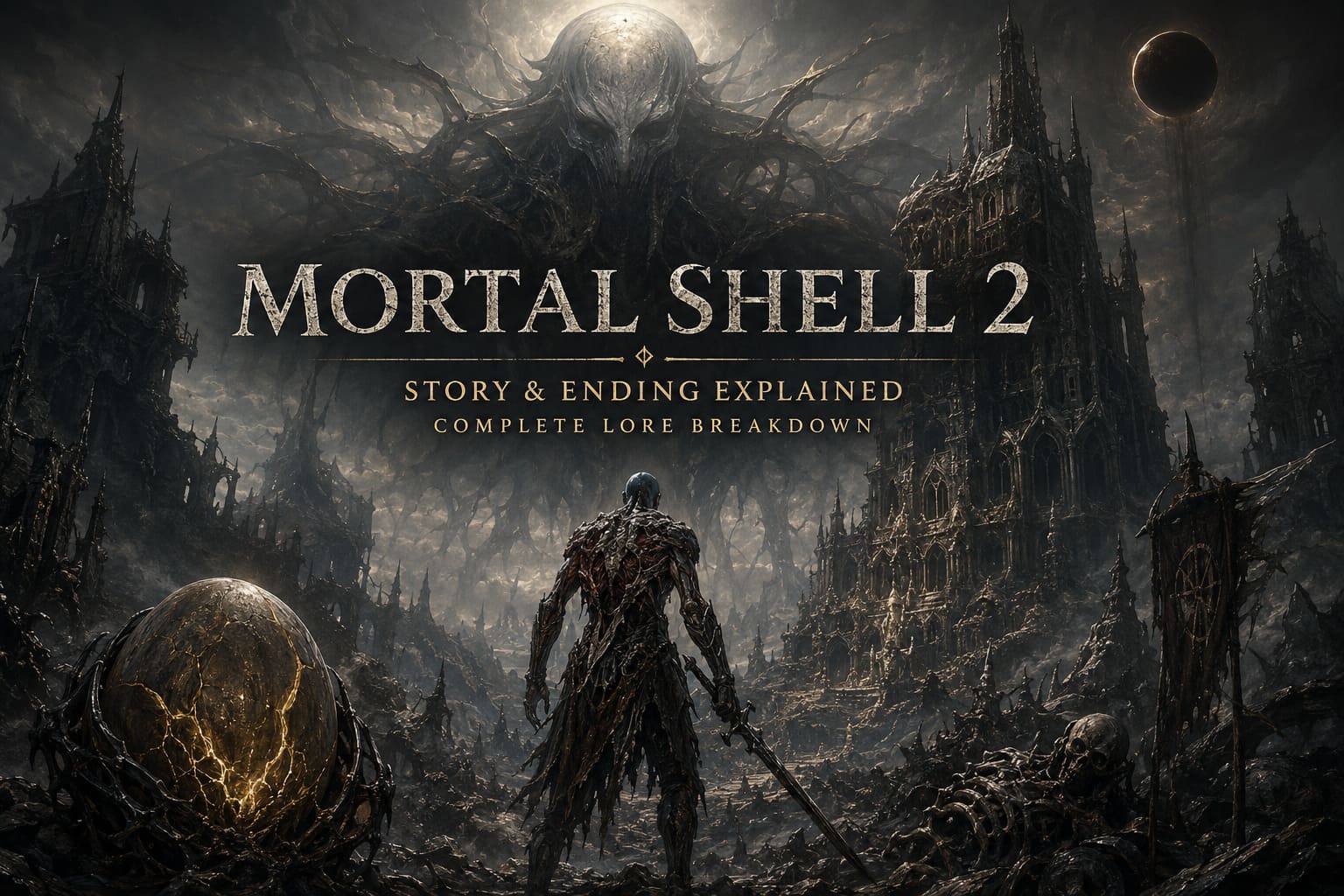
Mortal Shell 2 Story and Ending Explained: Complete Lore Breakdown
I’ve played enough Soulslikes to know when a game is hiding something behind a wall of vague dialogue, strange corpses, and NPCs who look like they haven’t slept in 400 years. Mortal Shell 2 does exactly that.
But this time, I think there’s a much bigger idea underneath all the blood, cosmic horror, dead warriors, and miserable-looking ruins.
The sequel takes the grim foundation of the original Mortal Shell and pushes it into much stranger territory. Fallgrim is no longer just a compact nightmare where you stumble from one horrific location to another. The world is enormous, packed with dungeons, frozen burial grounds, forbidden forests, ruined temples, and gigantic structures made from bone.
And the story is just as ambitious.
At first, Mortal Shell 2 appears to tell a fairly straightforward story: the Harbinger must recover the stolen Ova of an ancient cosmic being and return them to their mother. Kill the false gods. Take back the eggs. Save the world.
Simple enough.
Except it really isn’t.
The deeper you go, the more the game starts pulling that heroic premise apart. By the final sequence, the entire meaning of the journey changes. What looked like a mission to save Fallgrim becomes something much darker.
So, with the obvious spoiler warning out of the way, here’s my full Mortal Shell 2 story and ending explained.
The World of Mortal Shell 2
The easiest mistake is assuming the Undermether is simply another evil god.
She isn’t.
At least, not in the conventional sense.
Long before the events of the game, the Undermether descended from the heavens. She was so impossibly powerful that ancient civilizations interpreted her arrival as divine intervention. People worshiped her, built enormous temples, and organized their entire societies around her presence.
Then everything went horribly wrong.
The Undermether’s influence wasn’t something human minds could safely handle. Her presence caused madness, religious fanaticism, violence, and eventually societal collapse.
The people who worshiped her didn’t simply become devoted.
They became obsessed.
Entire civilizations destroyed themselves while trying to understand or serve something they couldn’t possibly comprehend.
This is where Mortal Shell 2 leans heavily into cosmic horror. The Undermether isn’t frightening because she wants to conquer humanity. She’s frightening because humanity may not matter to her at all.
That’s an important distinction.
The False Gods and the Stolen Ova
The chaos eventually created an opportunity for powerful figures to rebel.
These entities became known as the false gods.
They turned against the Undermether and stole her Ova — strange cosmic eggs containing her unborn offspring. The eggs were scattered throughout Fallgrim and hidden inside heavily protected locations.
From a human perspective, this initially sounds like the classic fantasy setup.
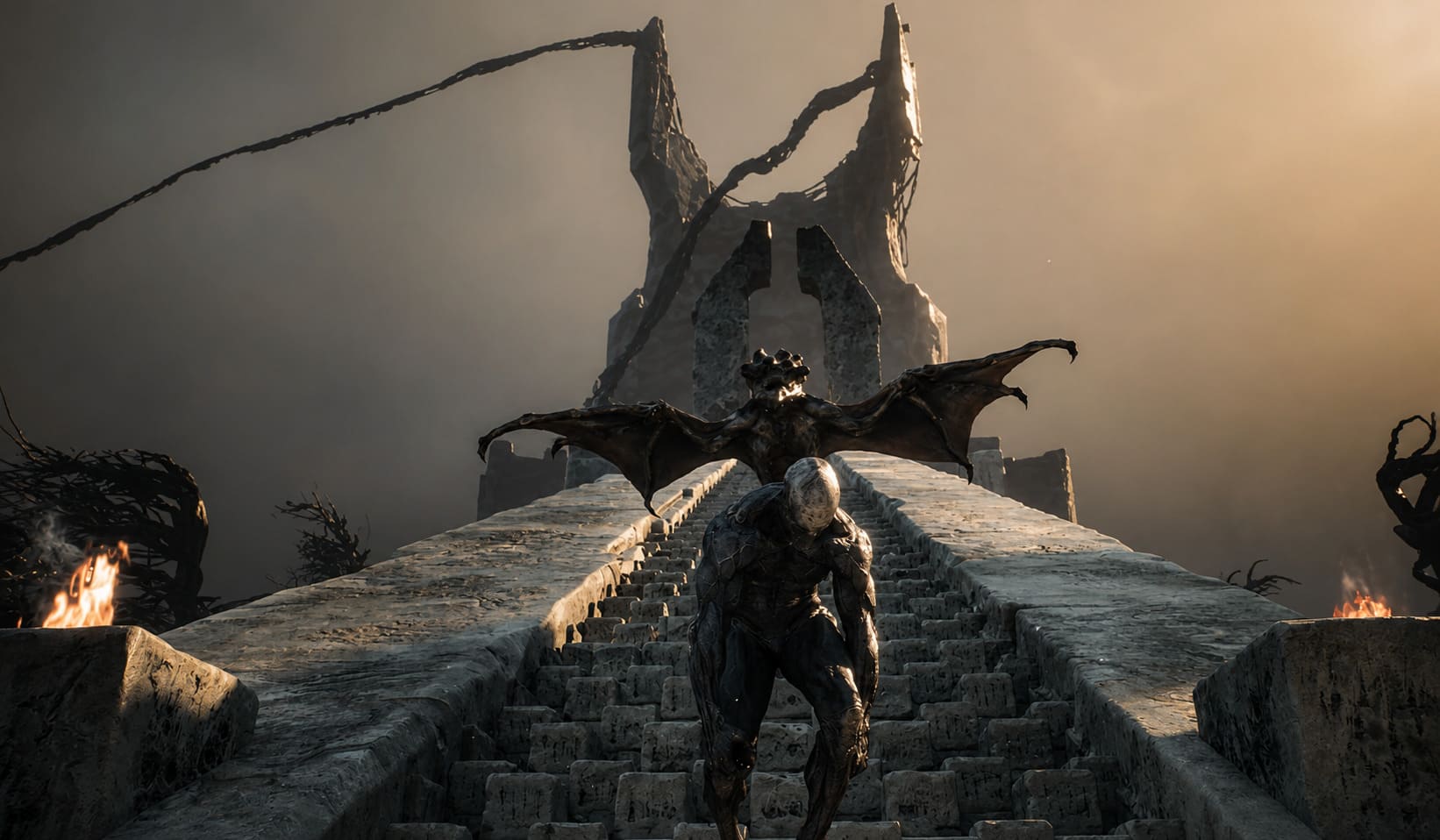
An evil group steals something sacred.
A chosen warrior has to recover it.
Everyone lives happily ever after.
Except Mortal Shell 2 keeps dropping hints that the false gods might not have been completely wrong.
They weren’t necessarily trying to steal the Ova because they wanted power.
They may have been terrified of what would happen if those offspring were ever born.
And honestly, after seeing the ending, I think this is one of the smartest things the game does with its story.
The villains become much harder to categorize.
The Horrifying Stone Birth Ritual
One of the ugliest pieces of lore concerns the so-called stone birth ritual.
The ancient civilizations developed a brutal method of forcing cosmic offspring out of their progenitors using molten stone and enormous spikes.
It sounds like something pulled directly from a nightmare.
The process was horrific and often fatal.
But it also reveals something important about the relationship between humanity and the Undermether’s offspring. These weren’t treated as ordinary children. They were objects of worship, experimentation, fear, and eventually imprisonment.
Hadern becomes particularly important here.
He initially protected the unborn entities while they were still in their larval state. But as they developed, he began to understand that something was deeply wrong.
The things being worshiped as divine children looked more and more like monsters.
Eventually, Hadern imprisoned them.
And that decision becomes one of the central historical conflicts behind the entire game.
The Harbinger
Then we meet the protagonist.
The Harbinger is unlike the heroes you normally find in fantasy games.
There is no royal bloodline.
No legendary sword.
No glorious prophecy.
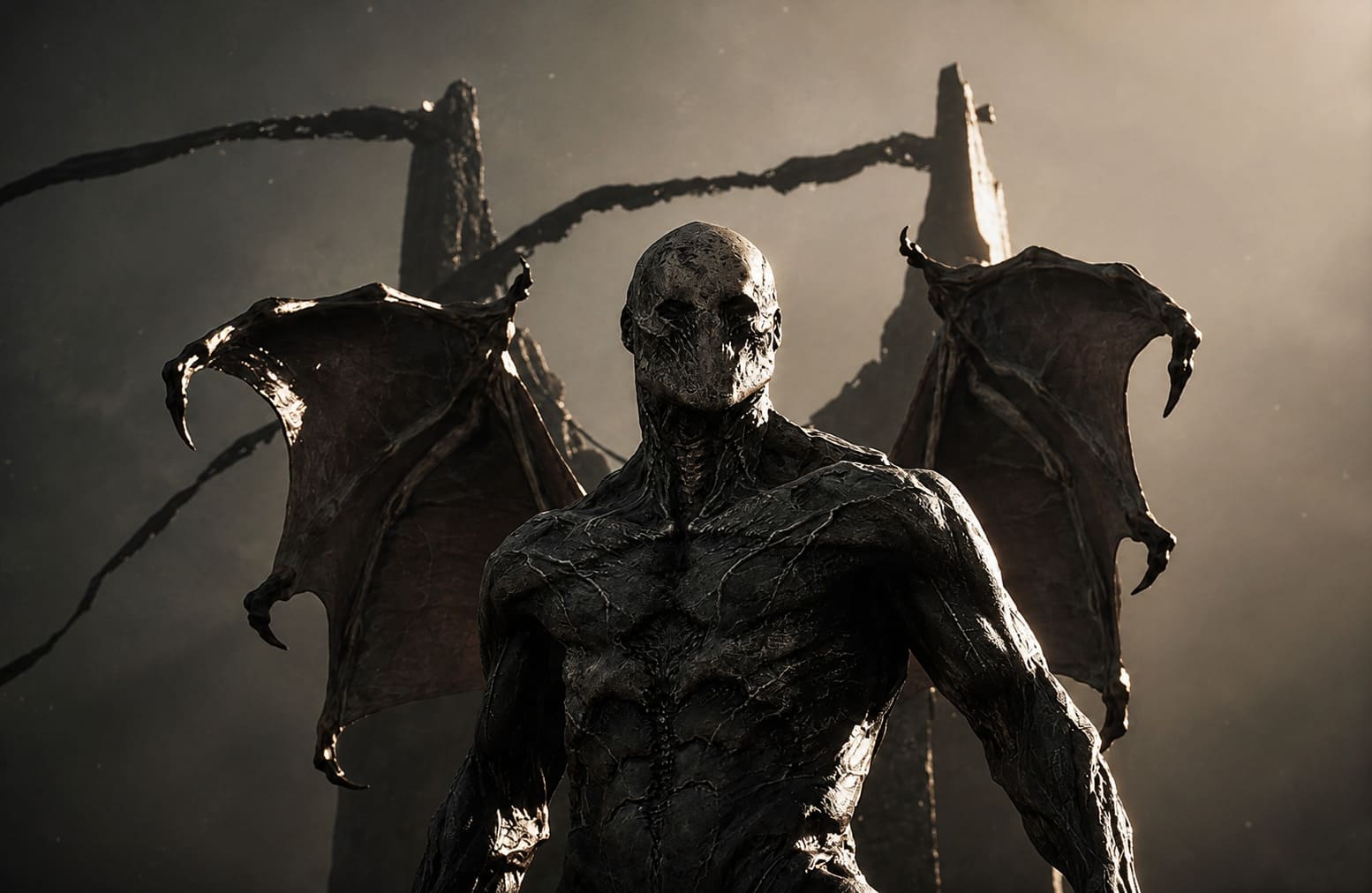
The Harbinger is essentially an empty biological vessel.
A faceless, skinless creature created for a specific purpose.
Its mission is brutally simple:
- Find the stolen Ova.
- Defeat the false gods.
- Recover the offspring.
- Return them to the Undermether.
That’s it.
The Harbinger isn’t initially presented as a person with a normal identity. It is a weapon.
But the Shell system changes that.
When the Harbinger inhabits the remains of dead warriors, it doesn’t simply borrow their combat abilities. It also encounters fragments of their lives.
And this is where the story becomes much more personal.
The Eight Shells and Their Stories
The Shells aren’t just character builds.
They’re pieces of the world’s history.
| Shell | Role | Story Connection |
|---|---|---|
| Haros | Vanguard Warrior | Witnessed the corruption of his king |
| Tiel | Rogue | Became consumed by cosmic Tar |
| Solomon | Scholar | Learned truths that destroyed his sanity |
| Eredrim | Commander | Led a doomed campaign against the temples |
| New Shells | Specialized Warriors | Reveal additional perspectives on Fallgrim’s collapse |
Haros is especially important early on because he gives the player a grounded perspective on the world’s collapse. He wasn’t some supernatural monster.
He was a warrior watching his kingdom rot from the inside.
Tiel offers a completely different angle. His attempt to exploit the power of Tar shows how quickly humans turn cosmic corruption into a resource.
Solomon is arguably the most disturbing.
He sought knowledge.
He got it.
And the knowledge nearly destroyed him.
That’s classic cosmic horror, and Mortal Shell 2 uses it well.
You don’t go insane because something attacks you.
You go insane because you finally understand what you’re looking at.
Hunting the Ova
The main campaign revolves around recovering the stolen Ova.
The Harbinger travels across Fallgrim, moving through increasingly dangerous regions while confronting the factions and creatures protecting the eggs.
The Overgrown Temple
The first major destination is the Overgrown Temple, controlled by the Gloombound Cult.
These people have been physically and mentally warped by their exposure to cosmic energy. Their bodies have become grotesque combinations of flesh and vegetation.
At the center is the Gloombound Ritualist.
Defeating the Ritualist allows the Harbinger to purify the area’s Beacon and recover the first Ovum.
It’s also the point where the game makes it clear that the Ova aren’t just ordinary collectibles.
The entire world seems to react to their recovery.
The false gods know the Harbinger is coming.
Garrick’s Den and the Tar Golem
The second major stretch takes the Harbinger through the Derelict Hideout and eventually into Garrick’s Den.
This area is especially memorable because of its connection to Tar.
Tar isn’t simply an environmental substance. It’s tied directly to the corruption that has spread through Fallgrim.
The Tar Golem is basically the logical conclusion of that corruption: a gigantic creature built around the substance humans once tried to exploit.
After defeating it, the Harbinger obtains another Ova.
By this point, the pattern is obvious.
Every victory brings the protagonist closer to the Undermether.
But it also raises the question that the game doesn’t want you asking too early:
What happens when the Harbinger actually succeeds?
The Frozen Graves and Bone Citadels
The final regions become increasingly surreal.
Frozen graveyards stretch across mountains.
Gigantic fortresses are built from the remains of enormous creatures.
Enemies become more aggressive, bosses become stranger, and the environments stop feeling remotely human.
This is where the combat system really comes into its own.
Without the traditional stamina system, Mortal Shell 2 encourages constant aggression. Resolve, Seals, melee combos, and sidearms all feed into a much faster combat rhythm.
I actually think that works surprisingly well with the story.
The Harbinger doesn’t fight like a normal warrior.
It fights like something that doesn’t belong to the human world.
The combat is relentless because the protagonist itself is relentless.
Marrow Keep
Once the Ova have been collected, the final destination opens.
Marrow Keep.
This place is completely insane.
Imagine a Gothic castle ripped apart and rebuilt with living flesh, bone, and cosmic architecture. That’s basically Marrow Keep.
It exists somewhere between the physical world and the realm of the Undermether.
And waiting at the top is the Ascended Usurper.
The name tells you almost everything.
The remaining false gods have effectively merged into a single entity. Instead of facing several separate rulers, the Harbinger fights one enormous fusion of their power.
It’s the perfect final obstacle.
Not because it’s necessarily the strongest thing in the game, but because it represents everything the Harbinger has been fighting against.
Human ambition.
Cosmic fear.
Religious obsession.
And the desperate attempt to control something that should never have been controlled.
Mortal Shell 2 Ending Explained
This is where the game completely changes the story.
The Harbinger defeats the Ascended Usurper.
The barrier separating Fallgrim from the Undermether’s domain breaks apart.
And then she arrives.
The Undermether descends over Marrow Keep.
The Harbinger opens its chest and reveals the recovered Ova.
For a moment, it looks like the player has won.
The eggs return to their creator.
The corruption begins disappearing.
The whispers stop.
The cultists collapse.
The skies clear.
Fallgrim finally becomes quiet.
At first glance, this looks like a happy ending.
It isn’t.
The Harbinger Was Never the Hero
The Undermether’s return triggers the real horror.
The energy she releases forces the Harbinger out of its Shell.
The player finally sees what the protagonist actually looks like.
Not a knight.
Not a hero.
Not even really a human.
Just the original, empty, skinless vessel.
Then the Ova begin to hatch.
And this is the moment where the entire story clicks into place.
The newborn creatures look like the Harbinger.
They are faceless.
They are predatory.
And there are thousands of them.
The Harbinger wasn’t a chosen champion sent to save humanity.
It was a prototype.
A weapon.
A member of a brood.
The Ova weren’t precious treasures that needed to be rescued so the world could heal.
They were the next generation of the Undermether’s offspring.
Were the False Gods Actually Right?
This is the question I kept thinking about after the credits.
And I don’t think the game gives us a clean answer.
The false gods were absolutely responsible for terrible things. They manipulated people, used Tar, encouraged horrific rituals, and built their own systems of power.
But their fear of the Undermether wasn’t completely irrational.
They understood something the Harbinger didn’t.
If the brood was born, humanity might be finished.
And that’s exactly what happens.
The world is cleansed.
But “cleansed” doesn’t mean saved.
That’s the trick.
The corruption disappears because the people who were corrupted are gone.
The Final Scene
The last image is probably the most important one in the entire game.
The Harbinger rises into the sky.
Thousands of newly hatched entities gather around the Undermether.
Below them sits Fallgrim.
Silent.
Empty.
Dead.
There are no armies left.
No cults.
No kingdoms.
No desperate survivors waiting for salvation.
The Harbinger completed its mission perfectly.
And that is what makes the ending so cruel.
The protagonist wins. Humanity loses.
There isn’t a secret last-minute redemption.
There isn’t a hidden civilization waiting underground.
The world really is finished.
The Harbinger did exactly what it was created to do.
What the Ending Really Means
For me, the best interpretation is that Mortal Shell 2 is ultimately a story about perspective.
The Harbinger sees itself as a protagonist because that’s the role the player gives it.
The humans see the Undermether as a god.
The false gods see her as an existential threat.
The Undermether sees everything below her as part of a biological process.
None of these perspectives are completely reliable.
And that’s why the ending works.
The game spends dozens of hours teaching you to believe that recovering the Ova is the correct objective.
Then it shows you the consequence of actually completing it.
The final twist isn’t simply that the Harbinger is evil.
It’s that the Harbinger was never operating according to human morality in the first place.
It doesn’t hate humanity.
It doesn’t want to destroy Fallgrim.
It doesn’t even seem capable of making that decision.
It was built for one purpose.
Recover the brood.
Return it to the mother.
Mission accomplished.
Mortal Shell 2 Item Database: All Weapons, Sidearms, Tarstones, and Key Items
My Take on the Ending
I honestly prefer this ending to a more conventional Soulslike conclusion.
After playing through all the misery of Fallgrim, I didn’t need another vague ending where the protagonist sits on a throne and the screen fades to black while three NPCs explain that everything is probably doomed anyway.
Mortal Shell 2 goes further.
It lets you actually succeed.
And then it tells you that success was the nightmare.
That’s much nastier.
The final image of the empty world is also important because it strips away all the noise. There are no bosses left. No dungeons. No monsters attacking you. No cultists screaming.
Just silence.
The world is peaceful.
Because nobody is left to disturb it.
That, to me, is the real horror of Mortal Shell 2.
Not that the gods are monsters.
Not that humanity was manipulated.
Not even that the Harbinger was created as a weapon.
It’s the realization that peace can look exactly like extinction.
And after spending the entire game fighting to save Fallgrim, discovering that your victory was the thing that killed it is one hell of a final punch.
Mortal Shell 2 Tarstone Guide: Best Tarstones & How to Unlock Offering Chests
Final Verdict
Mortal Shell 2 takes the possession mechanics, grotesque fantasy atmosphere, and cryptic storytelling of the original and expands them into a much larger cosmic horror story.
The Harbinger begins as an apparently simple protagonist on a mission to recover the Ova.
By the end, we understand the truth.
The Harbinger is one of the Ova’s siblings. The Undermether is not humanity’s savior. The false gods were not entirely wrong. And Fallgrim was never truly being rescued.
It was being prepared.
The ending leaves the player with no heroic victory to celebrate.
Only an empty world, a newborn cosmic army, and a protagonist finally returning to the role it was created to fulfill.
For a game built around stealing the bodies of the dead, Mortal Shell 2 has a surprisingly sharp final message:
sometimes the worst thing you can do to a dying world is successfully save it.