Is Twisted Tower a Pure Horror Game or Action Adventure? Genre Explained
There are games that make you nervous because they are genuinely terrifying, and then there are games that make you grin while wondering what the hell you just witnessed. Twisted Tower feels like it belongs firmly in the second category.
With its creepy amusement-park setting, grotesque mascots, bizarre weapons, dark humor, and fast movement, the upcoming game from Atmos Games is already causing a bit of a genre identity crisis. Is this supposed to be a horror game? A first-person shooter? An immersive sim? A platformer? An action-adventure game with horror elements?
After looking at the game’s presentation and thinking about how its mechanics actually work, I don’t think calling Twisted Tower a “horror game” tells the whole story. In fact, I’d argue that the horror label can be slightly misleading if you’re expecting something like Amnesia or Outlast.
Twisted Tower is much closer to an action-heavy FPS and exploration-driven adventure wrapped inside a twisted horror theme park.
And honestly, that’s exactly what makes it interesting.
Twisted Tower Is Basically BioShock Meets a Nightmare Theme Park
The easiest way to understand the game’s identity is to forget traditional genre labels for a moment.
The developers have described the concept with comparisons along the lines of “BioShock meets Willy Wonka” and “BioShock at Disneyland.” Those comparisons sound ridiculous at first, but once you understand the premise, they make surprisingly good sense.
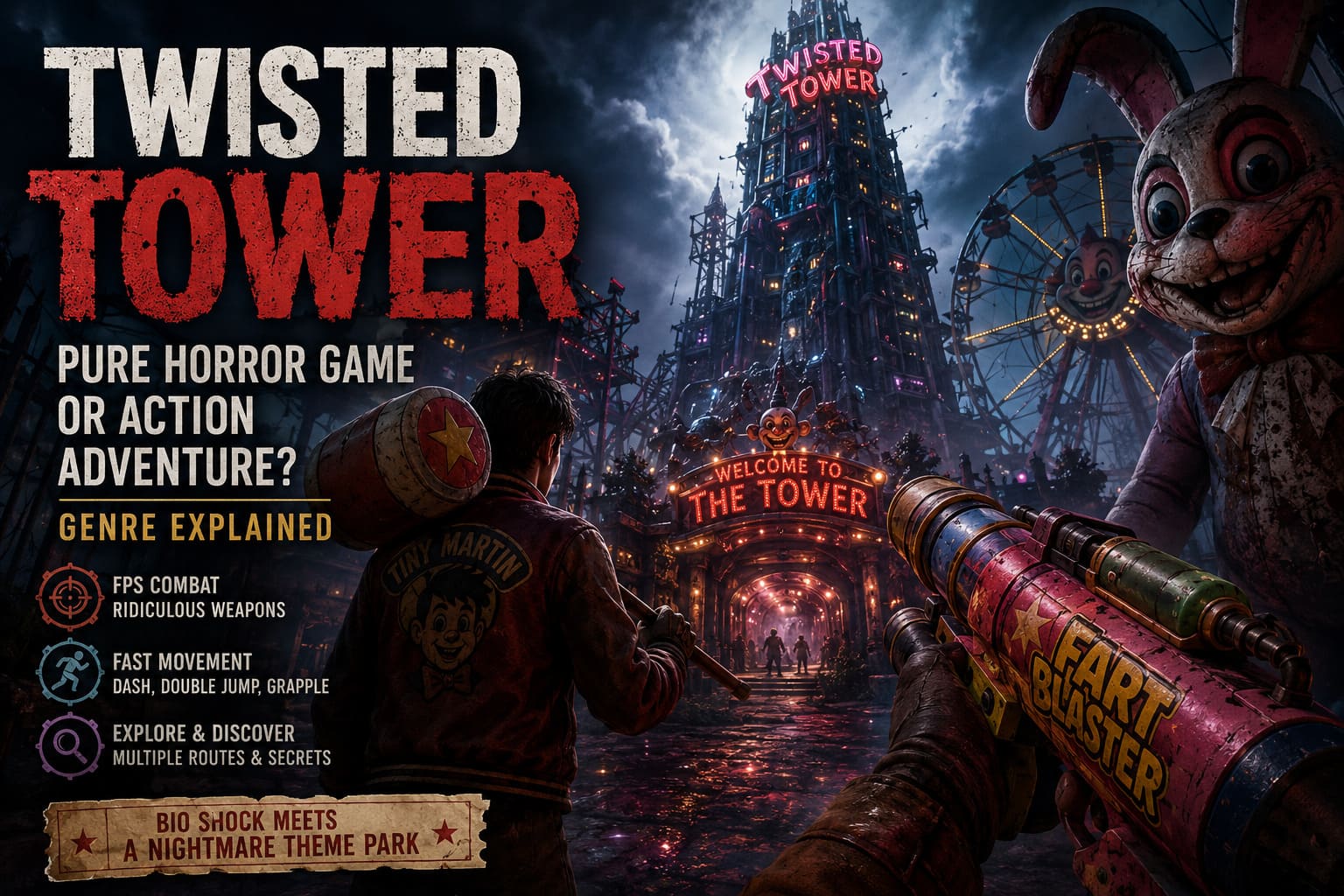
You play as Tiny Martin, a young man who receives a mysterious velvet ticket offering him access to an enormous tower hidden inside an abandoned 1950s amusement resort.
Tiny isn’t there simply because he enjoys getting chased by murderous mascots. He has a personal reason for climbing the tower: he wants to reach the top, win the ultimate prize, and hopefully win back Charlotte, the woman he loves.
Naturally, things don’t go according to plan.
The beautiful vacation attraction has become a grotesque nightmare, and the tower is filled with hostile versions of familiar fairy-tale and amusement-park characters. Instead of cheerful entertainment, Tiny gets traps, monsters, guns, blood, and a whole lot of very questionable decisions.
The tower itself is divided into several highly stylized areas:
| Area | What Makes It Stand Out |
|---|---|
| The Hotel | Decaying mid-century architecture and oppressive atmosphere |
| The Waterpark | Rusted attractions and unsettling aquatic environments |
| The Clown Casino | Neon lights, gambling imagery, and horrifying jesters |
| The Carnival Forest | Dark woodland paths filled with hidden threats |
| The Space Station | Retro-futuristic environments where reality gets increasingly strange |
That variety is important because Twisted Tower doesn’t seem interested in keeping you trapped inside one horror formula.
It wants to constantly throw something new at you.
Why I Wouldn’t Call Twisted Tower Pure Horror
This is where I think the genre discussion gets interesting.
When I hear “pure horror game,” I immediately think of games where vulnerability is the central mechanic. You’re weak, resources are limited, enemies are terrifying, and simply surviving an encounter can feel like an accomplishment.
Think about Outlast, Amnesia: The Dark Descent, or classic survival-horror design.
You hear something behind you.
You don’t have a shotgun.
You don’t have a super dash.
You don’t have an arsenal of ridiculous weapons.
You run.
That’s not really what Twisted Tower is doing.
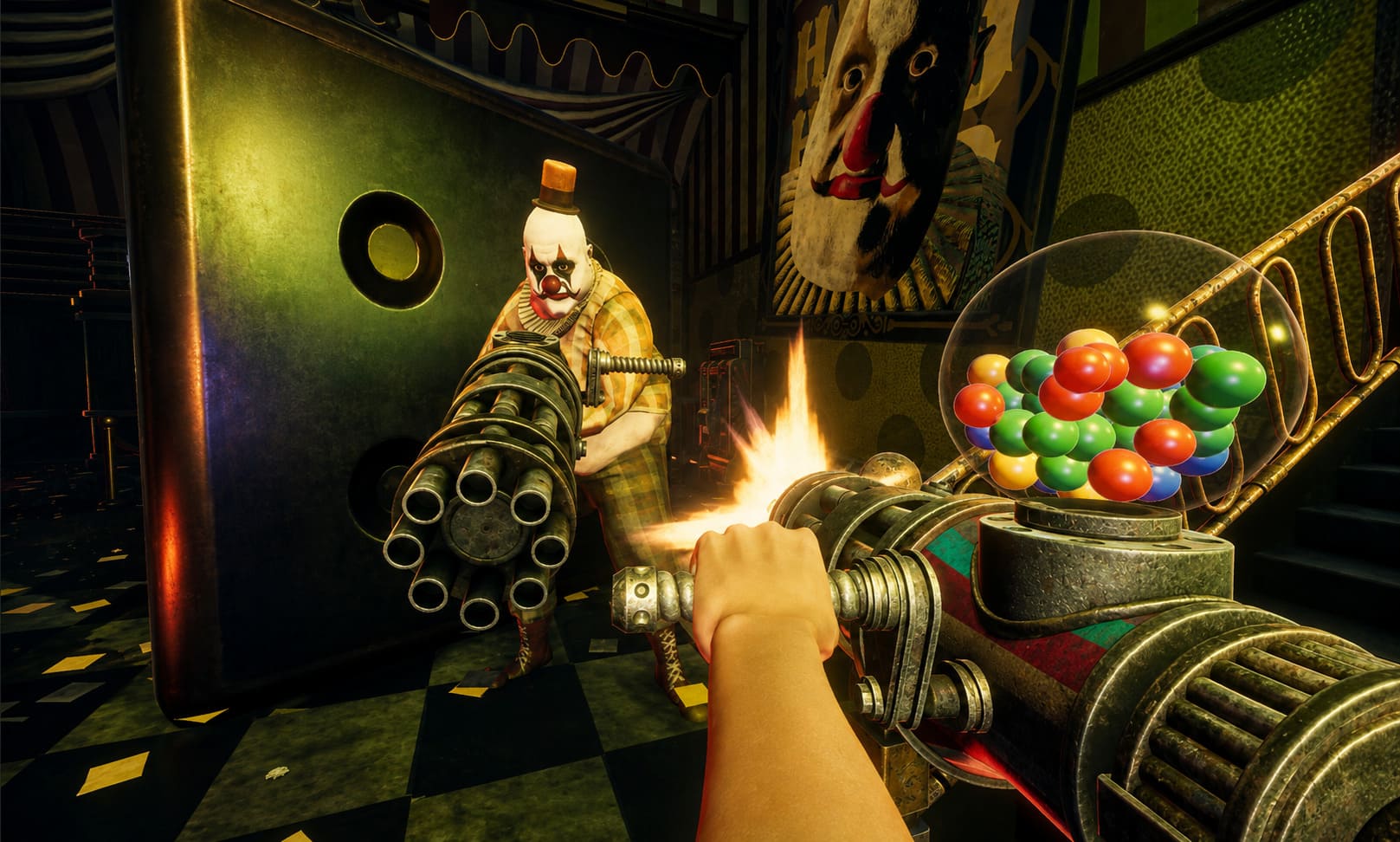
Here, the monsters aren’t simply obstacles that you desperately need to escape. They’re targets.
And Tiny has some wonderfully stupid-looking ways to deal with them.
The Weapons Change Everything
One of the biggest reasons Twisted Tower doesn’t fit comfortably into the pure-horror category is its weapon design.
The arsenal feels deliberately exaggerated, almost as if someone took a toy box, mixed it with a cartoon armory, and then asked what would happen if everything inside it could kill monsters.
Among the weapons showcased are things such as:
- A rubber-band pistol for accurate shooting.
- A massive whack-a-mole mallet for close-range combat.
- A ridiculous fart-powered shotgun capable of devastating blasts.
- A bubblegum machine gun designed for tearing through groups.
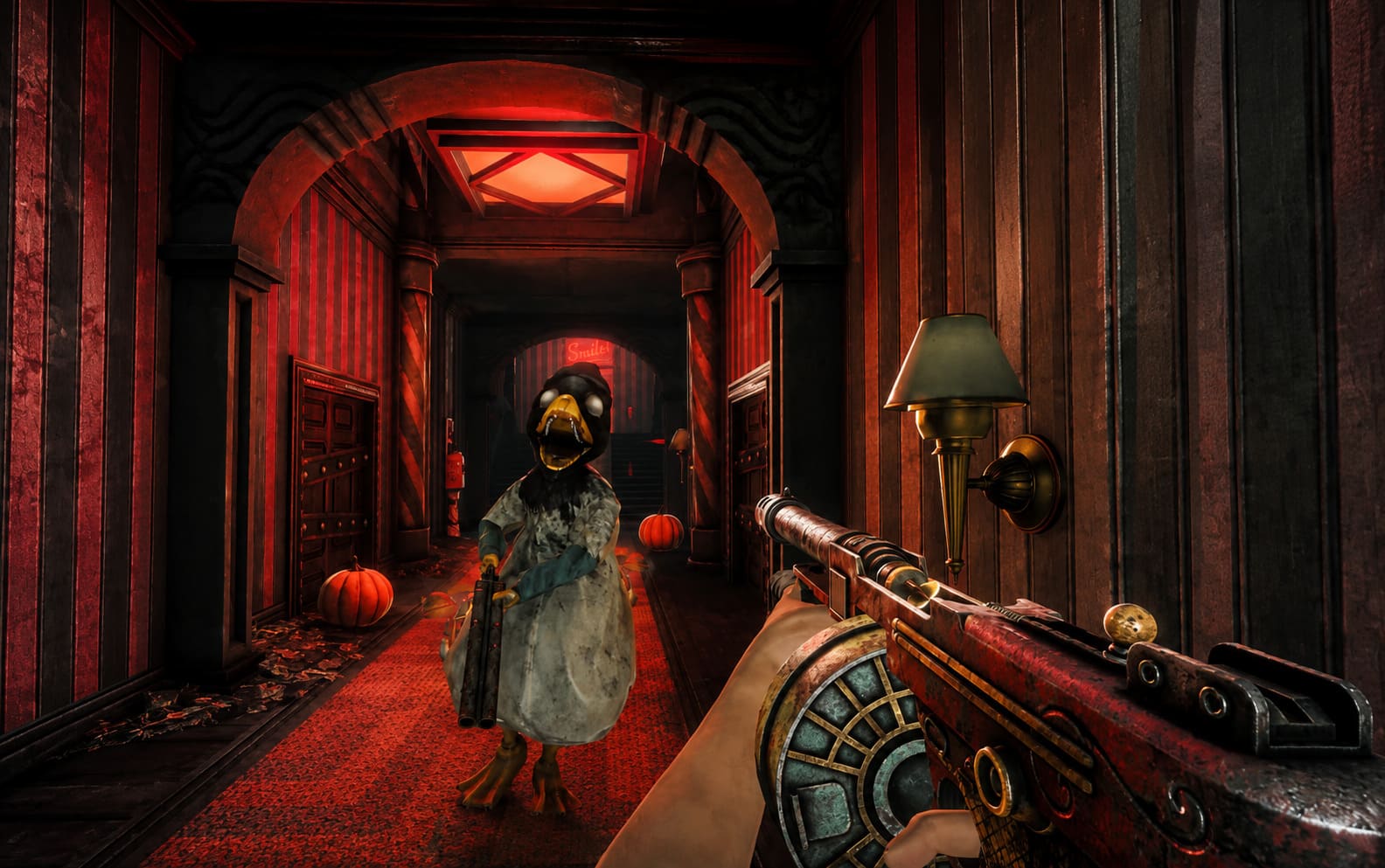
- A dart-firing Tommy Gun for rapid-fire encounters.
- A sniper slingshot for long-range attacks.
And then there’s the game’s wonderfully ridiculous attitude toward violence, with enemies producing what the developers refer to as “bloodfetti.”
That tells you a lot about the intended tone.
The game wants you to be disturbed by what you’re seeing, but it also wants you to laugh at it.
That’s a very different philosophy from psychological horror where the goal is to make you uncomfortable enough to stop playing.
Personally, I think that’s one of Twisted Tower’s strongest ideas.
Movement Makes It Feel More Like an FPS
The second major clue is movement.
In traditional horror, movement often exists to make you feel vulnerable. You might be slow, clumsy, or unable to fight. The environment works against you.
Twisted Tower gives you tools that do almost the opposite.
As you progress, Tiny can gain abilities that improve his mobility, including double jumping, dashing, and grappling.
That changes the entire rhythm of combat.
Instead of:
See monster → panic → run away
you get something closer to:
See monster → shoot it → dash through the room → grapple upward → discover another route → shoot something else.
That’s fundamentally action-game design.
And I’m glad the developers went this direction.
A horror aesthetic combined with fast movement can be incredibly satisfying when done correctly. You still get the creepy atmosphere, but you aren’t forced to spend half the game hiding underneath furniture.
It Also Has Strong Action-Adventure DNA
Calling Twisted Tower an FPS is accurate, but even that doesn’t completely describe it.
The game also puts significant emphasis on exploration.
The tower isn’t simply a collection of shooting arenas connected by loading screens. The environments encourage you to look around, investigate strange attractions, find alternative routes, and uncover secrets.
That gives the game a distinctly action-adventure flavor.
You aren’t just asking:
“Where is the next enemy?”
You’re also asking:
“What’s behind that door?”
“Can I reach that platform?”
“Is there another way through here?”
“What did I just find?”
That sense of curiosity is important.
For me, some of the most memorable games aren’t the ones with the best combat systems. They’re the ones that make me want to explore a suspicious-looking hallway simply because I know something weird is probably waiting at the end of it.
Twisted Tower appears to understand that instinct.
The Immersive Sim Influence Is Easy to See
Another reason the game is difficult to classify is its relationship with immersive sim design.
The emphasis on multiple routes, environmental interaction, exploration, mobility, and player choice pushes it beyond a straightforward corridor shooter.
The player isn’t necessarily expected to approach every situation in exactly the same way.
You can focus on combat, explore for secrets, use movement abilities to reach unusual areas, and interact with the environment to uncover more of the world.
That’s where the BioShock comparison starts making much more sense.
It isn’t because Twisted Tower is simply copying BioShock.
It’s because both games understand the appeal of placing players inside a bizarre, hostile environment and letting them poke around until something interesting happens.
So Where Does the Horror Actually Come In?
If the mechanics scream FPS and action-adventure, why does Twisted Tower look so horrifying?
Because horror is the game’s identity, even if it isn’t the game’s primary mechanical genre.
That’s an important distinction.
The horror is everywhere in the presentation.
The environments take nostalgic ideas associated with childhood entertainment and corrupt them into something threatening. Bright colors, smiling mascots, carnival attractions, fairy-tale imagery, and old-fashioned resort aesthetics are transformed into disturbing versions of themselves.
This is the same basic appeal behind the modern mascot-horror trend.
Something that should be friendly becomes horrifying.
And that contrast is often more effective than simply putting a monster in a dark corridor.
A smiling mascot standing motionless in a brightly lit amusement park can sometimes be much creepier than a monster hiding in complete darkness.
The Story Could Be Darker Than the Gameplay Suggests
There is also a more serious layer underneath all the absurdity.
Tiny’s journey isn’t just about winning a game show.
The deeper he travels into the tower, the more the story begins to connect the strange world around him with his own history and buried memories.
That gives Twisted Tower a psychological dimension.
And this is where I think the developers can potentially strike a very interesting balance.
The player can be laughing at a ridiculous weapon one minute and discovering something genuinely disturbing about Tiny’s past the next.
That contrast can work extremely well.
In fact, I would rather have a game that occasionally surprises me with genuine darkness than one that spends ten straight hours trying to scare me with the same jump-scare formula.
Twisted Tower Genre Breakdown
If I had to categorize the game based on its overall design, I’d rank its genre identity roughly like this:
| Genre | Importance |
|---|---|
| First-Person Shooter | Core gameplay |
| Action-Adventure | Exploration and progression |
| Immersive Sim | Player freedom and environmental interaction |
| Horror | Atmosphere, story, enemies, and visual identity |
| 3D Platformer | Movement and traversal |
That doesn’t mean horror is unimportant.
Quite the opposite.
Horror is arguably the game’s personality.
But FPS and action-adventure mechanics appear to be its skeleton.
Twisted Tower Mallet Guide: Secret Uses & Max Toy Arsenal Upgrade Strategy
What Kind of Player Should Be Excited for Twisted Tower?
If you enjoy games that combine genres instead of staying inside one rigid formula, Twisted Tower looks particularly promising.
I’d especially recommend keeping an eye on it if you like:
- Fast first-person combat.
- Weird and creative weapons.
- Exploration with multiple routes.
- Dark comedy mixed with horror.
- Mascot-horror aesthetics.
- Platforming and movement abilities.
- Strange environments with hidden secrets.
- Stories that gradually reveal darker personal mysteries.
On the other hand, if your ideal horror experience is one where you’re completely defenseless, constantly conserving resources, and hiding from enemies for most of the game, Twisted Tower probably isn’t that game.
And that’s perfectly fine.
Twisted Tower Lore Explained: Dark Secrets of the Past & Ending Explained
My Final Verdict: It’s Horror-Flavored Action, Not Pure Horror
After looking at the bigger picture, I think the best way to describe Twisted Tower is as an atmospheric first-person action-adventure shooter with strong horror and immersive-sim elements.
Calling it simply a horror game undersells the combat.
Calling it simply an FPS ignores the exploration.
Calling it simply an action-adventure game ignores just how deeply horror is embedded into its world and story.
The most accurate description is probably somewhere in the middle.
Twisted Tower is an action game wearing a horror costume.
And personally, that’s what makes me want to play it.
I love horror games, but I’ve reached the point where another game consisting entirely of walking slowly through dark corridors doesn’t automatically excite me. Give me a bizarre amusement park, grotesque mascots, ridiculous weapons, movement abilities, secrets, and a story that might actually get surprisingly dark, and now you’ve got my attention.
The combination of creepy nostalgia and explosive arcade-style combat is unusual enough to stand out.
So, is Twisted Tower a pure horror game?
No.
Is horror a major part of its identity?
Absolutely.
If anything, the game’s biggest appeal may be that it lets you experience the atmosphere of a nightmare without taking away your ability to fight back.
You aren’t the helpless victim trapped inside the tower.
You’re the lunatic with a bubblegum machine gun trying to climb it.
And honestly, that sounds like a pretty good time.