The Mermaid Mask Full Game Walkthrough: How to Solve Every Puzzle and Find the Killer
I’ve played detective adventures for years, from old-school point-and-click classics to modern narrative mysteries, and very few games manage to balance puzzle-solving with believable investigations. The Mermaid Mask immediately reminded me why I enjoy this genre so much. Instead of simply collecting clues until the game hands you the answer, it constantly asks you to think like an investigator. Every conversation, environmental detail, and puzzle feels connected to the larger mystery.
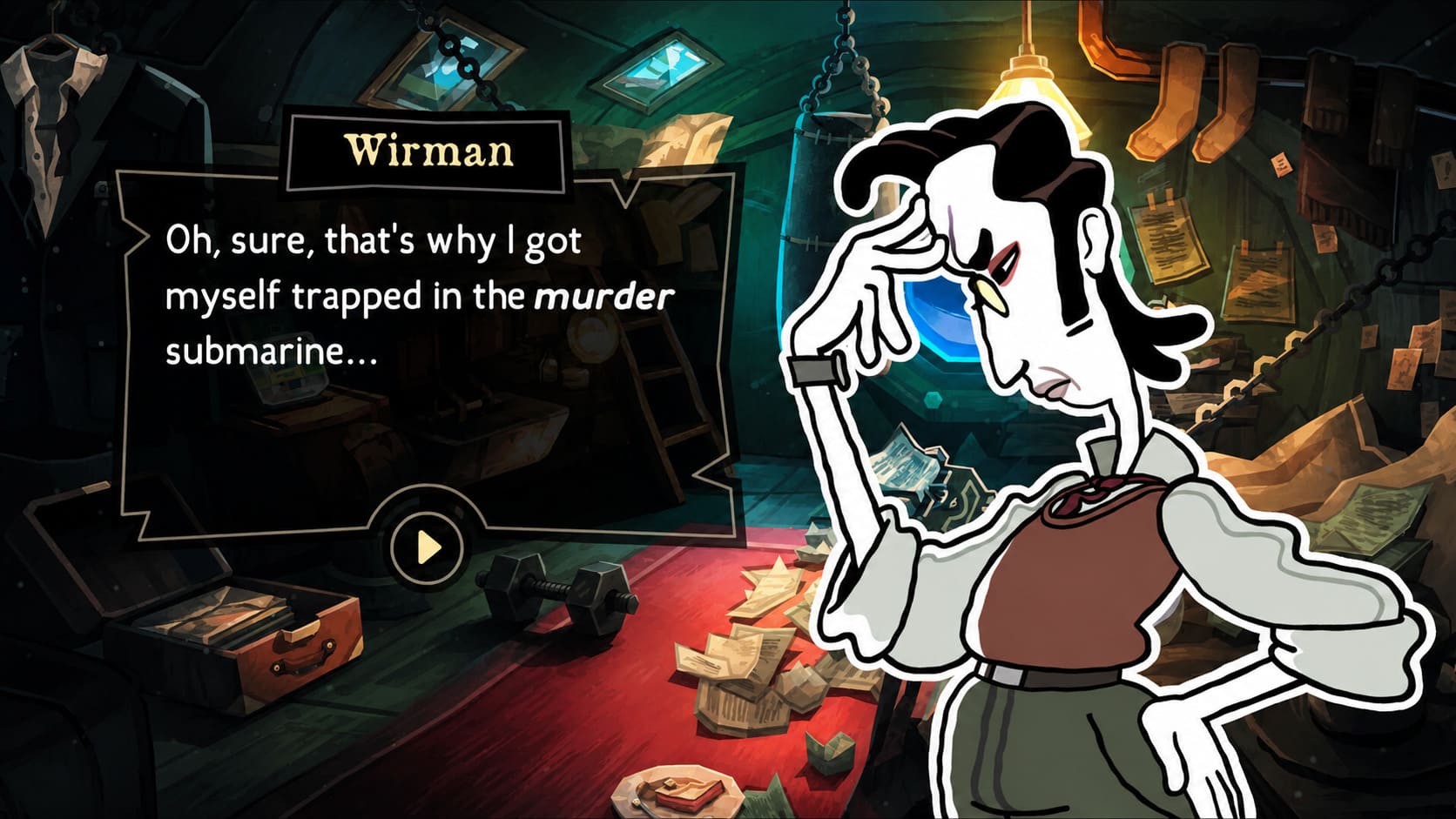
Developed by SFB Games, the creators behind several memorable mystery adventures, this new detective story places Detective Grimoire and Sally Spears into what initially appears to be an impossible murder. Captain Magnus Mortuga has been found dead inside a completely sealed room aboard the mysterious Mortuga Submarine. Naturally, everyone begins talking about curses, ancient artifacts, and impossible events. As someone who has seen countless detective games rely on supernatural twists, I appreciated that The Mermaid Mask encourages players to question everything before accepting the obvious explanation.
If you’re looking for a walkthrough without spending hours wandering around the submarine or repeatedly guessing puzzle solutions, this guide covers the major investigation flow while also sharing a few strategies that genuinely helped me throughout my playthrough.
First Impressions
Before stepping onto the submarine itself, the game spends a little time establishing the atmosphere at the Stonetop Inn. It may seem like a slow introduction, but I wouldn’t recommend rushing through it.
This opening section quietly teaches nearly every important mechanic you’ll use later.

- Inspecting environmental objects
- Reviewing case information
- Tracking suspects
- Listening carefully to conversations
- Learning how Detective Grimoire and Sally approach investigations differently
Many players instinctively skip optional interactions during tutorials, but in this case they’re surprisingly valuable because the game expects you to pay close attention later.
Getting Started at the Stonetop Inn
The investigation officially begins inside your room before you’ve even met the crew.
I recommend checking every interactive object rather than immediately leaving.
The fantasy novel lying near Sally doesn’t seem important at first, but it establishes the playful tone SFB Games is known for.
The real priority is opening the Case File. This quickly explains who hired you, what happened aboard the Mortuga Submarine, and why the murder appears impossible.
Another feature you’ll constantly rely on is the notebook. Throughout the entire adventure it becomes your best friend, storing:
| Investigation Feature | Why It Matters |
|---|---|
| Character Profiles | Keeps track of everyone aboard the submarine. |
| Timeline | Helps identify contradictions. |
| Evidence | Organizes discovered clues. |
| Linked Statements | Reveals inconsistencies between testimonies. |
One habit I developed early was reopening the notebook after every major conversation. New information appears frequently, and it’s surprisingly easy to miss a small contradiction that later becomes essential.
Talking to Every Suspect Actually Matters
One of my favorite aspects of The Mermaid Mask is that conversations rarely feel like filler.
Unlike many detective games where dialogue simply unlocks the next objective, almost every suspect reveals something useful—even if they aren’t intentionally helping you.
There are eight primary crew members aboard the submarine, each with distinct personalities and believable motives.
Instead of rushing toward accusations, I found it much more effective to follow a consistent investigation routine.
My preferred interrogation order looked like this:
- Ask every available introductory question.
- Listen for timeline details.
- Compare their statements with previous interviews.
- Present evidence only after exhausting normal dialogue.
The game rewards patience.
If you randomly present inventory items, you’ll often receive amusing responses, but your investigation won’t actually progress.
Another clever touch is the animation system. Characters subtly change posture whenever a sensitive subject comes up. Sometimes it’s nothing more than folded arms, a hesitant glance, or an awkward pause, but those visual cues often signal that you’re approaching an important contradiction.
How I Solved the Hardest Puzzles
The puzzles deserve special praise because they rarely rely on obscure logic.
Most of them become surprisingly manageable once you stop thinking about brute force and instead observe your surroundings.
The Mechanical Pig Lock
This was probably the first puzzle that made me stop and actually think.
Initially I assumed the facial expressions were random, but they’re connected to clues hidden elsewhere aboard the submarine.
The solution involves adjusting:
- The eyes.
- The ears.
- The rotating snout.
Once everything aligns correctly, the hidden compartment opens, rewarding you with both a useful key and an old photograph that becomes relevant much later.
Rather than guessing combinations, pay attention to nearby journals and notes.
The Skull Arrangement Puzzle
This section initially looks intimidating because of the number of unique skull designs.
Fortunately, there’s an underlying pattern.
The decorative carvings around the puzzle frame aren’t simply decoration—they’re the actual instructions.
After realizing that, the solution became much more logical.
The outer positions should contain the horned skulls, while the central pieces need to face toward the golden centerpiece.
When everything is positioned correctly, the cabinet underneath finally unlocks.
Mushroom Classification
This puzzle felt refreshingly different.
Instead of matching symbols or rotating gears, you’re organizing biological specimens.
Three characteristics matter.
| Category | What To Watch For |
|---|---|
| Pattern | Spotted or striped caps. |
| Size | Smallest to largest. |
| Color | Verified with the analyzer. |
One detail I really appreciated is that Detective Grimoire and Sally subtly comment whenever you’re close to the correct solution.
Rather than outright telling you the answer, they gently point you toward the mistake.
It’s one of those small design decisions that keeps the puzzle satisfying without becoming frustrating.
Serpent Statue Lock
This is probably the most mechanical puzzle in the game.
You’ll discover a large sea serpent statue blocking access to the lower deck.
Its built-in cabinet contains four rotating dials.
The displayed sequence is 3 – 9 – 7 – 4.
This doesn’t represent the dial positions themselves.
Instead, it refers to the number of intersecting geometric lines that must appear inside each viewing window.
That distinction confused me initially.
Once I understood what the puzzle was actually asking, the solution became much more straightforward.
Investigating the Locked Room
Eventually you’ll reach what is arguably the most important location in the game.
The Cauldron Room immediately stands out because almost everything inside raises additional questions instead of providing answers.
I spent quite a while examining every corner before moving on, and I’m glad I did.
Several pieces of evidence are easy to overlook.
Don’t miss these discoveries:
- The door sealed from the inside.
- The enormous stone cauldron.
- Deep scratch marks inside the basin.
- The weathered wooden doll floating nearby.
The scratch marks especially caught my attention.
At first they appear insignificant, but they’re one of those clues that quietly reshape your understanding of the crime scene.
The wooden doll also becomes far more important later than it initially seems.
Like many great detective games, The Mermaid Mask enjoys introducing evidence long before revealing why it matters.
Connecting Contradictions
One mechanic that genuinely impressed me was the notebook’s ability to connect conflicting testimonies.
Instead of forcing players to memorize every conversation, the game lets you establish logical links between statements.
However, it doesn’t automatically solve the mystery for you.
You still need to recognize why those contradictions matter.
This creates a satisfying balance between accessibility and genuine detective work.
I often found myself reviewing conversations several times before making new connections.
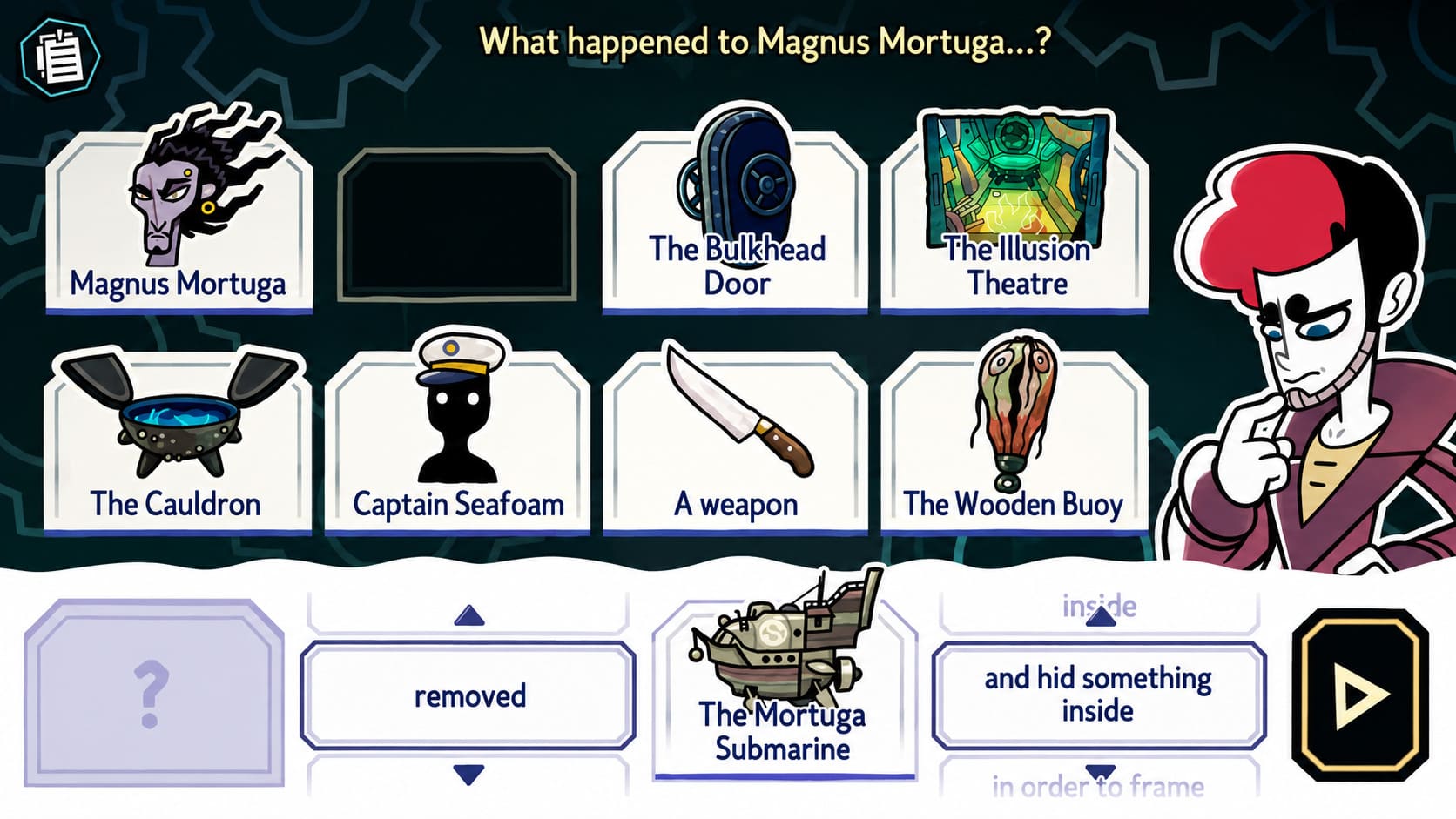
Understanding the Deduction System
Eventually the investigation reaches its final reasoning phase.
Rather than asking a single multiple-choice question, the game requires you to construct complete deductions.
You’ll fill in missing sections of logical statements using:
- Suspects.
- Locations.
- Evidence.
- Murder method.
- Escape route.
This mechanic works surprisingly well because it forces you to understand the entire sequence of events rather than simply identifying the killer.
The final deductions generally revolve around three central questions.
| Question | Evidence Needed |
|---|---|
| Who committed the murder? | Broken alibi and witness contradictions. |
| What caused the fatal injury? | Physical weapon matching the wound. |
| How was the locked room created? | Environmental clues and hidden passageways. |
I strongly recommend resisting the temptation to guess.
The game is much more rewarding when every answer comes from evidence you’ve personally connected.
The Mermaid Mask Review: Platforms, Release, and Gameplay Analysis
Tips That Made My Investigation Easier
After finishing the game, there are several habits I’d recommend to anyone starting their first playthrough.
- Always inspect rooms twice. New dialogue frequently unlocks fresh interactions with previously examined objects.
- Don’t ignore optional conversations. Some of the funniest exchanges also hide surprisingly useful hints.
- Use the notebook constantly. Waiting until you’re stuck usually means you’ve forgotten an important contradiction.
- Study the environment before solving puzzles. Nearly every major puzzle includes visual clues nearby.
- Think like a detective instead of a gamer. If something feels impossible, there’s almost always a logical explanation hiding underneath the supernatural rumors.
Final Thoughts
After completing The Mermaid Mask, I came away impressed by how confidently it handles detective storytelling. It never relies on endless item combinations or unfair puzzle design, and it trusts players to pay attention instead of constantly pointing them toward the next objective.
The investigation aboard the Mortuga Submarine remains engaging because every new clue changes your perspective on the previous ones. The locked-room mystery is carefully constructed, the suspects are memorable without becoming caricatures, and the environmental puzzles feel integrated into the narrative rather than existing as random obstacles.
For me, the biggest strength of the game is its pacing. There are moments of quiet exploration, tense interrogations, satisfying puzzle-solving, and dramatic deductions, all blended together in a way that rarely feels repetitive. Even after years of playing detective adventures, I found myself second-guessing my theories several times before finally reaching the truth.
If you enjoy mystery games where observation matters more than luck, and where every clue contributes to a larger picture, The Mermaid Mask is well worth experiencing. My biggest advice is simple: take your time, question everyone, inspect everything, and never assume the first explanation is the correct one. Like every great detective story, the truth is hiding in the details.