Halloween The Game 2026 NPC Civilian Commands Guide: How to Rescue Haddonfield Residents
If there is one thing I love about a good asymmetrical horror game, it is when the developers give survivors more to worry about than simply running from the killer. Halloween: The Game takes that idea and pushes it into a much more interesting direction by filling Haddonfield with AI-controlled civilians who can become victims, distractions, liabilities, or even an important part of your survival strategy.
Set in the terrifying world of 1978 Haddonfield, the game puts survivors against Michael Myers in a 1v4 horror setup that will feel familiar to fans of games such as Friday the 13th: The Game and Texas Chain Saw Massacre. But the civilian system gives the match a different rhythm. You are not just repairing objectives, searching for useful items, or trying to stay alive. You are also dealing with ordinary people who have absolutely no idea what is coming.
And honestly, that sounds chaotic in exactly the right way.
A strong survivor player should eventually stop thinking of NPC civilians as background decoration. They are part of the battlefield. Understanding how to warn them, move them, hide them and send them toward safety can make a huge difference during a match. If you want to become one of Haddonfield’s real heroes, learning the NPC civilian commands in Halloween: The Game should be near the top of your list.
Halloween The Game Survivor Stealth Tips: How to Outsmart Michael Myers
Why NPC Civilians Matter in Halloween: The Game
Haddonfield feels much more alive when the streets are populated with AI characters. Instead of running through an empty neighborhood where every person you encounter is another player, you can discover civilians inside houses, standing around vehicles, walking through streets, or simply going about their evening as if Michael Myers isn’t about to turn the entire neighborhood upside down.
That contrast is what makes the system work so well from a horror perspective.
At the beginning of a match, many civilians are completely unaware of the danger. They follow their normal routines and do not immediately respond to your attempts to move them around. Once Michael enters the picture, however, everything changes. Civilians can panic, flee, hide, scream and become potential targets for the killer.
For survivors, this creates another layer of responsibility. You might be trying to find supplies while simultaneously hearing Michael somewhere nearby. You may have just found a civilian when the killer appears at the end of the street. Suddenly, your original plan is irrelevant and you have to decide whether to hide, run, split the group or risk an escort through dangerous territory.
That unpredictability is where the civilian mechanic gets interesting.
The Basic Civilian Command System
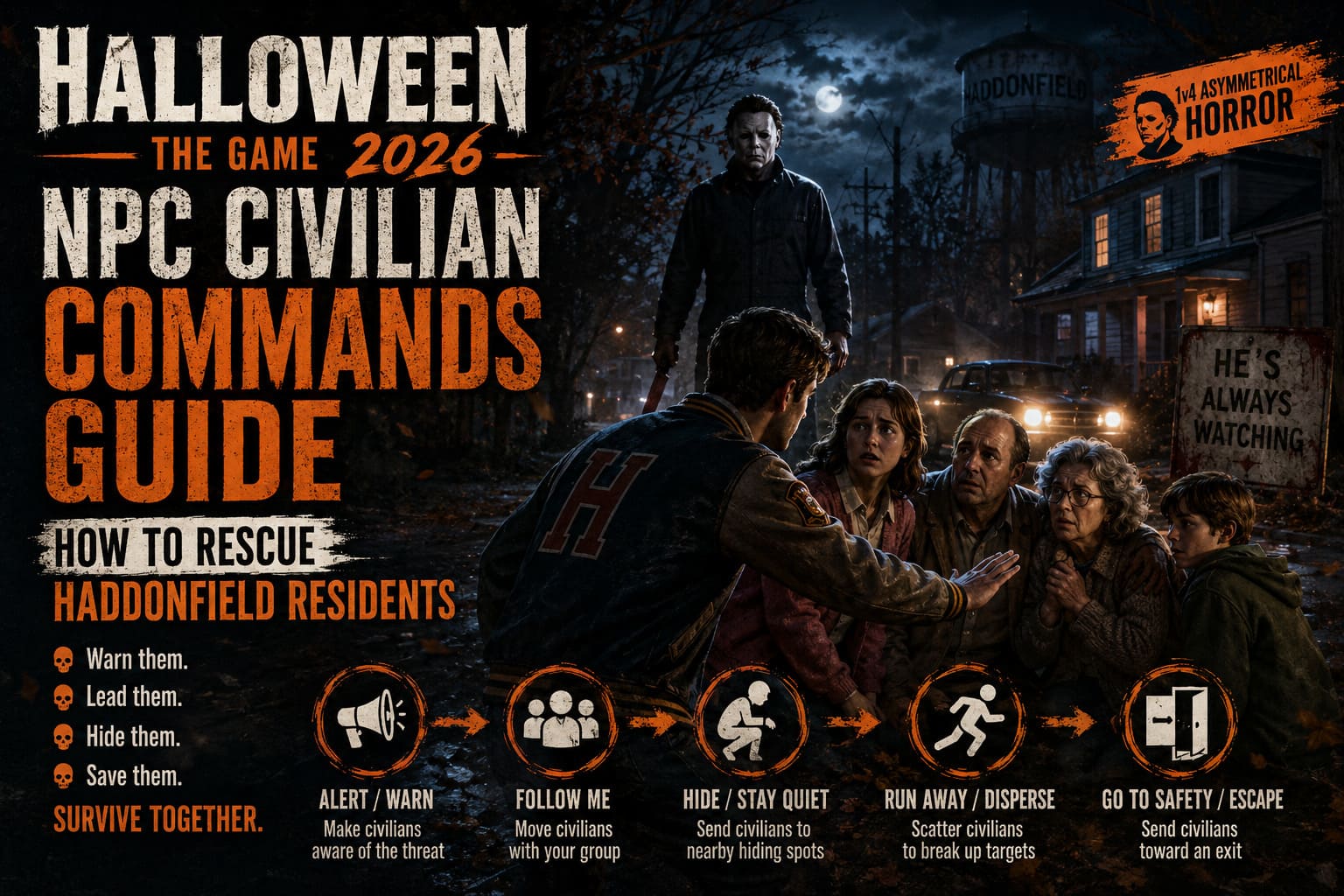
The civilian interaction system revolves around contextual commands and a communication wheel designed for quick decisions. When you approach an NPC, available interactions can appear depending on their current state and your surroundings.
The important thing is not simply memorizing every command. You need to understand when each command makes sense.
| Command | Main Purpose | Best Used When |
|---|---|---|
| Alert / Warn | Makes the civilian aware of the threat | When first approaching an unaware NPC |
| Follow Me / Group Up | Moves civilians with your character | When escorting civilians toward a safer location |
| Hide / Stay Quiet | Sends civilians toward nearby hiding places | When Michael is approaching |
| Run Away / Disperse | Separates civilians from one another | During an ambush or dangerous encounter |
| Go to Safety / Escape | Sends civilians toward an available exit | When an extraction route is open |
Knowing the commands is easy. Using them without getting everyone killed is the real challenge.
1. Alert or Warn: Wake Them Up Before You Move Them
The Alert / Warn command is basically the starting point for civilian management.
An unaware NPC is not necessarily going to cooperate with you simply because you want them to. If the character is still following their normal routine, your first priority is making them understand that something is seriously wrong.
Once alerted, the civilian can transition into a more frightened state and become responsive to additional commands.
This sounds simple, but I can already imagine players making the classic mistake of running into a house, grabbing an NPC and immediately trying to drag them across the map without preparing them first. In a horror game, that is basically asking for an AI meltdown.
Treat the Alert command as the moment where the rescue actually begins.
2. Follow Me: The Most Useful Command for Rescue Runs
Follow Me / Group Up is probably the command you will use most during organized civilian rescues.
Once a civilian is willing to follow, they attempt to stay with your character while you move through Haddonfield. That allows you to take an NPC away from danger and potentially bring several civilians toward an escape location.
There is a major downside, though: more people means more noise and more risk.
Moving a group of civilians through the neighborhood can turn a quiet rescue into a giant neon sign saying, ‘Michael, we’re over here.’
I would strongly recommend avoiding unnecessary sprinting when you have multiple civilians behind you. If the area is relatively safe, take the longer route if it keeps the group away from obvious danger zones.
You also need to keep checking behind you. A civilian falling several meters behind can quickly become an easy target, and once you realize someone is missing, going back for them may put the entire group in danger.
3. Hide or Stay Quiet: Sometimes Doing Nothing Is the Smartest Move
This is where civilian management starts feeling like an actual survival-horror mechanic rather than a simple escort mission.
If Michael is nearby, Hide / Stay Quiet can be far more useful than Follow Me.
Civilians may look for nearby hiding places, potentially using locations such as closets, beds, furniture or outdoor cover. The basic idea is to reduce their visibility and keep their panic from becoming an obvious signal for Michael.
The biggest mistake is waiting until Michael is already standing in front of you.
If you hear his presence nearby or realize the area is becoming dangerous, consider hiding the civilians before the killer reaches your position.
That extra few seconds can be the difference between a clean escape and watching your entire rescue operation collapse.
A good survivor isn’t always the fastest player. Sometimes the best play is crouching in a dark room and doing absolutely nothing until the danger passes.
4. Run Away or Disperse: Break the Killer’s Options
When everything goes wrong, Run Away / Disperse becomes your emergency button.
Imagine you have several civilians following you through the neighborhood when Michael suddenly appears. Trying to keep everyone together might sound heroic, but it can also create a perfect target-rich environment.
Ordering civilians to disperse forces them to scatter instead of remaining in one convenient group.
That creates a difficult decision for Michael. The killer can pursue one target, but cannot instantly be everywhere at once. If your teammates are positioned correctly, this can give some civilians enough time to escape while the killer is distracted.
Of course, dispersing isn’t automatically safe. You are sacrificing control for survival.
I would use this command when the group is already compromised and staying together is more dangerous than splitting apart. If you still have time to reach a secure hiding location, hiding is usually the cleaner option.
5. Go to Safety: Know When to Stop Babysitting
Once an escape route becomes available, the Go to Safety / Escape command becomes extremely valuable.
If you have opened an extraction point, prepared a getaway vehicle, or created another viable route out of the area, you can direct civilians toward safety rather than personally escorting every single one of them.
This is where efficient teams can gain a serious advantage.
One survivor can take responsibility for civilians while another teammate continues working on objectives or prepares another escape route. Once the civilians are sent toward safety, the escorting player is free to return to the neighborhood.
That creates a much better gameplay loop than having the entire team babysit the same group of NPCs.
The trick is knowing whether the route is actually safe. Sending civilians toward an escape point without checking the surrounding area can turn a successful rescue into a delivery service for Michael Myers.
Managing Panic Is Just as Important as Managing Movement
Civilian AI is not simply about pressing commands. Their emotional state matters.
A civilian who has witnessed a murder or spent too much time being chased can become increasingly panicked. A terrified NPC may scream, freeze or become harder to control, creating additional problems for nearby survivors.
This is one reason why experienced players should pay attention to the civilian’s condition rather than treating them like another objective marker.
If an NPC is becoming hysterical, stop pushing forward blindly.
Look for a quiet area. Put distance between the civilian and Michael. Use appropriate items or interactions if available to help stabilize the situation. A few seconds spent calming things down can prevent a much larger disaster later.
Don’t Turn Every Rescue Into a Convoy
One of my biggest pieces of advice is simple: you do not need to rescue everyone at the same time.
It is tempting to gather three or four civilians and create one giant rescue operation. It feels efficient. It also makes you incredibly easy to track.
A huge civilian group can generate more noise, occupy more space and become harder to protect when Michael shows up.
Smaller rescue groups are often easier to manage.
You might rescue one civilian, move them to a safe location, then return for another. This is slower on paper but can be considerably safer depending on the match.
The right strategy depends on the killer’s location, your team’s resources and how open the escape route is.
Use Your Teammates as the Distraction Crew
If you are trying to escort civilians across Haddonfield, do not assume the entire job belongs to you.
Communication with teammates becomes extremely important.
One player can escort civilians while another creates a distraction. Vehicles, alarms, thrown objects and other environmental interactions can potentially draw attention away from your rescue route. If Michael catches up, another survivor may be able to stun or interrupt him long enough for the civilian group to get moving again.
This is where Halloween: The Game can become much more entertaining than a basic hide-and-seek match.
One player is running for their life. Another is desperately trying to keep NPCs together. A third is creating a distraction. Meanwhile, someone else is probably yelling over voice chat because Michael is suddenly behind everyone.
That is the kind of multiplayer horror chaos I want.
Common Civilian Rescue Mistakes
There are a few habits that can ruin an otherwise good rescue attempt.
Ignoring the Alert command is an obvious one. If the civilian is unaware of the threat, trying to force them into your plan can waste valuable time.
Keeping everyone together for too long is another problem. A large group may look impressive, but it can also make your team extremely predictable.
Waiting until Michael is visible before using Hide is probably the most painful mistake. Once the killer is already on top of your group, your options shrink dramatically.
And finally, sending civilians toward an escape point without checking it first can be disastrous. An extraction zone is only useful if your team can actually defend the route.
A Simple Rescue Strategy for New Players
If you are completely new to the civilian system, don’t overcomplicate it.
Start by finding a nearby NPC and using Alert / Warn. Once they understand the danger, decide whether the area is safe enough for Follow Me.
Keep your route short and avoid unnecessary noise. If Michael approaches, stop trying to be a hero and use Hide / Stay Quiet if there is enough time. If the situation collapses and the group is already exposed, Disperse can give at least some civilians a chance to escape.
Once a safe extraction route is available, use Go to Safety and move on to the next objective.
That basic loop is surprisingly effective:
Alert → Move → Hide when necessary → Disperse during emergencies → Escape when possible.
After a few matches, you will naturally start making those decisions without thinking about them.
Why the Civilian Mechanic Could Become a Big Part of the Meta
The most interesting thing about this system is that it adds another resource to the match: human attention.
You cannot personally control everything happening in Haddonfield. You have objectives to complete, items to find, teammates to support and a killer actively looking for opportunities. Civilians force you to decide what deserves your attention right now.
That creates genuine risk-versus-reward decisions.
Do you save an NPC or continue repairing an objective? Do you hide civilians and lose time, or sprint toward the exit and risk attracting Michael? Do you keep everyone together or split the group? Do you personally escort someone or trust them to reach safety?
Those choices are far more interesting than simply pressing another generator button.
Final Thoughts
The NPC civilian system in Halloween: The Game has the potential to become one of the most memorable parts of the experience. Michael Myers is obviously the star of the nightmare, but the civilians make Haddonfield feel like a place worth protecting rather than just another multiplayer map.
If you want to survive consistently, learn to think beyond your own character. Alert civilians before giving them orders, keep groups manageable, use hiding spots before the killer arrives, disperse when an ambush becomes unavoidable, and take advantage of escape commands whenever a safe route opens.
Most importantly, don’t treat civilians like disposable NPCs. If the game rewards successful rescues, protecting them can become a meaningful part of your team’s overall strategy rather than an optional side activity.
And let’s be honest: there is something incredibly satisfying about getting a terrified group of Haddonfield residents through the night while Michael Myers is somewhere behind you doing his best Boogeyman impression.
The streets may belong to Michael after dark, but that doesn’t mean survivors have to hand him the whole neighborhood.