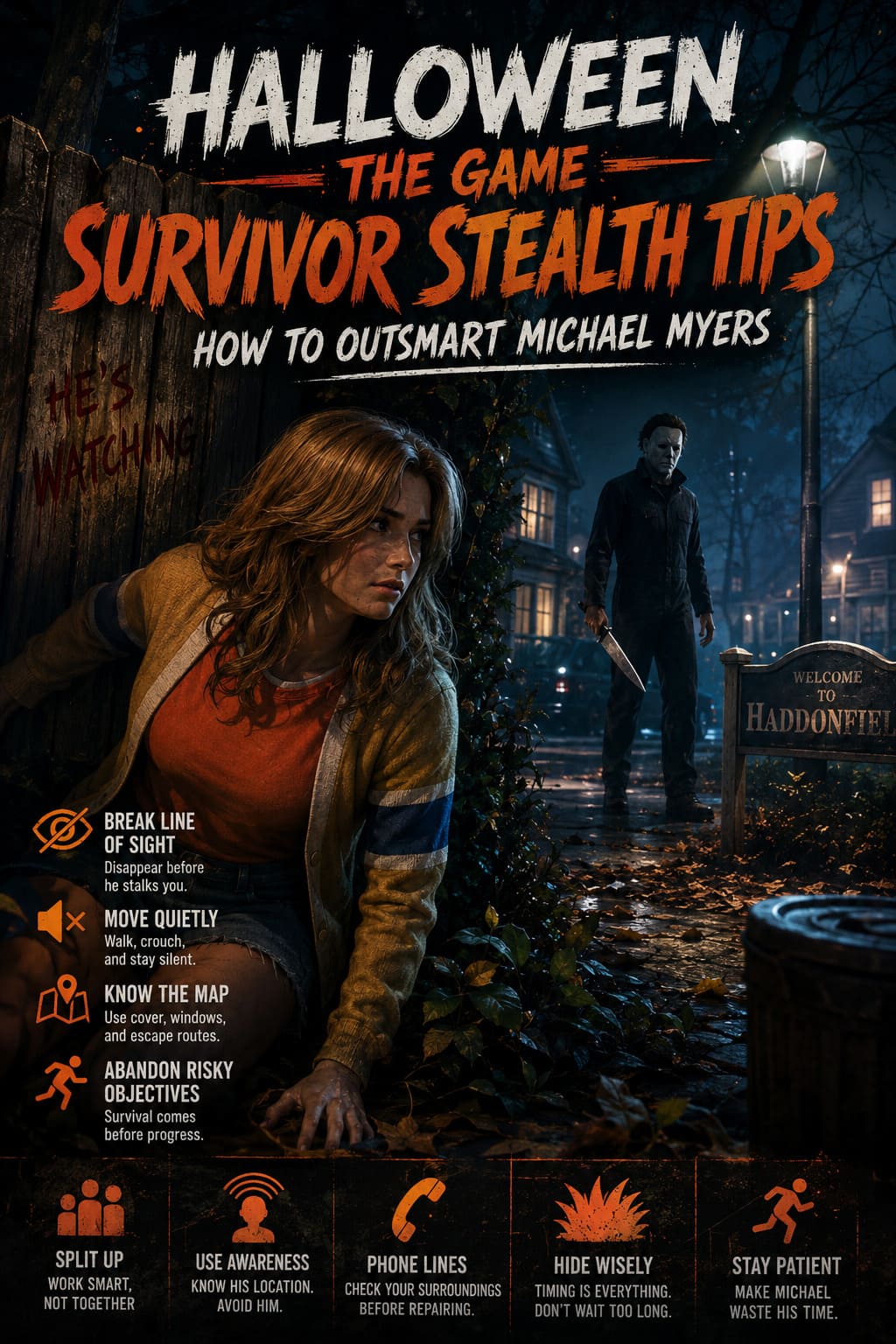
Halloween The Game Survivor Stealth Tips: How to Outsmart Michael Myers
Halloween: The Game takes the classic slasher formula and turns it into a brutal 1v4 survival experience where confidence can get you killed faster than almost anything else. Playing as an ordinary Civilian in Haddonfield, you are not equipped to brawl with Michael Myers, and trying to play like a traditional action-game survivor is usually a one-way ticket to the respawn screen.
What makes the game interesting is that survival is less about being faster than Michael and more about being smarter than him. After spending time with asymmetrical horror games, I can already say that this is the kind of game where the player who stays calm usually has a much better chance than the player who immediately starts sprinting around the map. Noise, visibility, positioning, and timing are your real weapons.
If you want to consistently escape Haddonfield, you need to start thinking like prey. That sounds terrible, but it is actually the secret to winning. Michael wants you to panic, make noise, run through open streets, and reveal your position. Give him none of that.
Halloween The Game All Maps List: Every Confirmed Location by IllFonic
1. Stop Sprinting Everywhere
The first habit I would break as a new Civilian is constantly holding the sprint button. It feels natural because every horror game teaches us that distance equals safety, but Halloween: The Game punishes reckless movement much harder. Sprinting creates noise and makes your movement considerably easier for Michael to track.
Walking should be your normal method of travel when you are not in immediate danger. Crouch when you need to move through sensitive areas, approach buildings carefully, and think twice before crossing an exposed street just because it looks like the shortest route. A ten-second detour can be worth far more than saving a few seconds and announcing your location to the killer.
Inside houses, I especially recommend slowing down around windows, doors, and other obvious entry points. Michael players naturally watch these areas because they know survivors eventually have to pass through them. Your objective is not to move quickly; your objective is to remain unnoticed.
| Situation | Best Movement Choice | Why |
|---|---|---|
| Exploring a safe area | Walk | Keeps your noise profile low |
| Passing near a suspected danger zone | Crouch or walk | Reduces the chance of being detected |
| Michael has spotted you | Sprint | Create distance and immediately seek cover |
| Crossing an exposed area | Move carefully | Avoid becoming an easy visual target |
2. Breaking Michael’s Line of Sight Is Everything
Michael Myers is terrifying for a very specific reason: he does not always need to chase you to become a problem. His stalking mechanics reward him for maintaining visual contact, meaning that standing in the wrong place for too long can make the situation dramatically worse.
When you realize Michael is watching you, do not stand there trying to figure out what he is doing. Break his vision immediately. The goal is to deny him the opportunity to continue building his advantage.
Running directly down a street is often the worst possible response. Instead, think laterally. Move behind a solid wall, duck behind a vehicle, disappear into dense vegetation, change buildings, or use the environment to create several layers between yourself and Michael.
This is one of those mechanics that becomes much easier once you stop thinking of the map as a collection of objectives and start treating it as a collection of defensive positions. Every wall can become cover. Every house can become a maze. Every corner can buy you another few seconds.
3. Don’t Let the Stalk Mechanic Snowball
Michael’s stalking ability is more than a spooky visual gimmick. Allowing him to observe you for too long can turn an already dangerous encounter into an absolute nightmare. Once he has gained enough information and power from stalking, your options become much more limited.
That means you should never intentionally let Michael stare at you simply because he is standing at a distance. I have seen this kind of mistake repeatedly in asymmetrical horror games: a survivor notices the killer, freezes for a moment, and essentially gives the killer free information.
If you suspect you are being stalked, assume you are in danger. You don’t need to confirm Michael’s intentions. Break the visual connection, relocate, and make him search for you again.
4. Split Up Without Completely Abandoning Your Team
There is a fine line between good teamwork and becoming one convenient target. Four survivors moving together might feel safe, but putting the entire team around one objective can give Michael an incredible opportunity to pressure everyone simultaneously.
Haddonfield gives survivors multiple objectives and points of interest, including residents who can become important to your overall plan. Instead of having everyone pile into the same house, consider dividing responsibilities between different parts of the map.
A strong team might have two players working around one objective while another pair searches for resources or prepares another escape option. Solo movement can also work for experienced players, but beginners should avoid wandering completely alone unless they have a clear reason to do it.
The important part is communication. Splitting up only works when everyone knows what everyone else is doing. If Michael appears on one side of town, the rest of the team should understand that they may have a short window to accomplish something elsewhere.
5. Treat Priority Residents as Strategic Objectives
The residents of Haddonfield are more than background characters. Their presence creates additional points of interest and forces survivors to think about how they approach objectives instead of simply rushing from one interaction to another.
When dealing with a priority resident, look at the bigger picture. Ask yourself where Michael is, which routes you can use to leave, and whether another survivor is creating pressure somewhere else. Completing an objective while standing in an obvious location with no escape plan is a classic horror-game mistake.
I prefer to approach these encounters with an exit already in mind. Before interacting with anything important, identify at least one nearby hiding location and one alternative escape route. If Michael suddenly appears, you don’t want your first thought to be, ‘Where do I run?’
6. Phone Lines Can Become Death Traps
Contacting the authorities is one of the most important steps toward getting out of Haddonfield, but communication objectives can also attract Michael’s attention. Phone lines can be damaged, forcing survivors to deal with another layer of map management before they can rely on them.
Never approach a damaged phone line and immediately start repairing it without checking your surroundings. Take a second to listen and look for signs that Michael may already be nearby. If you are playing with a team, having another player watch the surrounding area can make the interaction considerably safer.
If the location feels compromised, leave. Seriously. There is no prize for stubbornly repairing an objective while Michael is closing in. Sometimes the smartest move is to abandon the interaction, work on something elsewhere, and return when the killer has moved away.
7. Hiding Spots Are Tools, Not Magic Disappearing Buttons
Closets, bushes, beds, cars, and other environmental hiding locations are some of your most valuable resources. The mistake is assuming that jumping into a hiding spot automatically makes you safe.
Timing matters enormously. If Michael already knows exactly where you are and is staring directly at your position, hiding at the last possible second may accomplish absolutely nothing. Good hiding is proactive. You want to disappear before the killer has a clear visual connection with you.
Listen for movement, watch the surrounding area, and use your environment before you actually need it. If you hear Michael nearby, don’t wait until he is standing in front of you to make a decision.
8. Windows Are Escape Routes, Not Guaranteed Safety
Windows can be incredibly useful for changing your position, but predictable movement is exactly what an experienced Michael player wants. If every survivor vaults through the same window and immediately sprints in the same direction, the killer doesn’t have to be a genius to anticipate the route.
After vaulting, take a moment to understand the situation. If Michael cannot see you, there is often more value in disappearing quietly than instantly turning the moment into a loud chase. Use the landing area as a transition point and move toward cover instead of blindly running into the open.
This is also where map knowledge starts separating experienced players from beginners. After several matches, you should naturally remember which houses have useful exits, which yards provide concealment, and which windows lead into dangerous dead ends.

9. Use Awareness Information Like a Scout
The Awareness mechanic can give survivors valuable information about Michael’s position. Used correctly, it can completely change how you navigate Haddonfield.
The temptation, of course, is to use the information aggressively. You see Michael moving away and suddenly think you can sneak right behind him. Don’t. Information is most powerful when it allows you to avoid the killer rather than challenge him.
If Michael’s position is revealed on one side of the map, use those few moments to work somewhere else. Repair an objective, investigate another location, help a resident, or prepare an escape route while the killer is occupied. You are essentially turning Michael’s location into a temporary safe-zone map.
Think several moves ahead. Don’t ask where Michael is right now. Ask where he is likely to be in thirty seconds if he continues moving in the same direction.
10. Learn When to Abandon an Objective
This might be the hardest lesson for objective-focused players. Seeing a nearly completed interaction makes you want to finish it, even when the situation has become dangerous. Unfortunately, Michael doesn’t care that you are 90 percent finished.
If the killer suddenly enters the area, abandon the objective and reposition. Losing progress is frustrating, but getting caught can cost your team far more. A good survivor understands that objectives can be attempted again. A dead survivor contributes nothing.
Sometimes the best play is actually to make Michael believe you are still nearby and then quietly rotate to another area. Other times, you should simply disappear completely. The correct decision depends on the information you have, but the principle stays the same: survival comes before progress.
11. Build a Mental Map of Haddonfield
One of the biggest advantages you can gain without unlocking anything is simple map knowledge. Learn the houses, backyards, alleys, hiding spots, windows, objective locations, and escape routes. Once you know the environment, you stop reacting and start planning.
After a few matches, try to memorize at least three things: where you can disappear, where you can rotate safely, and where you can go if Michael cuts off your preferred route. This knowledge becomes incredibly valuable during a chase because panic makes players forget obvious options.
My favorite kind of moment in games like this is when Michael thinks he has cornered you, only for you to use a route you already memorized and completely vanish. That’s the good stuff. You’re not overpowering the killer; you’re making him waste time.
12. The Best Survivor Weapon Is Patience
Halloween: The Game rewards a completely different mindset from conventional multiplayer games. You are not supposed to dominate the killer. You are supposed to survive him.
That means the best survivor is rarely the loudest or most aggressive player. It is the person who notices Michael’s position, understands the environment, chooses the safest route, and knows when to stop moving.
If you remember only a few rules, make them these:
- Walk whenever you can and sprint only when you have a reason.
- Break Michael’s line of sight before his stalking advantage becomes a serious problem.
- Use walls, bushes, vehicles, houses, and closets as planned defensive positions.
- Split objectives intelligently instead of giving Michael one giant group of targets.
- Use Awareness to avoid Michael, not to hunt him down.
- Abandon dangerous objectives rather than sacrificing yourself for a few seconds of progress.
Final Thoughts
What I like about the survival side of Halloween: The Game is that it understands what makes Michael Myers frightening. The killer doesn’t need to be constantly chasing you for the match to feel tense. Sometimes the scariest moment is simply hearing something nearby, knowing Michael could be watching, and realizing that your next decision might determine whether you make it out alive.
Forget the instinct to sprint everywhere. Forget the idea that every objective has to be completed immediately. Play quietly, gather information, control your visibility, and make Michael waste his time searching for you.
Haddonfield is full of places to hide, but hiding alone won’t save you. Smart positioning will. Once you learn to treat every sound, doorway, window, bush, and alley as part of your survival strategy, Michael becomes less of an unstoppable monster and more of a problem you can outthink.
And honestly, that’s where the game gets really fun. Escaping by pure luck feels good for about five seconds. Outsmarting Michael because you read the map, broke his line of sight, predicted his rotation, and slipped away without making a sound? That’s the kind of horror-game win that sticks with you.