Zenonia 1 Crashing on Startup Windows 10/11: 2026 PC Fix Guide
There is something weirdly satisfying about going back to an old RPG you played years ago and discovering that the game still has more personality than half of the modern releases in your library. Zenonia 1 is exactly that kind of game.
Originally created by Gamevil, Zenonia built its reputation on fast action-RPG combat, a surprisingly substantial story, memorable characters, equipment progression, and that unmistakable pixel-art style. Regret’s adventure may have started on mobile hardware from another era, but the game still has plenty of fans trying to experience it on modern PCs in 2026.
And that’s where things can get ugly.
Depending on how you’re running Zenonia 1 today — through an old PC build, compatibility layer, Android emulator, or another preservation setup — you may run into a particularly annoying problem: the game crashes immediately after launching. Sometimes you get a black screen. Sometimes the splash screen appears for half a second and disappears. Other times Windows simply dumps you back onto the desktop with absolutely no useful explanation.
I’ve dealt with enough old games to know the feeling. You spend ten minutes staring at a crash that gives you no error message, then another twenty minutes wondering whether Windows, your GPU driver, the emulator, or the game itself is responsible.
The good news is that legacy games often don’t need some magical fix. They need the modern operating system to stop treating them like modern software.
This guide walks through the most useful Zenonia 1 startup crash fixes for Windows 10 and Windows 11, starting with the easy compatibility changes and moving toward CPU affinity, graphics wrappers, runtime repairs, security exclusions, and emulator-specific adjustments.
Why Zenonia 1 Crashes on Modern Windows PCs
Before changing random settings, it helps to understand what you’re fighting.
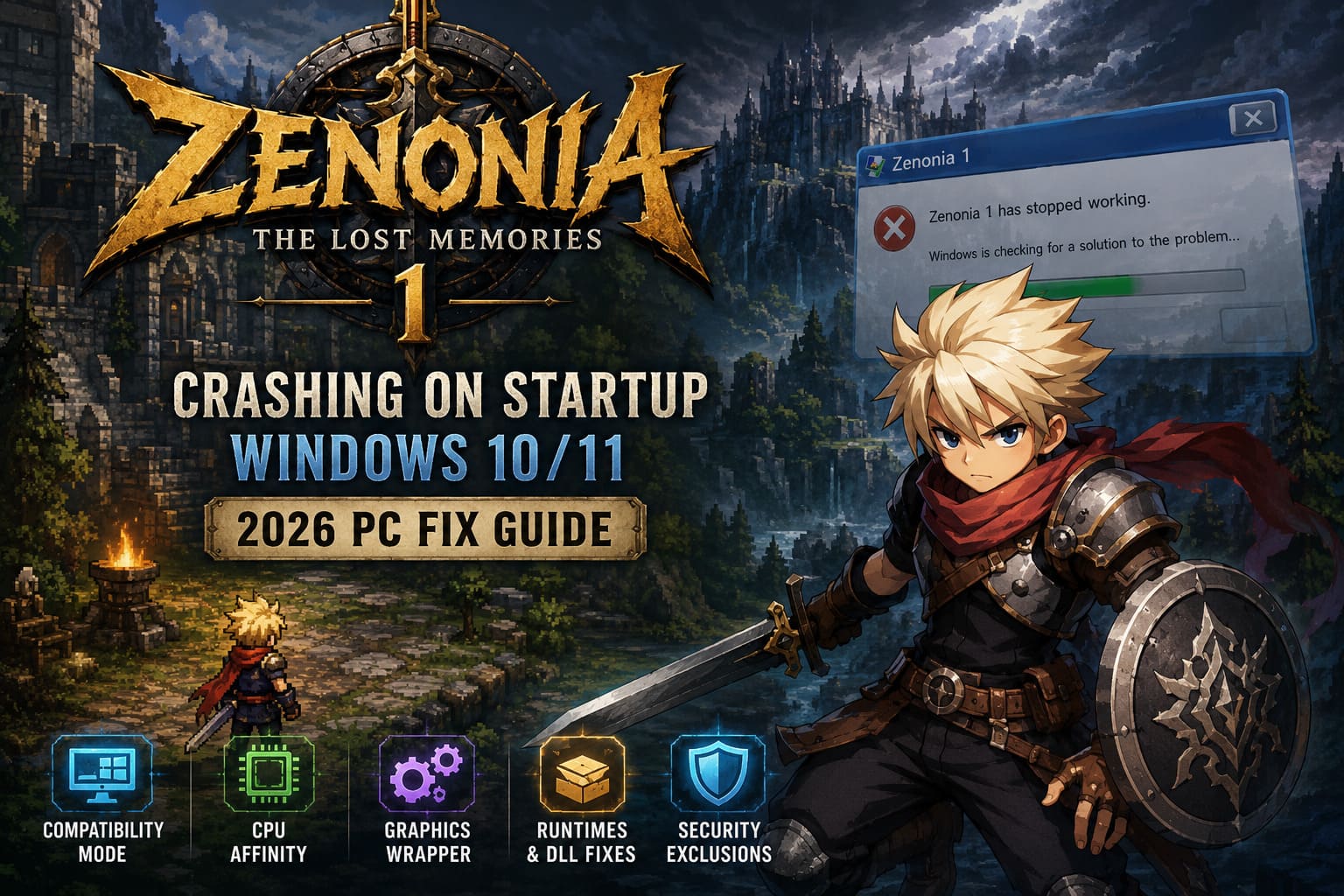
Zenonia 1 was designed for a completely different hardware and software landscape. Modern Windows systems, high-resolution displays, multi-core CPUs, new GPU drivers, aggressive security features, and modern display scaling can expose problems that simply never existed on the hardware the game originally targeted.
Here are the biggest troublemakers.
| Problem | What You May See | Potential Solution |
|---|---|---|
| Legacy DirectX/OpenGL | Instant crash or black screen | Graphics wrapper |
| Fullscreen optimization | Crash when entering fullscreen | Disable fullscreen optimization |
| High-DPI scaling | Distorted window or CTD | DPI override |
| Modern CPU scheduling | Freeze or crash during loading | CPU affinity |
| Missing runtimes | DLL-related startup failure | Repair DirectX/VC++ |
None of these problems is guaranteed to be the cause on every PC. Zenonia 1 can be running through several different versions, ports, or emulation environments, so treat the following fixes as a troubleshooting path rather than a one-click miracle.
Fix 1: Start With Compatibility Mode
This is the first thing I’d try on an old Windows game because it takes about a minute and can eliminate several compatibility headaches at once.
Find the actual Zenonia executable rather than only modifying a desktop shortcut.
If you’re using a shortcut, right-click it and choose Open file location.
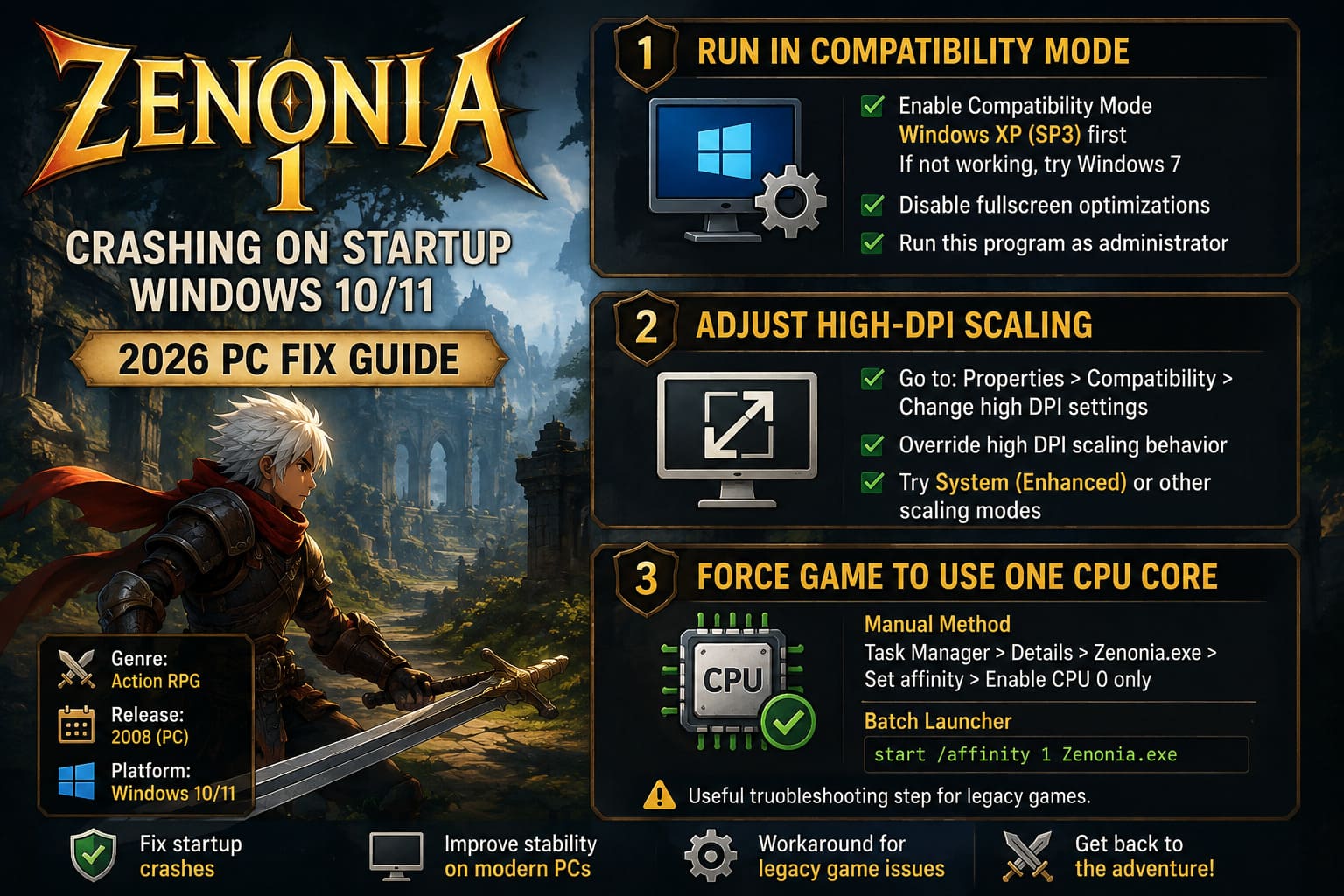
Then:
- Right-click the Zenonia
.exe. - Select Properties.
- Open the Compatibility tab.
- Enable Run this program in compatibility mode for.
- Try Windows XP (Service Pack 3) first.
- If that doesn’t help, test Windows 7.
- Enable Disable fullscreen optimizations.
- Enable Run this program as an administrator.
- Click Apply, then OK.
- Launch the game again.
I’d start with Windows XP SP3 because Zenonia 1 belongs to a much older software generation. If the game behaves worse under XP compatibility, Windows 7 is absolutely worth trying.
Don’t change ten different settings at once. Test after each major adjustment. Otherwise, you’ll never know which option actually fixed the crash.
Fix 2: Deal With Windows High-DPI Scaling
Modern monitors are brutal on old games.
Zenonia 1 was never designed with today’s 1440p and 4K desktops, Windows scaling percentages, and giant high-density displays in mind. If the game flashes a strange black window, opens at the wrong size, or crashes as it switches resolutions, DPI handling is a prime suspect.
Return to:
Zenonia.exe → Properties → Compatibility → Change high DPI settings
Under High DPI scaling override:
- Check Override high DPI scaling behavior.
- Open the dropdown.
- Test System (Enhanced).
- Click OK.
- Click Apply.
- Start Zenonia again.
If System (Enhanced) makes the game look worse, don’t assume the game is doomed. Try another scaling mode, including the default Application behavior.
The goal here is simple: stop Windows from applying modern scaling in a way the ancient game doesn’t understand.
This is especially worth testing if you have Windows display scaling set to 125%, 150%, 175%, or higher.
Fix 3: Force Zenonia 1 Onto a Single CPU Core
This is one of those old-game tricks that sounds ridiculous until it works.
Modern desktop CPUs can have a huge number of logical processors. Zenonia 1 comes from an era when developers obviously weren’t designing around today’s 8-, 12-, 16-, or 24-core monsters.
Some legacy software has timing or synchronization assumptions that don’t play nicely with modern processor scheduling.
Test CPU Affinity Manually
Start Zenonia 1 and immediately open Task Manager with:
Ctrl + Shift + Esc
Then:
- Select More details if necessary.
- Open the Details tab.
- Find the Zenonia process.
- Right-click it.
- Choose Set affinity.
- Disable All Processors.
- Enable only CPU 0.
- Confirm the change.
Now return to the game.
If Zenonia suddenly stops crashing, you’ve found a very strong clue that processor scheduling or timing is involved.
Create a Simple Affinity Launcher
If the game dies before you can change affinity manually, a batch launcher can do the job.
Create a .bat file in the Zenonia installation folder and use:
start /affinity 1 Zenonia.exeReplace Zenonia.exe with the exact executable name if necessary.
The 1 affinity mask starts the process on a single logical processor.
This isn’t something I’d recommend blindly applying to every game. It’s specifically useful as a troubleshooting experiment for legacy software. If Zenonia works perfectly afterward, you’ve learned something important about the crash.
Fix 4: Use a Graphics Wrapper for Legacy Rendering Problems
Now we get into the more serious retro-PC territory.
If compatibility mode and CPU affinity don’t help, the graphics layer itself may be the problem.
Older applications can depend on legacy DirectX or OpenGL behavior that modern graphics drivers don’t reproduce exactly the way the original software expected. This can produce the classic symptoms:
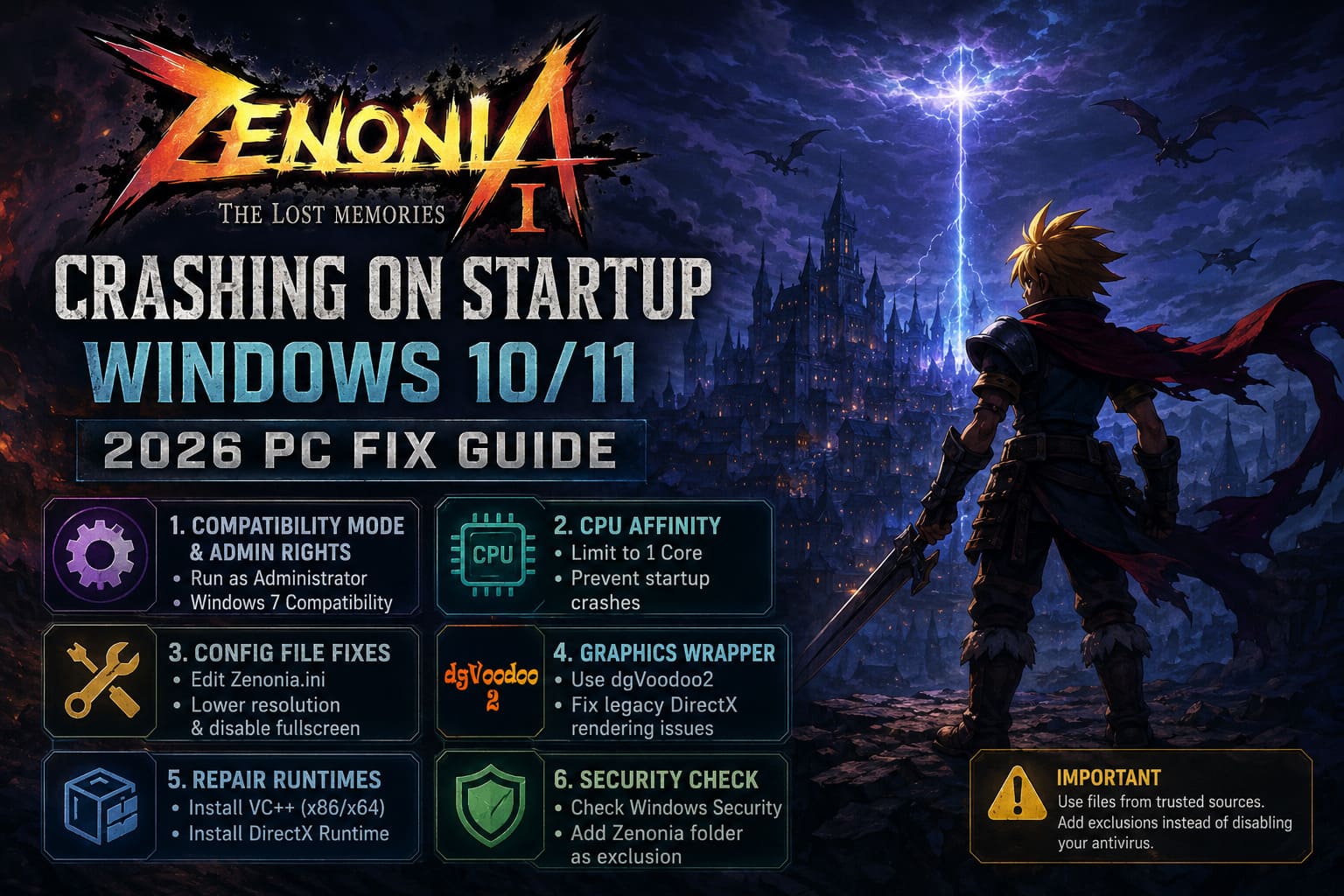
- Black screen
- Instant desktop crash
- Crash immediately after the splash screen
- Corrupted graphics
- Window opening and disappearing
- Failure when switching into fullscreen
A compatibility graphics wrapper can translate older rendering commands into something modern hardware and drivers understand more reliably.
One well-known option in the retro-gaming community is dgVoodoo2.
The basic process is:
- Obtain the appropriate version of the wrapper from its trusted official distribution source.
- Extract the archive.
- Locate the appropriate architecture folder, commonly the MS\x86 files for 32-bit legacy software.
- Copy the required Direct3D wrapper DLLs.
- Place the appropriate files beside the Zenonia executable.
- Launch the game and test.
Do not randomly copy every DLL from a wrapper package into the game folder. Architecture matters, and using the wrong library can create a completely different crash.
Also, keep a backup of the original game directory before experimenting with DLL wrappers. With old games, preserving the original files is always the smart move.
If the wrapper makes things worse, simply remove the added files and return to the clean installation.
Fix 5: Repair DirectX and Visual C++ Components
A freshly installed Windows machine isn’t necessarily equipped with every legacy runtime an old game expects.
This is particularly important when you’re dealing with an application that was built around older DirectX components.
Install or repair the appropriate Microsoft Visual C++ Redistributables, paying attention to both x86 and x64 packages when applicable.
For legacy games, the x86 package can be particularly important because a 32-bit game needs 32-bit runtime libraries even when you’re using a 64-bit version of Windows.
You should also install Microsoft’s DirectX End-User Runtime package for older DirectX components.
After repairing the runtimes:
- Restart Windows.
- Launch Zenonia again.
- Test before changing additional settings.
This step is boring, but boring fixes are sometimes the best fixes. There is no reason to start editing configuration files if Windows is simply missing a runtime dependency.
Fix 6: Check Windows Security and Antivirus Interference
Old games are weird by modern standards.
An unsigned executable, an unusual DLL, an old installer, or a compatibility wrapper can occasionally trigger security software even when the program itself isn’t malicious.
If Zenonia closes silently during startup, check whether Windows Security or your third-party antivirus recorded a blocked or quarantined file.
Open:
Windows Security → Virus & threat protection → Protection history
Look for recent events corresponding to the time of the crash.
If you have confirmed that your Zenonia installation comes from a legitimate and trusted source, you can consider adding its folder as an exclusion.
The Windows path is generally:
Virus & threat protection → Manage settings → Exclusions → Add or remove exclusions
Then add the specific Zenonia installation folder.
Important Warning
I would not recommend casually disabling Windows Defender altogether just to make an old game launch.
If security software is interfering, a narrowly targeted exclusion is considerably better than turning off real-time protection for the entire system.
And if you obtained the game or a wrapper from a questionable source, don’t blindly whitelist it. Verify the files first.
Zenonia 1 Crashes Inside an Android Emulator
A lot of modern Zenonia 1 players aren’t running a native PC executable at all.
They’re using an Android emulator such as BlueStacks, LDPlayer, Nox, or another Android environment.
In that situation, the troubleshooting process changes.
Switch the Graphics Renderer
Open your emulator’s graphics settings and look for the rendering option.
Depending on the emulator, you may be able to switch between:
- DirectX
- OpenGL
- Other available rendering backends
If Zenonia crashes with DirectX selected, test OpenGL.
If OpenGL produces graphical corruption or fails to launch, go back and test DirectX.
There isn’t a universal winner here because emulator versions and GPU drivers behave differently.
Try an Older Android Device Profile
This one is easy to overlook.
Zenonia 1 is an old mobile game. An emulator presenting itself as a brand-new flagship Android phone can occasionally create compatibility problems with software that was never designed around today’s Android ecosystem.
If your emulator supports custom device profiles, test an older, widely supported handset profile rather than the newest device available.
The point isn’t to make the virtual phone artificially weak. It’s to create a software environment closer to the one Zenonia expected.
Make Sure Hardware Virtualization Is Enabled
If you’re using an Android emulator and experiencing crashes, severe instability, or terrible performance, check whether CPU virtualization is enabled.
Depending on your motherboard and processor, this may appear in BIOS/UEFI as:
- Intel VT-x
- Intel Virtualization Technology
- AMD-V
- SVM Mode
The exact menu location depends on your motherboard.
Hardware virtualization can make a massive difference to emulator stability and performance. If it is disabled, the emulator may have to rely on less efficient virtualization methods.
After enabling it, save the BIOS/UEFI changes and boot back into Windows.
What If Zenonia 1 Still Crashes?
At this point, don’t start downloading twenty random “Zenonia fixes” from sketchy websites. That’s how a retro-game troubleshooting session turns into a malware cleanup session.
Instead, isolate the problem.
Test 1: Launch the Clean Game
Remove any compatibility wrappers or injected DLLs temporarily.
Test 2: Use Compatibility Mode
Try XP SP3, then Windows 7.
Test 3: Disable Fullscreen Optimization
This is particularly useful if the crash happens during the transition into fullscreen.
Test 4: Test DPI Behavior
Try System (Enhanced), then return to Application if necessary.
Test 5: Test CPU Affinity
If one core fixes the problem, you’ve discovered a valuable lead.
Test 6: Repair Runtimes
Install the appropriate legacy DirectX and Visual C++ components.
Test 7: Check Security Logs
Make sure Windows Security hasn’t blocked a required executable or DLL.
Test 8: If Using an Emulator, Change Renderer
Test OpenGL and DirectX separately.
This systematic approach is much better than changing everything simultaneously.
Zenonia 1 Walkthrough: 100% Full Main Quest Line Guide (Good & Evil Paths)
My Recommended Zenonia 1 Troubleshooting Order
If I were sitting at my own PC trying to resurrect Zenonia 1 tonight, this is the exact order I’d use:
- Back up the installation. Don’t touch anything until you have a clean copy.
- Enable Windows compatibility mode. Start with Windows XP SP3.
- Disable fullscreen optimizations.
- Run the executable as administrator.
- Test high-DPI scaling.
- Try single-core CPU affinity.
- Repair legacy DirectX and Visual C++ runtimes.
- Investigate graphics wrappers.
- Check Windows Security logs.
- If you’re using an emulator, troubleshoot its graphics engine and virtualization settings separately.
That order matters. There’s no point messing with a graphics wrapper if Windows is simply refusing to let the executable write its required files.
Zenonia 1 Full Story and Plot Summary Explained: Regret’s Complete Lore Breakdown
Final Thoughts: Don’t Let Windows Kill the Retro RPG Magic
The frustrating thing about playing an old favorite like Zenonia 1 in 2026 is that the hardware is vastly more powerful than anything the original game could have dreamed about, yet getting the game running can sometimes be harder than running a brand-new AAA release.
That’s the curse of legacy gaming.
The problem usually isn’t that your PC is too weak. It’s almost the opposite. Modern Windows, modern processors, high-DPI displays, security systems, graphics drivers, and emulator architectures have moved so far beyond Zenonia 1’s original environment that the game can stumble over assumptions that used to be completely normal.
Start with compatibility mode, fullscreen settings, DPI handling, and administrator privileges. If the crash persists, CPU affinity is absolutely worth testing. For stubborn graphical failures, a properly configured legacy graphics wrapper can be the missing piece. Repairing old DirectX and Visual C++ components is another low-risk step that can solve mysterious startup failures.
And if you’re playing through an Android emulator, stop treating it like a normal Windows game. The emulator is part of the equation, so its renderer, device profile, and virtualization configuration need to be tested as well.
Zenonia 1 may be old, but that’s part of what makes getting it running worthwhile. Once Regret finally appears on screen instead of Windows dumping you back to the desktop, that familiar pixel-art world feels surprisingly good again.
Sometimes the best gaming session isn’t about launching the newest release.
Sometimes it’s about beating Windows into submission so you can play an RPG you loved years ago.