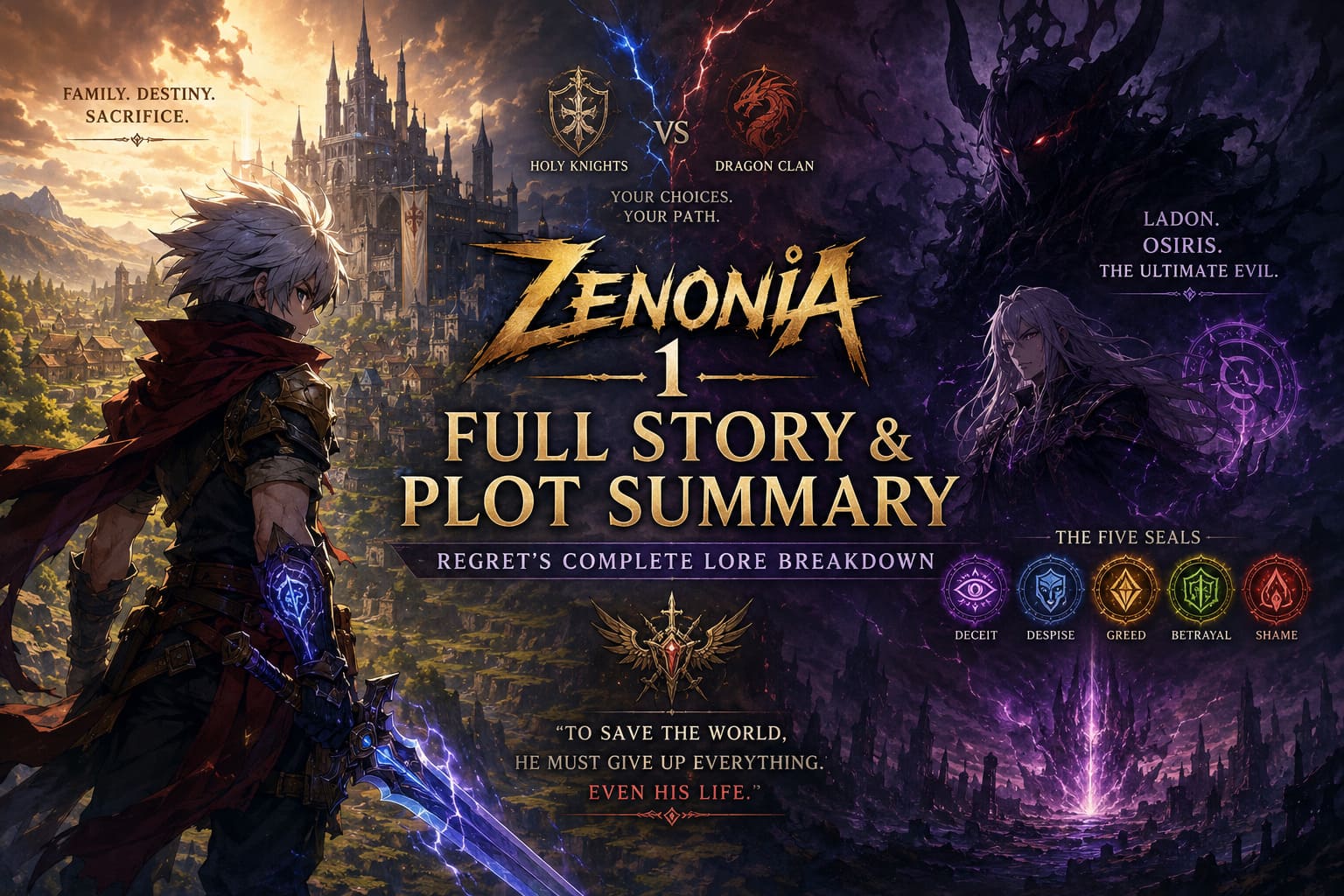
Zenonia 1 Full Story and Plot Summary Explained: Regret’s Complete Lore Breakdown
There are plenty of mobile RPGs that were fun for a few hours and then disappeared from my memory. Zenonia 1 isn’t one of them. Coming back to Gamevil’s classic in 2026, especially now that the game is finding new life on modern platforms, reminded me why this series became so memorable in the first place.
At first glance, Zenonia looks like a fairly straightforward action RPG. You have a young hero, monsters to fight, quests to complete, gear to collect, and a mysterious world waiting to be explored. But underneath all of that is a surprisingly dark story about family, manipulation, destiny, morality, and sacrifice.
And honestly, Regret’s story is much sadder than I remembered.
What begins as a revenge quest after the death of his adoptive father eventually turns into a battle over the fate of the entire world. Even more interestingly, Zenonia doesn’t simply tell you which side is good and which side is evil. Depending on your choices, the same characters and events can look completely different.
So let’s break down the full Zenonia 1 story and lore, including Regret’s origins, the five seals, the Good and Evil paths, Ladon, Osiris, and how everything connects to the later games.
The Story Before Regret Was Even Born
To understand Regret, you have to go back years before the opening of Zenonia.
The world had already suffered through a devastating war involving powerful forces, including the Holy Knights and the Dragon Clan. During this turbulent period, a legendary military commander named Pardon discovered a mysterious baby.
There was something deeply unusual about this child.
Pardon apparently understood that the boy was connected to forces far more dangerous than an ordinary human could possibly comprehend. Instead of handing him over to the authorities or allowing him to become another weapon in the ongoing conflict, Pardon made a radical decision.
He abandoned his military career.
Pardon disappeared from the political world and settled in a remote village, where he raised the child as his own son. He gave the boy the name Regret.
For the next fifteen years, Regret knew nothing about his real origins.
As far as he was concerned, he was simply a normal village kid working as a lumberjack.
And that’s one of the things I really like about the opening of Zenonia. Regret isn’t introduced as some legendary warrior who already knows his destiny. He’s introduced as an ordinary kid whose entire understanding of his life is about to collapse.
The Demon Attack Changes Everything
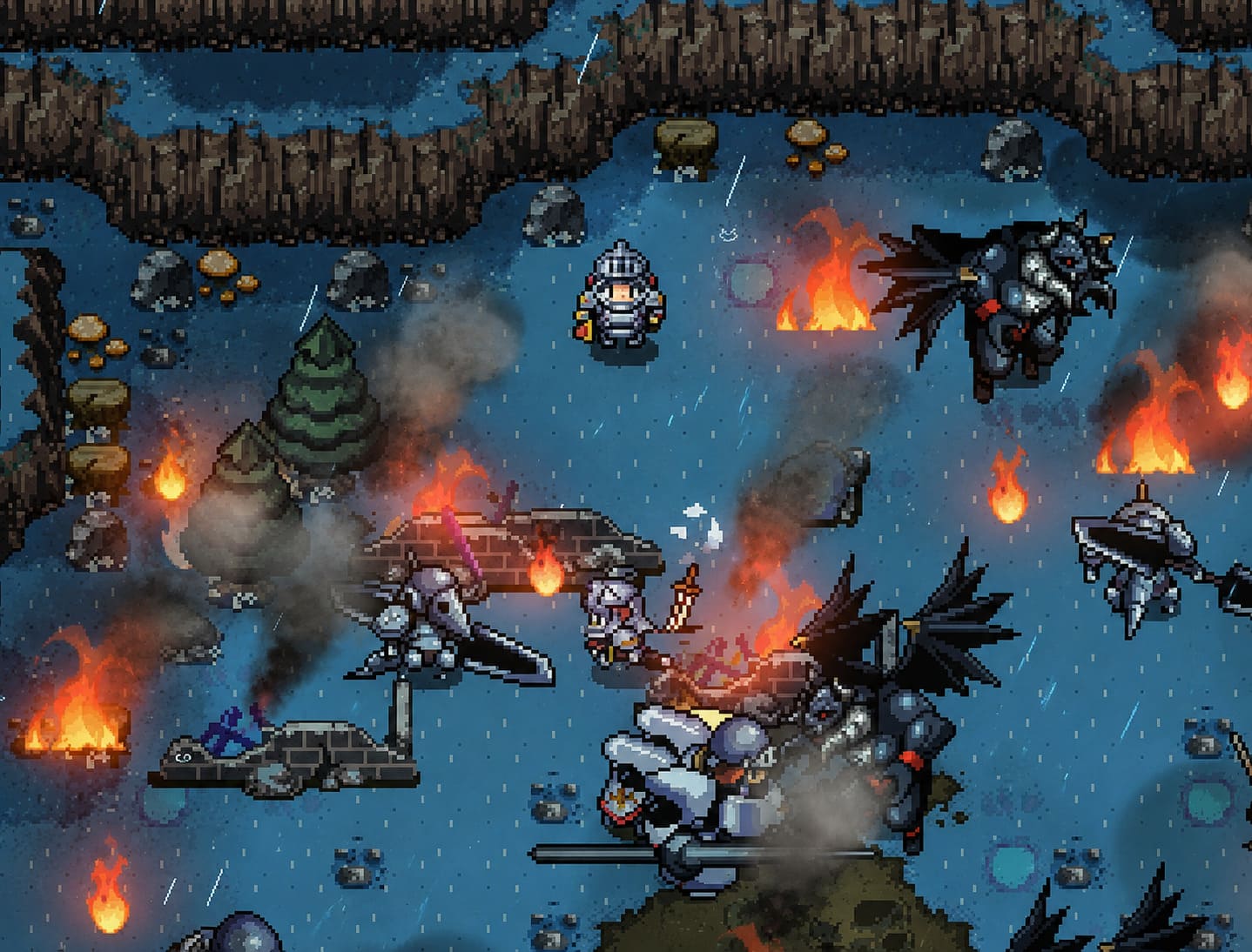
Regret’s quiet existence ends when a terrifying demon suddenly attacks his village.
The attack isn’t just a random monster encounter. The demon specifically changes the course of Regret’s life by killing Pardon.
This is the moment when the story stops being a simple fantasy adventure and becomes a mystery.
Regret loses the only father he has ever known, but the reaction of the villagers makes the situation even stranger. Instead of comforting him, the townspeople become cold and suspicious.
Suddenly, Regret doesn’t feel like one of them anymore.
Pardon had apparently been the person holding the community together around Regret. Once he was gone, whatever fear or suspicion the villagers had been hiding finally surfaced.
Regret leaves.
At this point, his motivation is incredibly personal: find the demon, discover why Pardon was killed, and figure out who he really is.
Naturally, things get considerably more complicated.
Holy Knights vs. Dragon Clan: Nothing Is As Simple As It Looks
As Regret travels beyond his village, he becomes involved in a much larger conflict between the Holy Knights and the Dragon Clan.
This is where Zenonia introduces one of its most interesting systems: morality.
Your choices can gradually push Regret toward either a Good alignment or an Evil alignment. The important part is that these aren’t simply cosmetic dialogue changes.
They can completely alter how you interpret the major factions and characters.
And this is where Zenonia was surprisingly clever for its time.
The Holy Knights aren’t automatically perfect heroes, while the Dragon Clan isn’t simply a collection of cartoon villains. Depending on Regret’s choices, the game encourages you to question who is actually telling the truth.
As someone who loves RPGs with morally complicated factions, I think this remains one of the strongest ideas in the original game.
The Good Path: Protecting the Seals
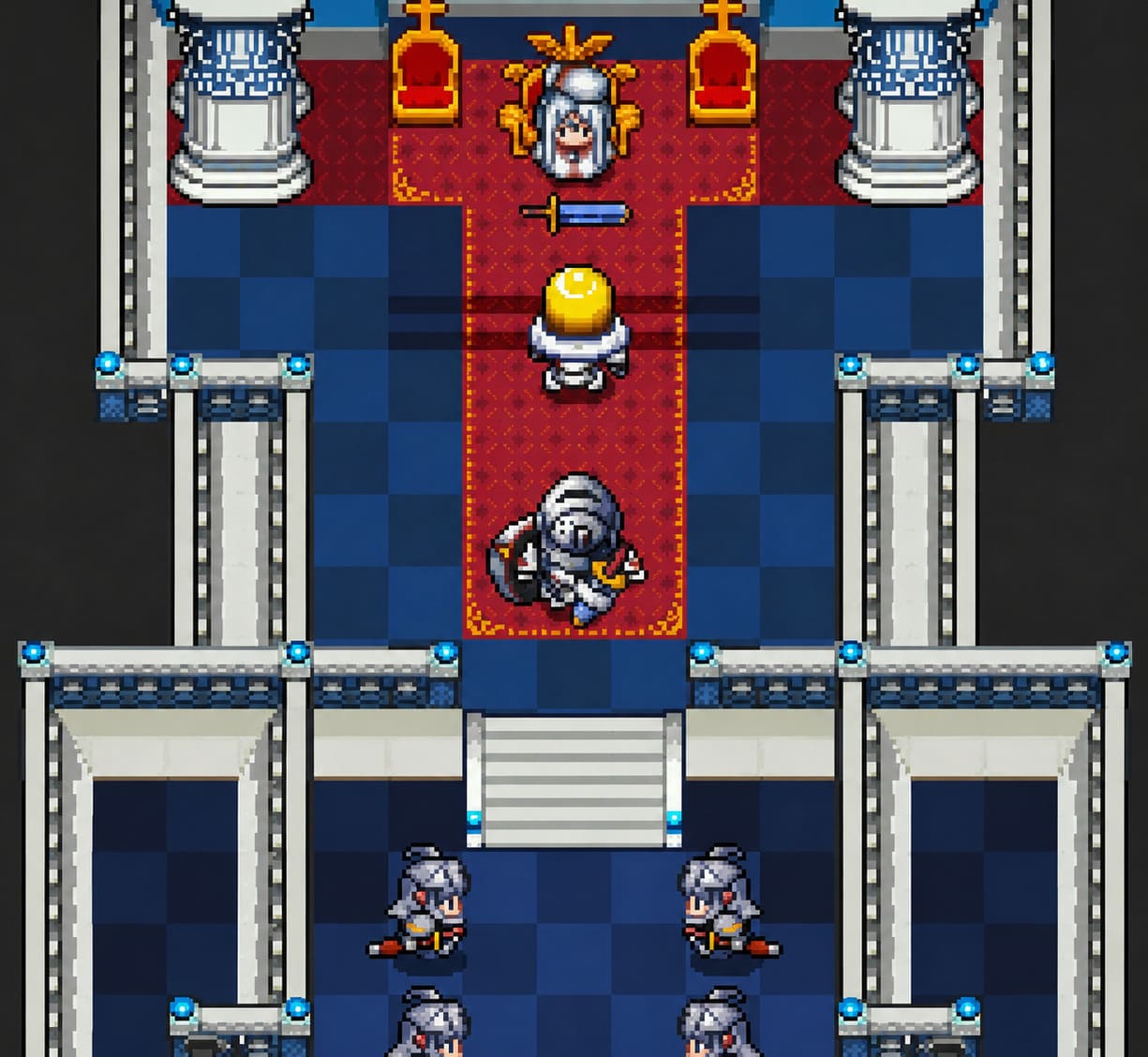
If you consistently make righteous choices, Regret eventually sides with Lady Charity and the Holy Knights.
On this route, Pardon is portrayed as someone who sacrificed his former life to protect Regret from the forces that wanted him dead.
Regret gradually learns that the supernatural conflict surrounding him isn’t just political. Ancient evil is attempting to return, and several magical seals are preventing that disaster from happening.
The Five Seals are essentially barriers keeping an ultimate evil from fully emerging.
Regret’s mission becomes one of protection.
He must travel across the world, confront powerful guardians, and prevent the seals from being destroyed. Characters such as Vicious and Virulent become major threats along the way.
The deeper Regret goes, the more he realizes that Pardon wasn’t simply hiding him from ordinary enemies.
He was hiding him from his destiny.
For me, this route works best when you view Regret as someone trying to honor the memory of the father who raised him. He doesn’t know the full truth, but he chooses to protect people anyway.
That makes the eventual revelations hit much harder.
The Evil Path: Revenge Takes Over
The Evil route turns Regret’s story upside down.
If you repeatedly choose darker options, Regret eventually joins forces with the Dragon Clan, including figures such as Virulent and Vicious.
But the biggest change isn’t simply who Regret fights.
It’s why he fights them.
The Dragon Clan convinces Regret that the Holy Knights were responsible for Pardon’s death. According to their version of events, Pardon was punished because he abandoned his military position and chose to protect a child connected to dark prophecy.
Regret, already consumed by grief, has an easy reason to believe them.
He becomes convinced that the Holy Knights betrayed his father.
Instead of protecting the five seals, he begins destroying them.
That means Regret is unknowingly doing exactly what the forces manipulating him want.
Regret’s Five Targets
On the Evil path, the journey revolves around breaking the ancient barriers that keep the world’s ultimate evil contained:
- Seal of Deceit — associated with Pale.
- Seal of Despise — tied to Vague on this route.
- Seal of Greed — a dangerous area dominated by traps rather than a conventional boss fight.
- Seal of Betrayal — protected by the Ghost of Ladon.
- Seal of Shame — where Lady Charity becomes Regret’s opponent.
This is where the story’s central theme becomes obvious: Regret believes he’s fighting for justice while unknowingly helping destroy the world.
That’s a much more interesting villain arc than simply turning the protagonist evil.
The Five Seals and the Road to the End
Regardless of your moral alignment, Regret’s adventure eventually brings him to the same terrifying truth.
The five seals are connected to something much older and more powerful than the factions fighting over them.
Once the final stages of the story unfold, Regret travels toward the Canyon of Despair, located south of the capital city of Leo.
And this is where Zenonia finally pulls back the curtain on Regret’s identity.
The Truth About Regret
Regret isn’t an ordinary orphan.
He is connected directly to Ladon, the ultimate dark lord.
More specifically, Regret is revealed to be Ladon’s biological son and a human vessel connected to the dark entity’s power.
Suddenly, the strange circumstances surrounding his childhood make sense.
Pardon wasn’t randomly raising an abandoned child.
He had been protecting someone whose very existence was connected to the greatest threat facing the world.
This revelation completely changes the meaning of the game’s opening.
Pardon knew more than he ever told Regret.
And Regret’s entire childhood was essentially built around keeping him ignorant of the terrible destiny attached to his birth.
Regret vs. Ladon
Deep inside the Canyon of Despair, Regret finally confronts Ladon.
It’s the showdown that the entire game has been building toward.
After everything Regret has experienced — Pardon’s death, the faction conflict, the seals, betrayal, and the discovery of his origins — he finally gets the chance to confront the source of the darkness connected to his life.
Regret defeats Ladon.
For a moment, it looks like the nightmare is finally over.
It isn’t.
Something much worse emerges.
Osiris: The Real Threat Behind the Darkness
After Ladon’s defeat, Osiris appears.
And this is one of the wildest twists in the original Zenonia story.
Osiris reveals that he has been connected to Regret from the beginning. A primordial source of evil was planted within Regret’s body, making the hero and the ultimate darkness inseparably connected.
The relationship between them isn’t simply hero versus villain.
It’s almost cosmic.
Regret represents the possibility of light surviving despite its connection to darkness, while Osiris represents the destructive force buried inside him.
That leads to the final battle.
Regret fights Osiris and ultimately manages to defeat him, preventing the complete destruction of the world.
But victory comes with an enormous price.
Zenonia 1’s Tragic Ending
Regret cannot simply walk away from everything.
To permanently contain the evil, he must make the ultimate sacrifice.
Regret dies.
And honestly, this is one of the reasons his character stuck with me more than the average mobile RPG protagonist. His story isn’t about becoming a legendary hero and receiving a glorious reward.
It’s about a young man who spends the entire game trying to understand why his life was taken away from him — only to discover that saving everyone else requires him to give up that life completely.
However, Zenonia doesn’t leave Regret’s soul to disappear.
Through the intervention of Lady Charity and higher divine forces, Regret’s soul is transported to the Land of the Fallen. There, he is resurrected in the body of a young child.
That seemingly impossible resurrection becomes extremely important for the future of the series.
How Regret Connects to the Later Zenonia Games
If you only play Zenonia 1, the ending feels like a conclusion.
But the wider franchise reveals that Regret’s story was nowhere near finished.
In Zenonia 3: The Midgard Story, Regret eventually appears as an older character and takes on a completely different role.
Instead of being the young hero searching for his origins, he becomes a mentor and father figure to Chael, an orphan he adopts after making a promise to Chael’s dying mother, Isel.
And this is where the series gets cruel again.
History repeats itself.
The demon king Antione eventually takes control of Regret’s body, forcing Chael into an unbearable situation. To save Midgard, Chael has to fight and ultimately kill the very man who raised him.
The parallel with Regret’s own childhood is hard to miss.
Regret once lost Pardon.
Now Chael loses Regret.
The cycle of sacrifice continues.
What Zenonia 1 Is Really About
When I look back at Zenonia 1 now, I think its story works because the fantasy plot is actually hiding a much more personal tragedy.
Regret spends the entire game trying to answer one question:
Who am I?
But every answer creates another problem.
He learns that Pardon wasn’t his biological father.
He learns that his birth is connected to Ladon.
He learns that the factions fighting around him aren’t as simple as they appear.
He discovers that his own body contains a connection to primordial evil.
And eventually, he realizes that destiny doesn’t have to determine what kind of person he becomes.
That’s the most important part of his character.
Regret may have been born from darkness, but his choices define him more than his bloodline does.
The Good and Evil routes reinforce that idea beautifully. The game isn’t merely asking whether Regret is good or evil. It’s asking what happens when someone with a terrible destiny is given the freedom to choose his own path.
Final Thoughts
Playing through the Zenonia 1 story in 2026, I expected nostalgia more than anything else. Instead, I was surprised by how much of the lore still works.
Sure, the presentation is dated compared with modern action RPGs. Some of the storytelling is dramatic in that wonderfully old-school RPG way, and the morality system isn’t as sophisticated as what we’d see in a huge modern production.
But the core ideas are strong.
Regret’s story is a tragedy about identity, family, manipulation, and sacrifice. Pardon isn’t simply the adoptive father who dies during the opening act. His decision to protect Regret is the foundation of the entire story. The Holy Knights and Dragon Clan aren’t just opposing teams. They’re part of a much larger struggle over how Regret’s destiny will unfold.
And the five seals aren’t just another set of dungeon objectives.
They’re the locks on a catastrophe that has been waiting for Regret since the day he was born.
That’s why I still think Zenonia 1 deserves to be remembered as more than an old mobile RPG. Beneath the action combat and classic grinding is a surprisingly ambitious fantasy story — one where the hero’s greatest enemy isn’t necessarily the demon standing in front of him.
Sometimes, it’s the darkness he was born carrying inside himself.