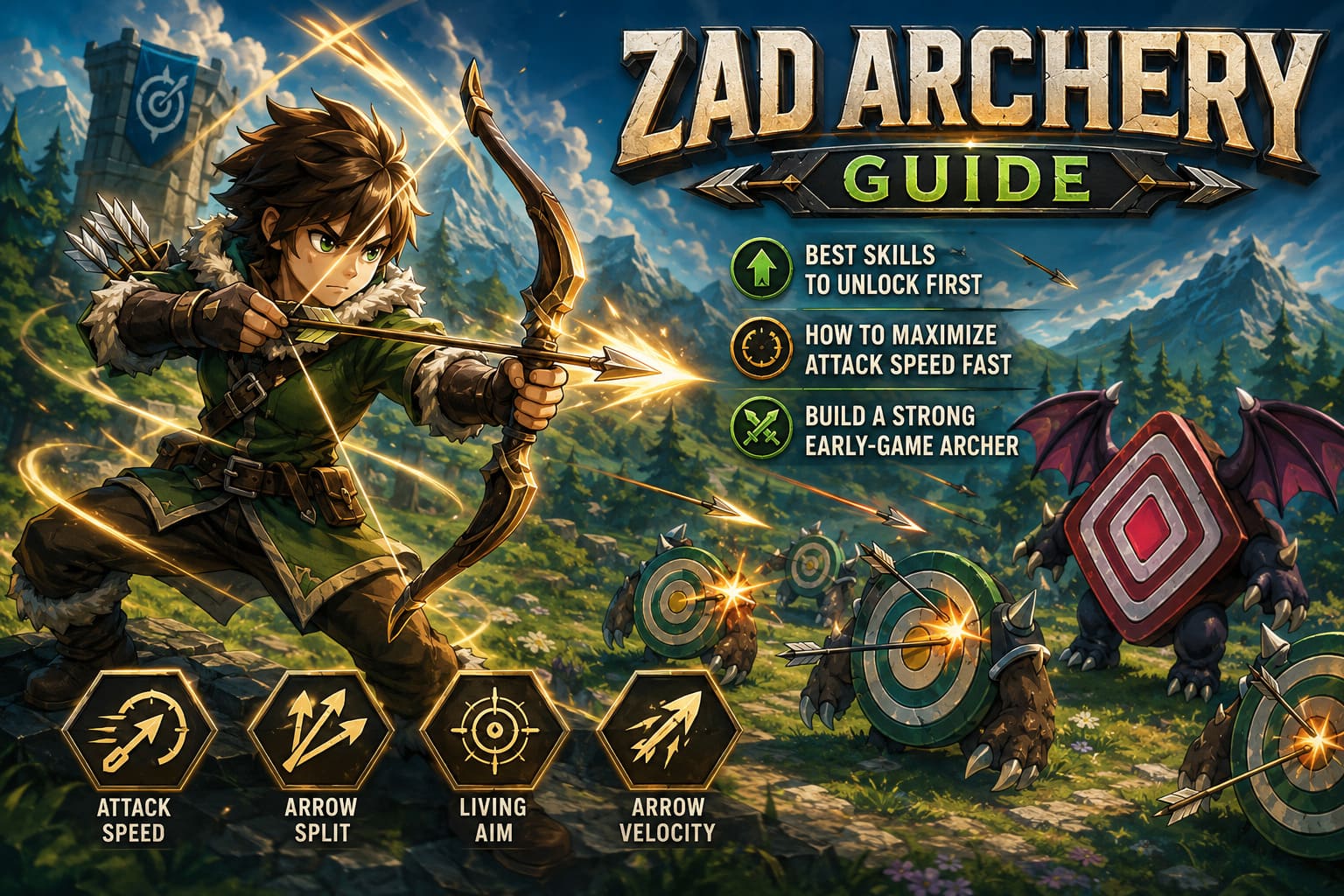
Zad Archery Guide: Best Skills to Unlock First & How to Maximize Attack Speed Fast
I’ve played more incremental RPGs than I probably should admit, and they all tend to have the same trap: the game gives you a huge pile of upgrades and makes almost every one of them look useful.
Zad Archery is no different.
The skill tree starts looking harmless enough, but once you begin unlocking nodes and seeing how different bonuses interact, it becomes obvious that your first few choices matter more than they initially appear. You can absolutely spend points on whatever looks interesting, but if your goal is to progress quickly, there’s a much better way to approach the opening hours.
After spending time with the early progression, my biggest takeaway is simple: Zad Archery rewards players who build around firing frequency rather than trying to create a perfect damage build immediately.
That means attack speed, projectile count, arrow velocity and reliable automated targeting should be near the top of your shopping list.
The reason is straightforward. More arrows mean more hits. More hits mean more effects triggering. More effects mean more resources, faster waves and quicker access to the systems that actually make the build interesting.
And once that snowball gets going, the early-game archer starts feeling completely different.
Why Your First Skill Points Matter So Much
The early section of Zad Archery can feel deceptively slow. Your character doesn’t initially resemble the projectile-spamming machine you eventually become, and that’s exactly why your first upgrades are important.
Early resources are limited, so I don’t recommend spreading points across every branch simply because you can.
The best early build is focused.
You want your first upgrades to make the basic combat loop faster and more reliable. Defensive improvements aren’t useless, but they’re rarely the reason you’re stuck on a wave during the opening progression. Usually, the problem is that you’re simply not killing targets quickly enough.
That makes offensive scaling the obvious priority.
Another reason I like this approach is that better damage isn’t only about killing things. Faster clearing also improves the rate at which you collect gold, materials and other progression resources. That creates a feedback loop where one offensive upgrade helps you afford the next one.
In other words, your best defense early on is often killing everything before it becomes a problem.
The Best Skills to Unlock First
There are several directions you can take through t
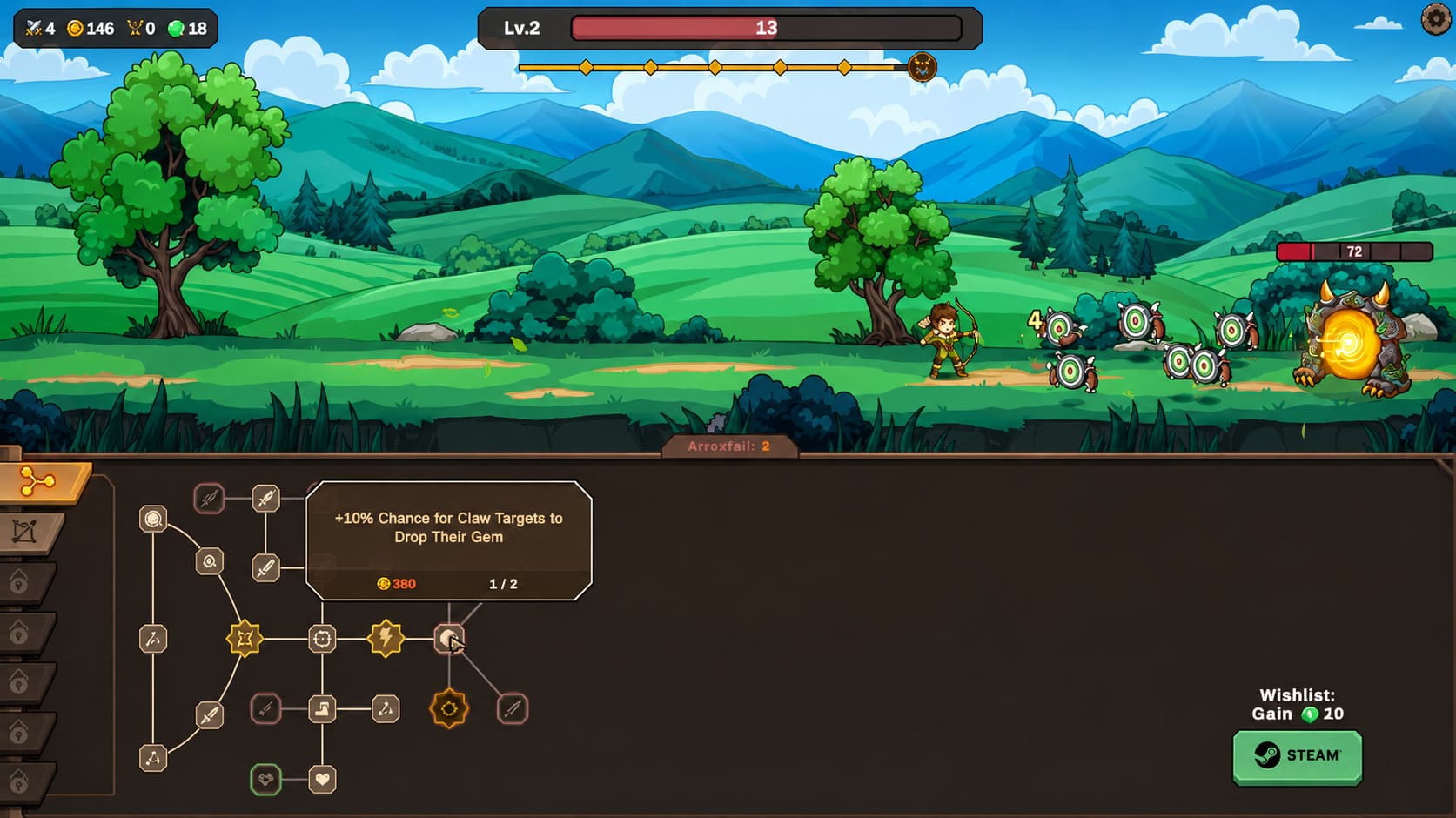 he early skill tree, but I would strongly favor a path built around automation and projectile frequency.
Here is the basic priority I recommend:
| Skill / Stat | Early Priority | Why It Matters |
|---|---|---|
| Living Aim | Very High | Improves automated combat and targeting |
| Basic Arrow Split | Very High | Adds more projectiles and improves wave clearing |
| Attack Speed | Very High | Increases overall damage frequency |
| Arrow Velocity | High | Gets projectiles to targets faster |
| Precision | Medium-High | Makes your damage output more consistent |
| Critical Damage | Medium | Becomes stronger with better gear |
| Movement Speed | Low | Useful later, but not a priority early |
| Health Regeneration | Low | Usually unnecessary while your damage is scaling |
1. Living Aim
If you’re wondering where I’d put the first serious investment, it’s Living Aim.
This is one of those upgrades that doesn’t necessarily produce the biggest number on your character sheet, but it improves the actual feel of the game. Automated targeting means you spend less time worrying about individual enemies and more time watching your build work.
That’s particularly valuable in an incremental game.
One of the worst things an idle-style RPG can do is force you to babysit basic combat constantly. Living Aim pushes Zad Archery toward the experience I think it wants to provide: set up your character, optimize the build and watch the screen fill with arrows.
I’d prioritize getting this established before worrying about more specialized damage bonuses.
2. Basic Arrow Split Is a Huge Early Pickup
After stabilizing your targeting, I would move toward Basic Arrow Split.
This is where the build starts becoming much more satisfying.
Additional projectiles are extremely valuable when enemies appear in groups. Instead of one arrow dealing with one target, a single attack can potentially influence several enemies. Even when the individual arrows aren’t particularly powerful, the sheer number of projectiles adds up quickly.
There’s also an important secondary benefit.
More projectiles give you more opportunities to trigger other effects.
That’s something newer players can easily overlook. A percentage-based effect might look unimpressive when you’re firing occasionally, but once your character is producing a constant stream of arrows, those same percentages become much more noticeable.
This is why I prefer projectile quantity over chasing huge individual hits during the opening stages.
A massive critical strike looks cool.
A screen full of arrows is usually better.
Attack Speed Should Be Your Main Early-Game Stat
If there’s one thing I’d tell a new Zad Archery player before they start spending points, it’s this:
Don’t underestimate attack speed.
It might not be the most exciting stat at first glance, especially when you’re comparing it against flashy critical damage upgrades. But attack speed affects practically everything connected to your offensive loop.
More attacks mean:
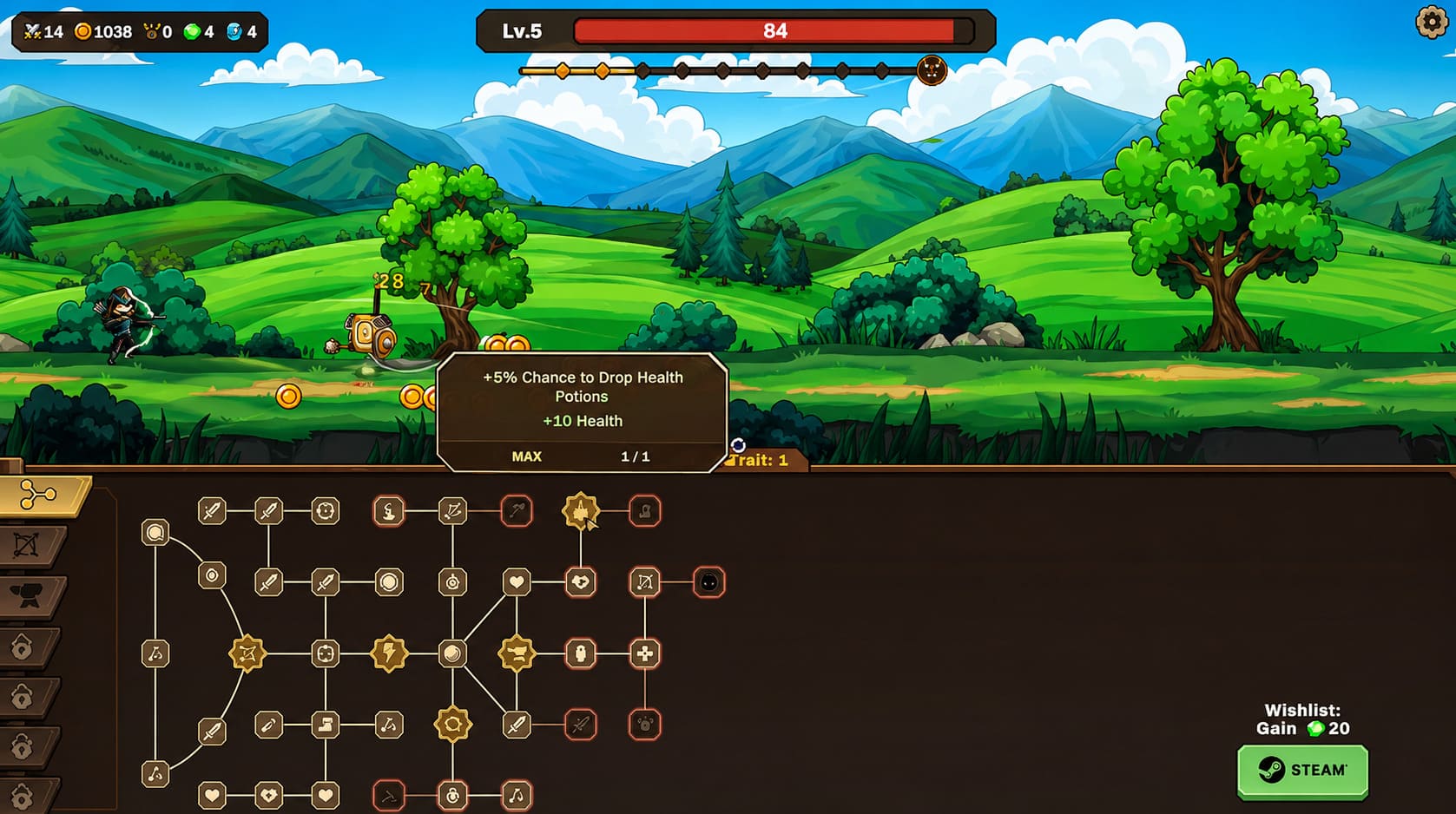
- More projectile opportunities
- More chances for split effects
- Faster target kills
- Faster resource generation
- More frequent passive triggers
- Better sustained damage
This is why attack speed can outperform raw damage surprisingly quickly.
Imagine you have two builds. One fires a powerful arrow every few seconds, while another fires slightly weaker arrows almost constantly. On paper, the first build might look better. In actual combat, the faster build can clear groups more consistently because it isn’t waiting around between attacks.
Zad Archery is much more fun once your bow starts feeling automatic rather than deliberate.
That’s the point where the progression begins to snowball.
Attack Speed vs. Critical Chance
This is one of the first decisions that can tempt players away from the efficient route.
Critical chance is obviously useful. Nobody is going to complain about bigger hits. But during the early stages, I wouldn’t build around it.
The problem is that critical scaling generally becomes more interesting when you already have enough base damage and equipment bonuses to support it.
Early on, you’re dealing with relatively modest numbers.
Increasing how often you attack gives you a more consistent improvement across every wave.
I’d personally use this progression:
Attack Speed → Arrow Split → Arrow Velocity → Precision → Critical Scaling
That isn’t a universal rule for every possible build, but it’s a very comfortable route for players who simply want to progress efficiently without constantly rebuilding their character.
Arrow Velocity Is Better Than It Looks
Arrow velocity is another stat that’s easy to dismiss because it doesn’t directly increase the damage number.
I wouldn’t make that mistake.
In a game built around projectile combat, travel time matters. If your arrows take too long to reach targets, your attack speed isn’t being used as efficiently as it could be.
Fast projectiles also make the combat feel considerably cleaner.
You fire.
The arrow reaches the target.
The target dies.
The next wave appears.
That sounds trivial, but shaving time off projectile travel becomes increasingly noticeable when you’re firing dozens of attacks instead of a handful.
Attack speed creates the volume; arrow velocity makes that volume arrive where it needs to go.
Don’t Waste Your Early Points on Everything
One thing I learned from playing a lot of progression-heavy games is that “useful” doesn’t necessarily mean “worth buying right now.”
Movement speed is a good example.
It’s certainly not a bad stat, but I wouldn’t rush into it during the opening portion of Zad Archery. If your character is already surviving comfortably, increasing movement speed doesn’t solve the main progression problem.
The same applies to early health regeneration.
If you’re killing enemies quickly enough, you don’t need to spend precious points fixing a problem you haven’t actually got.
I’d rather put those points into offensive scaling and make the incoming damage irrelevant.
This is especially important when you’re trying to reach the game’s additional progression systems quickly.
When the Jobs System Changes the Build
Eventually, Zad Archery opens up beyond the basic skill tree, and that’s when your build starts becoming much more flexible.
The Jobs System introduces another layer of specialization, and this is where I’d start looking for bonuses that complement your attack-speed investment rather than replacing it.
The ideal setup is one where your passive bonuses support your basic firing cycle.
For example, an effect that improves firing frequency becomes much more valuable when combined with additional projectiles. Likewise, anything that reduces downtime becomes stronger when your build is already focused on rapid attacks.
This is where the game starts behaving less like a simple clicker and more like a traditional build-crafting RPG.
Your goal isn’t to find one magical stat. It’s to make several mediocre-looking bonuses reinforce each other.
Crafting: Build Your Bow Around Speed
Once crafting becomes available, don’t automatically chase the highest possible base damage.
I’d look for equipment that complements your existing stats.
A bow with slightly lower raw damage but useful attack-speed or projectile-related bonuses can be considerably more valuable than a huge damage stick that slows down your overall rotation.
Crafting also gives you an opportunity to correct weaknesses in your character.
If your attack speed is already excellent but your arrows are too slow, improve velocity.
If your projectile output is strong but your damage is falling behind, then start shifting toward direct damage.
Think of crafting as fine-tuning, not replacing your entire build.
Mining and Alchemy Are Part of the Same Progression Loop
It can be tempting to ignore secondary systems when they unlock.
I wouldn’t.
Mining and gathering aren’t just side activities that exist to make the game look deeper. Their resources feed into crafting and character progression, which eventually feeds back into combat.
The same applies to Alchemy.
Temporary buffs can be particularly useful when you’re approaching a difficult wave or boss and your permanent upgrades aren’t quite enough to push through.
I’d save stronger consumables for moments where they actually matter rather than burning them constantly on easy farming.
A well-timed potion combined with an attack-speed-focused build can turn a difficult encounter into a complete wipeout.
My Recommended First-Hour Progression
If I were starting Zad Archery again today, I’d keep the opening extremely simple.
First: establish Living Aim.
Second: move toward Basic Arrow Split.
Third: start stacking attack speed.
Fourth: improve Arrow Velocity and Precision.
Fifth: unlock the additional progression systems and start looking for equipment that reinforces the same strategy.
Only after the core offensive engine is running would I start spending heavily on more specialized defensive or movement-based options.
This approach isn’t about creating the theoretically perfect character.
It’s about getting to the point where your character starts generating power faster than the game can throw problems at you.
Zad Archery Skill Tree Optimization: Best Paths and Meta Progression Guide (2026)
The Biggest Beginner Mistake
The most common mistake I’d expect newer players to make is trying to build for the late game too early.
They see critical damage, rare gear, defensive bonuses and complicated crafting options and immediately start preparing for content they haven’t even reached.
Don’t.
Build for the problem directly in front of you.
In the early game, that problem is usually slow progression.
Attack speed solves it.
Projectile count solves it.
Automation solves it.
Once you’ve built that foundation, you can start experimenting with specialized setups later.
That’s one of the things I enjoy about games like Zad Archery. The early game doesn’t require you to understand every mechanic. It rewards you for recognizing which mechanics are actually helping your current progression.
Zad Archery Beginner Guide: Best Tips, Tricks, and Progression Strategy (2026)
Final Verdict: Build Fast, Then Build Fancy
Zad Archery gives you plenty of opportunities to complicate your character, but I think the strongest opening strategy is surprisingly straightforward.
Prioritize automation, projectile quantity and attack speed.
Living Aim gives you a reliable combat foundation, Basic Arrow Split dramatically improves your screen coverage, while attack speed turns those mechanics into a consistent stream of damage.
From there, Arrow Velocity and Precision help clean up the weaker parts of the build, while the Jobs System, Crafting, Mining and Alchemy eventually give you enough tools to specialize.
The important thing is not to chase every stat equally.
I’ve played enough RPGs to know that the most satisfying builds usually aren’t the ones with the biggest number on a single upgrade. They’re the builds where everything starts working together. In Zad Archery, that moment arrives when your bow stops feeling like a bow and starts feeling like a projectile factory.
Get the firing engine running first.
Then worry about making it pretty.