A Plague Tale Legacy Nintendo Switch Cloud Edition 2026: Release Date Rumors, Switch 2 Specs, and Community Leak Breakdown
If you have spent any serious time with the A Plague Tale games, you already know that this is not a franchise built around hardware-friendly visuals. Asobo Studio has always pushed atmosphere, lighting, character detail, environments, particle effects, and cinematic presentation hard enough to make these games feel closer to interactive prestige dramas than traditional action adventures. That is exactly why the possibility of A Plague Tale: Legacy coming to Nintendo Switch in 2026 is such an interesting topic.
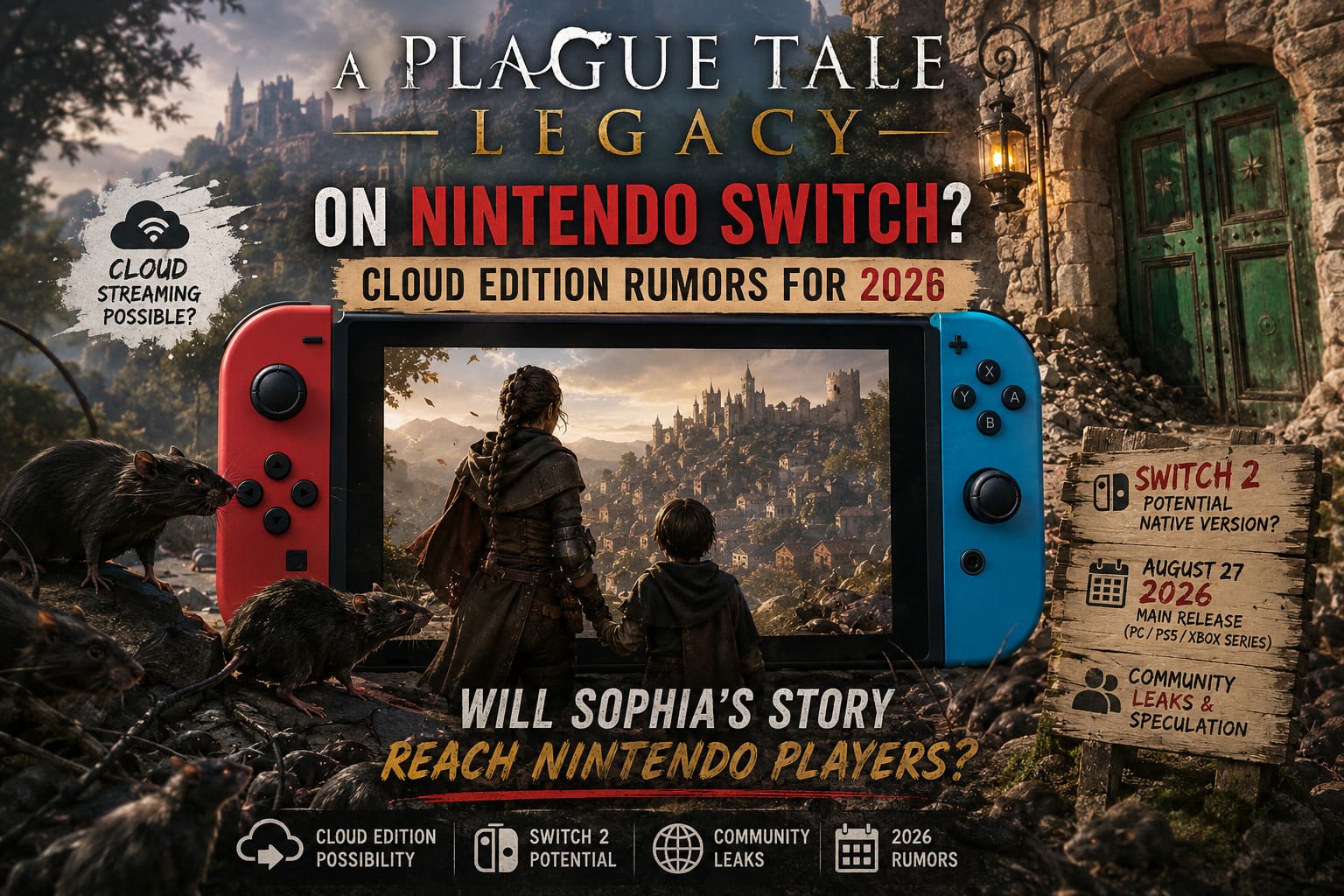
The big question is not really whether the original Nintendo Switch can technically display the game. The more realistic question is whether Focus Entertainment would be willing to bring the experience to Nintendo’s handheld ecosystem through cloud streaming, or whether the publisher would rather wait for more powerful hardware. For players who want to experience Sophia’s adventure away from a gaming PC, PlayStation 5, or Xbox Series X|S, that distinction could make all the difference.
As things stand, the main release is scheduled for August 27, 2026, with PC, PlayStation 5, and Xbox Series X|S positioned as the core platforms. Nintendo players are therefore left staring at the sidelines while the rest of the gaming world prepares to return to this grim universe.
And honestly? I understand why Switch owners are asking questions.
Star Wars Zero Company Release Date, Preorder Rewards, and The Den Strategic Gameplay Guide
Why Nintendo Switch Fans Are Watching A Plague Tale: Legacy
The previous games created an interesting precedent for the franchise on Nintendo hardware. A Plague Tale: Innocence eventually received a cloud version, while A Plague Tale: Requiem also demonstrated how a technically demanding A Plague Tale experience could be delivered to Switch players without forcing the aging hardware to render everything locally.
That history matters.
When you look at what modern A Plague Tale games are trying to achieve, native Switch hardware is simply fighting an uphill battle. These aren’t lightweight indie adventures with static environments and a handful of enemies on screen. The series loves enormous environments, detailed character models, dynamic lighting, atmospheric effects, complicated animations, and scenes where the number of rats alone can make your GPU sweat.
A cloud version changes the equation completely.
Instead of asking the Switch to render the entire game, remote hardware does the heavy lifting. Your console essentially receives a video stream while your inputs are sent back to the server. From a technical perspective, that makes a Nintendo Switch Cloud Edition of A Plague Tale: Legacy far more believable than a conventional native port.
The catch is obvious: your internet connection becomes part of the game.
The Technical Problem Is Bigger Than Graphics
The biggest obstacle isn’t simply that Legacy might look too pretty for the original Switch. It is the entire technical foundation behind the experience.
The game is expected to feature demanding environments, advanced lighting, large-scale visual effects, and complex gameplay systems. The reported emphasis on different historical periods and the game’s expansive environments makes the rendering workload even more interesting.
For a developer, optimizing all of that for old Switch hardware could mean cutting visual quality so aggressively that the original experience loses some of its identity.
Nobody wants Sophia running through a beautiful cinematic environment while everything three meters away looks like it was rendered on a toaster.
| Platform Approach | Main Advantage | Biggest Problem |
|---|---|---|
| Native Nintendo Switch Port | Play anywhere without streaming | Hardware limitations |
| Switch Cloud Edition | High-end visuals without local rendering | Internet dependency |
| Native Next-Gen Nintendo Hardware | Better performance and portability | Requires a separate optimized version |
| PC / PS5 / Xbox Series X|S | Best opportunity for full visual quality | Less convenient for handheld players |
From a player’s perspective, I would personally take a well-implemented cloud version over a severely compromised native port. A Plague Tale depends heavily on atmosphere, and atmosphere disappears fast when technical compromises start attacking every part of the presentation.
Why A Switch Cloud Edition Still Makes Sense
There is a very simple business argument for bringing Legacy to Nintendo players.
The original Switch has an enormous audience, and plenty of owners simply aren’t interested in buying another console just to play one particular adventure. A cloud edition gives publishers a way to reach those players without spending the same amount of development time required for a full native port.
That makes the idea particularly attractive for a narrative-heavy single-player game.
A Plague Tale doesn’t need competitive multiplayer infrastructure or a massive player population to survive. If the cloud servers can handle demand, the publisher can potentially sell the game to Switch owners while keeping the original high-end version intact.
The previous cloud releases also give Focus Entertainment a blueprint.
The infrastructure, storefront model, and basic concept aren’t completely foreign to the franchise. That doesn’t guarantee another cloud release, but it makes the possibility considerably less crazy than it would be for a series attempting cloud distribution for the first time.
The Nintendo Switch 2 Question Changes Everything
Here is where the situation gets much more interesting.
The gaming hardware landscape around 2026 is completely different from the period when developers were trying to squeeze demanding games onto the original Switch. If Nintendo’s newer hardware can handle substantially more sophisticated software locally, publishers have a powerful reason to focus their resources there rather than spending heavily on cloud versions for aging hardware.
For A Plague Tale: Legacy, that could mean a completely different strategy.
Instead of launching a Cloud Edition for the original Switch, Focus Entertainment could potentially target Nintendo’s newer hardware with a dedicated version capable of running more of the game locally.
From a developer’s perspective, that is attractive. Native hardware means better responsiveness, no video compression, no server-related interruptions, and no requirement for players to maintain a strong internet connection.
For players, it is even better.
Imagine playing Legacy in bed, on a train, or somewhere with unreliable Wi-Fi without worrying that your beautiful medieval adventure is about to turn into a blurry slideshow. That’s the dream scenario for handheld players.
Why Some Players Actually Prefer Cloud Gaming
I know cloud gaming gets roasted constantly, especially on Nintendo platforms, but I think the criticism needs some context.
If the choice is between:
- Never playing A Plague Tale: Legacy on Switch
- Playing a compromised native port
- Playing a good cloud version
I’ll happily choose the third option.
Latency is the big issue, obviously. A cinematic stealth game is more forgiving than a competitive shooter, and Legacy’s slower exploration and narrative sequences could actually make it a relatively good candidate for streaming.
But the quality of the experience depends heavily on the connection.
A player with a strong, stable internet connection might have a surprisingly good time. Someone playing over unstable Wi-Fi could experience input delay, image compression, sudden resolution drops, or even disconnects at the worst possible moment.
And there is nothing more immersion-breaking than trying to escape a nightmare sequence while your cloud stream suddenly turns into Minecraft-quality pixels.
The Community Is Split
The reaction from Nintendo-focused gaming communities is easy to understand.
One group simply wants access. These players aren’t demanding 4K resolution or ultra settings. They just want to play the game on the platform they already own.
For them, a Cloud Edition would be a win.
Another group would rather wait for a native version on newer Nintendo hardware. Their argument is equally strong: why settle for streaming when significantly more capable hardware could potentially deliver the game locally?
Then there is a third group that has basically given up on cloud releases altogether.
Players who had poor experiences with previous Switch Cloud Editions understandably don’t want a repeat. Streaming quality can vary dramatically depending on location, network congestion, Wi-Fi quality, and server performance. Even if the technology works perfectly in a developer’s testing environment, the real-world experience can be wildly different.
That makes the community debate much more complicated than simply asking whether the game is technically possible.
Could A Plague Tale: Legacy Arrive on Switch Later?
This is the scenario I would keep an eye on.
A game does not necessarily need a Nintendo version on launch day to eventually appear on the platform. Publishers frequently evaluate sales, audience interest, technical feasibility, and post-launch opportunities before committing to additional versions.
If Legacy performs strongly on PC and current-generation consoles, there is a straightforward commercial argument for expanding its reach.
Holiday sales could make an especially attractive target.
Nintendo players shopping during the holiday season represent a huge potential audience, and a cloud release could give Focus Entertainment another opportunity to monetize the game after its initial launch window.
The timing could also allow the developer to gather real-world feedback from the PC, PlayStation, and Xbox versions before finalizing a Nintendo edition.
That’s probably a smarter approach than rushing something out the door.
What Would Make Me Choose the Cloud Version?
Personally, I’d want a few things before recommending the Switch Cloud Edition without hesitation.
Stable performance would come first. A technically impressive cloud release is useless if the stream constantly drops resolution or struggles with latency.
The full game should be included. No weird compromises, missing areas, reduced content, or awkward visual cuts simply because it is running through the cloud.
Save synchronization would also be essential. If I’m playing on another platform and then jumping to my Switch, I want the transition to feel seamless.
And finally, the pricing needs to make sense. If a cloud version costs almost the same as a native next-generation release while offering fewer advantages, players are naturally going to question the purchase.
My Prediction for Nintendo Players
If I had to place a bet right now, I wouldn’t completely rule out A Plague Tale: Legacy on Nintendo hardware in 2026, but I would be cautious about expecting a traditional Switch release alongside the August launch.
The original Switch simply isn’t an obvious target for a game built around this level of graphical ambition. A cloud version is technically much more realistic, but Nintendo’s evolving hardware situation could give Focus Entertainment another option that might ultimately be more appealing.
The most interesting possibility is therefore not whether Legacy can reach Nintendo players.
It is how it gets there.
A cloud edition could arrive as a relatively straightforward solution for the existing Switch audience. A native version for newer Nintendo hardware could offer a much better long-term experience. And the publisher could even choose to pursue both strategies if the commercial potential is strong enough.
Final Verdict: Don’t Write Off the Switch Version Yet
There is currently no reason for Nintendo fans to assume that Sophia’s journey is permanently off the table. The franchise already has a history with cloud technology, and the technical demands of A Plague Tale: Legacy make streaming a logical solution for less powerful hardware.
At the same time, the rapidly changing Nintendo hardware landscape makes a future native version just as interesting.
For me, the ideal outcome would be simple: give Nintendo players a proper version without destroying what makes A Plague Tale special. If that means a polished cloud edition on the original Switch, great. If it means waiting for more capable Nintendo hardware and getting a native release instead, I can live with that too.
What I don’t want is a rushed port that turns one of 2026’s most atmospheric adventures into a technical mess.
Sophia deserves better than that.
For now, Nintendo fans will have to watch the official announcements and keep an eye on the usual gaming community rumor mill. Until Focus Entertainment and Asobo Studio confirm their plans, the possibility of A Plague Tale: Legacy on Nintendo Switch remains one of those deliciously uncertain gaming mysteries—and considering how much this series loves secrets, that feels strangely appropriate.