The Severed Gods Build Guide: Best Starter Builds and Meta Synergy Squads
If you are playing The Severed Gods like a traditional turn-based RPG, stop. Seriously. That approach will get your party wrecked sooner than you expect.
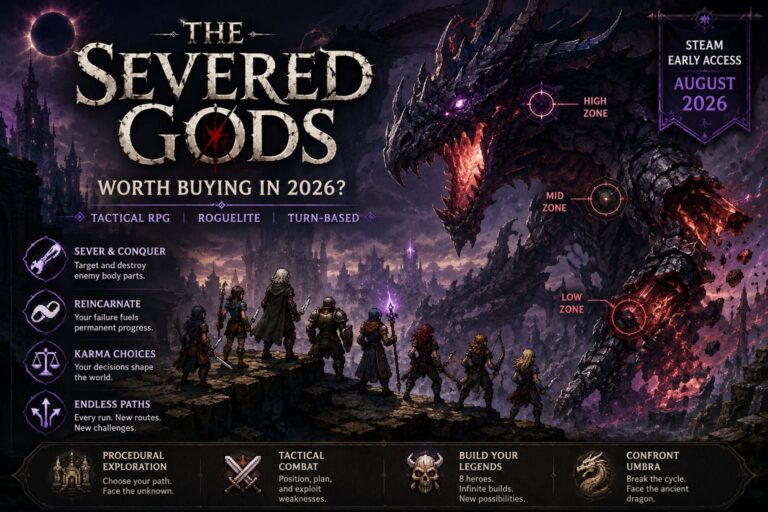
Topebox’s 2026 roguelite RPG looks familiar at first glance, especially if you grew up on classic pixel-art JRPGs, but its combat system has a nasty little twist. Enemies are not simply walking health bars. Their bodies are divided into different height zones, their posture changes during battle, and your heroes can only attack certain areas with specific skills.
That completely changes how you build a team.
After spending a ridiculous amount of time thinking about party compositions, relic combinations, posture breaks, and the best ways to turn a doomed run into a ridiculous comeback, I have one major takeaway: The Severed Gods rewards preparation far more than raw damage.
You can have an absurdly powerful damage dealer and still lose because nobody on the team can reach the correct body segment.
This guide covers the best starter build, the strongest squad combinations, useful relic priorities, and the tactics that make the reincarnation loop much easier to handle. Whether you’re still learning the camp road or preparing for a serious run against Umbra, these are the systems you need to understand.
The Real Key to Combat: Height and Posture
The defining mechanic in The Severed Gods is its height-based combat system.
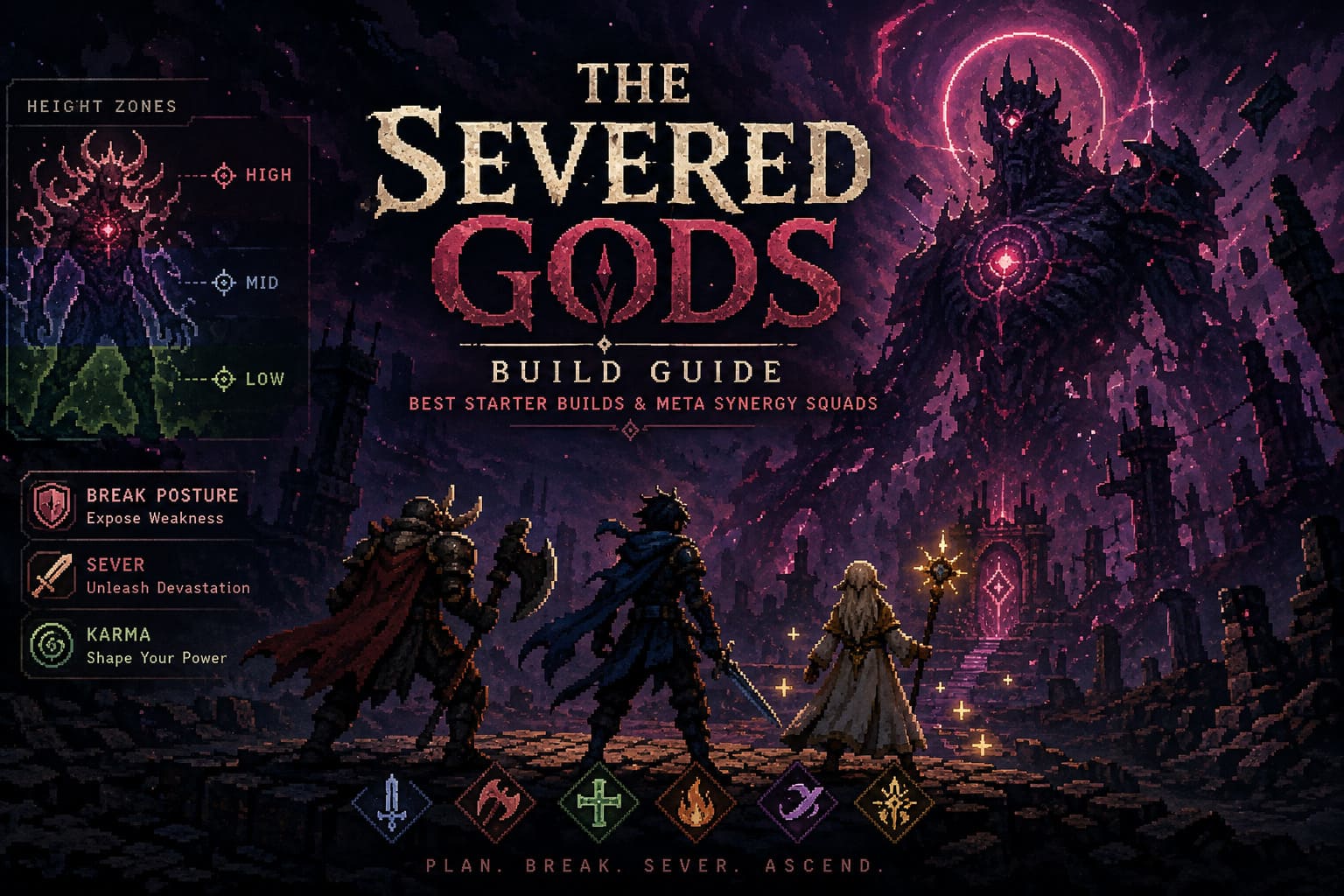
Enemies are divided into three primary zones:
| Zone | Typical Role | Why It Matters |
|---|---|---|
| Low | Ground-based attacks | Often connected to defensive or disruptive abilities |
| Mid | General-purpose targets | Usually the easiest zone to pressure consistently |
| High | Dangerous weak points | Frequently tied to powerful boss attacks |
Each body segment has its own posture shield, and breaking that shield is often more important than simply throwing your biggest damage skill at the enemy.
This is where the game gets genuinely interesting.
An enemy can change its posture during combat. A boss preparing an attack from the High zone may suddenly shift downward, while another creature can expose a previously inaccessible weak point. Your skills don’t magically adapt to this change either. If your entire party is built around one height, you’re going to spend a lot of turns staring at the wrong target.
And that is exactly how runs die.
The best squads therefore aren’t necessarily the ones with the highest theoretical DPS. They are the ones that can reliably cover Low, Mid, and High targets while maintaining enough damage and sustain to survive the longer encounters.
Breaking posture also opens the door to the game’s most satisfying mechanic: Sever.
Once the relevant shield is destroyed, an enemy can enter a vulnerable state. If you’ve lined up your party correctly, that moment can turn a slow, grinding boss fight into absolute carnage.
Best Starter Build: The Dual-Strike Swordfighter
For new players, I strongly recommend keeping the basic starter trio together for a while.
The combination of Swordfighter, Axe-Throwing Tank, and Divine Healer isn’t flashy, but it teaches you practically everything you need to understand about the game’s combat system.
The Swordfighter is where I’d put most of your attention.
The goal is to turn this character into a fast Mid/High posture breaker who can manipulate the battle before the enemy gets a chance to dictate the pace.
Recommended Swordfighter Build
Primary Attributes: Agility and Willpower
Agility is extremely valuable early on because acting first can mean the difference between breaking a posture shield and watching your entire party eat a devastating attack.
Willpower helps push your offensive scaling and critical potential, making the Swordfighter useful after the posture break as well. You don’t want a character who is only good at opening shields. You want somebody who can capitalize on the opening they create.
Core Skills
Sky-Slicing Dash should be one of your priorities. This High-target attack gives the Swordfighter an answer when an enemy exposes its upper segment. Once upgraded with the Posture Exploit trait, it becomes particularly nasty against enemies preparing High-zone attacks.
Horizontal Cleave handles the Mid zone and is extremely useful when dealing with groups. It is also one of those attacks that feels better and better as you learn enemy positioning because you stop wasting turns trying to force a single-target attack into the wrong situation.
Then there is Tactical Parry.
This reaction-style ability is easy to underestimate. A successful parry can completely change the flow of a turn, reducing incoming damage while allowing the Swordfighter to counterattack a vulnerable section.
That combination gives the starter hero a very useful identity:
- Fast opener
- Posture breaker
- Counterattacker
- Finisher
That’s exactly what I want from a starting character.
Relics for the Swordfighter
Your relic choices should reinforce what the character is already good at rather than trying to turn him into something completely different.
Two particularly useful early options are:
- Obsidian Whetstone: Improves physical armor-piercing damage and increases posture-breaking efficiency against Mid-level targets.
- Reincarnated Karma Band: Rewards successful skill combos by providing a temporary attack boost based on the previous turn’s performance.
The Whetstone is the safer option for consistent progression. The Karma Band is more exciting if you’re already comfortable chaining abilities and maintaining momentum.
And yes, relic greed can absolutely ruin a run. Don’t pick an item simply because its description sounds powerful. If it doesn’t support your team’s actual damage profile, it may as well be dead weight.
How to Play the Starter Swordfighter
The biggest mistake new players make is attacking immediately without checking what the enemy is preparing.
Don’t do that.
At the beginning of a serious encounter, look at the enemy’s posture and determine which zone is about to become dangerous.
If a boss starts preparing a High-zone breath attack, that’s your signal.
Use Sky-Slicing Dash and start working down that upper posture shield. If you break it before the attack fires, you’ve potentially prevented a massive chunk of incoming damage while creating a Vulnerable window for the rest of your squad.
This is one of those mechanics that looks simple on paper but becomes incredibly satisfying once it clicks.
You’re not just dealing damage.
You’re interrupting the enemy’s plan.
Best Meta Squad Compositions
Once you’ve gone through several reincarnation cycles and unlocked more heroes and artifacts, the starter team eventually gives way to more specialized compositions.
I would divide the current meta into three major archetypes: balanced posture control, status-effect burst, and Karma-based scaling.
Each one has a very different feel.
1. Posture-Lock Team — Best All-Around Composition
Team: Swordfighter + Axe-Throwing Tank + Divine Healer
This is still the squad I’d recommend to players who want consistency rather than gambling everything on a high-roll run.
The Swordfighter handles Mid and High targets, while the Axe-Throwing Tank focuses on Low and Mid zones. The Divine Healer fills the gaps with healing, buffs, and utility.
The Tank’s Ground Slam is especially useful for repeatedly damaging Low posture shields while applying a Stagger-style effect that reduces enemy speed.
Meanwhile, the Swordfighter keeps attacking higher zones.
The beauty of this composition is that both frontline characters are working on different parts of the same problem.
Then comes the payoff.
Once you’ve broken posture across multiple zones, the Divine Healer can use Heavenly Alignment to synchronize the team’s attack heights for a turn.
That’s when the whole party can pile onto a previously awkward vulnerable zone.
And when this works against a boss, it feels downright unfair.
| Hero | Primary Job | Main Coverage |
|---|---|---|
| Swordfighter | Fast Breaker | Mid / High |
| Axe-Throwing Tank | Disruptor | Low / Mid |
| Divine Healer | Sustain & Buffs | Team Utility |
For a first serious meta team, this is the composition I would trust the most.
2. Elemental Bleed & Burn Squad — High DPS Option
Team: Pyromancer + Rogue Assassin + Guardian Bulwark
This is the squad for players who look at a defensive strategy and think, Nah, I’d rather kill everything before it becomes a problem.
Fair enough.
The Pyromancer handles Mid-zone area damage and applies Burn across multiple targets. The Rogue Assassin then exploits those damage-over-time effects with powerful High-zone attacks.
The Assassin’s synergy is particularly nasty because targets already suffering from a DoT effect can take additional critical damage.
That creates a straightforward combat rhythm:
Pyromancer spreads Burn → Assassin attacks marked targets → Bulwark absorbs retaliation.
The Guardian Bulwark provides the insurance policy.
Its Provoke ability forces enemy attacks toward the heavily armored frontline character, keeping the much more fragile Pyromancer and Assassin alive.
This team has a higher ceiling than the starter composition, but it is also less forgiving.
If your damage rotation falls apart, the enemy can punish you very quickly.
3. Karma Hyper-Carry Squad — Best Late-Game Scaling
Team: Shadow Blade + Light-Bringer Paladin + Alchemist Support
This is where The Severed Gods starts getting really weird, and I mean that as a compliment.
The Karma system isn’t just window dressing. Your choices throughout the run can influence the strength and identity of certain characters.
The Shadow Blade benefits heavily from negative Karma, making a Sin-focused route attractive if you’re intentionally building around this character.
The Light-Bringer Paladin, meanwhile, can provide defensive value by converting the consequences of high Sin into protective effects through abilities such as Dark Absolution.
Then there’s the Alchemist.
The Alchemist is essentially the person who looks at your relic collection and says, What if we made all of this considerably more ridiculous?
The Relic Multiplier Combo
The centerpiece is Catalyst Injection, which temporarily increases the effectiveness of equipped combat relics.
When combined with powerful late-game artifacts such as Umbral Heart, this setup can create absurd burst windows.
A Shadow Blade that already has strong Karma scaling suddenly gets access to amplified relic effects as well.
This is the kind of build that isn’t necessarily amazing during the first few rooms. It gets scarier as the run develops.
By the time you reach Umbra, however, the numbers can become downright silly.
Meta-Progression Tips That Actually Matter
There are a few habits that separate successful runs from those doomed “one more room” attempts.
Use Short Rests
Don’t treat Short Rest as something you use only when everything has already gone wrong.
If your MP is drained before an important encounter, resting can be far more valuable than taking another fight while your abilities are unavailable.
Roguelite players have a terrible habit of thinking they can squeeze in one more battle.
Sometimes you can.
Sometimes that “one more battle” is exactly where the run ends.
Sever Dangerous Body Parts First
When facing a major boss, don’t blindly focus on overall HP.
Ask yourself which body part represents the biggest threat.
A giant creature’s stinger, breath organ, weapon arm, or another specialized segment may be responsible for one of its most devastating abilities.
If you can break and Sever that part, you’ve effectively removed a weapon from the boss.
That’s much more valuable than shaving a few extra percentage points off the central health pool.
Build Relics Around Your Character
This sounds obvious, but it is one of the easiest mistakes to make during a long run.
If your Swordfighter is scaling physical attacks, prioritize relics that improve:
- Armor penetration
- Attack speed
- Physical damage
- Critical performance
- Posture-breaking efficiency
Don’t grab an Intelligence-focused relic simply because its rarity is higher.
A useless legendary is still useless.
The best relic isn’t necessarily the rarest one. It’s the one that makes your existing strategy work harder.
Is The Severed Gods Worth Buying? 2026 Review & Gameplay Analysis
Which Build Should You Choose?
If you’re still learning the game, go with the Posture-Lock team. It gives you reliable zone coverage, healing, disruption, and plenty of opportunities to learn how enemy posture changes work.
If you want speed and explosive combat, choose the Elemental Bleed & Burn squad. It’s more aggressive and significantly more satisfying when the rotation works perfectly.
For experienced players chasing a powerful late-game run, the Karma Hyper-Carry composition is easily the most interesting. It requires more planning, but the payoff can be ridiculous.
The important thing is not to think about these builds as rigid templates.
The Severed Gods is at its best when you adapt.
Your relics may push you toward a completely different strategy. A branching path may give you an unexpected character upgrade. An enemy’s posture pattern may force you to change your attack order.
That’s part of the fun.
The strongest player isn’t necessarily the one with the strongest spreadsheet build. It’s the player who can look at a bad situation and immediately find the mechanic that turns it around.
The Severed Gods Nintendo Switch Release Date: Is It Coming to Xbox Game Pass in 2026?
Final Verdict
The Severed Gods has the kind of combat system that can feel a little overwhelming at first, but once the height-based mechanics click, the whole game opens up.
The trick is to stop thinking of combat as a simple exchange of damage.
Watch the posture zones. Break the correct shields. Sever dangerous body parts. Build your relics around your actual team. And, most importantly, make sure your squad can reach the zones it needs to reach.
The starter Swordfighter is a surprisingly strong foundation, especially when built around Agility, Willpower, Mid/High coverage, and posture breaking. The balanced trio remains the safest choice, while status-effect teams offer faster clears and Karma-based compositions provide some of the most entertaining late-game scaling.
And then there’s Umbra.
That final confrontation is where all those little decisions finally matter.
If you’ve spent an entire run carefully building a synergy squad, collecting the right relics, managing Karma, and surgically removing boss body parts, watching Umbra’s strongest attack disappear because you severed the exact segment responsible for it is incredibly satisfying.
That’s the real hook of The Severed Gods.
It doesn’t just ask you to make strong characters.
It asks you to understand the battlefield.
Once you do, the game stops feeling brutally unfair and starts feeling like a puzzle you are getting better at solving. And honestly, that’s exactly what I want from a good roguelite RPG.