Resonance A Plague Tale Legacy Deluxe Edition Physical Steelbook: Ultimate Preorder Guide
If you’ve spent hundreds of hours with the A Plague Tale games, you probably know the feeling: sometimes a game becomes more than something you launch after work. You want the box, the artwork, the Steelbook, the little physical extras that make the whole experience feel permanent. That is exactly why Resonance: A Plague Tale Legacy has caught my attention so hard ahead of its August 27, 2026 release.
Asobo Studio is taking the series somewhere surprisingly different. Instead of following Amicia and Hugo, the new game puts Sophia in the spotlight and sends players fifteen years before the events of A Plague Tale: Requiem. The setting is radically different too, with Minotaur’s Island, ancient Minoan mysteries, deadly creatures, brutal close-range combat, and puzzles built around manipulating light.
For me, that combination is already interesting enough. But the physical editions are where things get particularly complicated. If you’ve been searching for the Resonance: A Plague Tale Legacy Deluxe Edition physical Steelbook, you need to understand exactly what each package contains before throwing money at a preorder.
A Plague Tale Is Changing Its Combat Formula
The biggest reason I’m watching Resonance closely has nothing to do with collectibles. It’s the gameplay.
The earlier games built much of their tension around stealth, avoiding enemies, crafting resources, and desperately looking for a way through situations where direct combat usually meant trouble. Resonance appears ready to kick that formula in the teeth.
Sophia has a much more aggressive fighting style. Her combat revolves around timed parries, reactive melee attacks, quick counterplay, and health recovery through kills. That could make encounters feel considerably more active than the stealth-heavy sequences many players associate with the franchise.
Personally, I think this is the right kind of risk. A prequel that simply copied Innocence and Requiem would probably feel safe but predictable. Giving Sophia a completely different combat identity makes the game feel like its own chapter rather than an excuse to revisit familiar mechanics.
Sophia’s Story Takes the Series Somewhere Strange
Sophia is not just being dropped into another dark medieval adventure for the sake of changing protagonists. Her journey is connected to her own past, her mysterious lineage, and the secrets hidden on Minotaur’s Island.
The island draws heavily from Greek mythology and Minoan history, creating an atmosphere that feels very different from the medieval European locations we know from previous games. Ancient ruins, labyrinthine environments, forgotten artifacts, and supernatural threats give the game a much more mysterious flavor.
One of the coolest ideas is the way the narrative connects different periods of history. Sophia investigates the island while discovering echoes of ancient conflicts and their relationship to the terrifying Macula.
That gives the story a bigger sense of scale. The Macula has always been one of the strangest elements of A Plague Tale, and tying its mythology to an ancient civilization could finally answer questions that fans have been carrying around for years.
Light Becomes More Than an Atmospheric Tool
The light-based mechanics are another feature that immediately grabbed my attention.
Sophia obtains a mysterious Minoan sphere and uses it to manipulate beams of light throughout the environment. That turns illumination into an actual gameplay mechanic rather than just another visual effect.
Expect puzzles that require players to redirect light, manipulate environmental elements, understand positioning, and figure out how to move safely through dangerous areas.
It sounds simple on paper, but this kind of mechanic can become fantastic when developers combine it with exploration and enemy encounters. If Asobo manages to make the light system matter during both puzzles and survival situations, it could become one of the defining mechanics of Resonance.
The Physical Editions Are Where Things Get Interesting
Now we get to the part collectors actually care about.
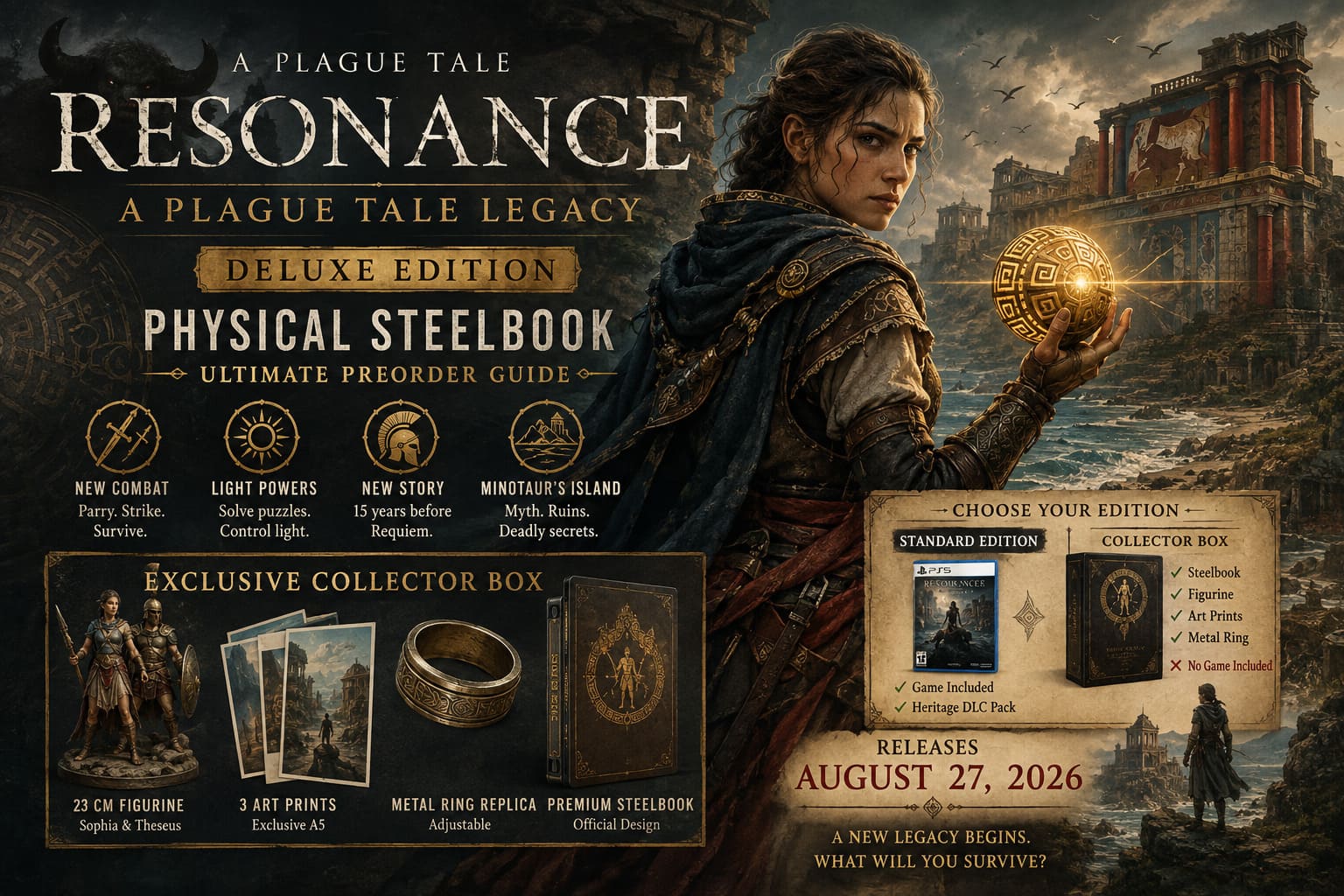
The physical release structure for Resonance: A Plague Tale Legacy is unusual because the official premium Steelbook is tied to a collector-focused merchandise package rather than simply being included with the standard physical game.
That distinction matters.
If you only want to put the game on your shelf and start playing immediately, the standard physical edition is the straightforward choice. If you want the fancy metal case and premium physical extras, you’re looking at a completely different purchase.
Standard Physical Edition
The standard physical release is designed for PlayStation 5 and Xbox Series X|S players who want the actual game disc.
It comes in the traditional retail packaging and is the option that makes the most sense for players who don’t care about having an expensive collector’s display piece.
Preordering the standard physical version also provides access to the Heritage DLC Pack, which includes several bonuses:
- Hero’s Blade weapon skin
- Alec’s pendant charm
- Digital artbook
For a normal player, this is probably the sensible route. You get the game, preorder bonuses, and physical ownership without spending collector-level money.
The Exclusive Collector Box Is the Big Prize
The real attraction for collectors is the Exclusive Collector Box.
This is the package aimed squarely at people who see a game shelf as a hobby rather than simple storage. The edition is individually numbered and includes several physical items built around the world of Resonance.
The package includes:
- A 23 cm hand-painted Sophia and Theseus figurine
- Three exclusive A5 art prints
- An adjustable metal ring replica inspired by artifacts from the game
- The official premium Steelbook
The Steelbook is obviously the headline item for anyone specifically hunting for premium physical packaging. But the figurine and replica accessory make the entire package much more interesting as a display piece.
The visual identity of A Plague Tale also feels almost tailor-made for a Steelbook. Dark medieval textures, ancient symbols, weathered metal, dramatic lighting, mysterious ruins and supernatural imagery can look fantastic when translated into premium physical artwork.
There’s One Major Catch
Here’s the detail I would absolutely check before ordering.
The Exclusive Collector Box does not include a copy of the game.
There is no physical game disc inside, and the box does not provide a digital copy either.
That means the collector package is essentially a premium merchandise bundle. If you want to actually own the physical game and have the official Steelbook, you’ll need to purchase the standard physical edition separately.
At first glance, that might seem strange. As a collector, though, I can understand the logic. The premium box is platform-agnostic, which means the same merchandise can work for PlayStation and Xbox owners rather than forcing the manufacturer to create separate versions containing different discs.
Still, it makes the buying decision much less straightforward.
Physical Edition Comparison
| Edition | Game Included | Steelbook | Collector Figure | Art Prints | DLC Bonuses |
|---|---|---|---|---|---|
| Standard Physical Edition | Yes | No | No | No | Yes |
| Exclusive Collector Box | No | Yes | Yes | Yes | No |
| Standard + Collector Box | Yes | Yes | Yes | Yes | Yes |
| Custom Steelbook | Depends | Custom | No | Usually No | Depends |
The Standard + Collector Box combination is the dream setup for hardcore physical collectors, although it naturally costs more than simply buying the game.
Why the Steelbook Actually Makes Sense for This Game
I’m usually pretty selective about Steelbooks. Plenty of them look cool in promotional photos and then end up feeling like expensive metal DVD cases.
Resonance is different because the game’s visual style lends itself extremely well to this format.
The combination of ancient mythology, medieval characters, ruined architecture, mysterious symbols and dramatic light-versus-shadow imagery should translate beautifully onto a metal case.
A good Steelbook also gives collectors something that a digital license simply cannot provide: a physical object connected to the game you played.
That might sound sentimental, but anyone who has been collecting games for years knows exactly what I mean. You remember the game, then you look at the box years later and immediately remember where you were when you played it.
What About Custom Steelbooks?
There is another option for people who don’t want the full collector package.
Custom Steelbook creators have already shown interest in designing premium cases inspired by the game. These unofficial alternatives can focus entirely on artwork, allowing fans to buy a metal case without committing to a complete collector’s box.
Some designs feature dramatic character artwork on the front and expansive views of Minoan ruins or mysterious island landscapes on the back.
For someone who already owns the standard game and simply wants a better-looking case, this can be an attractive alternative.
There is an obvious difference, though: custom Steelbooks are not the official collector product. If authenticity and official licensing matter to you, the Collector Box remains the one to chase.
My Recommended Buying Strategy
If I were putting together my own Resonance collection, I wouldn’t overcomplicate it.
First, I’d secure the standard physical edition. That guarantees the actual game disc and preorder bonuses.
Then, if the budget allows, I’d hunt down the official Exclusive Collector Box for the Steelbook, figurine, prints, and ring replica.
That gives you the complete physical package instead of discovering after purchase that your expensive collector box doesn’t actually contain the game.
For collectors who only care about the Steelbook, a quality custom alternative could make more financial sense. You lose the official collector status, but you also avoid paying for several extras you might not personally care about.
Why I’m More Excited for Resonance Than I Expected
The funny thing about Resonance: A Plague Tale Legacy is that the physical edition discussion almost overshadows the game itself.
That’s understandable when you see what is included in the collector package, but the actual game could be the more interesting story.
Asobo Studio is taking one of its most recognizable franchises and changing several fundamental ingredients. Sophia replaces Amicia as the central character, the setting moves into a world influenced by Minoan mythology, melee combat becomes much more prominent, and light manipulation adds a new puzzle layer.
That’s a lot of change for one sequel/prequel.
I don’t want another A Plague Tale that simply checks the same boxes. I want something that makes me think, ‘Okay, this is weird, but I love it.’ From what we’ve seen so far, Resonance has a real chance of doing exactly that.
Final Verdict: Which Physical Edition Should You Buy?
If you’re a casual player, the Standard Physical Edition is the obvious choice. You get the game itself and the preorder bonuses without turning the purchase into a full collector project.
If you’re a serious physical-media fan, the Exclusive Collector Box is the centerpiece. The official Steelbook, numbered packaging, Sophia and Theseus figurine, art prints and metal ring make it a proper display package rather than a simple premium game case.
If you’re like me and want the whole thing, the best setup is Standard Physical Edition + Exclusive Collector Box. Yes, it costs more, but you end up with both the playable physical game and the premium collector hardware.
The most important thing is to know what you’re buying before checkout. The Collector Box’s lack of a game copy is the detail most likely to surprise people who assume ‘collector edition’ automatically means ‘game included.’
With August 27, 2026 approaching, physical copies and limited collector merchandise are exactly the kind of items worth securing early if you already know you want them. Resonance: A Plague Tale Legacy looks ready to open a strange new chapter for the franchise, and for fans who love having a physical reminder of their favorite games, this one could be a particularly satisfying addition to the shelf.