Onimusha Way of the Sword Soul Guide: How to Absorb Red, Yellow, Blue Orbs and Spend Red Souls for Combat Buffs
Onimusha: Way of the Sword is the kind of action game that looks familiar for the first few hours and then starts punishing you for playing it like everything else. Yes, there are swords, dodges, parries and demons everywhere, but the combat is built around much more than simply learning attack patterns. One of the systems that really clicked with me is the Soul mechanic.
Every serious fight eventually becomes a small resource-management game. You defeat a Genma, souls burst from its body, and suddenly you have to decide whether it is safe to stop attacking and absorb them. That sounds simple on paper. In practice, it can be the exact moment when another enemy decides to put a sword through Musashi’s back.
That risk is what makes the system interesting. Red, Yellow and Blue Souls are not interchangeable resources, and understanding what each color does can make a noticeable difference during difficult encounters. Red Souls are especially important because they feed your progression and combat upgrades, while Yellow and Blue Souls can keep you alive and give you access to Oni Armaments.
After spending a lot of time thinking about how the system fits into the overall combat loop, I would strongly recommend learning Soul management early instead of treating it as something you can figure out later. The better you become at harvesting souls safely, the more comfortable the entire game becomes.
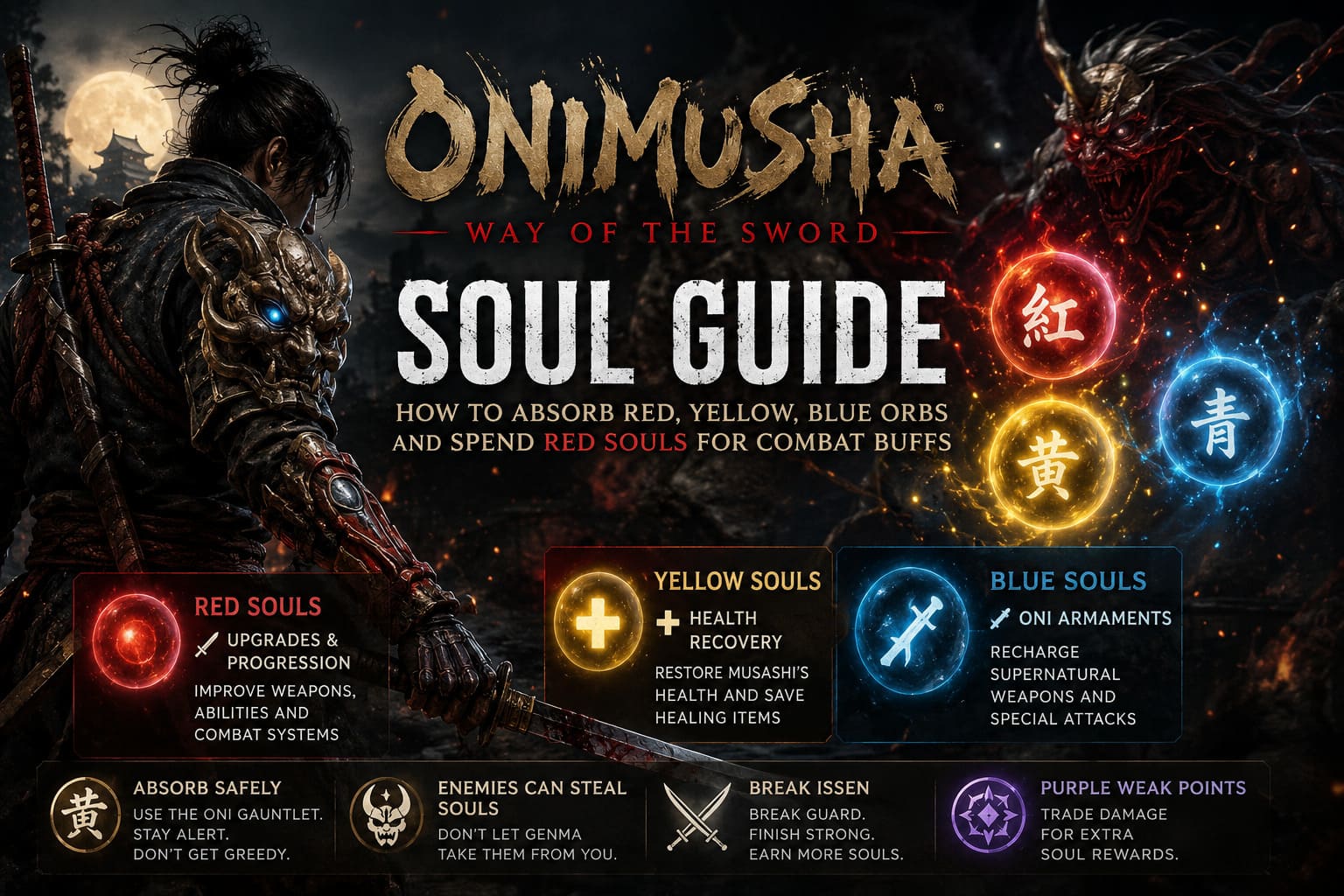
Onimusha: Way of the Sword Soul Colors Explained
The first thing every player should understand is what each Soul color actually represents. The game does not simply throw three different collectibles at you for decoration. Each one supports a different part of Musashi’s toolkit.
| Soul Color | Main Purpose | Why It Matters |
|---|---|---|
| Red Souls | Upgrades and progression | Used to improve weapons, abilities and other combat-related systems |
| Yellow Souls | Health recovery | Restores Musashi’s health and can save valuable healing items |
| Blue Souls | Oni Armaments | Recharges supernatural weapons and their special attacks |
Once you understand that division, Soul collection becomes much more deliberate. I stopped looking at a battlefield as simply a place where enemies needed to die and started looking at it as a resource pool. That mindset is particularly useful in longer encounters where healing items are limited.
Red Souls: Your Most Important Long-Term Resource
Red Souls are essentially the backbone of Musashi’s progression. You will encounter them constantly, especially after defeating regular Genma and performing powerful finishing attacks. If you are planning to improve your weapons and combat abilities, you are going to need a healthy supply.
What I like about Red Souls is that they give regular combat a purpose beyond simply clearing the next group of enemies. Even a small fight contributes toward your future upgrades. The game rewards players who understand that killing efficiently today can make the next difficult encounter easier.
However, Red Souls are also the easiest resource to become careless with. You see a huge pile of them floating around after a finisher and instinctively want to absorb everything immediately. That is exactly when you need to look around first.
Before holding the Soul absorption button, check the battlefield. If another Genma is still aggressive, create some distance. A few seconds of positioning can be worth much more than greedily grabbing every Red Soul while standing in the middle of an enemy group.
Yellow Souls Are Basically Emergency Healing
Yellow Souls restore Musashi’s health when absorbed. This makes them extremely valuable, particularly when you are deep into an encounter and your regular healing resources are running low.
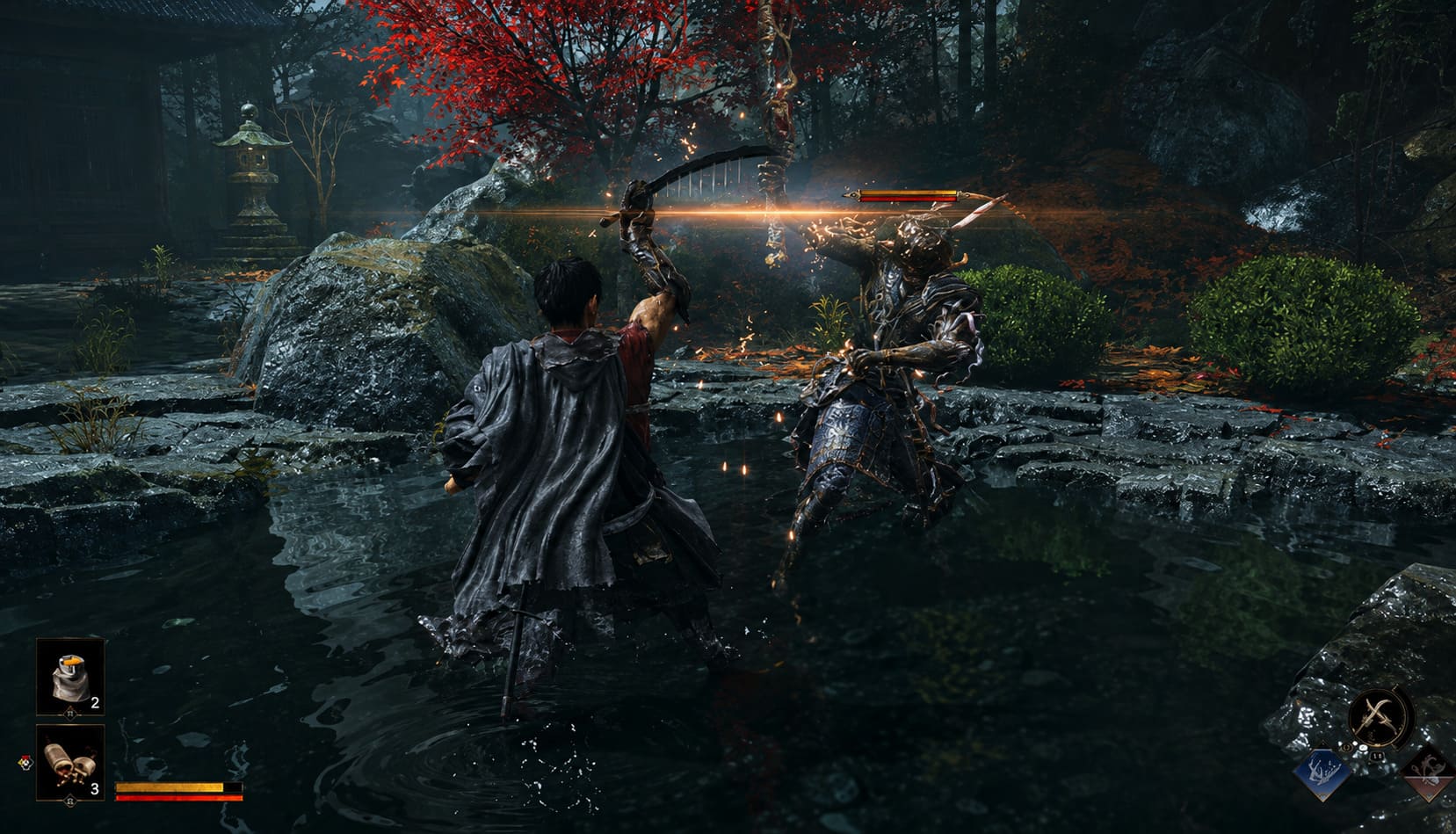
For me, Yellow Souls are arguably the most satisfying to collect because they turn successful combat into immediate survival. You take down an enemy, a yellow orb appears, and suddenly the fight gives you a small second chance.
The catch is that Yellow Souls are generally less common than Red Souls. You cannot always expect the battlefield to provide enough healing to completely replace your consumables. Instead, think of Yellow Souls as a bonus layer of sustain that rewards aggressive and technically strong play.
There is also an interesting interaction with specific equipment. The Two Celestials Oni Armament can cause enemies to release additional Yellow Souls when you successfully land attacks. If you are struggling with health management, this can make a noticeable difference.
Blue Souls Keep Your Oni Armaments Ready
Blue Souls serve a completely different role. Instead of restoring health or purchasing upgrades, they recharge Oni Armaments.
These supernatural weapons are some of the most entertaining tools in Musashi’s arsenal. Their special attacks can deal heavy elemental damage, interrupt dangerous enemy sequences and help control groups that would otherwise become difficult to manage.
I would not recommend thinking of Blue Souls as something you should automatically spend the second your Oni Armament becomes available. Sometimes the smartest decision is to keep your powerful ability ready for an elite enemy or a particularly dangerous attack pattern.
Good Soul management is therefore partly about knowing when not to use your resources.
How to Absorb Souls Without Getting Killed
This is where the Soul system becomes much more interesting. Absorbing Souls is an active action, not an automatic pickup. Musashi has to use the Oni Gauntlet to pull nearby orbs toward himself.
While performing the absorption, you can still move directionally, but you cannot fight normally. That creates a surprisingly dangerous vulnerability window.
My biggest piece of advice is simple: never assume a Soul pile is free loot. If you see five Red Souls floating next to an angry Genma, those five Red Souls are not worth taking a hit just because they are sitting there.
A safer approach is:
- Stagger enemies first before attempting to absorb a large Soul cluster.
- Create physical distance with movement or defensive play.
- Watch the arena instead of focusing exclusively on the floating orbs.
- Absorb quickly once the area is safe and return to combat immediately.
Once this becomes muscle memory, Soul collection feels much less dangerous.
Genma Can Steal Your Souls
One of the nastiest twists in the Soul system is that Musashi is not always the only creature interested in the floating orbs.
Certain Genma can absorb Souls themselves. This becomes particularly important during encounters with powerful enemies such as Daidara. If you leave Souls floating around for too long, an enemy can consume them and become stronger.
That changes the priority of an encounter completely. Suddenly, those Red and Yellow Souls are not just rewards waiting for you at the end of the fight. They are resources that the enemy can potentially turn against you.
Daidara is a great example. When he consumes Souls, his stomach visibly expands, making it clear that something has changed. At that point, you cannot simply continue playing defensively and hope the problem disappears.
Attack the swollen weak point aggressively to force the consumed Souls back out. This is one of those mechanics that initially feels strange, but once you understand it, it becomes a natural part of the fight.
Break Issen Is One of the Best Ways to Farm Souls
If there is one combat mechanic I would recommend mastering early, it is Break Issen.
Instead of mindlessly reducing an enemy’s health, pay attention to its red stamina or guard gauge. Parrying attacks correctly and using powerful two-handed attacks can help drain that gauge. Once the enemy’s guard breaks, a red indicator appears.
That is your moment.
Hit the enemy with the appropriate light or heavy attack and Musashi performs a cinematic Break Issen finisher. Apart from looking fantastic, the mechanic has an enormous practical advantage: the execution gives you invincibility frames during the animation and produces a large Soul reward.
This is why I think Break Issen is more than a flashy finishing move. It is a resource-generation tool. You are effectively converting good defensive play and stamina management into damage, safety and Souls at the same time.
Once you start planning fights around Break Issen opportunities, regular Genma encounters become much more rewarding.
Use Purple Weak Points for Extra Soul Rewards
Boss fights introduce another layer to Soul management through targeted weak points.
When a major enemy’s posture is broken, you can often choose where to attack. Red indicators generally represent areas where you can maximize direct damage. Purple-marked sections, however, can provide a different advantage.
Targeting purple weak points can trade some immediate damage for additional Soul rewards.
That creates an interesting decision during longer boss fights. If you desperately need to end the encounter, focus on damage. If you are comfortable controlling the boss and want to improve your resource economy, hunting the purple targets can be worthwhile.
Personally, I prefer using this approach when I already understand the boss’s attack patterns. There is no reason to take unnecessary risks for extra Souls when you are one mistake away from losing the fight.
Where Should You Spend Red Souls?
Collecting thousands of Red Souls is only useful if you actually invest them intelligently. The Enhancement system gives you several ways to improve Musashi, and not every upgrade will have the same impact on your personal playstyle.
1. Upgrade Your Weapons
Weapon progression is the obvious place to start. Increasing your weapons’ effectiveness improves Musashi’s damage output and makes tougher Genma much easier to deal with.
However, do not think about weapon upgrades purely in terms of a bigger damage number. Certain improvements can also make your attacks feel more efficient, improve attack chains and help you break enemy stamina more reliably.
If you frequently rely on the two-handed stance, upgrades that improve the effectiveness and recovery of heavy attacks can be particularly valuable.
2. Improve the Oni Gauntlet
The Oni Gauntlet is one of the most interesting upgrade paths because it improves the system that feeds your other systems.
Soul absorption speed should be a priority for players who regularly find themselves exposed while collecting resources. The faster Souls reach Musashi, the shorter the dangerous absorption window becomes.
Later improvements can also provide defensive benefits while absorbing, making the entire mechanic less punishing.
3. Invest in Blaze and Blazing Effects
Blaze is another mechanic worth building around if you enjoy playing aggressively and mastering parries.
Successful perfect deflections can build toward a stronger combat state, increasing Musashi’s offensive potential. Upgrading related passive abilities can improve how long this enhanced state lasts and make it easier to maintain during demanding fights.
This is one of those upgrade paths I would recommend based on skill rather than simply following a universal meta. If your parries are inconsistent, there are probably more immediately useful upgrades. If you are already comfortable reading enemy attacks, however, Blaze can become extremely powerful.
4. Don’t Ignore Mobility
Mobility upgrades are easy to overlook because they do not always produce an obvious damage increase. That is a mistake.
Perfectly timed evasions can create moments where combat slows around Musashi, giving you an opportunity to punish an enemy with a powerful attack. For aggressive players, this can be just as valuable as another damage upgrade.
The game rewards players who understand that survival and damage are often connected. A well-timed dodge does not merely save health—it can create your next offensive opportunity.
How to Fix Onimusha: Way of the Sword Fatal Error Memory Allocation Block
My Recommended Soul Priority
If you are unsure where to focus your resources, I would approach the system in this order:
- Learn safe Soul absorption. There is no point earning Souls if you constantly lose health collecting them.
- Upgrade weapons and core combat tools. More efficient kills make every future encounter easier.
- Improve Soul absorption speed. This reduces the risk attached to your resource collection.
- Build around your strongest combat style. Parry-heavy players should consider Blaze-related upgrades, while aggressive players may prefer offensive and mobility improvements.
I would also avoid blindly spending every Red Soul as soon as you have enough for an upgrade. Think about what actually causes you problems. If enemies are surviving too long, improve damage. If you are constantly getting interrupted while collecting Souls, improve the Gauntlet. If you are already comfortable with damage but struggle to stay alive, prioritize tools that improve your defensive options and access to Yellow Souls.
Onimusha Way of the Sword ROG Ally X Performance Guide: How to Get 60 FPS Optimized Settings
Final Thoughts: Learn the Soul Loop and Musashi Gets Stronger
Onimusha: Way of the Sword becomes much more enjoyable once you stop treating Souls as random collectibles and start seeing them as part of the combat engine.
Red Souls build your long-term progression. Yellow Souls provide desperately needed healing. Blue Souls keep your supernatural weapons charged. Meanwhile, the act of collecting them forces you to understand positioning, enemy behavior and timing.
That last part is what I appreciate most. The Soul system encourages you to stay engaged with the battlefield. You cannot simply kill everything, stand still and vacuum up the rewards without thinking. Enemies can steal Souls, absorption leaves you vulnerable, and powerful attacks can create better opportunities to harvest resources.
My advice is to embrace that risk instead of trying to avoid the system. Learn when to step away, when to finish an enemy with Break Issen, when to chase a purple weak point and when to leave a Soul floating for a few seconds.
Once those decisions become automatic, Musashi starts feeling considerably more powerful. Not because the game suddenly becomes easy, but because you are finally using its combat economy the way it was designed to be used.
And honestly, that is where Onimusha: Way of the Sword shines. The swordplay may get the attention, but the Soul system is one of the mechanics that quietly ties everything together. Master it, invest your Red Souls intelligently, and even the nastier Genma encounters become far more manageable.