Manor Lords Strategy Guide: How to Expand Settlement Size and Feed Peasants Fast (2026 Meta)
There is a point in Manor Lords where building a bigger settlement stops feeling like progress and starts feeling like a personal attack.
You have timber. You have families. You have a decent food supply. Approval looks healthy. So you place a few more Burgage Plots, upgrade some houses, and think you are finally ready to turn that sleepy medieval village into a proper town.
Then winter arrives.
Suddenly the food reserves are disappearing, the marketplace looks empty, families are complaining, approval starts falling, and you are staring at your settlement wondering how everything went wrong so quickly.
I have played enough city builders and strategy games to know that this is usually not a production problem. It is a planning problem. Manor Lords punishes players who expand faster than their logistics can support. The game makes a small village deceptively easy to maintain, but once the population starts climbing, every weakness in your economy becomes much more obvious.
The good news is that you don’t need some ridiculous spreadsheet-level economy to build a large settlement. You just need to understand how housing, food variety, markets, storage, and labor interact.
After spending plenty of time experimenting with different settlement layouts, backyard extensions, farming setups, and food chains, this is the approach I would recommend in the current Manor Lords meta.
The Biggest Mistake: Building Houses Too Quickly
The temptation to expand housing is obvious.
You have enough timber, so why not build ten more Burgage Plots?
Because housing creates demand, and demand is what eventually breaks an unprepared settlement.
Every new family means another household consuming food, fuel, clothing, and other resources. More families also need more market coverage and more workers. If you build houses faster than you can support those requirements, your settlement can look wealthy on paper while actually running on borrowed time.
My general rule is simple:
Don’t build housing just because you can. Build it because your economy can support the families that will live there.
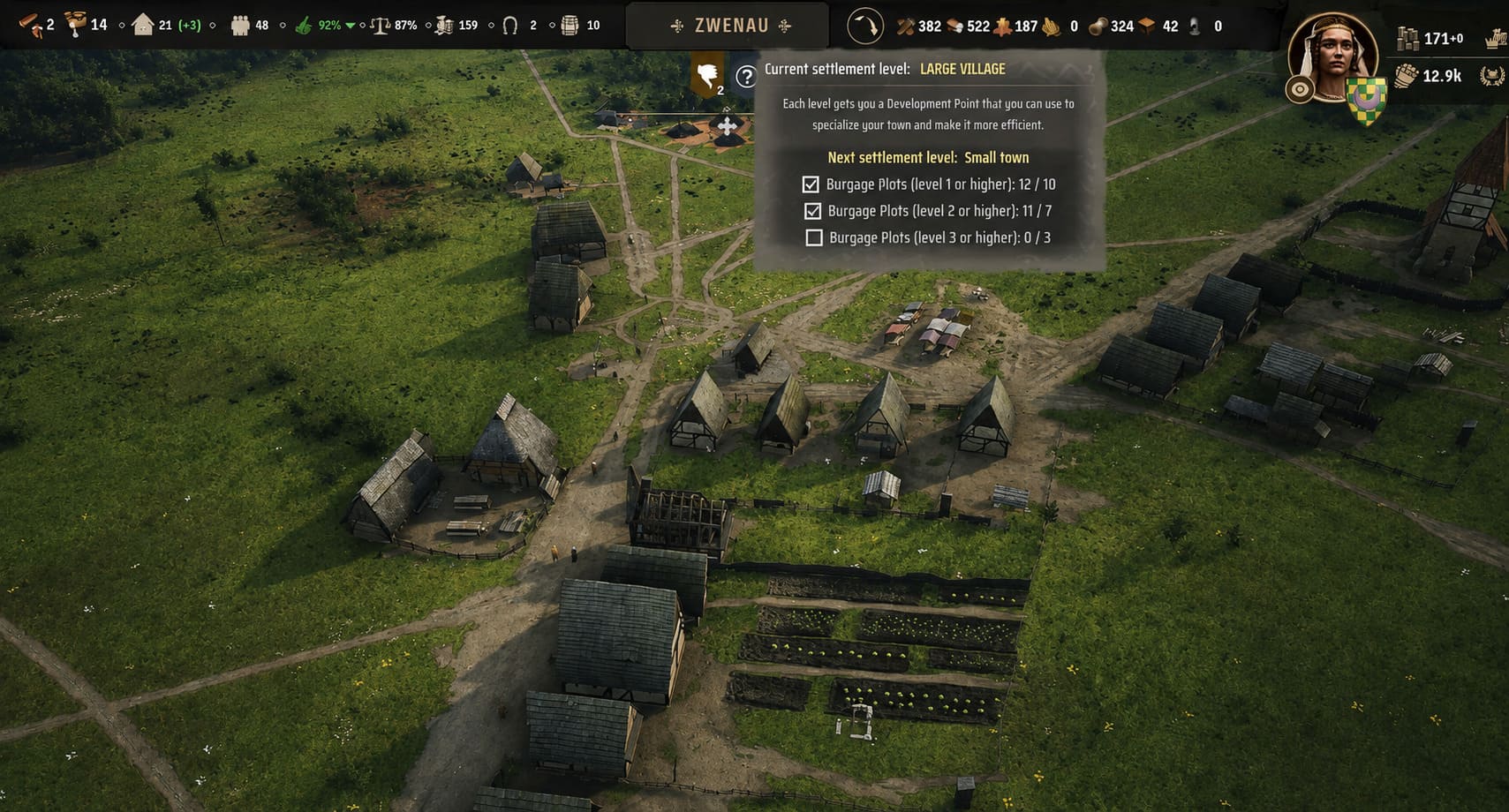
Keep an eye on your Settlement Level requirements and use them as a target rather than treating every available plot as an invitation to expand.
The exact requirements can change as the game develops, so I always recommend checking the Settlement Level tooltip rather than blindly following an old build order.
That little tooltip is one of the most useful pieces of information in the entire interface.
Burgage Plot Placement Matters More Than You Think
One of the best things about Manor Lords is that your houses are not just decorative blocks.
The shape of the Burgage Plot matters.
When you place a plot, pay attention to the backyard space. If the game gives you the option to create an additional living space, that can be extremely valuable during the early and mid-game.
These double plots are one of my favorite tools for growing a settlement efficiently.
Instead of constantly expanding the physical footprint of your residential district, you can sometimes get more families from the same general area. That means fewer roads, less wasted space, and a more compact marketplace.
But there is a catch.
More families are still more families.
A double plot isn’t a magic population cheat. If your food economy is already struggling, filling your town with additional households simply makes the problem arrive faster.
I like using double plots once my basic food production is comfortably ahead of consumption. They are fantastic for accelerating growth, but I would never rely on them as a replacement for proper resource planning.
Approval Rating Is Your Population Engine
A lot of players think approval is simply a happiness statistic.
It isn’t.
In practice, it is one of your most important growth systems.
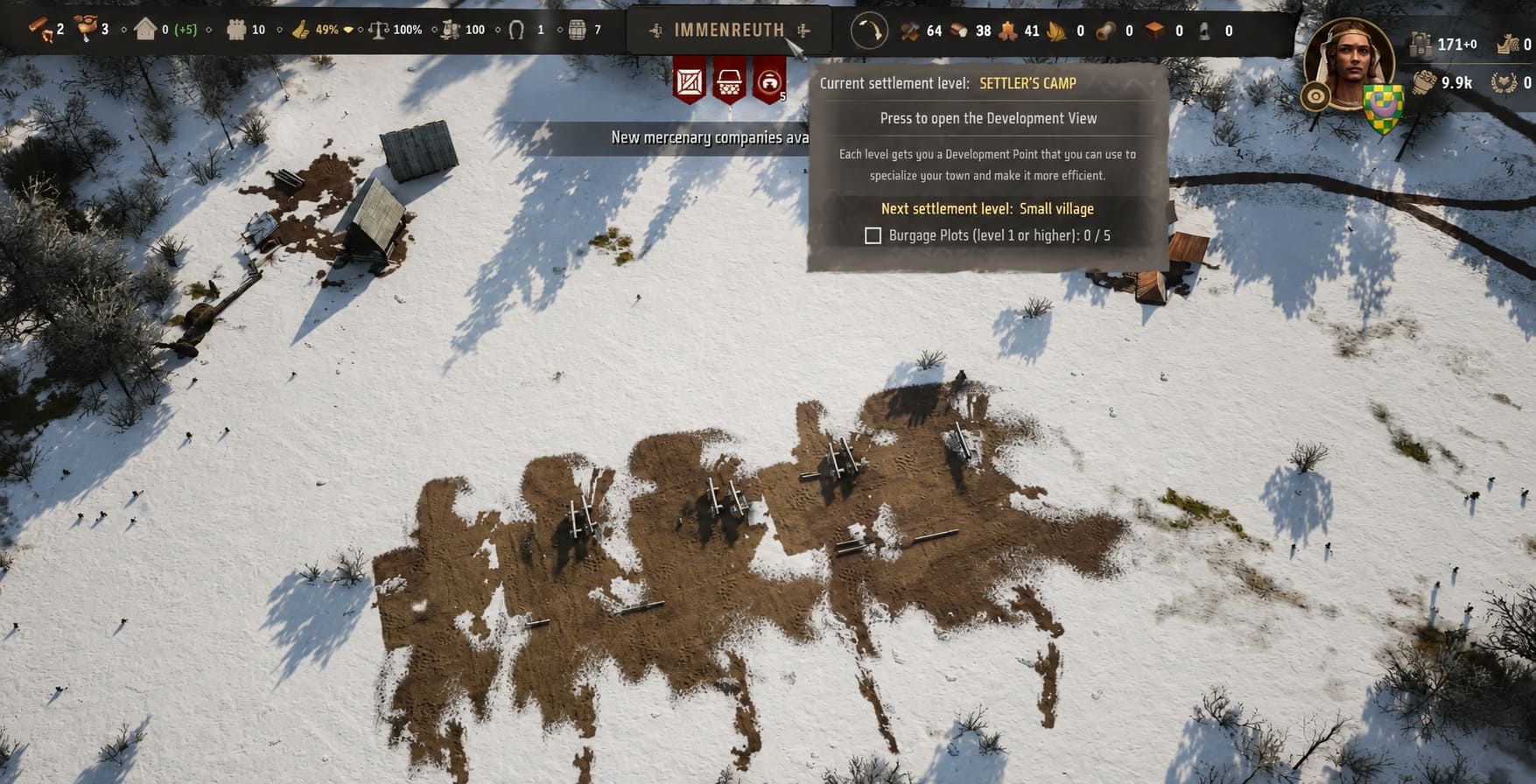
Keeping approval above 50% allows immigration to continue, while maintaining a very high approval rating accelerates the arrival of new families. That makes approval directly connected to your ability to expand.
And this is where many settlements enter a nasty cycle:
More houses → more families → higher consumption → shortages → lower approval → slower immigration → economic problems.
You want the opposite.
More houses → enough food → stable market → high approval → steady immigration → controlled expansion.
That means I would rather have a smaller town with 75%+ approval and a healthy food surplus than a visually impressive settlement where everyone is one bad harvest away from disaster.
Taxes also deserve caution. Early on, squeezing your population for extra income can create more problems than it solves. Regional Wealth and trade are useful, but destroying your approval just to accelerate your treasury is rarely worth it.
How I Feed a Growing Settlement Fast
Food is where Manor Lords gets particularly interesting.
You don’t simply need food.
You need a reliable combination of food sources that can keep supplying the population throughout the year.
Early in a campaign, berries and meat can carry you surprisingly far. Eventually, though, your population will outgrow those sources.
That’s when I start building a proper food ecosystem.
My preferred food mix includes:
- Berries for early seasonal production.
- Meat from hunting.
- Eggs from Chicken Coops.
- Vegetables from large backyard plots.
- Honey from Apiaries.
- Bread once farming and milling become reliable.
- Apples if you invest into the appropriate development path.
The important part isn’t simply producing enormous quantities of one resource.
It’s creating variety.
Food variety becomes increasingly important as you upgrade Burgage Plots, and relying on one source can leave your economy extremely vulnerable to seasonal fluctuations.
If all your food comes from berries, for example, you are basically asking winter to ruin your plans.
Vegetables Are One of My Favorite Early Food Investments
If I have the space, I love vegetable gardens.
The reason is simple: backyard size matters.
A tiny backyard is not going to produce the same potential harvest as a properly sized vegetable plot. When I plan residential districts, I deliberately reserve some of the larger plots for families that can support substantial vegetable gardens.
I prefer long, relatively narrow plots rather than awkward shapes that waste available backyard space.
The downside is labor.
Vegetable gardens are not completely free food. The family living there has to spend time working the plot. If that household is also responsible for an important production chain, you can end up with a very inefficient worker.
So I try to assign large vegetable plots to families that aren’t carrying an essential industrial job.
That small bit of planning makes a noticeable difference.
Chicken Coops Are Better Than They Look
Chicken Coops are almost the opposite strategy.
Instead of giving a family a huge backyard, you can place them on smaller plots and use the extension for chickens.
Their output isn’t massive on an individual basis, but that’s not really the point.
Eggs provide another source of food variety with very little active management.
Once you have a compact residential district, several chicken extensions can create a useful baseline of eggs.
I wouldn’t build my entire food economy around them. That would be silly. But as a supplementary source, they are excellent.
This is one of those Manor Lords mechanics where small numbers become significant once your settlement reaches a decent size.
Don’t Underestimate Berries
Berries are one of those resources that feel almost overpowered at the beginning and completely insufficient later.
The trick is knowing when to stop depending on them.
If you have a rich berry deposit, don’t necessarily throw a huge number of families into one Forager Hut and expect everything to work perfectly. Production buildings have storage and logistical limitations, and simply adding workers doesn’t always solve the bottleneck.
I’ve had better results using multiple Forager Huts with smaller worker assignments around a strong berry area.
This spreads out the workload and gives the production chain more breathing room.
It also means one building becoming overloaded doesn’t immediately cripple the entire food system.
The important thing is to watch the actual numbers rather than assuming that more workers automatically means more food.
Farming: Powerful, But Easy to Screw Up
Farming is where many Manor Lords players eventually graduate from “village management” to “why is everyone starving when I have three fields full of wheat?”
The answer is usually logistics.
A farm doesn’t magically become bread.
You need to grow crops, harvest them, thresh them, process grain into flour, and then turn that flour into bread.
Every stage can become a bottleneck.
That’s why I prefer smaller, manageable fields instead of immediately creating gigantic agricultural monsters.
Long, relatively narrow fields are also easier to work efficiently, particularly when you’re dealing with oxen and upgraded farming mechanics.
And then there’s the seasonal problem.
Timing matters.
Your farming workforce needs to be flexible enough to respond when harvesting becomes urgent. I don’t like having half my town permanently assigned to farms when nothing important is happening.
Instead, I move labor around depending on the season.
When harvest arrives, farming gets priority.
When the fields are quiet, those families can contribute elsewhere.
That flexibility is one of the biggest differences between a settlement that merely survives and one that actually scales.
Your Marketplace Is the Nervous System of the Town
This is the part I think new players underestimate the most.
You can have food sitting in storage and still have unhappy families.
Why?
Because production and distribution are two different problems.
Your food needs to move through the logistics network and eventually reach the marketplace.
This is why I like keeping the Granary close to the main Marketplace.
The shorter the distance between storage and distribution, the easier it becomes for your market workers to keep stalls supplied.
Dedicated Granary workers can also dramatically improve the efficiency of this process because they are designed to move larger quantities of goods.
A common mistake is to build production buildings far away from everything else and then wonder why the economy feels sluggish.
Manor Lords is heavily influenced by walking distance.
A worker who spends half the day traveling is not really a productive worker.
The Settlement Layout I Actually Use
If I’m starting a fresh region, I don’t try to create the final city immediately.
I build a compact core first.
My opening priorities are usually:
- Logging Camp for reliable construction timber.
- Woodcutter Hut for fuel.
- Forager Hut for early food.
- Hunting Camp where the wildlife supports it.
- Granary and Storehouse positioned near the central market.
- A small residential district with carefully planned Burgage Plots.
I then stabilize the basics before aggressively adding more houses.
Once the town has reliable food, fuel, and approval, I start upgrading selected Burgage Plots rather than upgrading everything simultaneously.
This matters because upgrading a huge number of houses creates a huge jump in demand.
Controlled upgrades are much safer than mass upgrades.
What I Would Build During the First Two Years
Months 1–3: Survive First
The first few months are about establishing a functioning economy.
Don’t get distracted by military ambitions or an enormous residential district.
Secure timber, fuel, basic food, storage, and enough housing for steady population growth.
If you can finish this phase with a food surplus and stable approval, you’re already ahead of many failed settlements.
Months 4–12: Build the Economy
Now I start adding infrastructure.
A Well, Church, Trading Post, better Burgage Plots, backyard extensions and improved market logistics become increasingly important.
This is also where I start diversifying food.
If your town still depends almost entirely on berries at this point, you’re living dangerously.
Year 2+: Specialize
This is when the settlement begins to feel like a real town.
Upgrade your strongest Burgage Plots, develop your preferred economic paths, start serious farming where the terrain supports it, and think about regional expansion.
You should also have a clearer idea of what your region is good at.
If the soil is excellent, farming makes sense.
If the region has valuable resources, trade and specialization may be more attractive.
Don’t force your settlement into a generic build.
Use the map you’re actually playing.
Is Mandate Order Worth Buying? PC Review, Gameplay, and Manor Lords Comparisons (2026)
The Biggest Lessons I’ve Learned in Manor Lords
After playing a lot of strategy games, one thing I’ve learned is that the strongest build isn’t always the one with the highest theoretical production.
It’s the one that keeps working when something goes wrong.
In Manor Lords, that means having redundancy.
Don’t rely on one food source.
Don’t put every important production building miles away from your storage.
Don’t build dozens of houses before your economy is ready.
Don’t assign every available family to one industry just because the numbers look good.
And don’t forget that workers are also consumers.
That last point sounds obvious, but it changes how you think about expansion. Adding production capacity can actually create additional food demand because you’re taking families away from food-related work and increasing the total population.
The best settlement is therefore not the one with the biggest population.
It’s the one where population, production, logistics and consumption stay synchronized.
Mandate Order Release Date 2026: Is It Coming to PlayStation 5 and Xbox?
Final Verdict
The fastest way to build a large settlement in Manor Lords isn’t to spam Burgage Plots and hope the economy catches up.
It won’t.
Instead, expand in layers. Build enough housing to encourage immigration, keep approval high, diversify your food supply, use large backyard plots for vegetables, small plots for passive food extensions, and establish farming before your population completely outgrows the natural resources around you.
Most importantly, watch your marketplace.
A warehouse full of food doesn’t mean your peasants are being fed.
Once you understand that distinction, Manor Lords becomes much easier to scale. You stop reacting to shortages and start anticipating them. Your town grows because the economy is ready for it, not because you happened to have enough timber for another row of houses.
And honestly, that’s where the game becomes at its best.
Watching a tiny settlement slowly turn into a functioning medieval town is far more satisfying when you know every house, field, market stall and production chain is actually doing its job.