Mandate Order Retainer System Guide: Mechanics, Schools, and Strategy Explained
Mandate Order is the kind of strategy game that can punish you for thinking too small.
At first glance, it looks like another historical city builder where you place buildings, collect resources, expand your territory, and eventually send armies marching toward the nearest rival. After a few hours, though, it becomes obvious that the real battle is happening inside your own court.
That is where the Retainer System comes in.
Retainers, also known as guests or menke, are far more important than simple advisors. They can change the way your settlement produces food, manages resources, handles population, constructs defenses, and fights on the battlefield. In my experience, understanding this system early is one of the biggest differences between a settlement that merely survives and one that starts snowballing.
The interesting part is that Mandate Order does not simply give you a list of heroes and ask you to pick the strongest one. Your retainers belong to different philosophical schools, and those schools influence the direction of your entire state.
So, if you’re trying to figure out how the Mandate Order retainer system works, which schools are worth prioritizing, and how to turn random arrivals into a coherent strategy, this guide covers what you need to know.
What Are Retainers in Mandate Order?
Retainers are specialized NPCs who serve as scholars, administrators, military commanders, and economic specialists.
They are different from ordinary citizens. A farmer can produce food. A craftsman can work in a workshop. A soldier can fight.

A retainer can potentially make all three systems better.
That’s what makes them so valuable.
Depending on their abilities and philosophical background, a retainer can provide bonuses to production, improve administrative efficiency, strengthen military units, accelerate construction, influence policies, or help your settlement deal with environmental problems.
And here’s the part I really like: you don’t just collect these characters and forget about them. You have to think about where they are actually useful.
A powerful military retainer sitting inside an economic building might be completely wasted. On the other hand, putting an economic specialist into a high-output production center at exactly the right moment can solve a resource crisis before it turns into a disaster.
Personally, I think that’s what makes this mechanic work so well. The game asks you to think of retainers as active parts of your state rather than collectible portraits sitting in a menu.
How Retainers Arrive and Join Your Faction
Retainer recruitment isn’t completely static.
As your settlement develops, new scholars and specialists can appear seeking your patronage. Your progression, reputation, political status, territorial expansion, and general development all play a role in determining the quality of the people who become available.
Early arrivals are generally more modest, but that doesn’t mean you should ignore them.
A mediocre-looking retainer can still be extremely useful if their specialization matches what your settlement desperately needs.
For example, imagine you’re entering winter with a rapidly growing population and a dangerously low food reserve. A military commander might look impressive on paper, but an agricultural specialist could literally be worth more to your entire faction at that moment.
This is one of the first lessons I would give a new player:
Don’t recruit based purely on rarity or combat power. Recruit based on the problem your state has right now.
Where Should You Assign Your Retainers?
Once a retainer joins your faction, the important decision begins.
In broad terms, retainers can be used in two major areas: your civilian infrastructure and your military forces.
1. Assigning Retainers to Buildings
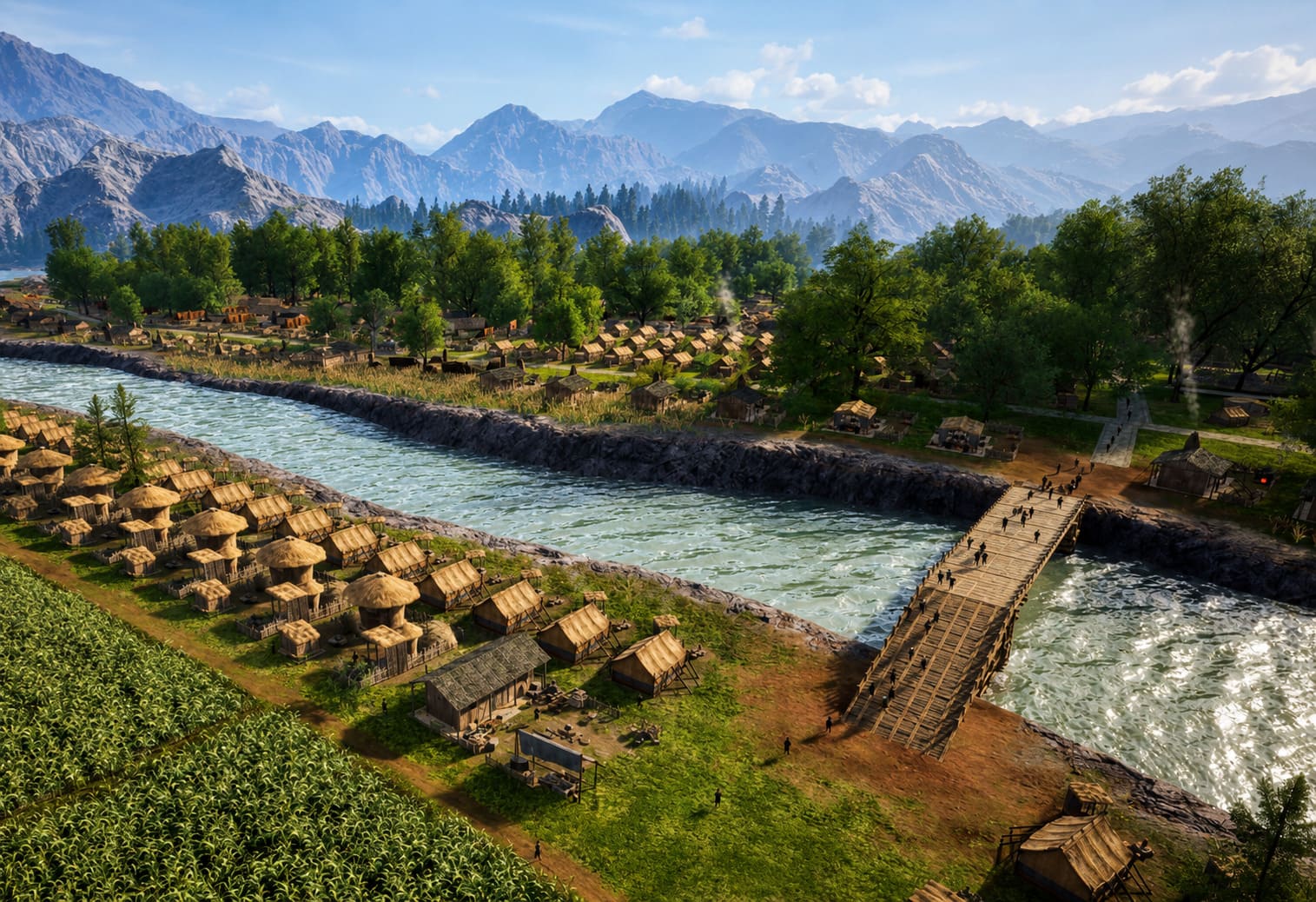
Economic and administrative retainers can be placed into relevant facilities to improve their performance.
Depending on the character, you may see improvements to:
- Food production
- Manufacturing speed
- Construction efficiency
- Administrative operations
- Resource transportation
- Workshop output
- Agricultural productivity
- Market and trade efficiency
The best approach is to identify your biggest bottleneck instead of spreading bonuses randomly.
If your workshops are producing plenty of tools but your transport network can’t move them quickly enough, boosting workshop production again won’t solve the problem.
Fix the bottleneck first.
This sounds obvious, but city builders constantly tempt players into making the numbers they already have look even bigger.
2. Assigning Retainers to Military Units
Military retainers are a completely different story.
A strong martial retainer can dramatically improve a specific unit or formation. Depending on their abilities, they can increase combat effectiveness, improve equipment, accelerate recruitment, or provide battlefield bonuses.
This can create a huge power spike.
A basic infantry unit that was barely capable of holding a defensive line can become a serious frontline force after receiving the right commander and equipment-related bonuses.
Personally, this is one of my favorite parts of the system because it creates a very satisfying connection between your city and your army.
Your soldiers aren’t magically getting stronger. Your state is becoming better at supporting them.
The Hundred Schools of Thought System
The philosophical side of the Retainer System is where Mandate Order gets considerably more interesting.
Each retainer belongs to one of the major intellectual traditions associated with ancient China. These schools aren’t simply labels. They represent different approaches to governing, warfare, economics, population management, and the relationship between the state and its people.
Your court can therefore develop an ideological identity.
The eight major schools represented in the system are:
| School | Main Strength | Best Use |
|---|---|---|
| Confucianism | Stability and morale | Population management and social order |
| Daoism | Environmental harmony | Seasons, nature, and survival |
| Legalism | Administration and efficiency | Production and state control |
| Mohism | Defense and construction | Fortifications and sieges |
| Military Strategy | Warfare | Army strength and battlefield tactics |
| Agriculturalism | Food production | Farms and population growth |
| Jiran | Economy and commerce | Trade and market income |
| Yin-Yang | Balance and special effects | Events and situational bonuses |
The important thing is not simply knowing what each school does.
You need to understand when each philosophy becomes valuable.
Confucianism: Keeping Your Population Under Control
Confucian retainers are especially useful when your settlement starts becoming large enough for population problems to become serious.
They focus on things like public opinion, morale, social stability, and population satisfaction.
When everything is going well, you might barely notice these bonuses.
When your settlement is hit by shortages, disasters, disease, or other negative events, suddenly stability becomes much more important.
A city with excellent production but miserable citizens isn’t actually functioning well.
Confucianism is therefore a great choice for players who prefer developing a stable, prosperous settlement before pushing aggressively into enemy territory.
Daoism: Surviving the Environment
Daoist retainers specialize in maintaining harmony with nature.
That becomes particularly useful when Mandate Order’s seasonal mechanics start affecting your economy.
Winter isn’t just a visual change. Harsh environmental conditions can create serious pressure on food supplies and production.
Daoist bonuses can reduce some of those problems and make your settlement more resilient.
I especially like this philosophy for expansion-heavy campaigns because the larger your territory becomes, the more difficult it can be to prepare for every environmental problem manually.
Legalism: The Efficiency Machine
If you like watching production numbers climb, Legalism is probably going to be your favorite school.
Legalist retainers emphasize administration, discipline, efficiency, and state control.
They are particularly useful when your settlement has reached the point where inefficiency is costing you more than a lack of raw resources.
A small village doesn’t need a perfectly optimized bureaucracy.
A large state absolutely does.
Use Legalist specialists in administrative positions, high-volume production chains, and areas where delays are creating cascading problems.
Mohism: Build the Fortress
Mohist retainers are the people I want nearby when someone starts talking about invading my territory.
Their strengths revolve around defensive construction, fortifications, and resource efficiency.
Walls, defensive structures, siege preparations, and other military infrastructure become much more attractive when you can construct them faster or for fewer resources.
If you’re playing a defensive campaign, Mohism can turn your settlement into a nightmare for anyone trying to break through.
And if you know a major war is coming, don’t wait until the enemy is already standing outside the gate.
Military Strategy: Your Battlefield Specialists
Military Strategy, or Bingjia, is the obvious choice for players who want to solve political problems with an army.
These retainers provide direct military benefits and can improve formations, recruitment, equipment, mobility, and battlefield performance.
They are especially valuable when you need a small number of elite formations rather than a gigantic army of mediocre troops.
One well-supported frontline unit can sometimes accomplish more than several poorly equipped formations.
That is why I recommend watching the retainer panel constantly during the early game. If a strong military specialist appears while your main army is still using low-tier equipment, don’t hesitate.
That kind of timing can completely change an early war.
Agriculturalism: Never Underestimate Food
Agriculturalism is perhaps the least glamorous school until your population starts eating through your reserves.
Then it suddenly becomes one of the most important.
Food is the foundation of expansion. More citizens mean more workers, more soldiers, and more demand.
That creates a simple problem:
Growth makes your food problem worse unless production grows with it.
Agriculturalist retainers help increase farming efficiency and seasonal crop output, allowing you to support a larger population without constantly draining your reserves.
If you are planning a population boom, don’t treat agricultural bonuses as optional.
Jiran: The Economic Play
Jiran focuses on trade, commerce, markets, and economic development.
This school becomes increasingly powerful as your faction establishes connections with other settlements and starts moving large quantities of resources.
Trade is particularly useful when you have a surplus of one resource but are desperately lacking another.
Instead of rebuilding your entire economy to fix a temporary shortage, a strong commercial network can allow you to buy what you need.
Jiran retainers are therefore excellent for players who want to create a wealthy, flexible state rather than simply maximizing raw production.
Yin-Yang: The Wild Card
Yin-Yang specialists are harder to categorize.
Their abilities revolve around balance, special effects, and situational mechanics. Their value can become particularly noticeable during special events and systems where outcomes are influenced by various factors.
They’re not necessarily the first retainers I’d build an entire strategy around.
But when the right event appears, the right Yin-Yang specialist can provide exactly the advantage you need.
Think of them as flexibility specialists rather than the foundation of your economy.
Building a Balanced Court
Here’s where things get interesting.
You cannot simply grab every retainer you see and assume more is always better.
The philosophical schools can interact with your wider political system, and having a court filled with conflicting approaches can create friction.
A Legalist-heavy government wants strict control and efficiency.
A Daoist-oriented approach is much more concerned with harmony and natural balance.
Those philosophies aren’t exactly pulling in the same direction.
That doesn’t mean you should completely avoid mixing schools. In fact, a mixed court can be extremely powerful.
The trick is to establish a dominant philosophy while keeping a few complementary specialists available.
For example:
- Legalism + Jiran can create a highly efficient economic state.
- Agriculturalism + Daoism works beautifully for population growth and environmental stability.
- Mohism + Military Strategy is ideal for defensive warfare.
- Confucianism + Agriculturalism can support a stable, rapidly growing population.
The best combination depends heavily on your current situation.
My Favorite Early-Game Retainer Strategy
If I were starting a new Mandate Order campaign today, I wouldn’t try to force a perfect build order.
I’d play opportunistically.
During the opening months, I’d prioritize these things:
- Watch every new retainer that becomes available.
- Look for one strong military specialist early.
- Keep at least one strong food-focused specialist if population is growing.
- Use Legalist or Jiran retainers in production and logistics bottlenecks.
- Switch priorities when the strategic situation changes.
That third point is more important than it sounds.
A lot of players get obsessed with military expansion because capturing territory feels like progress. But there’s nothing impressive about conquering three villages if your food economy collapses afterward.
Mandate Order rewards preparation.
Don’t Ignore Logistics
The logistics system deserves special attention because it connects almost everything.
Resources don’t simply teleport from the place where they’re produced to the place where they’re needed.
Transport yards, relay points, supply networks, and production facilities all have to work together.
This creates another important use for your retainers.
If your economy is producing enough iron but your army still can’t receive the equipment it needs, don’t automatically build another mine.
Look at the transportation chain.
A Legalist or Jiran retainer assigned to an important logistics or manufacturing hub can sometimes produce a much larger practical benefit than another raw-resource bonus.
This is one of those systems that looks complicated at first but becomes incredibly satisfying once you understand it.
Retainers Should Change With Your Campaign
One mistake I would avoid is keeping the same retainer assignments for the entire game.
Your priorities will change.
Early game might be about:
Food → Basic production → Population → Defense
Mid-game may become:
Iron → Logistics → Military production → Expansion
Late game could shift toward:
Large-scale warfare → Trade → Advanced infrastructure → Political stability
Your retainers should move with those priorities.
A character who was essential to your farming economy in year one might be much less valuable once you have enormous grain reserves.
Don’t be afraid to reassign them.
Mandate Order Fortress Guide: How to Build the Military Stronghold
The Retainer System Is the Real Heart of Mandate Order
After spending time with systems like this, I always appreciate when a strategy game makes its characters feel like part of the machinery rather than decorative portraits on a menu.
That’s exactly what Mandate Order’s retainer system is trying to accomplish.
These scholars connect economics, politics, population management, philosophy, logistics, and warfare.
Your city creates the resources that support your army.
Your army protects the city.
Your philosophical court determines how efficiently both systems operate.
And your retainers sit right in the middle of all of it.
That’s why I wouldn’t treat the Retainer System as a secondary mechanic. If you ignore it, you’re basically leaving one of the strongest strategic tools in the game unused.
The best approach is to keep checking who is available, understand what each school brings to the table, and then ask one simple question before making an assignment:
What is my faction struggling with right now?
If the answer is food, find an Agriculturalist.
If it’s administration, look toward Legalism.
If your borders are about to become a battlefield, call in the military specialists and Mohists.
If your economy is overflowing with one resource but starving for another, Jiran can become incredibly valuable.
And if everything is going well?
That’s when you can start preparing for the next problem before it arrives.
In a game set during one of the most politically fragmented periods of ancient Chinese history, that kind of preparation feels completely appropriate. Mandate Order isn’t just about building a bigger city or raising a bigger army. It’s about creating a state where every part of the machine supports the others.
Your retainers are the people who make that machine work.
Does Mandate Order Have Multiplayer Co-op? Full 2026 Gameplay Guide
Final Thoughts
The Mandate Order Retainer System might look intimidating when you first encounter all the schools, assignments, bonuses, and philosophical interactions. Don’t let that scare you.
You don’t need to memorize everything.
Start by identifying what your settlement needs, find a retainer who solves that problem, and build from there.
Most importantly, stay flexible.
The strongest campaign isn’t necessarily the one that follows the same build order every time. It’s the one where you recognize an opportunity when the right scholar, commander, or administrator walks through your gates.
For me, that’s what makes the system so compelling.
The best retainer isn’t always the strongest character. It’s the one who arrives at exactly the right moment.
And in a strategy game where a single bad winter, failed logistics chain, or unexpected invasion can wreck years of progress, timing can be just as powerful as raw strength.