Voidling Bound DNA Splicing Guide: How to Craft the Ultimate Specimen
Voidling Bound is one of those games that quietly eats your entire evening without asking permission. I usually jump in thinking I’ll just test a build or run a quick mission, and next thing I know I’m deep into genetic menus trying to convince myself that “one more splice” is a reasonable decision. It never is, but I still do it.
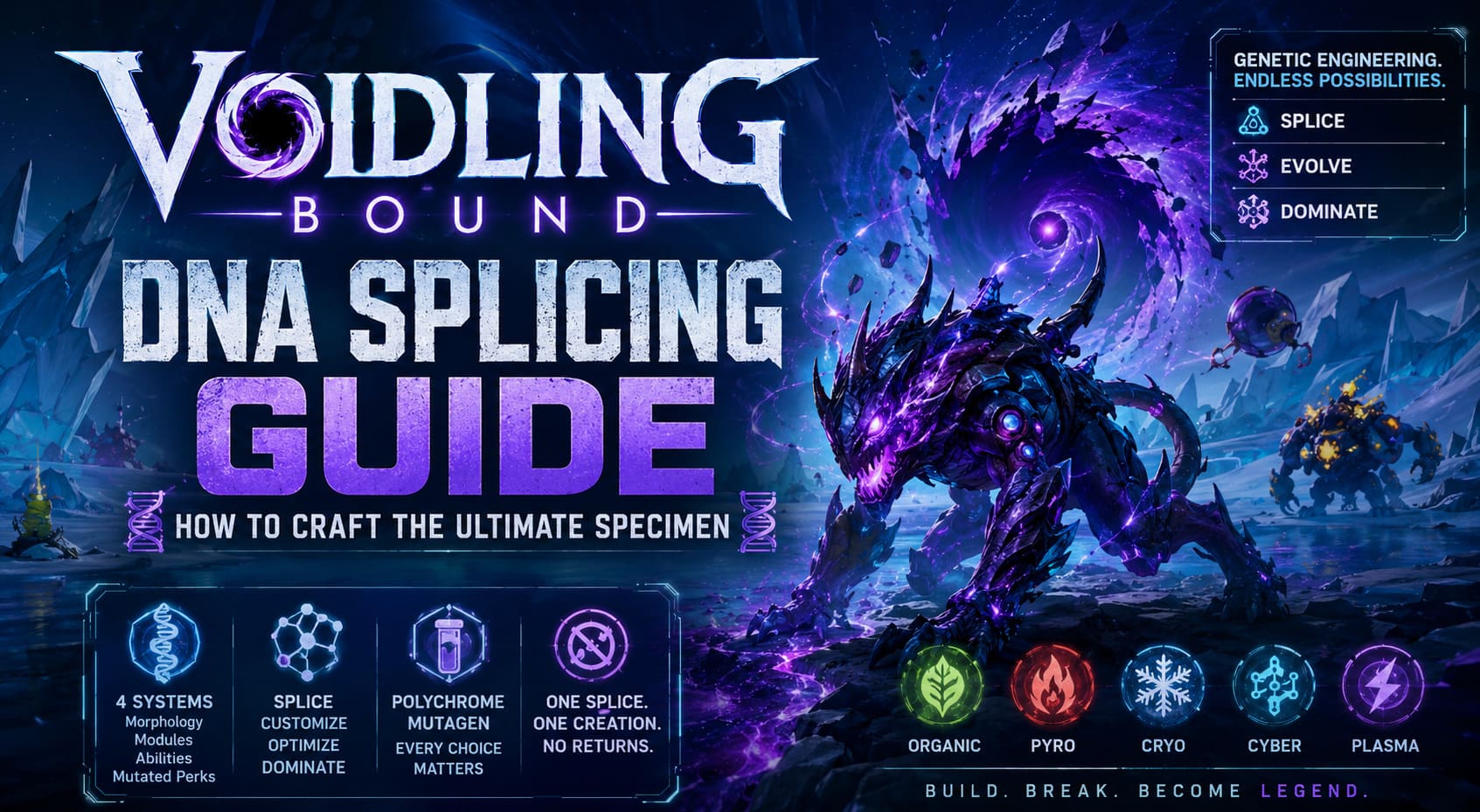
As someone who’s spent years in monster-taming and build-crafting games, I can say Voidling Bound stands out because of one thing: the DNA Splicing system doesn’t feel like a side mechanic. It feels like the real endgame where you stop following intended progression and start engineering your own rules.
Destiny 2 Anti-Champion Weapon System Explained – A Veteran Player’s Take on the New Meta
DNA Splicing – The Real Endgame System
Splicing isn’t something you casually experiment with early on. By the time you unlock it, you already have a roster of Voidlings you’ve likely invested time and resources into. That’s what makes the system interesting—and slightly dangerous.
Every splice costs Polychrome Mutagen, and that immediately changes your mindset. You stop thinking “what can I try?” and start thinking “what can I afford to potentially ruin?” It adds weight to every decision in a way most progression systems don’t.
There’s also a permanent consequence: once a Voidling is spliced, it becomes infertile. That single detail changes everything. You are no longer improving a creature—you are finalizing it.
Destiny 2 Tier 5 Exotic Armor Upgrade Guide – What It Really Means for Endgame Builds
What You Actually Modify When Splicing
The Splicing Station breaks every Voidling into four systems. Once you understand these layers, the entire game starts to feel like build engineering rather than creature collection.
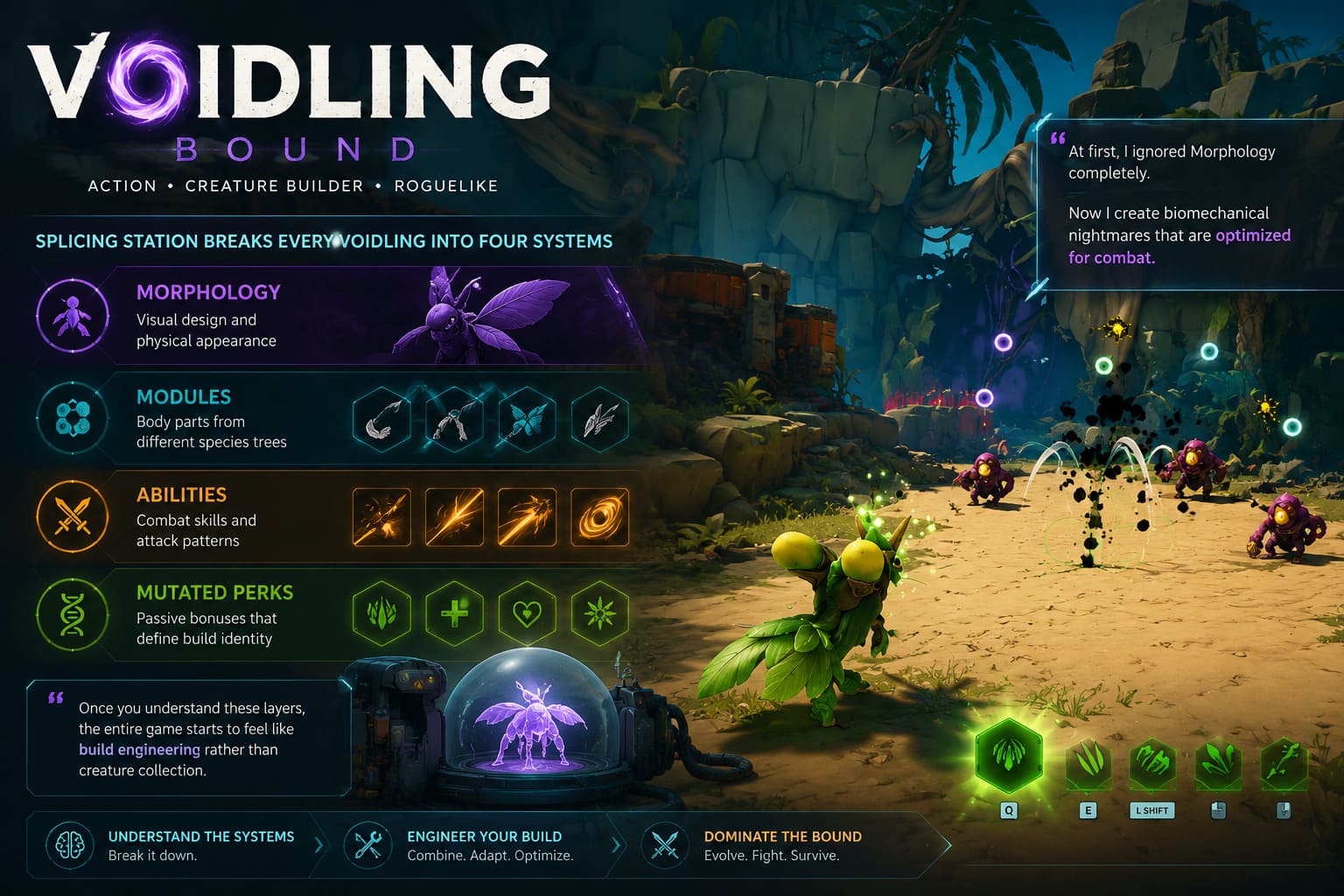
Here’s how I personally break it down while playing:
- Morphology – Visual design and physical appearance
- Modules – Body parts from different species trees
- Abilities – Combat skills and attack patterns
- Mutated Perks – Passive bonuses that define build identity
At first, I ignored Morphology completely. Now I spend an embarrassing amount of time making my Voidlings look like biomechanical nightmares that also happen to be optimized for combat.
The Core Strategy – Breed First, Splice Later
If there is one mistake I made early, it was rushing into splicing too soon. The system is not designed to fix weak Voidlings. It is designed to enhance already perfect ones.
The correct progression loop looks like this:
1. Breed for optimal stats and nature
2. Build a strong base creature
3. Only then commit to splicing
Once I stopped treating splicing as a shortcut and started treating it as a finishing tool, everything made more sense. It’s not about saving bad builds. It’s about elevating good ones into something absurd.
Step-by-Step Splicing Flow (How It Feels in Practice)
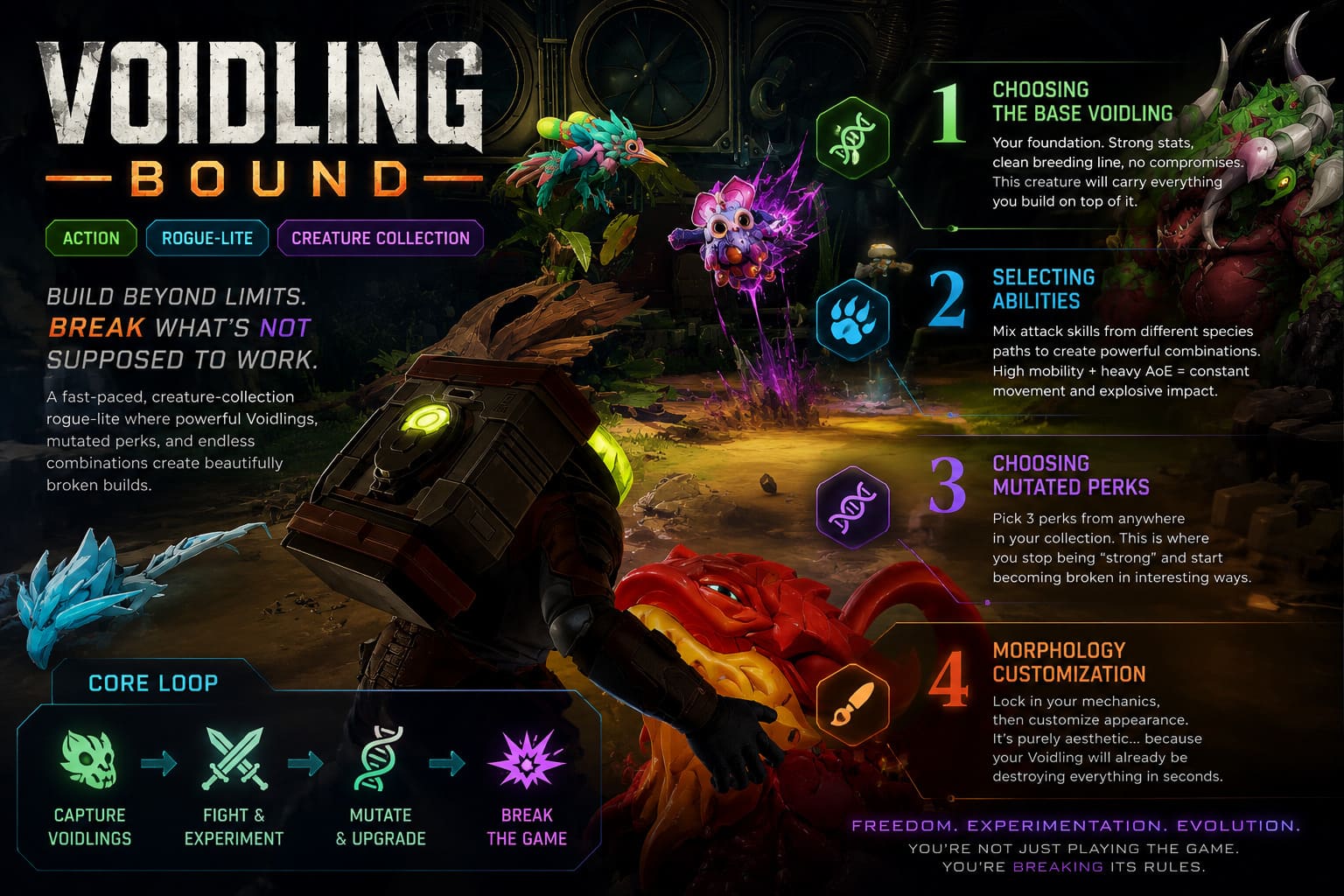
1. Choosing the Base Voidling
This is your foundation. You want something with strong stats, a clean breeding line, and no compromises. This creature will carry everything else you build on top of it.
2. Selecting Abilities
This is where experimentation starts to feel powerful. You can mix attack skills from different species paths, which leads to combinations that often feel intentionally overpowered.
I’ve personally built setups that combine high mobility with heavy AoE damage, and the result is a playstyle that feels like constant movement punctuated by explosions.
3. Choosing Mutated Perks
You get three perks from anywhere in your unlocked collection. This is where builds stop being “strong” and start becoming “broken in interesting ways.”
The freedom here is what makes the system addictive. You’re not just optimizing numbers—you’re building interactions between mechanics that were never meant to coexist.
4. Morphology Customization
After all mechanical decisions are locked in, you get to customize appearance. It’s purely aesthetic, but I’ll be honest: I’ve definitely spent too long perfecting the look of a Voidling that already destroys everything in seconds.
Element System – The Layer Most Players Underestimate
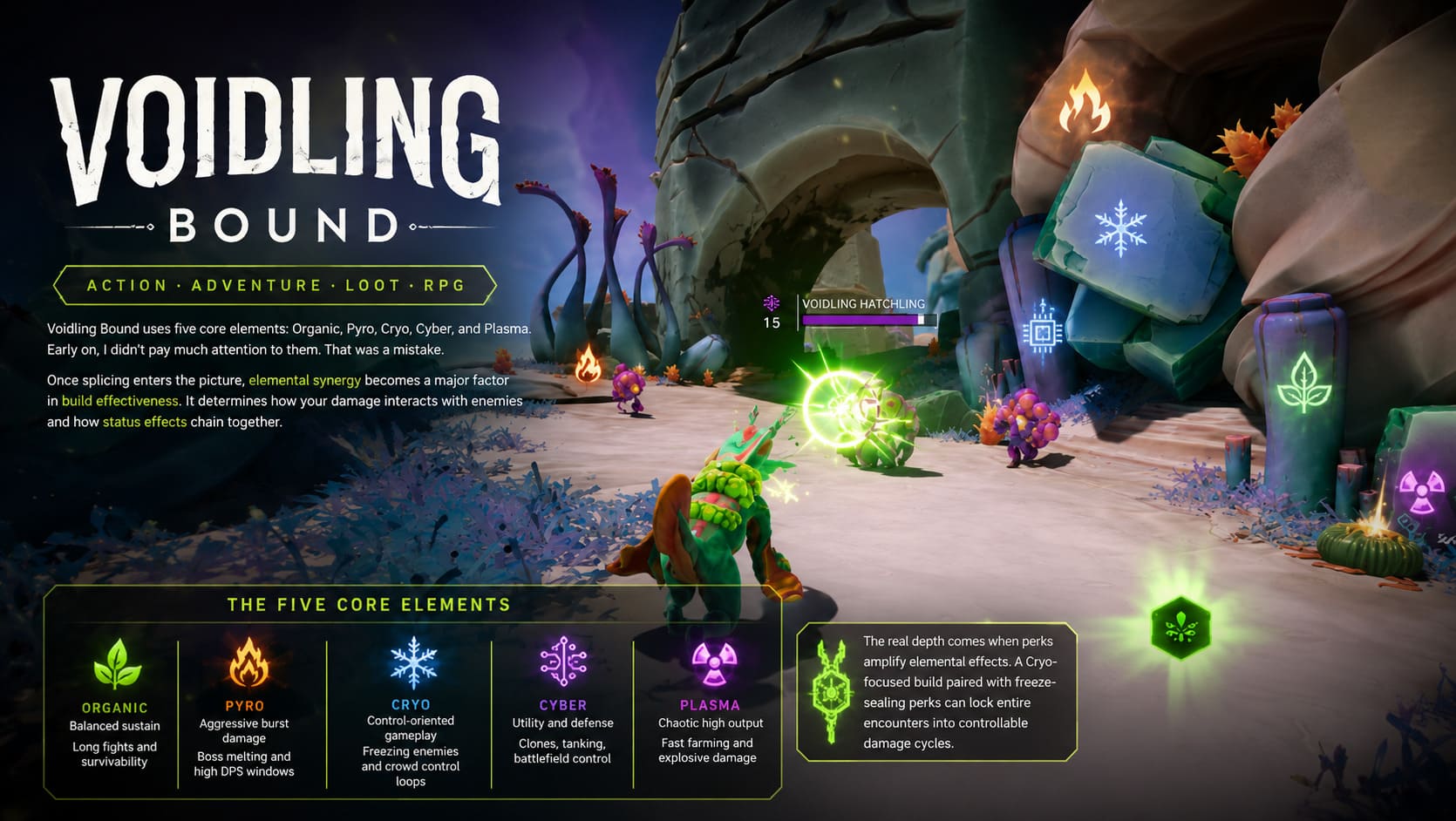
Voidling Bound uses five core elements: Organic, Pyro, Cryo, Cyber, and Plasma. Early on, I didn’t pay much attention to them. That was a mistake.
Once splicing enters the picture, elemental synergy becomes a major factor in build effectiveness. It determines how your damage interacts with enemies and how status effects chain together.
| Element | Playstyle | Strength |
|---|---|---|
| Pyro | Aggressive burst damage | Boss melting and high DPS windows |
| Cryo | Control-oriented gameplay | Freezing enemies and crowd control loops |
| Cyber | Utility and defense | Clones, tanking, battlefield control |
| Organic | Balanced sustain | Long fights and survivability |
| Plasma | Chaotic high output | Fast farming and explosive damage |
The real depth comes when perks amplify elemental effects. A Cryo-focused build paired with freeze-scaling perks can lock entire encounters into controllable damage cycles.
Builds That Actually Stand Out
Draconic Mobility Slam Build
This is the most aggressive setup I’ve tested. You combine high mobility traversal with powerful AoE slam attacks and cooldown resets.
The result is a loop where you move constantly across arenas, eliminate groups instantly, and reset abilities to repeat the process. It feels less like combat and more like controlled chaos.
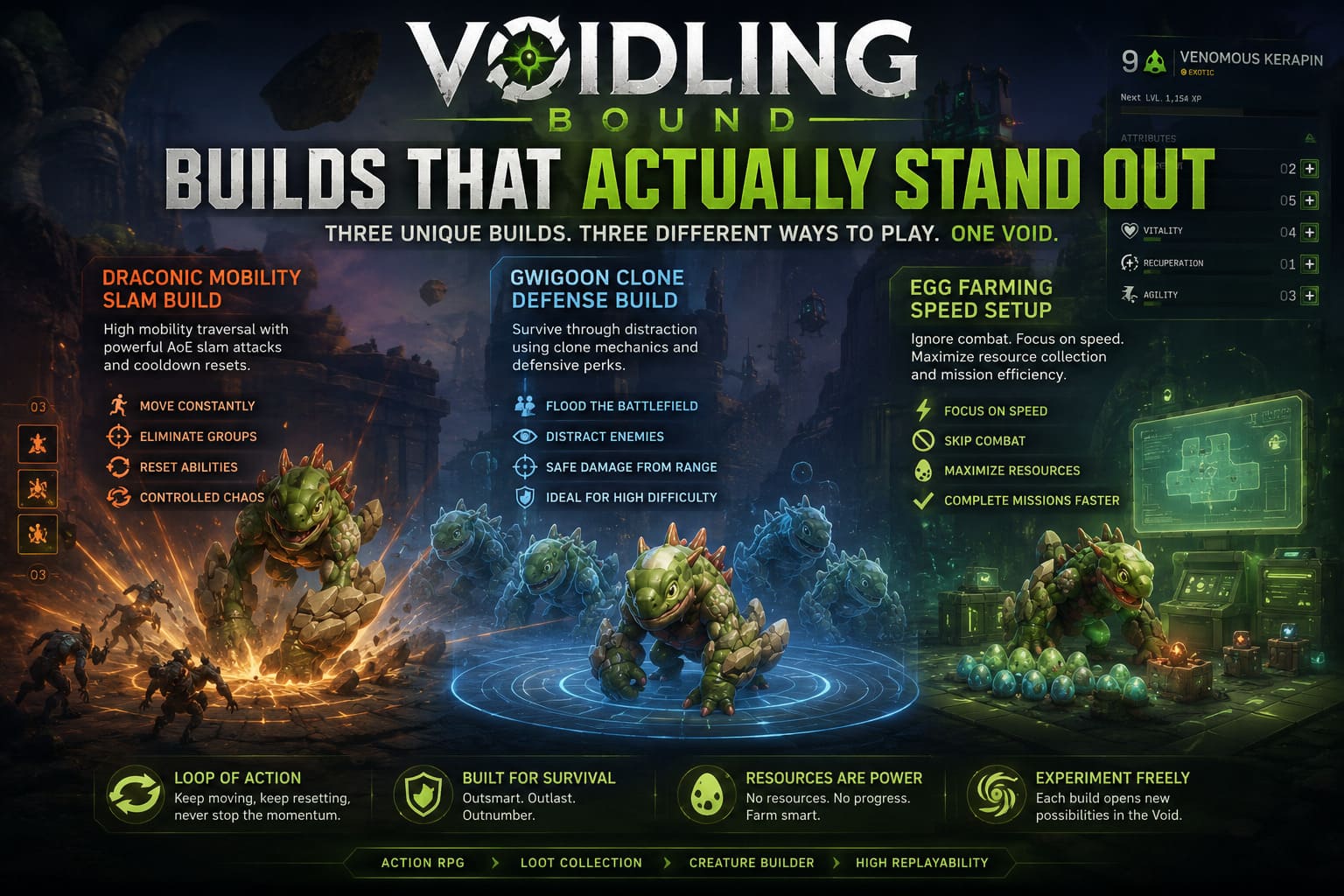
Gwigoon Clone Defense Build
This build focuses on survivability through distraction. You leverage clone generation mechanics and combine them with defensive perks.
Instead of taking hits yourself, you flood the battlefield with decoys while you deal damage safely from range. It’s not flashy, but it’s extremely effective in high difficulty content.
Egg Farming Speed Setup
This is a utility build designed purely for resource collection. You ignore combat entirely, focus on speed, and prioritize mission completion efficiency.
It’s not exciting, but it fuels everything else. Without this kind of setup, you simply don’t get enough resources to experiment freely with splicing.
Why DNA Splicing Feels So Addictive
The reason this system works so well is because it removes predictability. Every splice is a decision with consequences. Sometimes you create something incredibly strong. Sometimes you waste resources. Sometimes you discover combinations that feel unintended but perfectly functional.
That unpredictability keeps players engaged far longer than traditional progression systems. You’re not just upgrading—you’re experimenting, refining, and occasionally breaking the game in your favor.
Final Thoughts
Voidling Bound’s DNA Splicing system is not just a feature—it is the actual endgame identity of the game. It turns creature collection into build engineering and rewards players who are willing to experiment, fail, and iterate.
If you enjoy optimization, theorycrafting, or simply creating absurdly powerful combinations, this system will probably become your main reason for playing.
Just be warned: once you start splicing properly, normal Voidlings stop feeling complete.