Is Doloc Town 1.0 Worth Buying in 2026? Full Review & Community Verdict
If you’ve spent years chasing the same feeling that Stardew Valley, Terraria, and Starbound gave you, you’ve probably noticed something: the cozy farming genre has become painfully predictable. Every month another indie project appears, promising peaceful farming, friendly villagers, and endless exploration. Most of them play it safe.
Then I launched Doloc Town 1.0.
I’ll admit it—I expected another decent indie farming sim that I’d forget after a weekend. Instead, several hours disappeared before I even noticed. That’s usually a good sign.
Doloc Town doesn’t reinvent every mechanic ever created, but it mixes familiar ideas in a way that feels surprisingly fresh. After spending dozens of hours exploring its post-apocalyptic world, experimenting with automation, and watching the community react to the full release, I can confidently say this is one of the strongest indie farming games of 2026.
A Cozy Game That Doesn’t Look Cozy
The first thing that grabbed my attention wasn’t the farming.
It was the world itself.
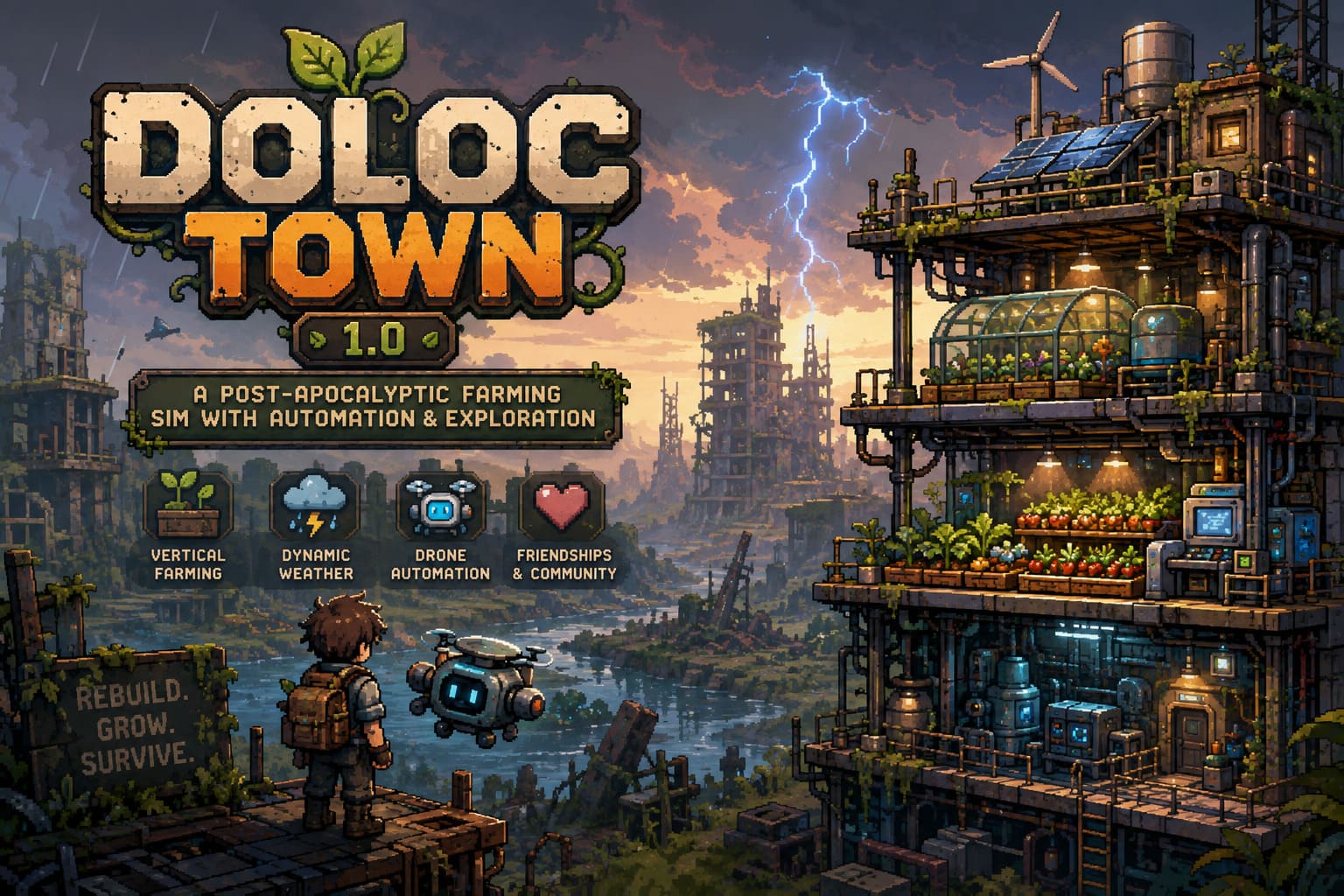
Instead of colorful villages surrounded by green forests, you’re dropped into a ruined landscape where nature barely survives. The setting feels lonely, mysterious, and strangely relaxing at the same time. The contrast works incredibly well.
The pixel art deserves serious praise.
Every location has multiple visual layers that create real depth despite the side-scrolling perspective. Weather effects aren’t just decorative either—they constantly remind you that this world is trying to survive just as much as you are.
That’s something I rarely feel in farming simulators.
Instead of decorating a perfect countryside paradise, you’re rebuilding hope after civilization collapsed.
Vertical Farming Changes Everything
Most farming games ask you one simple question:
“How big can your farm become?”
Doloc Town asks something different.
“How smart can you build it?”
Because the contaminated ground isn’t suitable for traditional farming, you’re encouraged to construct upward instead of outward. Platforms become gardens. Small spaces evolve into multi-floor production lines.
At first it feels unusual.
Then, after a few hours, it becomes difficult to imagine going back to standard flat farms.
I spent an embarrassing amount of time redesigning my vertical greenhouse because every improvement made the whole base feel more efficient. It scratches the same itch as building factories in automation games without becoming overwhelmingly complex.
What Makes the Farming System Stand Out?
- Vertical construction instead of flat farming fields.
- Custom plant basins and greenhouse layouts.
- Weather-driven irrigation that rewards planning.
- Automation systems that naturally evolve with progression.
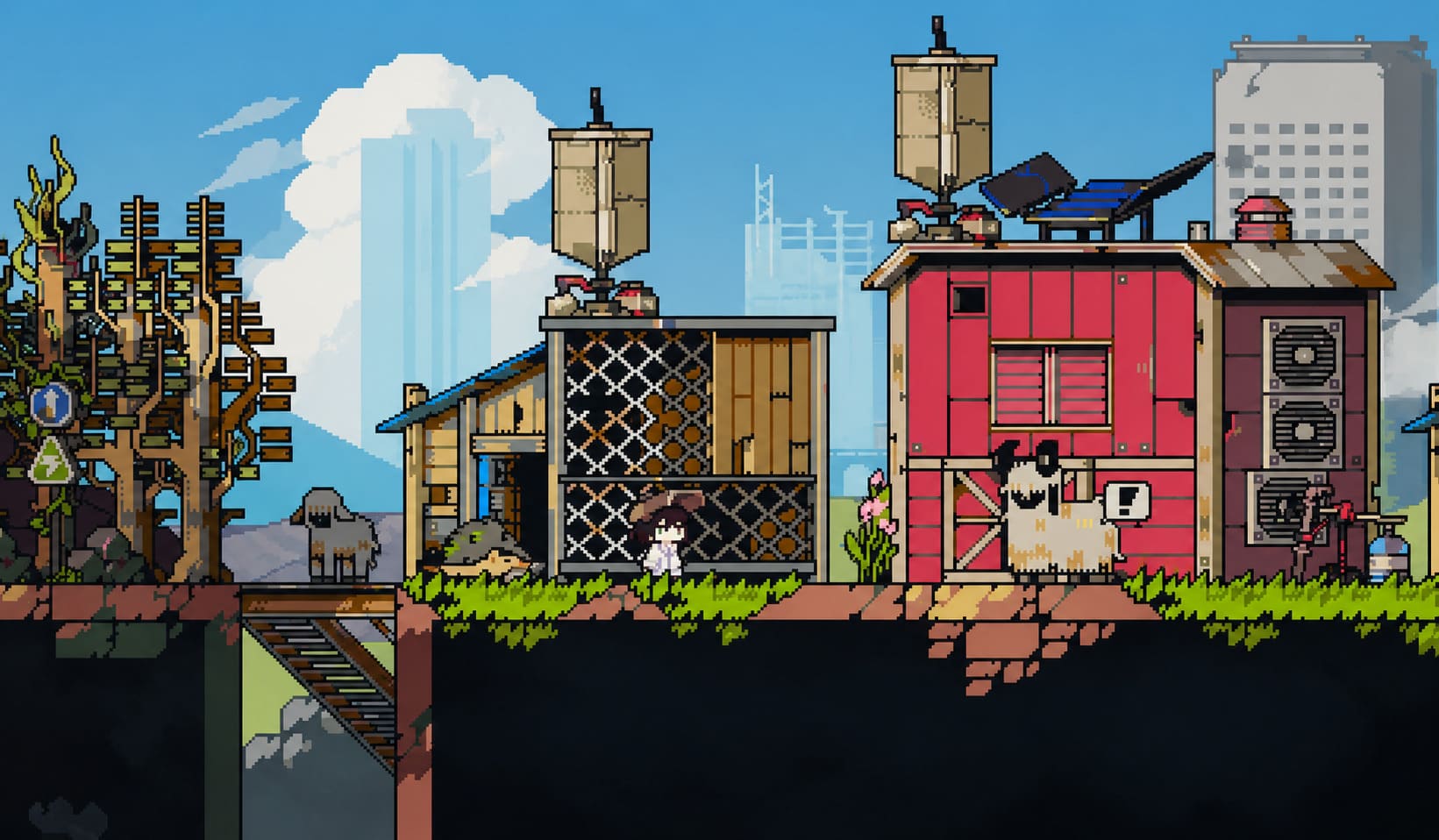
Nothing feels forced. The game slowly hands you better tools until your tiny survival garden transforms into a highly efficient agricultural machine.
Weather Isn’t Decoration—It’s Gameplay
Many games advertise dynamic weather.
Few actually make it matter.
Doloc Town is one of those rare exceptions.
Acid rain destroys crops if you leave them exposed. Heat waves dramatically increase water consumption, forcing you to rethink irrigation. Storms refill your water collection systems, while lightning eventually becomes an energy source once you unlock the right technology.
That constant relationship between nature and your farm gives every season its own personality.
Instead of waiting for rain to stop because it interrupts your plans, you’ll often hope for storms because they solve half your resource problems.
That’s smart game design.
The Automation Loop Is Surprisingly Addictive
If there’s one feature that kept pulling me back for “just one more day,” it was the drone system.
Early in the adventure, your mechanical companion feels like a simple helper.
Later, it becomes the heart of your entire production network.
Your drones eventually handle jobs that would normally consume hours of repetitive work.
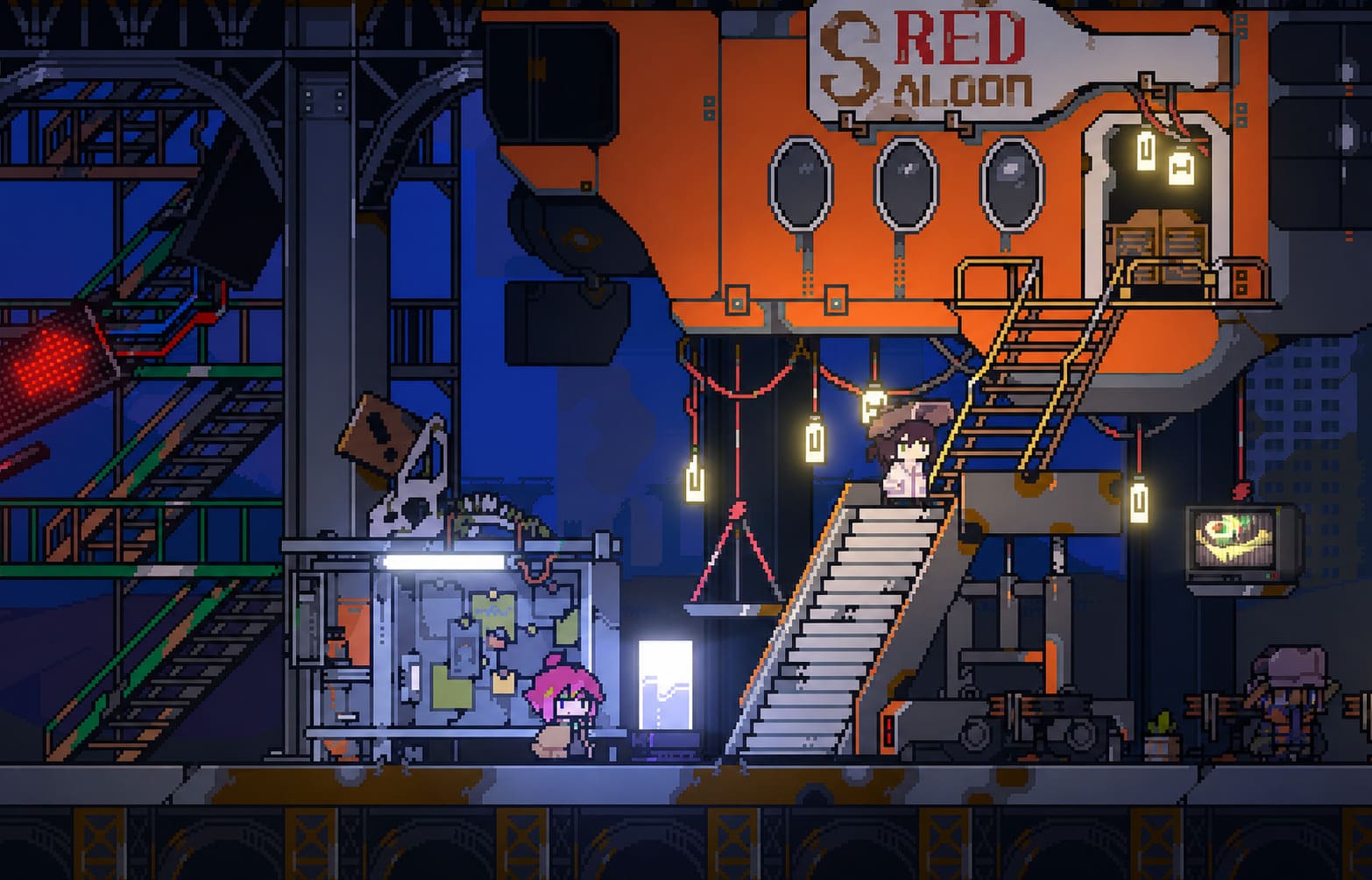
They Can:
- Plant crops.
- Harvest mature plants.
- Transport resources.
- Support exploration.
- Assist during combat.
Watching your base slowly operate on its own is incredibly satisfying.
It’s not trying to become Factorio, but it captures that same rewarding feeling where every new upgrade saves time and encourages you to build something even larger.
Combat Stays Simple… And That’s Okay
Some players expected deep action combat.
That’s not really what Doloc Town wants to be.
Outside the safety of town you’ll encounter hostile wildlife, corrupted machines, and dangerous environments, but combat focuses far more on positioning than complicated attack combinations.
Your drone handles most offensive actions while you dodge attacks, collect valuable resources, and survive hostile encounters.
Personally, I think this was the correct decision.
The game never forgets that it’s primarily a farming and exploration experience. Trying to force complicated combat into the formula would have disrupted the relaxing pacing that makes the game so enjoyable.
Building Relationships Still Matters
Even though farming and automation dominate much of the gameplay, the people living in Doloc Town never feel like background decoration.
Residents follow daily routines, react to your progress, and slowly open up through friendship quests.
The full 1.0 release significantly expands the social systems with improved quests, seasonal festivals, and stronger community progression.
One of my favorite details is watching the settlement visually improve as your own farm becomes more successful. It’s subtle, but it creates a satisfying sense that your work genuinely matters.
Performance and Technical Quality
One thing I genuinely appreciated was how polished the final release feels.
I’ve reviewed enough indie Early Access games to expect bugs, awkward interfaces, and inconsistent optimization.
Doloc Town surprised me.
Loading times are fast, frame rates remain stable, controls feel responsive, and even after building larger automated farms I experienced very few technical problems.
That level of polish deserves recognition, especially from a relatively small indie development team.
Where Doloc Town Isn’t Perfect
No game is flawless, and Doloc Town certainly has a few rough edges.
The biggest issue appears during the opening hours.
Inventory management feels restrictive. You’ll constantly juggle seeds, minerals, scrap, crafting materials, and food until additional storage becomes available.
Thankfully, crafting storage boxes early dramatically improves the situation.
The learning curve may also surprise newcomers. The game introduces weather protection, crop management, vertical building, resource processing, and technology progression within a fairly short period.
Experienced simulation fans will probably enjoy the complexity, but complete beginners may need several in-game weeks before everything clicks together.
Combat is another area that may divide players. While perfectly functional, it remains intentionally lightweight and won’t satisfy players looking for skill-based action gameplay.
Community Opinion Matches My Experience
Whenever I finish a long review, I like comparing my impressions with the broader gaming community.
Interestingly, the majority of players seem to have reached very similar conclusions.
Long-time Early Access fans consistently praise the enormous amount of new content introduced in Version 1.0, while newcomers often highlight how refreshing the post-apocalyptic setting feels compared to traditional fantasy farming simulators.
The pixel art receives near-universal praise, and the soundtrack is frequently mentioned as one of the game’s strongest features.
Even the criticisms line up closely with my own experience: early inventory limitations, a fairly dense opening learning curve, and intentionally simple combat.
That’s usually a healthy sign. When thousands of players independently point to the same strengths and weaknesses, you know the game’s identity is well understood.
Doloc Town Nintendo Switch Release Date & Best Steam Deck Settings Guide
Value for Money
| Category | Verdict |
|---|---|
| Story Content | Excellent |
| Exploration | Excellent |
| Farming Systems | Outstanding |
| Automation | Outstanding |
| Combat | Good |
| Replayability | Excellent |
| Overall Value | Highly Recommended |
For around $19.99, Doloc Town delivers outstanding value.
The main story comfortably lasts over thirty hours, while completionists can easily spend well beyond one hundred hours optimizing automation, perfecting farm layouts, completing relationships, and uncovering every corner of the world.
Unlike many farming games that begin repeating themselves halfway through, Doloc Town constantly introduces new mechanics that encourage experimentation and smarter base design.
That progression keeps the experience engaging much longer than I originally expected.
Is Doloc Town Coming to PS5, Xbox, and Xbox Game Pass? What We Know So Far
Final Verdict: Should You Buy Doloc Town?
After spending significant time with the full release, my answer is simple.
Yes.
Not because it’s the biggest farming simulator ever made.
Not because it offers the deepest combat system.
Not because it completely reinvents the genre.
It’s worth buying because it understands what makes cozy games enjoyable while having enough confidence to challenge several long-established design traditions.
The vertical farming system genuinely changes how you think about building. Automation creates an addictive long-term progression loop. Environmental mechanics make every season meaningful instead of cosmetic. And the post-apocalyptic setting gives Doloc Town an identity that very few farming simulators can match.
As someone who spends far too many evenings bouncing between indie survival games, automation builders, and cozy farming sims, I can honestly say Doloc Town earned a permanent place in my Steam library.
If you’re searching for one of the very best indie farming games released in 2026, this is an easy recommendation. Rather than copying the classics that inspired it, Doloc Town builds its own identity—and that’s exactly why it stands out.