Doloc Town Nintendo Switch Release Date & Best Steam Deck Settings Guide
Doloc Town has finally reached the big 1.0 milestone, and after spending serious time watching how this game evolved through Early Access, I can say one thing with confidence: this is exactly the kind of weird, cozy, slightly grimy farming game that makes sense on a handheld.
The full Doloc Town 1.0 release arrived on Steam on August 6, 2026, bringing the game out of its Early Access period that began on May 8, 2025. Developed by RedSaw Games Studio and published by Logoi Games and Pathea Games, the game mixes post-apocalyptic survival, farming, exploration, automation, combat, and side-scrolling platforming into a package that feels surprisingly comfortable on Steam Deck.
But there is one question hanging over the community right now:
When is Doloc Town coming to Nintendo Switch?
That answer is much less exciting than the game itself. There is currently no officially confirmed Nintendo Switch release date, despite the obvious appeal of having this colorful wasteland simulator on Nintendo’s handheld hardware.
For now, Steam Deck is the place to play Doloc Town portably. And honestly? That’s not a bad consolation prize.
Doloc Town Nintendo Switch Release Date: Is a Port Coming?
Let’s get the important part out of the way.
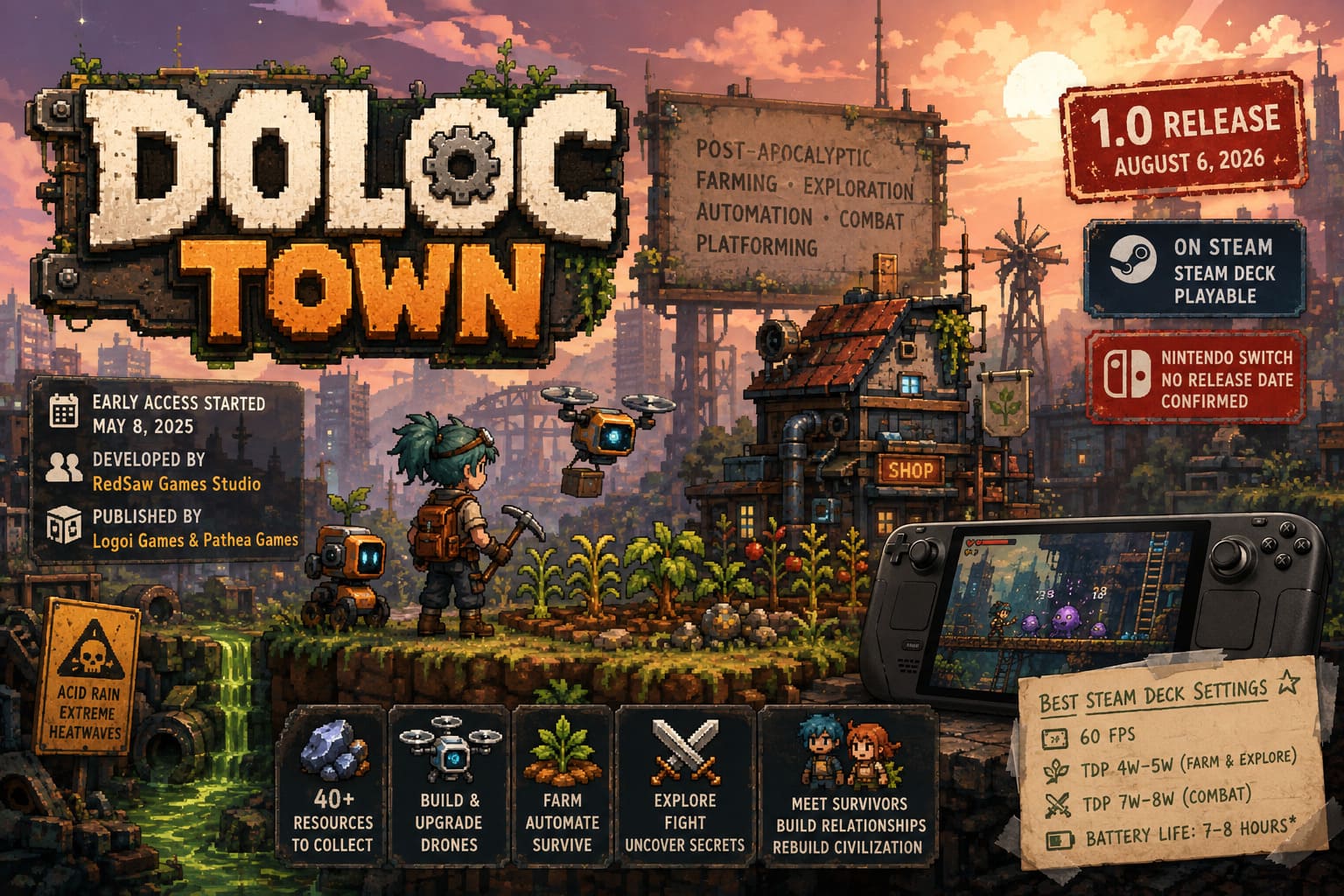
As of the August 2026 1.0 launch, there is no confirmed Nintendo Switch release date for Doloc Town. The developers have concentrated on getting the PC version across the finish line, and that makes perfect sense.
A lot of indie games get burned by rushing into console development before the PC version is properly stabilized. Doloc Town has spent more than a year in Early Access, so pushing 1.0 first and dealing with post-launch fixes before moving toward console hardware is a sensible strategy.
That said, I would be genuinely surprised if the developers weren’t at least considering Nintendo’s ecosystem.
Doloc Town’s technical profile screams “handheld game.” It is built around a 2D side-scrolling presentation, pixel-art visuals, relatively modest hardware requirements, and gameplay systems that don’t rely on photorealistic graphics or enormous open worlds.
Those are exactly the kinds of games that can work brilliantly on Switch.
There is also the involvement of Pathea Games, a publisher with substantial experience in the cozy and simulation space. The company’s history with titles such as My Time at Portia and My Time at Sandrock makes a future console version feel considerably more plausible than it would for a completely inexperienced indie team.
Still, gamers should separate “likely” from “confirmed.”
Right now, there is no official Switch date to circle on your calendar.
If I had to make a prediction, I’d watch the period around late 2026 into early 2027 for console news. That’s not an announced window; it’s simply the timeframe that makes the most sense if the team wants to stabilize the 1.0 PC build first.
Current Doloc Town Platform Situation
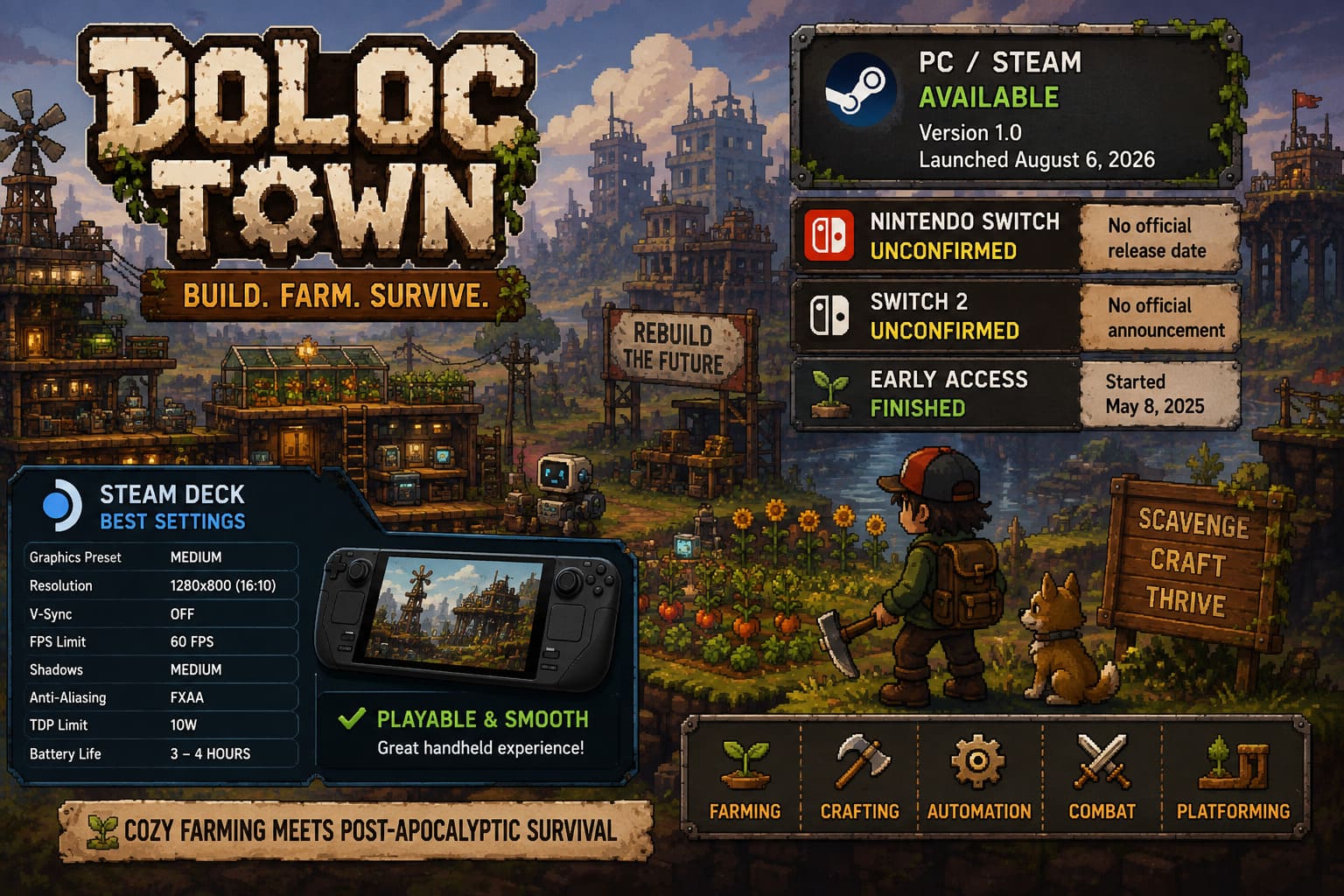
| Platform | Status | Release Information |
|---|---|---|
| PC / Steam | Available | Version 1.0 launched August 6, 2026 |
| Steam Deck | Available | Playable handheld experience |
| Nintendo Switch | Unconfirmed | No official release date |
| Switch 2 | Unconfirmed | No official announcement |
| Early Access | Finished | Started May 8, 2025 |
Doloc Town Steam Deck Performance: This Is Where the Game Gets Interesting
If you’re sitting there with a Steam Deck and wondering whether Doloc Town is worth installing, the short answer is yes.
The game is a surprisingly natural fit for Valve’s handheld.
The side-scrolling camera works well on the smaller display, the pixel-art presentation remains crisp, and the controller layout feels considerably more natural than I expected for a game containing farming, inventory management, platforming, combat, and automation.
There is something particularly satisfying about wandering through the wasteland with the Deck in your hands, harvesting materials, jumping across platforms, smashing through scrap, and then returning to your little operation to sort everything out.
It has that classic “just one more in-game day” problem.
You know the one.
You sit down thinking you’ll play for twenty minutes. Suddenly you’ve upgraded a tool, reorganized your storage, harvested three fields, researched something new, explored a ruin, and it’s somehow 2:00 AM.
The fact that Doloc Town combines cozy farming with post-apocalyptic scavenging makes it feel different from the usual farming-sim formula.
You’re not simply watering cute crops in a picturesque village.
You’re trying to build something useful in a world that has already fallen apart.
Best Steam Deck Settings for Doloc Town 1.0
Doloc Town isn’t particularly demanding, so you don’t need to torture the Steam Deck’s hardware to get good performance.
My preferred setup is focused on stable 60 FPS while keeping power consumption under control.
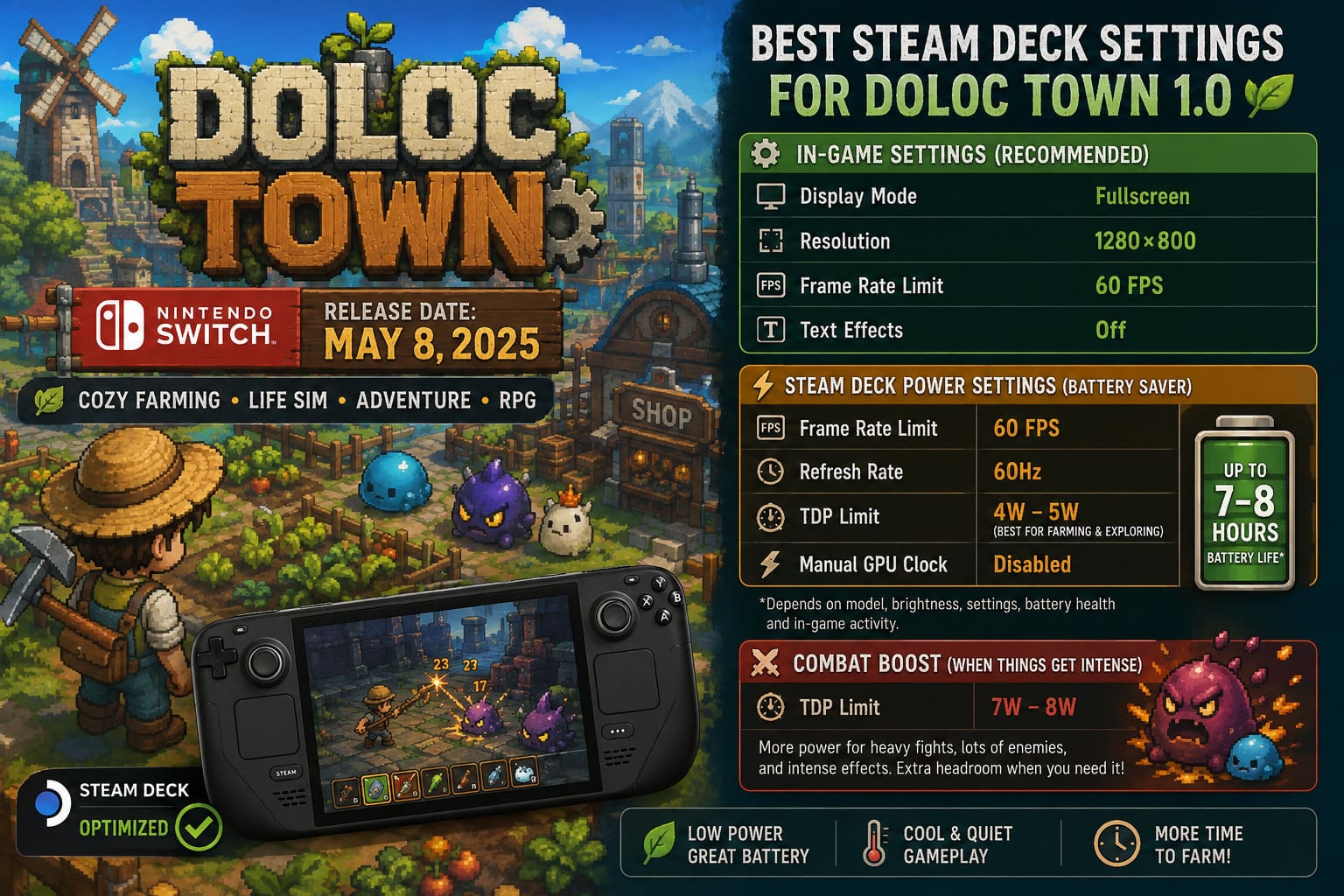
Recommended In-Game Settings
- Display Mode: Fullscreen
- Resolution: 1280×800
- Frame Rate Limit: 60 FPS
- Text Effects: Off
The native 1280×800 resolution is the obvious choice for Steam Deck. There is little reason to push unnecessary rendering resolution when the game’s art style already looks sharp at the Deck’s native display resolution.
The Text Effects option is worth switching off, too. Wavy or animated text can look charming on a large monitor, but on a small handheld display it can become more annoying than immersive.
When you’re reading dialogue, menus, tutorials, item descriptions, and quest information for hours, readability wins.
Every time.
Steam Deck Power Settings for Better Battery Life
The Steam Deck’s biggest advantage here is that Doloc Town doesn’t need much power to look good.
Inside the Steam Deck’s Quick Access performance menu, I’d start with:
- Frame Rate Limit: 60 FPS
- Refresh Rate: 60Hz
- TDP Limit: 4W–5W
- Manual GPU Clock: Disabled
The important setting is the TDP limit.
For normal activities such as farming, construction, crafting, exploration, inventory management, and moving around town, dropping the TDP to around 4W or 5W can dramatically reduce power consumption.
According to the performance profile described for the game, this can potentially push battery life toward the 7–8 hour range, depending on your Steam Deck model, brightness, system settings, battery health, and what you’re actually doing in-game.
That’s a ridiculous amount of portable farming.
And I mean that as a compliment.
For a game like Doloc Town, I’d much rather have a handheld that stays cool and lasts for hours than squeeze out unnecessary performance that I don’t even notice.
The One Steam Deck Setting You Should Change for Combat
There is one catch.
The 4W–5W profile is great when you’re peacefully farming or building, but Doloc Town isn’t always peaceful.
Once you head into deeper ruins or encounter larger groups of hostile blob creatures, the workload can increase. Particle effects and multiple enemies on screen can cause occasional performance dips at extremely low power limits.
That’s where I would stop being stubborn about battery savings.
Raise the TDP limit to around 7W–8W for combat-heavy sections.
The extra power gives the Steam Deck more headroom when the action gets messy without turning the handheld into a jet engine.
This is one of those situations where chasing a perfectly fixed power limit isn’t worth it. Farming at 4W? Great. Exploring at 5W? Fine. Fighting a ridiculous swarm while explosions and effects are filling the screen?
Give the Deck some breathing room.
Why Doloc Town Works So Well as a Handheld Game
This is probably the part that interests me most.
There are plenty of farming games on PC. There are also plenty of cozy games on Switch and Steam Deck. Doloc Town’s appeal comes from the fact that it doesn’t simply copy the familiar Stardew Valley formula and slap a new coat of paint over it.
Its world is broken, dangerous, and strangely beautiful.
You’re scavenging resources in a wasteland rather than inheriting a peaceful farm. You’re dealing with environmental threats instead of simply worrying about whether your crops get enough water. You have platforming sections, combat encounters, automation systems, and technology progression sitting alongside the traditional farming loop.
That creates a much more active rhythm.
One minute you’re managing crops.
The next you’re exploring ruins.
Then you’re collecting scrap.
Then you’re fighting mutated creatures.
Then you’re back home thinking about how to optimize your operation.
That constant change is important on a handheld. Games that require you to stare at the same static screen for hours can sometimes feel exhausting on a smaller display. Doloc Town’s mixture of movement, exploration, combat, and management keeps things moving.
Farming, Automation, and Surviving the Wasteland
The farming system is only one part of the package.
Doloc Town lets you collect more than 40 different types of resources, including minerals, industrial scrap, and mutated plant materials. That gives exploration a real purpose instead of making the wasteland feel like decorative scenery.
The environmental hazards are another nice twist.
You’re not operating in a perfectly safe climate. Acid rain and extreme heatwaves can interfere with your farming plans and force you to think about how and when you’re growing things.
Then there are the drones.
And honestly, this is one of the mechanics that could become dangerously addictive.
You can research technology, build customizable drones, improve their capabilities, and use them for both combat assistance and farming automation.
The progression creates a satisfying shift from manual labor toward technological independence.
At the beginning, you’re doing everything yourself.
Eventually, you’re building systems that do the boring work for you.
That’s the dream.
Exploration and Story Give the Wasteland More Personality
The 1.0 update adds the final chapter of the main storyline, along with the dangerous Old City Ruins area.
That is a major reason why the full release matters.
Early Access games can sometimes feel like collections of mechanics waiting for the actual adventure to arrive. With 1.0, Doloc Town finally has the opportunity to present its larger narrative in a complete form.
The world also has plenty of history to uncover.
You’re rebuilding civilization while learning about the forgotten past, meeting survivors, and uncovering secrets about what happened to the world.
The community aspect helps balance the darker setting. The characters aren’t just quest dispensers standing around waiting for you to deliver ten pieces of scrap.
Building relationships with the survivors gives the world some warmth.
And it needs it.
Without that human element, a post-apocalyptic farming game could easily become a depressing resource-management simulator.
Is Doloc Town Better on Steam Deck Than PC?
For raw performance and image size, obviously not.
A desktop PC with a large monitor is still the better option if you want to appreciate every pixel and keep the game running without worrying about battery consumption.
But for the actual style of gameplay, Steam Deck feels like a fantastic match.
The controller layout makes movement and platforming intuitive. Farming actions are easy to handle with physical controls, and having the entire game available in a portable format changes the way the progression loop feels.
Doloc Town doesn’t demand marathon sessions.
You can play for fifteen minutes while traveling, spend an hour expanding your farm, or lose an entire evening exploring the Old City Ruins.
That’s exactly what I want from a handheld farming game.
Nintendo Switch or Steam Deck: Should You Wait?
If your only gaming machine is a Nintendo Switch and you’re specifically waiting for a console edition, there’s unfortunately nothing official to guarantee that you can play Doloc Town there in 2026.
If you already own a Steam Deck, however, there’s very little reason to wait.
The 1.0 release is here, the game is designed around relatively lightweight hardware, and the recommended performance setup allows you to prioritize battery life without sacrificing the 60 FPS experience during normal gameplay.
I’d personally run 4W–5W for everyday farming and exploration, then jump to 7W–8W when entering combat-heavy areas.
It’s simple, effective, and much more sensible than running the Deck at maximum power all the time.
Is Doloc Town Coming to PS5, Xbox, and Xbox Game Pass? What We Know So Far
Final Verdict: Doloc Town Deserves a Handheld Audience
Doloc Town has landed at an interesting moment.
The PC version has finally reached 1.0, the game’s biggest story content is now available, the Old City Ruins expand exploration, automation systems give farming more depth, and the whole thing feels almost tailor-made for portable gaming.
The elephant in the room remains the Nintendo Switch release date.
There isn’t one yet.
I wouldn’t treat that as a reason to write off the game, though. If anything, the Steam Deck version proves that Doloc Town’s design is extremely well suited to handheld play.
The combination of pixel-art visuals, side-scrolling exploration, farming, survival mechanics, platforming, combat, drones, resource management, and story progression creates a loop that is easy to pick up and surprisingly difficult to put down.
And that’s the dangerous part.
You start by telling yourself you’re going to harvest a few crops.
Then you decide to build a drone.
Then you need resources for the drone.
Then you realize the resources are in the ruins.
Then you find something interesting in the ruins.
Then it’s three hours later.
That’s a pretty good sign for a farming sim.
Doloc Town 1.0 is already available on Steam, and for Steam Deck owners, it’s arguably one of the more interesting ways to experience the game right now. Nintendo Switch players may have to wait for an official announcement, but if a Switch or Switch 2 version eventually arrives with solid performance and good text scaling, I can absolutely see this becoming one of those games people keep installed permanently.