Star Wars Zero Company Xbox Series X Review: The New King of Sci-Fi Turn-Based Tactics
There is a particular feeling I look for in a turn-based strategy game. It is that moment when a plan that looked ridiculous three turns ago suddenly comes together perfectly: one character draws enemy fire, another slips behind cover, a third lands the shot you desperately needed, and somehow the whole squad survives.
After spending years with games like XCOM 2, Phoenix Point, Marvel’s Midnight Suns, Mutant Year Zero, and countless other tactical experiments, I’ve become pretty hard to impress. A Star Wars skin alone isn’t enough. Fortunately, Star Wars Zero Company doesn’t need the license to carry it.
After playing it on Xbox Series X, I came away thinking that Bit Reactor has understood something many developers miss: the best tactical games aren’t really about moving units across a grid. They’re about making you care about the people you’re moving.
And that is where Zero Company is at its strongest.
A Different Kind of Star Wars Story
The biggest surprise for me was the campaign.
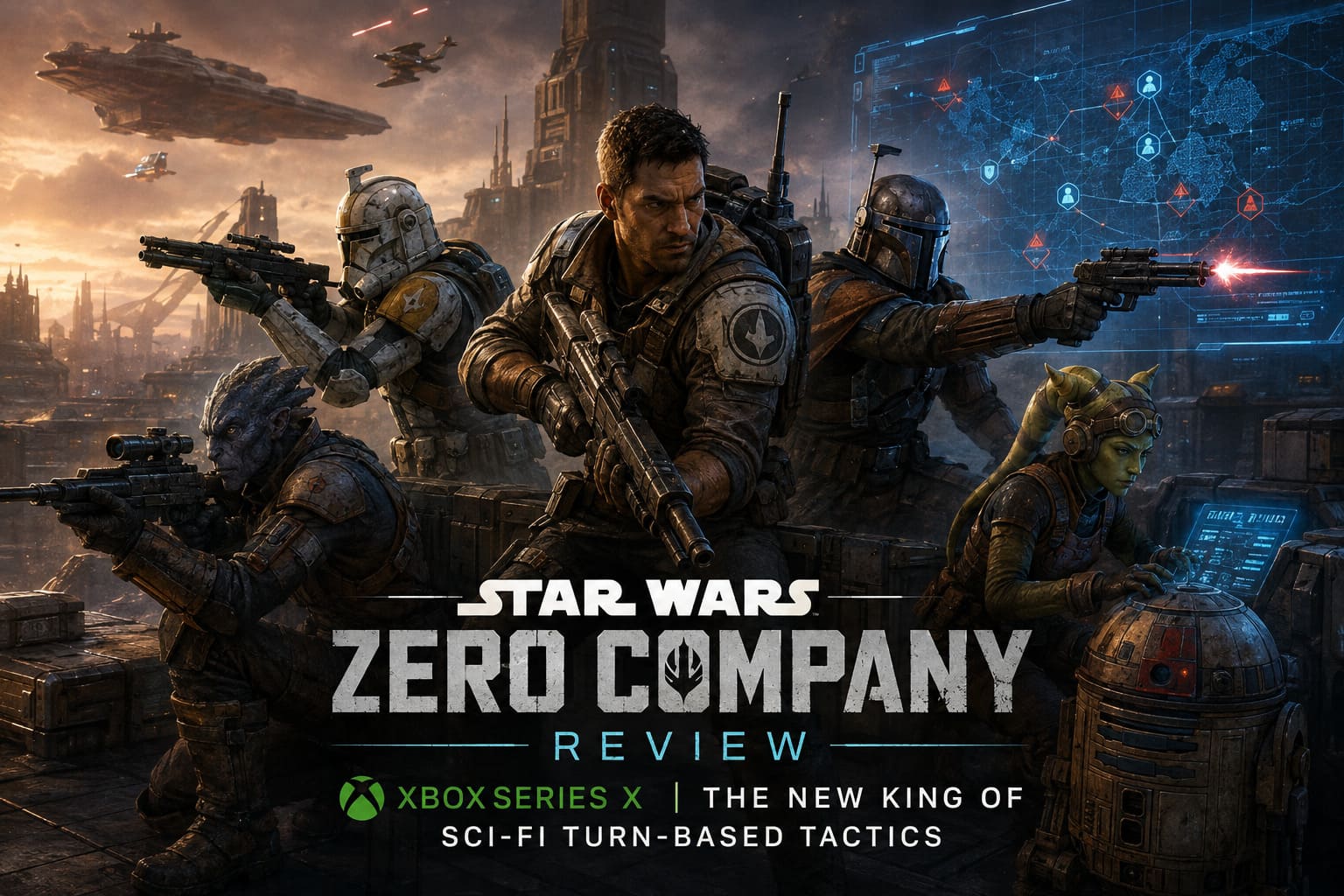
This isn’t another Star Wars story where everything eventually comes down to a Sith Lord, a superweapon, or the fate of the entire galaxy. Instead, Zero Company takes place during the twilight of the Clone Wars and focuses on the people operating underneath the enormous conflict.
You play as Hawks, a former Republic officer who has fallen a long way from his military past. He now runs Zero Company, a struggling mercenary outfit filled with soldiers, criminals, outsiders, and people who probably shouldn’t be trusted with a blaster.
The company’s financial problems are very real. Hawks owes money to the Hutts, and the easiest way out is to accept a dangerous contract connected to the Republic.
Naturally, things don’t remain simple for long.
What begins as a relatively straightforward military job eventually leads Zero Company toward the Shadow Plague, a disturbing bio-technological threat capable of turning ordinary people into violent, mindless creatures. Behind the conspiracy is Kundri Fathom and the Infinite Coil, a Separatist-aligned organization that gives the campaign a darker, more unusual flavor than I expected.
Why the Story Works
I’ve played plenty of licensed games where the developers seem terrified of ignoring the most famous elements of the franchise. Zero Company is much more confident.

Lightsabers aren’t the center of everything.
The Force isn’t solving every problem.
The Empire isn’t involved because it doesn’t need to be.
Instead, you get blasters, explosives, criminal organizations, clone veterans, aliens, mercenaries, and people simply trying to make it through another day of a galaxy-wide war.
That makes the story feel surprisingly fresh.
It’s still unmistakably Star Wars, but it explores the kind of corners of the universe that movies and major Jedi-focused games rarely have time for.
The Characters Are the Real Investment
The squad system is where Zero Company starts feeling less like a traditional licensed strategy game and more like a proper tactical RPG.
Your roster consists of Authored Operators and Custom Operators, and the difference between them works extremely well.
Authored Operators are the characters who drive the story. They have individual personalities, voice acting, histories, relationships, and personal missions. Trick, for example, is a Clone Trooper and one of the more dependable members of the company. Then there are characters such as Luco Bronc, an Umbaran sniper, a Mandalorian warrior, Kabbney “Kabb” Uppercut, and a young Jedi Padawan carrying the legacy of her fallen master.
Some of these characters are exactly the sort of weird personalities I want in a tactical game.
That’s important because tactical games naturally create stories through gameplay. The sniper who survives three missions with almost no health becomes “your sniper.” The rookie who accidentally saves the squad becomes a legend. The character who repeatedly misses easy shots becomes the squad’s permanent liability.
Zero Company understands this.
Custom Operators Add Another Layer
Custom Operators provide the freedom that authored characters can’t.
You can recruit personnel from a rotating pool and customize them extensively. Species, appearance, clothing, body type, voice, and personality archetype can all be adjusted.
The variety of alien options is particularly welcome.
You can build a squad that looks like it actually belongs in the Star Wars universe rather than six interchangeable human soldiers wearing different helmets.
The personality system is also a nice touch. Choosing an archetype such as Rogue, Mentor, or Professional affects how characters interact with the rest of the team.
It’s not revolutionary on paper, but in practice it gives your custom soldiers more identity.
Combat Is Familiar, But More Aggressive
Anyone coming from XCOM will understand Zero Company’s combat almost immediately.
You’ve got grids, cover, flanking, abilities, overwatch-style tactical thinking, enemy positioning, and the constant question of whether you’re about to make a brilliant move or a catastrophically stupid one.
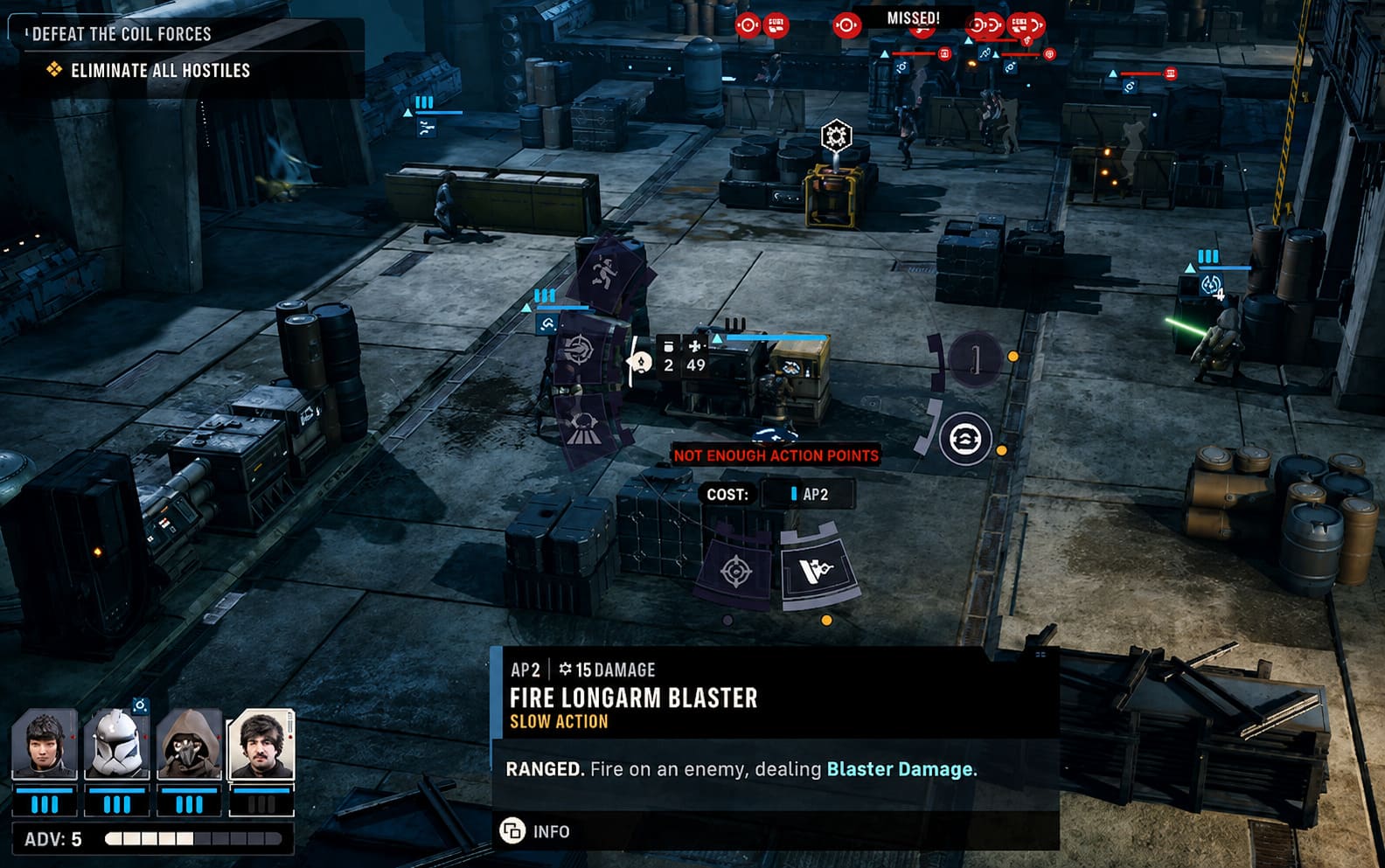
But there is one major difference:
Every Operator gets three Action Points.
That sounds like a small adjustment. It isn’t.
Three AP fundamentally changes how you approach a turn.
Instead of being restricted to a relatively predictable movement-plus-action rhythm, you have more freedom to improvise. You can move aggressively, reposition, attack, use an ability, or chain several actions together depending on the situation.
That makes combat feel faster and more flexible than some traditional XCOM-style systems.
And, importantly, it rewards aggressive players.
I personally prefer this approach. Some tactical games can become overly defensive, where the optimal strategy is simply to sit behind cover and wait for enemies to expose themselves. Zero Company pushes you toward taking calculated risks.
The Advantage System Encourages Momentum
The other major combat mechanic is Advantage.
Successful attacks and smart tactical decisions build a shared resource for the squad. Once you’ve accumulated enough, you can unleash powerful team abilities.
This creates an interesting rhythm.
You’re not just thinking about whether the current attack will kill an enemy. You’re thinking about what that attack contributes to the entire squad’s momentum.
The result is a combat system that often feels like a snowball. Get the first few moves right and you can establish control over the battlefield. Get them wrong and suddenly you’re desperately trying to recover.
That tension is exactly what I want from turn-based tactics.
Character Builds Are Surprisingly Flexible
Zero Company also avoids one of my biggest frustrations with RPG-style tactical games: permanent build anxiety.
You can experiment with specializations and talent trees without constantly worrying that you’ve permanently ruined a character.
Heavy weapons, snipers, technical specialists and other combat roles give you plenty of room to build squads around different strategies.
There are even unusual units such as Astromech droids, which can perform technical tasks, sabotage equipment and interact with battlefield systems.
The ability to respec characters freely is especially useful.
Instead of spending hours researching an optimal build online because you’re terrified of choosing the wrong talent, you can actually experiment.
That makes the game more approachable without making it simplistic.
The Den Gives the Campaign a Personality
Between missions, Zero Company moves into its strategic layer.
Your home base is The Den, an asteroid-based space station that functions as the company’s headquarters.
Unlike a traditional menu-driven base, The Den is explorable in third person. You can walk around, interact with your crew and strengthen relationships between characters.
Those relationships are represented through Bonds, which can eventually provide combat benefits.
This is a smart design decision because it gives the strategic layer an emotional purpose.
You’re not simply upgrading Building A to Level 2 because the spreadsheet says it’s efficient. You’re spending time with the people you’re about to send back into dangerous combat.
And that makes their survival matter more.
Managing the Galaxy
The strategic campaign operates around Cycles.
During each cycle, you have to decide where to spend your limited time and resources. You might take the main mission, send other Operators on covert assignments, gather intelligence, acquire credits, upgrade equipment, or improve the base.
You cannot do everything.
That limitation is important.
Good strategy games force you to make decisions rather than simply giving you enough resources to eventually unlock everything.
Zero Company gets this balance mostly right, although I do think the strategic layer isn’t quite as deep as the tactical combat.
If you’ve spent hundreds of hours with XCOM 2, you may occasionally wish there were more complicated systems to manage.
Xbox Series X Performance
On Xbox Series X, Zero Company looks considerably more expensive than I expected a turn-based tactics game to look.
The environments have strong cinematic presentation, and the art direction does a good job of blending classic Star Wars aesthetics with a slightly grittier space-western atmosphere.
The visual effects also help sell the combat.
Blaster fire has real impact, explosions feel substantial, and environmental destruction gives the battlefields a sense of physicality that tactical games sometimes lack.
The audio presentation deserves similar praise.
The orchestral score clearly understands the musical language of Star Wars without making every scene feel like a greatest-hits compilation. Blaster sounds, explosions and environmental effects provide the weight you expect from a big-budget Star Wars production.
Performance is generally smooth on Xbox Series X, even when battles become visually chaotic.
Loading is also fast enough that moving between The Den and missions rarely feels like an interruption.
What I Loved — And What Didn’t Quite Work
After spending a lot of time with the game, here’s how I would summarize the experience.
The Good
- Excellent 3-AP combat system that encourages creativity and aggression.
- A genuinely refreshing Star Wars story focused on mercenaries and ordinary soldiers.
- Strong character writing and memorable authored Operators.
- Deep custom character creation with plenty of alien species and personality options.
- Flexible talent trees and respec mechanics.
- Great cinematic presentation on Xbox Series X.
- The Advantage system adds a satisfying layer of squad-wide strategy.
- The Den makes relationships with your squad feel meaningful.
The Not-So-Good
- Battlefield variety can become repetitive during longer sessions.
- Enemy AI occasionally feels too cautious.
- The strategic layer isn’t quite as deep as the best entries in the XCOM formula.
- A few minor technical issues can appear during the experience.
None of these problems ruined my campaign, but they are noticeable if you’re coming into Zero Company expecting it to completely reinvent tactical strategy.
It doesn’t.
Instead, it refines a formula that already works extremely well.
Star Wars Zero Company vs. XCOM 2
For me, the inevitable comparison is XCOM 2.
| Feature | Star Wars Zero Company | XCOM 2 |
|---|---|---|
| Combat | 3-AP, aggressive tactical combat | Two-action tactical system |
| Setting | Star Wars / Clone Wars | Alien invasion |
| Squad Creation | Authored + Custom Operators | Primarily customizable soldiers |
| Relationships | Bonds and character interactions | Soldier relationships and customization |
| Respec | Highly flexible | More restrictive |
| Strategic Layer | Streamlined | Deeper and more complex |
| Presentation | Cinematic Star Wars production | Gritty tactical presentation |
I wouldn’t say Zero Company replaces XCOM 2.
That’s actually the wrong way to look at it.
XCOM 2 remains the deeper strategy sandbox, particularly when it comes to the strategic campaign. Zero Company, however, feels more cinematic and character-driven.
It’s closer to taking the emotional storytelling and accessibility of a modern RPG and combining it with the tactical foundation of classic squad strategy.
And honestly, that’s probably the better direction for a Star Wars game.
Star Wars Zero Company Action Points Guide: Master the AP Economy
Final Verdict
After playing a lot of tactical games over the years, I went into Star Wars Zero Company expecting a competent licensed strategy title.
I came away considerably more impressed.
This isn’t successful simply because it has Star Wars characters, alien worlds and familiar blaster sounds. It works because the underlying game is genuinely good.
The three-action-point system gives battles flexibility. Advantage creates momentum. Custom Operators provide freedom. Authored characters give the campaign personality. The Den makes the squad feel like a group of people rather than numbers on a screen.
Most importantly, the game understands that Star Wars is at its most interesting when it doesn’t constantly focus on the biggest heroes in the galaxy.
Zero Company is about people operating in the shadows of a much larger war.
And that gives it an identity of its own.
My verdict: 9/10.
If you’ve been waiting for another great squad-based tactical RPG, this is absolutely worth your attention. If you’re a Star Wars fan who has always wanted a game that explores the grittier corners of the Clone Wars, it’s even easier to recommend.
Star Wars Zero Company doesn’t dethrone XCOM 2 by copying it. It earns its place beside it by becoming its own kind of tactical adventure.