Star Wars Zero Company Story and Timeline Explained: Clone Wars Tactical Guide
I’ve played strategy games for years, from the original XCOM to Gears Tactics, Phoenix Point, Marvel’s Midnight Suns, and just about every tactical RPG that promised meaningful squad management. Most of them got the combat right. Very few made me care about the people standing behind the guns.
After spending time with everything Bit Reactor has shown for Star Wars Zero Company, that’s the feeling I walked away with. This doesn’t look like another Star Wars game where famous heroes save the galaxy. It looks like a war story told from the ground level — tired soldiers, mercenaries, Jedi survivors, and people who know the Clone Wars are already lost even if nobody wants to admit it.
And honestly? That’s exactly the perspective this era has been missing.
Rather than chasing lightsaber spectacle, Zero Company focuses on covert operations during the darkest stretch of the Clone Wars. Here’s why I think its story, timeline, and tactical systems could make it one of the most interesting Star Wars games in years.
A Clone Wars Story We Haven’t Seen Before
Most Clone Wars games throw players into legendary battles alongside Anakin Skywalker or Obi-Wan Kenobi. Zero Company takes the opposite approach.
You’re not commanding the Republic’s finest army.
You’re leading people the Republic would rather pretend don’t exist.
The story follows Hawks, a former Republic military officer who has become deeply disillusioned with the war. After watching bureaucracy and politics consume the Republic’s ideals, he leaves official command and builds an independent squad capable of handling missions too dangerous or too morally questionable for regular clone forces.
That premise instantly feels different.
Instead of a military campaign filled with heroic victories, this is about surviving impossible assignments behind enemy lines while both major factions slowly destroy the galaxy around them.
It’s a smaller story, but those stories often feel bigger emotionally.
Where Zero Company Fits in the Star Wars Timeline
One thing I appreciate is how carefully Bit Reactor positioned the game inside established Star Wars canon.
| Timeline Event | Approximate Period |
|---|---|
| The Clone Wars begin | 22 BBY |
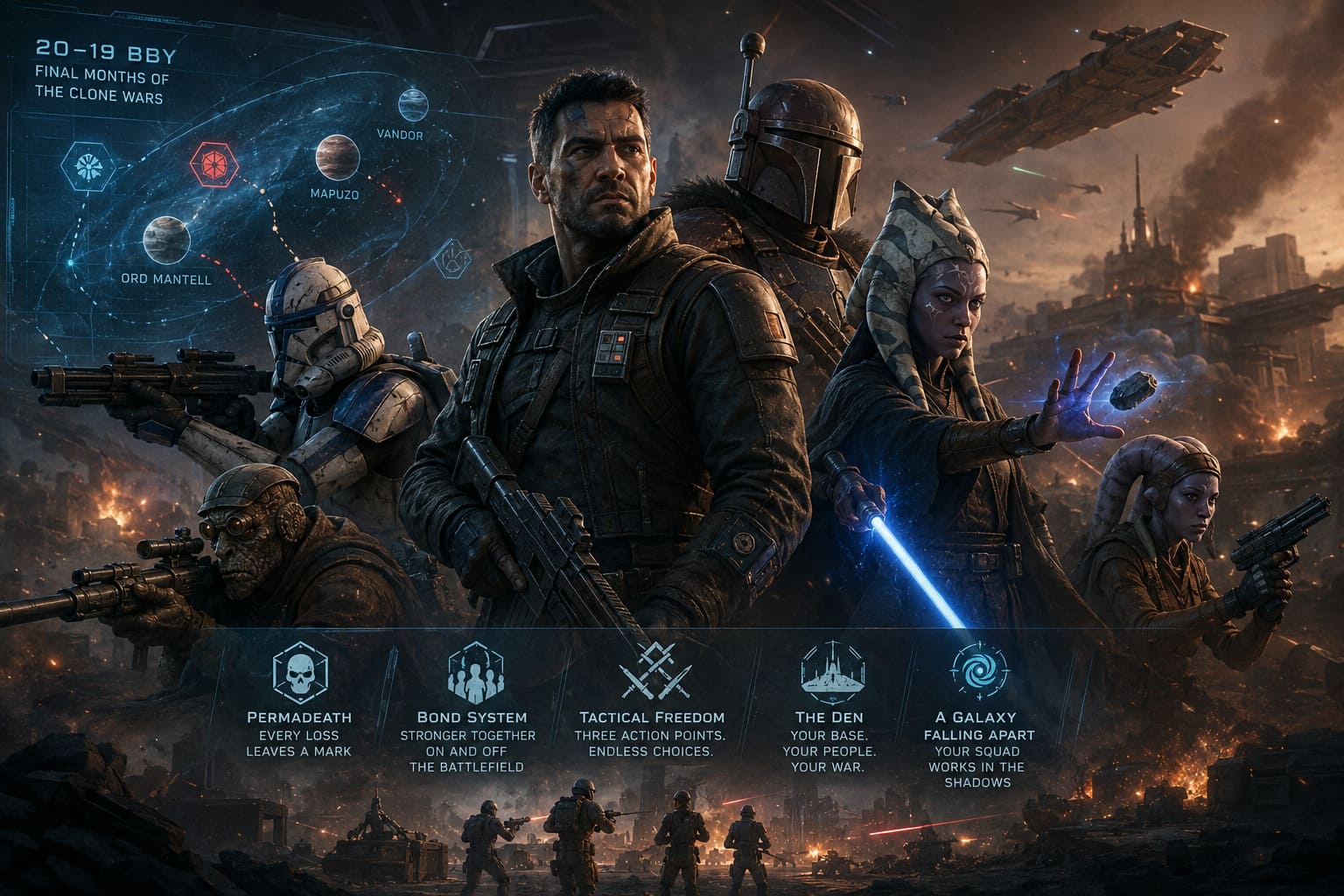
| Main events of Zero Company | 20–19 BBY |
| Revenge of the Sith | 19 BBY |
| Order 66 | 19 BBY |
The game happens during the final months of the Clone Wars, when the Republic is exhausted and the Separatists are becoming increasingly desperate.
That’s an incredibly rich period for storytelling because everything is falling apart.
Planets have been occupied for years. Entire systems have become lawless. Criminal organizations thrive while the Republic focuses on massive battles elsewhere.
Zero Company lives inside those forgotten corners of the galaxy.
While famous Jedi fight on Coruscant and Utapau, Hawks’ squad is dealing with threats nobody in the Senate even knows exist.
Hawks Feels More Interesting Than Another Legendary Jedi
I wasn’t expecting Hawks to become the character I’m most interested in.
He’s not Force-sensitive.
He isn’t wearing iconic clone armor.
He isn’t destined to become a galactic hero.
He’s simply someone who’s seen enough war to stop believing clean victories exist.
That makes him a refreshing Star Wars protagonist.
His decisions aren’t about saving the Republic at any cost. They’re about protecting his squad while completing missions that could change the balance of power without anyone ever learning their names.
That’s a perspective Star Wars rarely explores.
The Infinite Coil Might Be the Real Enemy
The campaign revolves around tracking Kundri Fathom, leader of an organization called the Infinite Coil.
Rather than another droid commander, she’s tied to something much stranger.
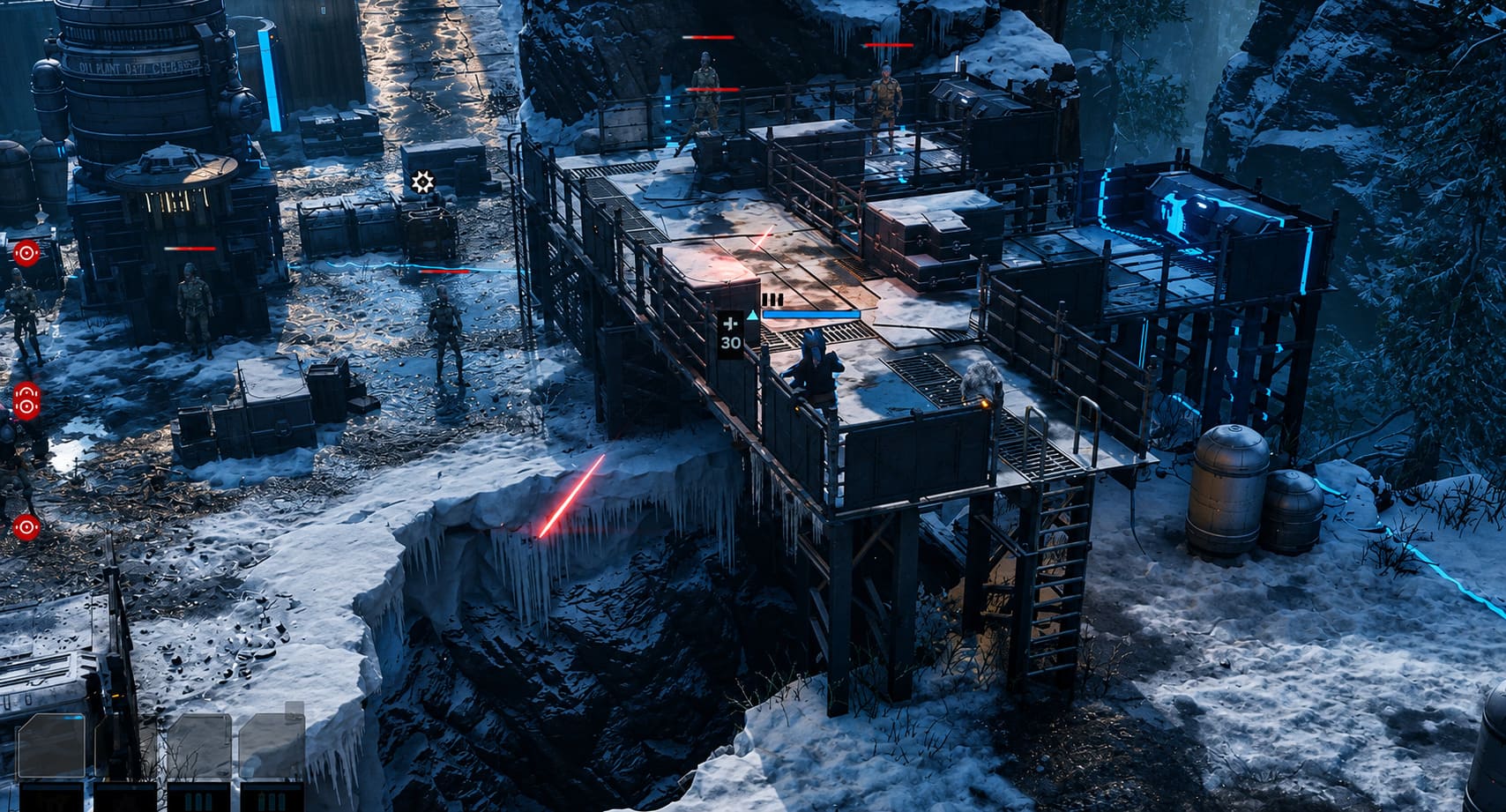
The mysterious Shadow Plague spreads through Outer Rim systems, threatening populations beyond the traditional Republic-versus-Separatist conflict.
Bit Reactor hasn’t revealed every detail yet, but that’s a smart move.
Keeping the Shadow Plague mysterious gives the campaign room for investigation, infiltration, and discovery instead of constant battlefield action.
As someone who enjoys strategy games with detective elements and hidden objectives, this storyline has a lot of potential.
Your Squad Isn’t Built Around Heroes — It’s Built Around Survivors
This is probably my favorite design decision.
Zero Company mixes permanent story characters with completely customizable Operators.
Core Story Characters
| Character | Why They Matter |
|---|---|
| Hawks | Former Republic commander and squad leader. |
| Clone Veteran | Experienced soldier who represents the Republic military. |
| Mandalorian Warrior | Heavy combat specialist with traditional Mandalorian training. |
| Tel-Rea Vokoss | Young Jedi Padawan using Force abilities in tactical combat. |
| Umbaran Sniper | Long-range stealth expert equipped with advanced Umbaran technology. |
That’s already a fascinating mix of cultures.
Clone.
Jedi.
Mandalorian.
Umbaran.
People who normally wouldn’t trust each other are suddenly forced into the same firefight.
That tension should create much stronger dialogue than a squad filled with identical clone troopers.
Custom Operators Could Become the Heart of Every Playthrough
Outside the main cast, players recruit their own mercenaries.
Available species include:
- Human
- Twi’lek
- Zabrak
- Togruta
- Neimoidian
- Devaronian
- Ovissian
- Weequay
Every Operator can be customized with different appearances, voices, equipment, and combat talents.
This matters because of permadeath.
Losing a custom character you’ve spent hours leveling always hurts more than losing a generic soldier.
XCOM understood that perfectly.
Zero Company looks ready to do the same.
The Combat Looks Like XCOM… But More Flexible
There’s no point pretending Bit Reactor isn’t borrowing ideas from XCOM.
The similarities are obvious.
- Cover system.
- Flanking.
- Overwatch.
- Percentage hit chances.
- Destructible environments.
And that’s actually good news.
Those mechanics remain some of the best tactical combat systems ever designed.
Where Zero Company starts creating its own identity is through movement flexibility.
Three Action Points Change Every Turn
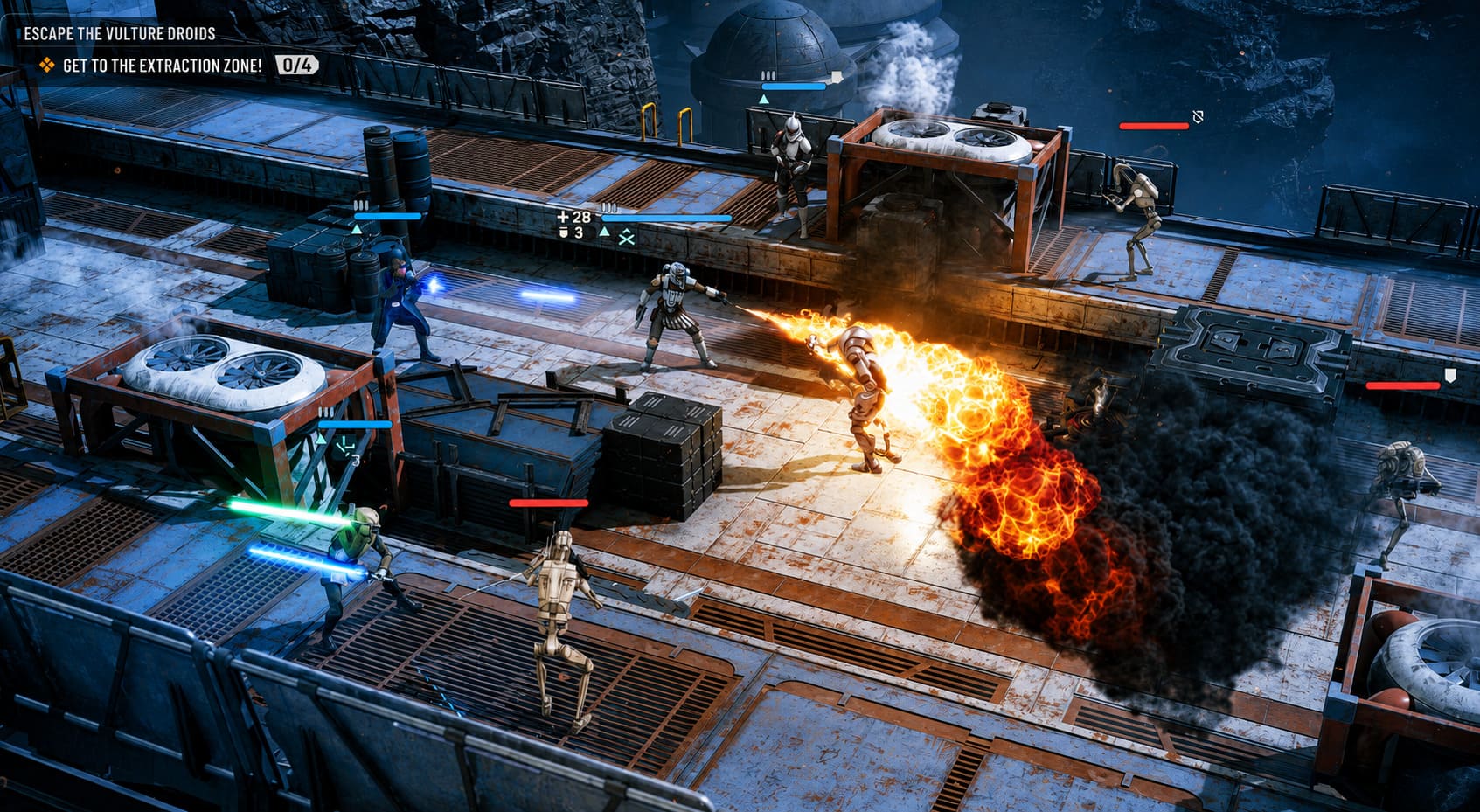
Instead of the familiar “move then shoot” structure, every character receives three Action Points.
That sounds simple, but it changes combat dramatically.
A turn might look like this:
- Throw a grenade.
- Move behind heavy cover.
- Enter Overwatch.
Or…
- Dash forward.
- Use Force Push.
- Finish an enemy with a blaster shot.
You’re constantly deciding how aggressive or defensive each Operator should become.
That freedom usually creates much more interesting tactical puzzles.
Every Class Has a Clear Battlefield Role
Bit Reactor isn’t going for dozens of overlapping subclasses.
Instead, classes appear focused and specialized.
| Class | Role |
|---|---|
| Assault | Close-range damage and mobility. |
| Heavy | Armor, explosives, crowd control. |
| Sharpshooter | Long-range precision eliminations. |
| Medic | Healing and battlefield recovery. |
| Recon | Scouting, stealth, enemy detection. |
| Scoundrel | Tricks, positioning, opportunistic attacks. |
| Gunslinger | Multi-target pistol combat. |
| Soldier | Balanced all-purpose fighter. |
Each class includes passive abilities, active skills, and an Ultimate ability.
I like this approach because it encourages building complementary squads instead of stacking damage dealers.
Jedi Powers Don’t Break the Tactical Rules
One concern I had immediately was Force users.
Would a Jedi simply overpower every encounter?
Thankfully, it doesn’t seem that way.
Force abilities appear designed as tactical tools rather than instant-win buttons.
Examples include:
- Force Push to remove enemies from cover.
- Telekinetic shockwaves affecting positioning.
- Battlefield manipulation instead of raw damage.
That feels much healthier for a strategy game than giving Jedi unlimited lightsaber dominance.
The Den Might Be the Most Important Feature Outside Combat
This is where Zero Company reminds me less of XCOM and more of games like Mass Effect or Marvel’s Midnight Suns.
The Den is a fully explorable mobile headquarters.
Instead of clicking menus, Hawks physically walks around the ship.
What You Can Do Inside The Den
- Recruit replacements.
- Upgrade armor and weapons.
- Research equipment.
- Speak with squad members.
- Unlock new operations.
- Learn additional lore.
I love headquarters that evolve over time.
Watching rooms expand and characters react to previous missions makes victories and losses feel permanent.
Relationships Actually Affect Gameplay
This feature surprised me the most.
Zero Company introduces a Bond System that rewards teammates fighting together repeatedly.
As bonds grow stronger, characters unlock cooperative abilities.
Some examples include:
- Free reaction attacks.
- Emergency movement assistance.
- Cover fire during enemy turns.
- Shared passive bonuses.
The important part isn’t just combat.
Back aboard The Den, stronger relationships unlock additional conversations and story scenes.
That means gameplay decisions shape narrative interactions naturally.
I always enjoy systems where storytelling grows from mechanics instead of separate dialogue trees.
The Galaxy Map Isn’t Just Mission Selection
Strategy games often reduce world maps to mission lists.
Zero Company appears more ambitious.
The holographic galaxy map changes depending on previous operations.
Fail a mission.
A planet’s situation worsens.
Protect civilians.
A sector becomes available for future contracts.
Those kinds of branching consequences give campaigns replay value without requiring completely different storylines.
Familiar Planets Return, But Fan Service Stays in the Background
Yes, recognizable locations appear.
Confirmed planets include:
| Planet | Connection to Star Wars |
|---|---|
| Vandor | Mountain world introduced in Solo: A Star Wars Story. |
| Mapuzo | Desert planet featured in Obi-Wan Kenobi. |
More Clone Wars-era locations are expected throughout the campaign.
The good news?
Bit Reactor says iconic characters appear only when the story genuinely needs them.
That’s exactly the right decision.
Anakin doesn’t need to become your squadmate.
The galaxy already feels connected simply because larger events happen around your mission.
Why Permadeath Makes Every Decision Matter
Permadeath isn’t new.
But Star Wars has rarely embraced it.
When an Operator dies permanently, they’re gone.
Weapons.
Experience.
Relationships.
Everything disappears.
That instantly changes how players approach missions.
Instead of rushing objectives, you’ll probably spend turns protecting wounded teammates or extracting soldiers before things spiral out of control.
Those are the moments strategy games create best.
What Makes Zero Company Different From Other Star Wars Games?
| Traditional Star Wars Games | Star Wars Zero Company |
|---|---|
| Lightsaber action. | Turn-based tactical combat. |
| Famous Jedi protagonists. | Original mercenary squad. |
| Large cinematic battles. | Covert operations behind enemy lines. |
| Fast-paced combat. | Planning, positioning, and squad survival. |
| Minimal squad customization. | Deep Operator progression and permadeath. |
That’s a surprisingly bold shift for the franchise.
EA could have asked for another action adventure.
Instead, they’re letting experienced strategy developers build something aimed at a completely different audience.
Star Wars Zero Company PC Requirements: Minimum and Recommended Specs Revealed
Why I Think Clone Wars Fans Should Pay Attention
After following Star Wars Zero Company closely, I think its biggest strength isn’t the tactical combat. It’s the way it treats the Clone Wars as a messy, exhausting conflict instead of a backdrop for famous heroes.
The Republic is cracking from the inside. The Separatists are becoming increasingly ruthless. Entire systems are abandoned while political leaders chase larger victories. That’s fertile ground for a strategy game where every mission feels like it could disappear from official history.
I also like that the developers aren’t trying to recreate XCOM with a Star Wars skin. The three-action-point system, Bond mechanics, Force-based battlefield control, and a headquarters built around character interaction all push the formula in meaningful directions.
If those systems work together, every campaign could tell a different story depending on who survives, who dies, and which relationships you invest in.
Star Wars Zero Company Release Date, Preorder Rewards, and The Den Strategic Gameplay Guide
Final Thoughts
I’ve wanted a Star Wars strategy game that respected the Clone Wars as an actual military conflict, not just a backdrop for lightsabers.
Zero Company looks closer to that vision than anything we’ve had before.
The combination of former XCOM developers, permanent squad consequences, customizable Operators, and a story focused on forgotten soldiers makes this feel less like fan service and more like a genuine war drama set inside Star Wars canon.
Will every mechanic land perfectly? We won’t know until launch.
But the foundation is incredibly promising.
If Bit Reactor delivers meaningful tactical depth, memorable squad relationships, and a campaign where your choices reshape the galaxy map, Star Wars Zero Company could become one of the strongest single-player Star Wars games of this generation—and easily the most interesting strategy title the franchise has produced in years.