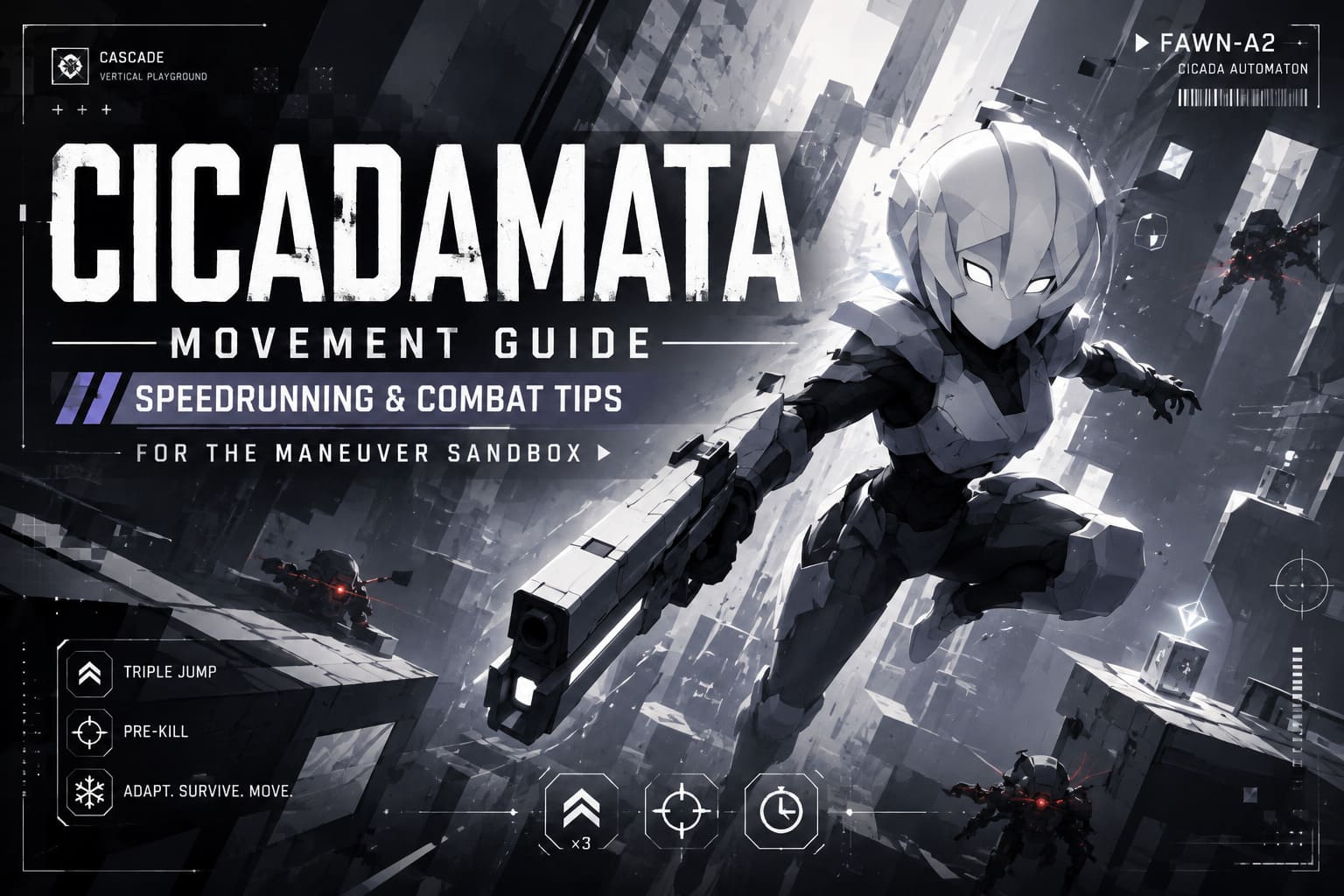
CICADAMATA Movement Guide: Speedrunning and Combat Tips for the Maneuver Sandbox
After playing a ridiculous number of movement shooters, I’ve developed a pretty good idea of what makes one feel great and what makes another feel like a collection of flashy mechanics looking for a game to live inside. CICADAMATA falls firmly into the first category.
It is fast, strange, deliberately minimalistic, and much more interested in making you move than making you collect things. Developed by flowergarden, CICADAMATA throws you into CASCADE as FAWN-A2, a CICADA automaton, and basically tells you to figure out how to survive its vertical digital playground.
The first few minutes can be deceptive. You might think this is simply another stylish first-person shooter with some platforming attached. It isn’t. The longer I played, the more I realized that the shooting is almost secondary to movement. Enemies, platforms, hazards, and even the geometry of each level feel like pieces of a giant movement puzzle.
And that’s exactly why I think CICADAMATA movement mechanics are worth learning properly rather than treating them as something you will naturally pick up.
The game becomes considerably more enjoyable once you stop thinking, “How do I get over there?” and start thinking, “What is the fastest and safest line through this entire section?”
Joyeuse Is Your Weapon, Tool, and Movement Companion
One of the things I appreciate most about CICADAMATA is how little time it wastes on conventional shooter design.
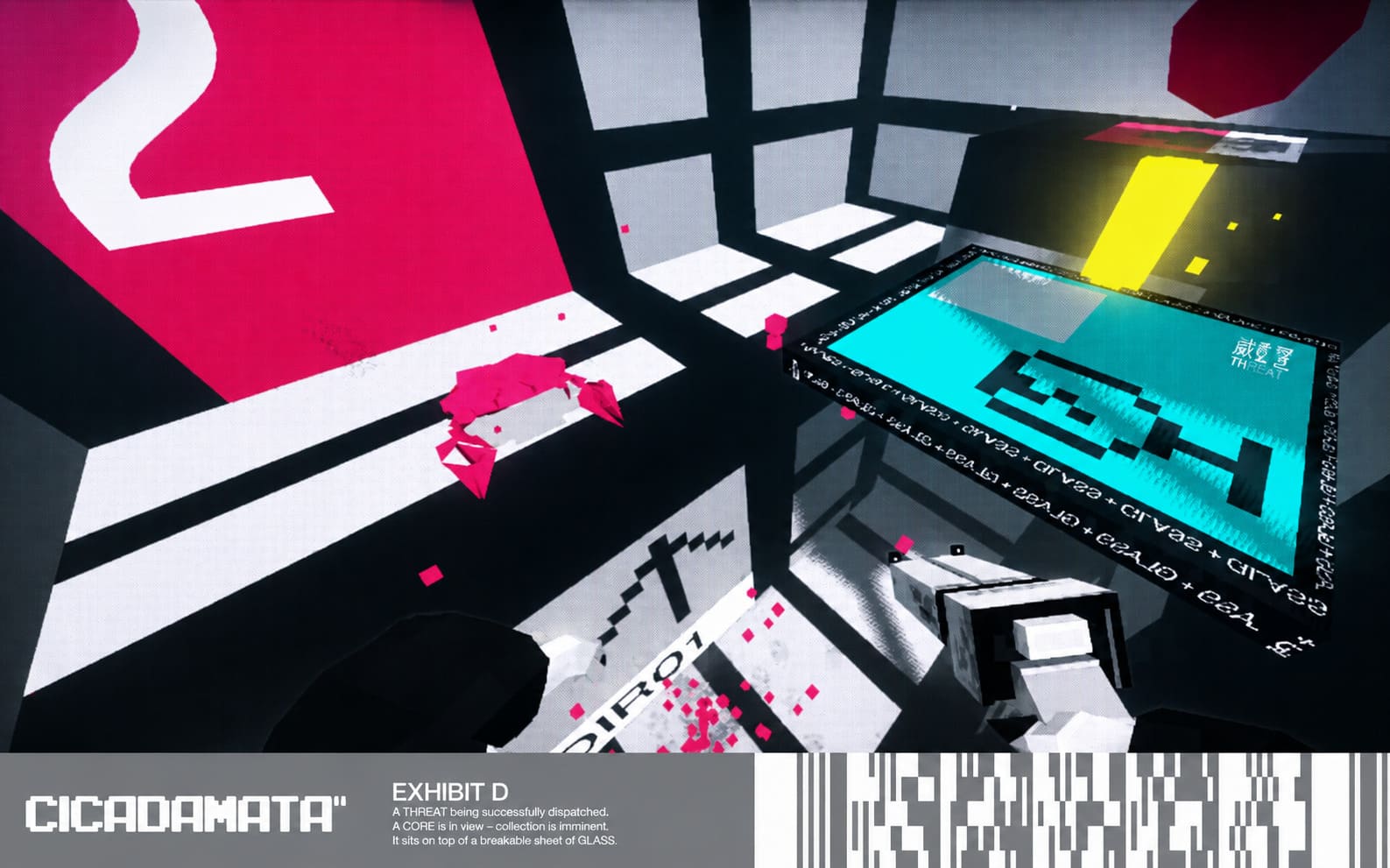
You don’t have an enormous inventory. You aren’t constantly swapping between six guns because one has 4% better damage. Your main weapon is Joyeuse, and its flexibility is more important than its quantity.
| Mode | Main Function | Best Use |
|---|---|---|
| Hip-Fire | Shotgun | Close-range enemies and clearing immediate threats |
| Aim | Sniper | Distant targets, weak points, hazards, and precision shots |
The shotgun is what I found myself using most often while moving aggressively. If an enemy is directly in your path, stopping to line up a perfect shot usually isn’t worth it. A quick blast can remove the problem while you continue your movement chain.
The sniper mode is different. It rewards preparation.
If you’re approaching a huge gap and can see an enemy waiting on the opposite side, there’s often no reason to land first and deal with the threat afterward. Take the shot before you arrive. That’s one of the simplest habits that can make a run feel dramatically cleaner.
The important thing is that Joyeuse doesn’t interrupt the movement-focused design. You don’t stop playing the platformer just because combat starts.
Combat happens while you’re moving.
That’s the mindset I recommend adopting early.
The Triple Jump Is the Heart of CICADAMATA
If there is one mechanic you should spend time practicing, it is the triple jump.
Coming from other movement shooters, I initially treated the three jumps as extra height. That was a mistake. The real value comes from understanding how each jump changes your trajectory and gives you another opportunity to correct your movement.
First Jump: Establish Your Line
The first jump is your foundation.
Use it to leave the ground, establish forward momentum, and decide where you’re actually going. It sounds basic, but experienced players will notice that the first jump is less about reaching the destination and more about creating a good setup for the next two.
Second Jump: Extend the Route
The second jump is where things become more interesting.
Rather than thinking of it as simply “jump number two,” think of it as a trajectory correction tool. You can use it to extend a horizontal movement line, adjust your position, or recover from a slightly imperfect first jump.
This becomes especially useful when crossing wide gaps.
Third Jump: Vertical Control
The third jump gives you another major burst of height and, more importantly, another chance to understand where you’re going.
This is where I recommend looking down occasionally.
CICADAMATA’s vertical design can make it surprisingly easy to lose track of your landing point. The third jump gives you enough altitude to quickly reassess the battlefield, identify the next platform, and prepare for the descent.
Don’t waste the third jump just because you still have it available.
Save it when necessary, especially when you’re dealing with complicated platform sequences.
Stop Fighting the Level
This is probably my biggest piece of advice for new players.
Don’t treat every obstacle as something you have to fight.
CICADAMATA’s environments are designed around movement. If an enemy is sitting in an awkward location, the obvious solution isn’t always to kill it. Sometimes the better answer is simply to go around it.
This matters even more when you’re attempting speedruns.
Every unnecessary fight costs time. Worse, it can destroy your momentum.
I tend to divide encounters into three categories:
- Immediate threats: Kill them quickly because they’re blocking your route.
- Distant threats: Use Joyeuse’s precision mode before they become a problem.
- Irrelevant enemies: Ignore them completely if they don’t interfere with your route.
That third category is incredibly important.
A perfect speedrun isn’t necessarily the run with the most kills. It’s the run where you spend the least amount of time doing things that don’t help you reach the objective.
Use Your Shadow as a Landing Indicator
One of the oldest tricks in platforming is also one of the most useful in CICADAMATA.
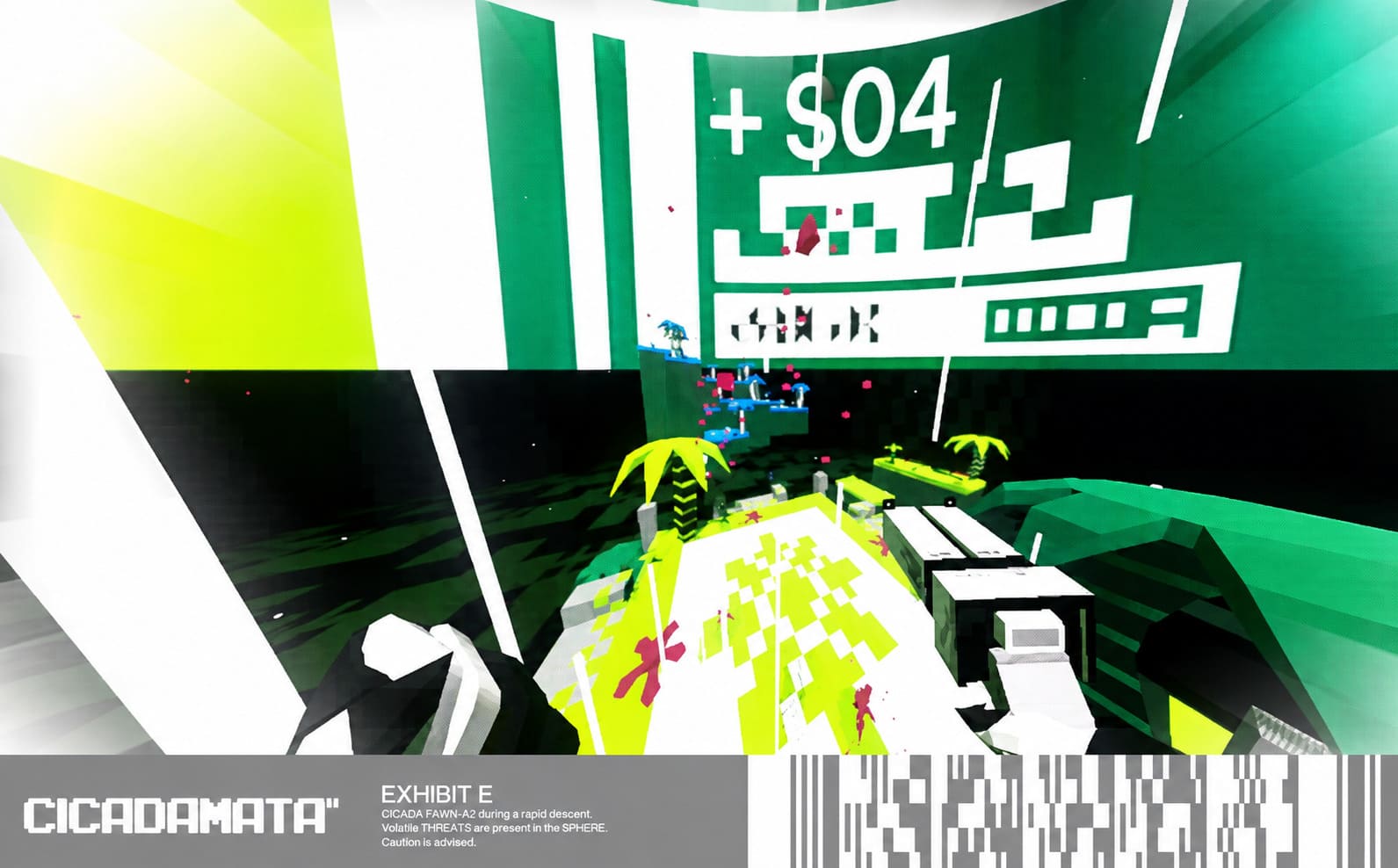
Watch your shadow.
When you’re high above the environment, judging distance from your first-person perspective can be surprisingly difficult. Your screen tells you where you’re looking, but it doesn’t always tell you exactly where your character will land.
The shadow does.
If you are descending toward a small platform, glance downward and use the shadow to make the final correction. This is particularly useful when you’re moving quickly and don’t have time to carefully calculate the trajectory.
I’ve played plenty of first-person platformers where I learned to trust the reticle or the character’s visual position. CICADAMATA encourages something slightly different.
Your shadow becomes part of your navigation system.
Once you get comfortable with it, some of those terrifying drops become much easier to read.
Ice Levels Change Everything
CICADAMATA becomes considerably more interesting when environmental physics start interfering with your normal movement habits.
Ice is the obvious example.
Reduced friction means that your ground movement becomes less predictable. If you’re used to making aggressive turns while running, you’ll quickly discover that the environment doesn’t care about your plans.
Instead of constantly fighting the slippery surface, use it.
Build momentum before a jump. Let the slide carry you toward the edge of a platform. Then use your jumps to make the actual directional correction in the air.
This creates a completely different rhythm:
Slide → Launch → Correct → Land → Repeat
That rhythm can be incredibly fast once you learn it.
The biggest mistake is trying to move on ice exactly as you would on normal ground. You can’t. The environment is asking you to think ahead rather than react at the last second.
Underwater Movement Requires Patience
Underwater sections are almost the opposite of ice.
Instead of giving you too much momentum, water takes it away.
Movement feels slower, trajectories become less immediate, and your weapon behavior can change enough to throw off instincts you’ve already developed.
This is especially noticeable when firing at moving targets.
Don’t shoot where an enemy is.
Shoot where the enemy is going to be.
Projectile behavior can make underwater combat feel almost like a prediction game. If you fire directly at a moving target out of habit, you’ll often find yourself watching the shot arrive after the enemy has already moved away.
The solution isn’t complicated, but it does require changing your timing.
Slow down mentally even if your overall run remains fast.
That’s something I’ve learned across movement-heavy games: fast players aren’t necessarily making decisions faster. They’re making fewer bad decisions.
Zone Time and Mid-Air Decision Making
Zone Time can be particularly valuable when you’re navigating complicated sections where one small correction determines whether you land safely or completely miss the route.
Rather than activating it randomly, I recommend thinking of Zone Time as a tool for precision rather than panic.
A good sequence might look like this:
- Launch from a stable surface.
- Use the first jump to establish your route.
- Chain the second jump to extend your trajectory.
- Use the third jump to gain height and inspect the landing area.
- Activate Zone Time when you need a precise adjustment.
- Commit to the landing rather than constantly changing direction.
The key is not to turn every difficult jump into slow-motion indecision.
Zone Time should help you make a decision, not postpone one.
Speedrunning CICADAMATA: Think in Routes, Not Rooms
For casual play, getting through a level is enough.
For speedrunning, that mentality has to disappear.
Instead of memorizing individual rooms, start memorizing routes.
Ask yourself:
- Where can I skip an enemy?
- Which platform gives me the best launch angle?
- Can I eliminate a distant target before reaching its area?
- Where can I maintain momentum?
- Which jump can be shortened?
- Where am I wasting time recovering from bad landings?
This turns each level into a route optimization problem.
The four localized cores are the actual objectives, so everything else should support reaching them efficiently and making it to extraction.
The best routes won’t necessarily look like the routes you’d take during a normal playthrough.
That’s part of what makes speedrunning games like CICADAMATA so satisfying. Once you understand the intended path, you can start looking for the better path.
Combat Tips That Actually Matter
CICADAMATA doesn’t need dozens of complicated combat rules. Most of your improvement will come from combining shooting with movement.
Don’t Stop Moving for Easy Targets
If an enemy can be killed while you’re jumping, kill it while jumping.
Stopping creates problems that weren’t there before.
Use the Shotgun to Protect Your Landing
If an enemy is positioned directly where you’re about to land, the shotgun is usually the answer.
Clear the space immediately before touchdown.
Pre-Kill Distant Enemies
If you’re moving toward a platform and a dangerous enemy is visible ahead, use Joyeuse’s precision mode before you arrive.
This prevents you from landing directly into a fight.
Don’t Reload at the Worst Possible Moment
The visual weapon animations are stylish, but animation timing still matters.
Try to avoid entering a complicated jump while you’re committed to a lengthy reload sequence. Good players naturally develop a rhythm where they reload during safer movement windows instead of discovering they need ammunition halfway through a dangerous aerial sequence.
Is CICADAMATA Coming to PS5? PlayStation Store Release Date and Rumors
My Biggest Advice for New Players
If you’re coming into CICADAMATA from traditional shooters, forget most of what those games taught you about “playing safely.”
Safe doesn’t always mean standing behind cover.
Here, safe often means moving correctly.
A stationary player can become an easy target. A player who is constantly changing altitude, direction, and position is much harder to punish.
That’s why I think the game’s greatest strength is the relationship between its movement and combat systems.
You’re not a soldier walking through an arena.
You’re basically a projectile with a gun.
Once that clicks, the game feels completely different.
Is CICADAMATA Worth Buying on Launch Day? Comprehensive 2026 Gameplay & Review Breakdown
Final Thoughts
After spending time with CICADAMATA, what stuck with me wasn’t any particular enemy or weapon. It was the sensation of moving through its environments when everything finally clicked.
A jump becomes a kill.
The kill becomes momentum.
The momentum becomes another jump.
Then you’re already looking toward the next platform before you’ve finished landing.
That’s the loop.
CICADAMATA is at its best when you stop thinking of movement, combat, and level navigation as separate systems. They’re all part of the same thing.
Master the triple jump. Learn to read your shadow. Use Joyeuse before enemies become problems instead of after. Treat ice as a movement tool rather than an inconvenience, and slow your thinking down in underwater sections. Most importantly, start looking at levels as speedrunning puzzles even if you never intend to touch a leaderboard.
You don’t need perfect execution immediately.
You need a good route, a willingness to experiment, and enough patience to let the movement mechanics become second nature.
Once that happens, CASCADE stops feeling like a collection of dangerous platforms and starts feeling like a playground.
And honestly, that’s when CICADAMATA gets really good.