Cheap Car Repair Game 2026: Bank Loan, Debt Mechanics, and Budget Sourcing Guide
As someone who spends countless hours streaming new simulation games and digging into mechanics that most players overlook, I can confidently say that Cheap Car Repair 2026 surprised me more than almost any automotive simulator released this year.
Most garage management games let you become rich almost by accident. You repair a few cars, buy better equipment, and suddenly you’re sitting on an endless pile of cash. Cheap Car Repair takes a completely different approach. It throws players into a struggling workshop where every credit matters, every purchase feels risky, and one bad financial decision can send your business into a downward spiral.
After dozens of hours experimenting with different strategies, I discovered that success isn’t determined by your mechanical skills alone. Understanding money management, loan systems, and parts sourcing is what separates a thriving garage from a bankrupt one.
Why Money Feels Different in Cheap Car Repair 2026
One of the biggest reasons the game feels refreshing is its commitment to economic pressure.
From the moment you begin your career, resources are limited. You’re constantly balancing customer expectations against your available funds. Every repair order becomes a small business decision.
Do you purchase a brand-new component and guarantee a smooth repair?
Or do you hunt for a cheaper alternative and keep more money in your account?
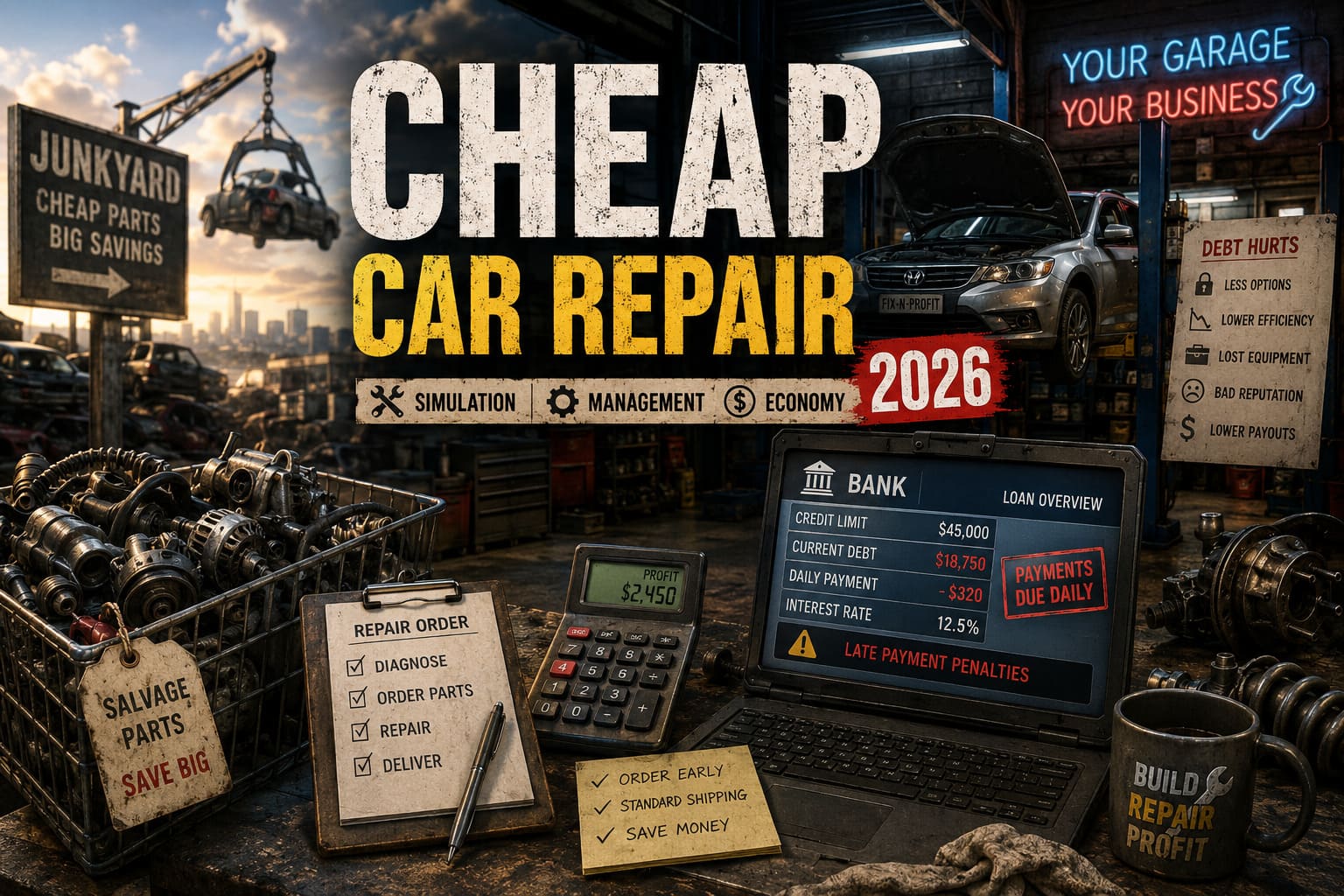
That constant tension creates some of the most memorable gameplay moments I’ve experienced in a simulator recently.
Unlike many repair games where money quickly becomes irrelevant, cash remains important throughout the entire progression system.
The Loan System: Helpful or Dangerous?
The banking mechanics initially seem like a lifesaver.
When your garage runs out of operating capital, the in-game banking software allows you to borrow money and continue working. For newer players, this sounds fantastic.
The reality is far more complicated.
What I Learned About Loans
| Feature | Impact on Gameplay |
|---|---|
| Credit Limits | Scale with garage progression and reputation |
| Interest Charges | Grow over time and reduce profit margins |
| Automatic Payments | Deduct funds daily regardless of income |
| Debt Penalties | Trigger if payments cannot be covered |
During my first career run, I relied heavily on loans whenever a repair became expensive.
Big mistake.
At first, the borrowed money solved immediate problems. However, the daily deductions slowly began eating into profits. Eventually I found myself completing jobs simply to cover previous debt rather than actually growing the business.
That’s when I realized loans should be treated as emergency tools rather than a normal source of operating capital.
My Personal Rule for Borrowing

I now follow a simple strategy:
Only take a loan if completing a specific repair will generate enough profit to cover the repayment and leave additional income behind.
If the borrowed money is merely delaying a financial crisis, you’re creating a bigger problem for your future self.
This mindset completely changed my progression speed.
What Happens When Debt Takes Over
One aspect I genuinely appreciate is how aggressively the game punishes poor financial planning.
Many simulators allow players to recover easily after going bankrupt. Cheap Car Repair doesn’t offer that luxury.
When your finances stay negative for too long, several unpleasant consequences start appearing.
Major Debt Consequences
- Restricted access to important purchasing options.
- Reduced operational efficiency.
- Loss of valuable workshop equipment.
- Reputation damage from unsatisfied customers.
- Smaller payouts from future contracts.
These penalties create a realistic feeling of pressure. Every missed payment has consequences, making financial management feel meaningful instead of being just another background system.
As a streamer, these moments actually created some of the funniest and most intense situations during live broadcasts. Viewers loved watching the chaos unfold whenever I pushed my luck too far.
The Secret Weapon: Salvage Hunting
If there’s one strategy I recommend to every player, it’s learning how to use the junkyard effectively.
Most beginners ignore salvage yards because damaged parts look worthless.
That’s exactly why they’re so valuable.
A component that appears completely ruined can often be restored using workshop equipment for a fraction of the cost of buying a factory-new replacement.
Over time, I stopped viewing the junkyard as a backup option and started treating it as my primary supplier.
The savings were enormous.
Benefits of Junkyard Sourcing
Lower Costs
- Components are dramatically cheaper.
Higher Profit Margins
- Repair expenses stay low while customer payouts remain unchanged.
Inventory Opportunities
- Extra parts can be stored for future repairs.
Reduced Loan Dependency
- Less spending means less need for borrowed money.
For players chasing maximum efficiency, this approach is incredibly powerful.
Why Modular Repairs Change Everything

Another feature that deserves praise is the game’s modular repair system.
Older garage simulators often force players to replace large assemblies even when only a tiny section is damaged.
Cheap Car Repair takes a more detailed approach.
Instead of replacing an entire system, you can often identify the exact failed component and swap only that piece.
This creates several advantages:
- Lower repair costs.
- Faster job completion.
- Better profit margins.
- More meaningful diagnostic gameplay.
As someone who enjoys realistic mechanics in simulation titles, I found this system surprisingly satisfying.
It rewards knowledge and attention to detail rather than simply throwing money at every problem.
The Shipping Trap Most Players Fall Into
One mistake I constantly see new players make is paying for rush deliveries.
Fast shipping feels convenient.
It is also one of the quickest ways to destroy profitability.
Whenever possible, I place orders before ending my workday and allow standard delivery to handle the shipment overnight.
The difference might seem small initially, but after dozens of repairs those savings add up significantly.
My Typical Workflow
- Diagnose vehicles.
- Create a parts list.
- Order everything before sleeping.
- Advance time.
- Start repairs the next morning.
This routine minimizes unnecessary delivery expenses and keeps cash reserves healthy.
Cheap Car Repair Guide: How to Expand Your Workshop and Make Millions
Flipping Cars for Extra Income
Once your garage develops a stable cash reserve, another opportunity opens up.
Vehicle flipping.
Abandoned cars and neglected auction vehicles can become surprisingly profitable investments if purchased carefully.
The key is avoiding vehicles with catastrophic mechanical damage.
I focus on cars that mainly suffer from cosmetic issues, light structural repairs, or neglected maintenance.
After cleaning, repairing, and improving presentation, many of these vehicles can be sold for a respectable profit.
It’s not the fastest money-making method in the game, but it’s one of the most reliable long-term income sources.
My Final Verdict on Cheap Car Repair 2026
After spending extensive time with the game, I believe its financial systems are what truly set it apart from competing garage simulators.
The constant struggle between spending and saving creates meaningful decision-making. Loans feel risky. Debt feels dangerous. Smart purchasing feels rewarding.
Most importantly, the game respects the player’s intelligence.
Success doesn’t come from grinding repetitive tasks. It comes from understanding economics, managing resources efficiently, and finding creative ways to keep costs under control.
If you’re starting your first garage career, my biggest recommendation is simple:
Stay away from unnecessary loans, embrace salvage parts, avoid expensive shipping options, and focus on maximizing every credit you earn.
Do that consistently, and you’ll discover that building a profitable automotive workshop is every bit as satisfying as rebuilding the cars themselves.
For simulation fans looking for a fresh challenge in 2026, Cheap Car Repair delivers one of the most engaging financial management systems I’ve seen in the genre.