Are There Enemies in Big Walk? Combat & Gameplay Explained
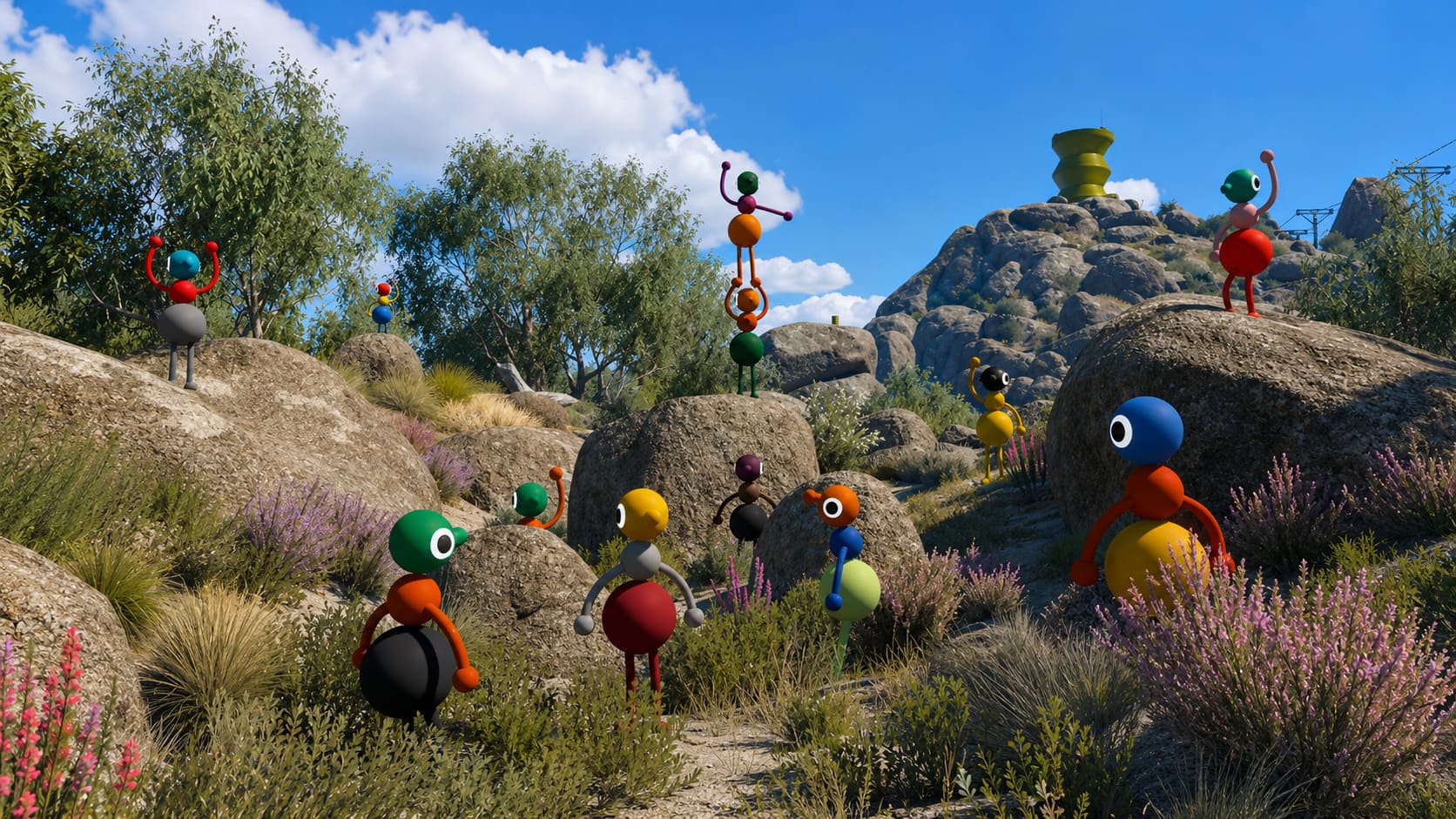
Big Walk looks like the kind of game that makes a lot of modern multiplayer design decisions feel completely backwards. There are no monsters waiting behind the next tree, no armed enemies patrolling the roads, no giant boss health bars and, most importantly, no traditional combat at all. House House, the studio behind Untitled Goose Game, is taking the multiplayer formula in a completely different direction with a game built around walking, talking, getting lost, solving ridiculous problems and messing around with your friends.
That immediately raises an obvious question for anyone who has spent years playing co-op games: Are there enemies in Big Walk?
No. At least not in the traditional video game sense.
You are not going to pull out a sword when something hostile jumps from the bushes. There is no weapon loadout, no ammunition economy, no enemy AI waiting to ambush your squad and no combat progression system hiding underneath the exploration. Big Walk is deliberately designed as what House House calls a ‘walker-talker’, and that description is actually a pretty perfect summary of the experience.
At first, the lack of enemies might sound like a strange choice for a large multiplayer adventure. Personally, I think it is one of the most interesting things about Big Walk. The game isn’t trying to make you feel powerful. It wants to make you feel like a bunch of friends who have been dropped into a weird open world with absolutely no idea what they are doing.
And honestly? That sounds fantastic.
Big Walk Release Date, Gameplay, and Everything We Know About House House’s New Game (2026)
Big Walk Doesn’t Need Combat to Create Tension
Most multiplayer games use enemies to give players an immediate reason to move. Something attacks you, you fight back, you survive, then you move to the next area. It is an incredibly effective gameplay loop, but it is also one that we have seen thousands of times.
Big Walk throws that formula out the window.
Instead of asking, ‘How are we going to kill this thing?’, the game constantly pushes you toward questions like, ‘Where are we supposed to go?’, ‘Can you see that thing from there?’, ‘Why did you press that?’, and my personal favorite, ‘Where the hell did everyone else go?’
That changes the entire mood.
You are exploring a huge natural environment alongside your friends, and the world itself becomes the source of friction. Paths can be confusing. Landmarks can be surprisingly difficult to identify. Players can split up without realizing it. A simple objective can turn into a ten-minute group argument because everyone has a different interpretation of what the game wants you to do.
That is Big Walk’s version of combat.
You are not fighting enemies. You are fighting confusion, distance, bad communication and the questionable decision-making skills of your friends.
So What Do You Actually Do in Big Walk?
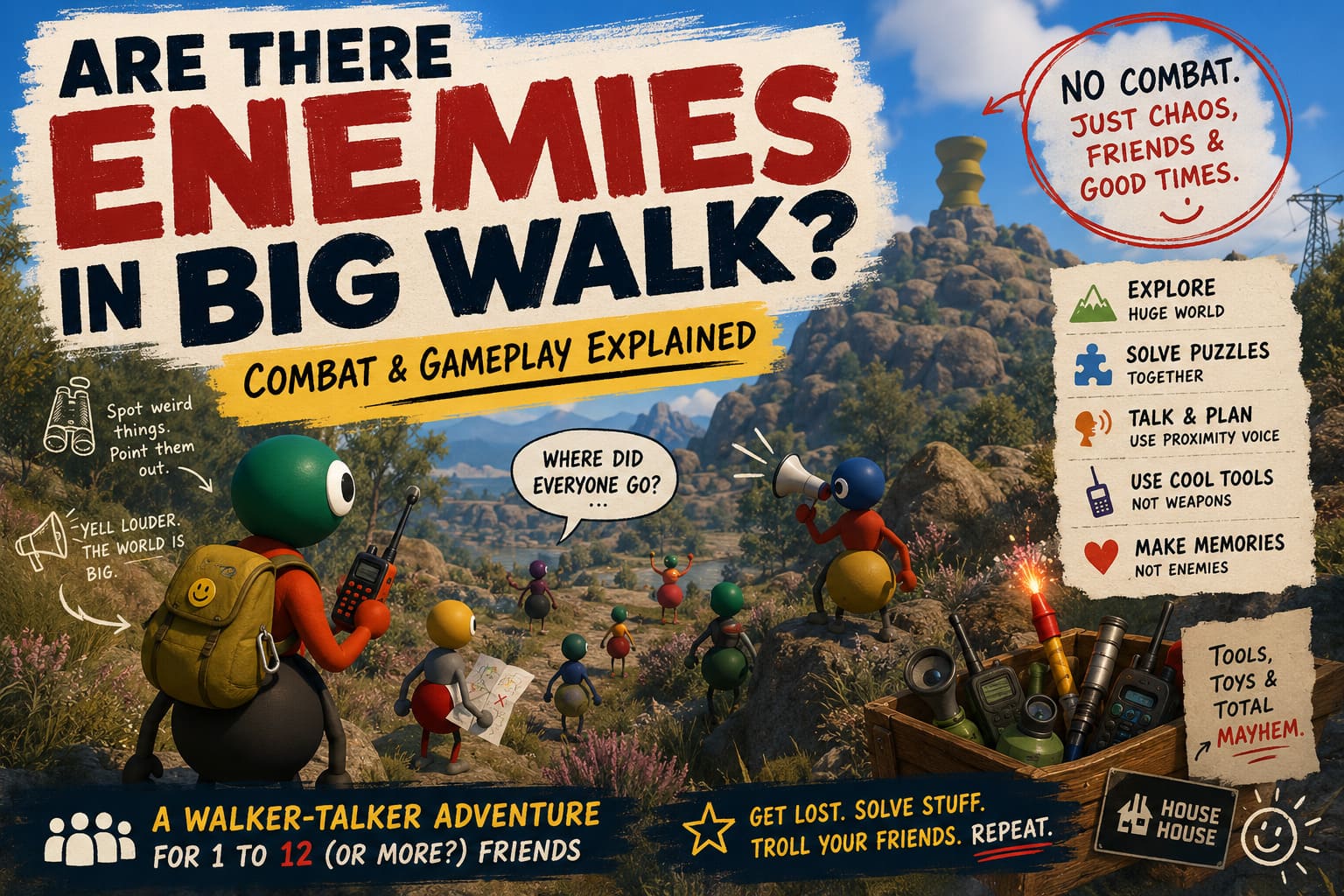
If you remove enemies and weapons from a multiplayer adventure, there has to be something replacing them. Big Walk appears to build its entire experience around exploration, environmental puzzles, communication and player interaction.
The game supports large groups, which makes these mechanics even more interesting. Once you put a bunch of people into the same open world, even simple objectives can become unpredictable.
Here is what appears to form the core gameplay loop:
| Gameplay Element | What It Means in Big Walk |
|---|---|
| Exploration | Discovering the world and finding your way through its large environments |
| Navigation | Using landmarks, terrain and teamwork instead of constantly following objectives |
| Puzzles | Solving environmental challenges that require multiple players |
| Communication | Using proximity voice chat and tools to coordinate |
| Social Interaction | Playing around, helping friends, trolling them and creating unexpected moments |
| Discovery | Finding interactive objects, hidden areas and strange situations together |
This is where Big Walk could become much more than a simple walking simulator. A static walking game can become boring very quickly. A multiplayer playground where everyone has to communicate, experiment and improvise is a completely different beast.
The Environment Is Basically Your Enemy
One of the most interesting ideas here is that the world itself replaces hostile creatures.
Imagine exploring a massive outdoor area with several friends. Someone notices a strange landmark on a hill. Another player wanders toward a different structure. A third person claims they know the way, despite clearly having no idea where they are going.
Suddenly, the group is split.
There is no enemy attacking anyone. There is no scripted chase sequence. Yet everyone is still dealing with a genuine problem: you have lost control of the group.
Navigation becomes a real gameplay mechanic instead of a boring activity between missions. The terrain matters. Your position matters. Your ability to communicate matters.
This is especially appealing to players who enjoy exploration games but hate being buried under maps, objective markers and giant glowing arrows telling them exactly where to walk.
Big Walk seems much more interested in letting players figure things out themselves.
And that means getting lost is not necessarily a failure.
Sometimes getting completely lost with eleven people is the actual game.
The Puzzles Turn Teamwork Into Controlled Chaos
Big Walk also replaces traditional enemy encounters with cooperative environmental puzzles.
These challenges can involve several players interacting with different parts of an environment at the same time. One player may have visual information that another player needs. Someone might have to activate a mechanism while the rest of the group figures out what it actually does.
That sounds simple until you remember how multiplayer groups behave.
Give four competent gamers a puzzle and they will probably solve it quickly.
Give twelve gamers a puzzle and suddenly one person is standing on a rock, two people are arguing, someone has wandered 500 meters away, another player is ringing a bell for no reason and the person with the actual solution has been ignored for three minutes.
That is exactly the kind of chaos that makes Big Walk appealing to me.
The challenge isn’t simply whether you are smart enough to solve the puzzle. It is whether your entire group can communicate well enough to solve it without imploding first.
Voice Chat Is Part of the Gameplay
This might be one of Big Walk’s smartest ideas.
The game uses proximity-based voice chat, meaning your friends’ voices change depending on where they are relative to you. Move farther away and communication becomes weaker. Physical obstacles can affect how clearly you hear other players, turning distance into an actual gameplay mechanic.
That creates moments that would never happen in a traditional co-op game.
Someone is yelling instructions from the other side of a canyon. Another player is trying to respond while moving through a tunnel. A third person cannot hear anyone and has absolutely no clue what is happening.
Now the group has to adapt.
When normal voice communication becomes difficult, players can rely on various objects and tools to stay connected. That makes communication itself part of the problem-solving process rather than something happening outside the game.
For a multiplayer game, that is a surprisingly clever twist.
Weapons Are Gone, but the Toy Box Is Still Huge
Just because there are no weapons does not mean Big Walk is lacking things to play with.
Quite the opposite.
The game appears packed with tools, gadgets and objects designed specifically to encourage experimentation and communication. Instead of collecting increasingly powerful weapons, players get equipment that helps them interact with the world and each other.
You can expect tools such as:
- Walkie-talkies for staying connected when the group splits apart.
- Megaphones for communicating across larger distances.
- Binoculars and laser pointers for drawing attention to distant locations or objects.
- Flares and fireworks for signaling where you are.
- Ridiculous interactive toys that are basically invitations to cause problems for your friends.
That last category is important.
Big Walk would probably feel much less interesting if every item existed purely to help you complete objectives. The fun comes from discovering that your tools can also be used for completely unnecessary nonsense.
Someone gives you a useful gadget.
Your first thought should be: ‘How can I use this to help?’
Your second thought, if you’re playing with the correct group of people, will be: ‘Can I throw this at my friend?’
That social mischief is a huge part of House House’s identity.
Big Walk Is the Opposite of a Stressful Co-op Game
There is something refreshing about a multiplayer game that doesn’t constantly scream at you.
Modern co-op games are often built around pressure. You have timers, enemy waves, resource management, bosses, increasingly difficult encounters and a constant expectation that everyone needs to perform.
Big Walk appears to be going in the opposite direction.
It is closer to sitting down with friends after a long day and collectively deciding to wander around somewhere strange for a few hours.
There is still structure. There are objectives and puzzles, and there is a reason to explore. But the experience doesn’t seem obsessed with punishing players for making mistakes.
That gives Big Walk a very different appeal.
You can imagine playing it late at night with a group, talking absolute nonsense while walking through the wilderness, stopping every few minutes because somebody found something interesting. There is no pressure to maintain a perfect run. There is no leaderboard determining who played best.
The memories are the reward.
The ‘Friendslop’ Appeal Makes Perfect Sense
The gaming community has increasingly embraced the idea of multiplayer games that are less about winning and more about hanging out. These games have sometimes been described as ‘friendslop’ — experiences where the entertainment comes from the group itself rather than an incredibly complicated progression system.
Big Walk fits that idea almost perfectly.
The game can generate funny stories naturally because players create the chaos themselves. Someone gets lost. Somebody discovers a bizarre object. A puzzle goes completely wrong. The group accidentally separates. One player decides to investigate something that absolutely nobody asked them to investigate.
Those moments are impossible to script perfectly.
And that is exactly why they can be so memorable.
Are There Bosses, Monsters or Hostile Players?
Based on the game’s stated design, no traditional enemies are part of Big Walk’s core gameplay.
You should not expect:
- Enemy combat encounters.
- Traditional boss fights.
- Weapon-based progression.
- Health-bar-focused survival.
- Combat arenas.
- Monster hunting.
- PvE battles as a central mechanic.
The challenge comes from interaction with the world and with your own group.
That distinction matters because Big Walk is not trying to hide a secret combat system that players will eventually unlock. The lack of enemies is not an incomplete feature. It is the point.
Why I Think the No-Combat Approach Could Work
As someone who has played more multiplayer games than I probably should admit, I am genuinely interested in what happens when developers remove one of the safest gameplay crutches around: enemies.
Combat is easy to understand. Give players a threat and they immediately know what to do.
Big Walk has to create fun without that shortcut.
That means House House is relying on something much harder to manufacture: the personalities of the players themselves.
If your group is funny, curious and willing to mess around, Big Walk could be incredible. If everyone treats every objective like a speedrun and refuses to communicate, you might end up wondering why you are walking around a field with twelve people.
Personally, I think that risk is part of the appeal.
The best multiplayer memories rarely come from perfectly executed missions. They come from the moments when everything falls apart and everyone starts laughing.
That is where Big Walk seems to be aiming.
Final Verdict: No Enemies, No Problem
So, does Big Walk have enemies?
No — and that is probably one of the game’s biggest strengths.
House House is not building another co-op adventure where players march from one combat encounter to the next. It is creating a strange, social playground where exploration, environmental puzzles, communication and pure multiplayer nonsense become the main attractions.
There is no sword to upgrade, no monster to kill and no boss to conquer.
Instead, your biggest threats might be getting hopelessly lost, misunderstanding a puzzle, losing your friends somewhere in the wilderness or discovering that the person leading the group has absolutely no idea where they are going.
Frankly, I would take that over another generic enemy camp any day.
Big Walk is about the journey, but more importantly, it is about who you take along for that journey. When the game works, the funniest moments should come from players rather than scripted encounters. And if House House manages to turn simple walking, talking and getting lost into genuinely compelling multiplayer entertainment, it could have something surprisingly special on its hands.
Sometimes the best co-op adventure is not about surviving the world.
Sometimes it is about surviving your friends.