Soulmask Boss Respawn Timer Guide 2026: World Bosses and Dungeons Reset Times Explained
After spending hundreds of hours in survival games over the years — from brutal sandbox grinders to massive open-world RPGs — I can confidently say that Soulmask has one of the more interesting endgame farming systems I’ve seen recently. It’s not overly casual, but it also doesn’t completely punish players who enjoy optimizing routes and farming efficiently.
The biggest mistake I see new players make in Soulmask is simple: they waste too much time standing around waiting for bosses to respawn.
If you understand how the game actually handles timers, dungeon resets, and proximity mechanics, you can turn Soulmask into a smooth farming loop instead of a frustrating waiting simulator. After testing routes myself, comparing notes with other long-time survival players, and experimenting in both solo and dedicated server environments, here’s the most practical breakdown of how boss respawns really work in 2026.
Why Respawn Timers Matter More Than Gear
In the early game, almost anything works. You gather resources, build your camp, and slowly unlock better tools. But once you reach the later regions and start hunting high-tier mask modules, legendary crafting materials, and advanced technology blueprints, efficiency becomes everything.
The strongest players aren’t necessarily the ones with the best weapons.
Usually, they’re the players who understand:
- boss rotation timing,
- dungeon cooldown cycles,
- fast travel optimization,
- and spawn manipulation.
A player who knows the farming loop can progress twice as fast as someone randomly wandering between arenas.
How Soulmask Handles Enemy Respawns
One thing Soulmask does surprisingly well is separating different enemy types into unique respawn systems. Not every creature follows the same rules, and understanding that changes how you approach the entire game.
Standard Open-World Enemies
Regular enemies and tribal camps are relatively simple.
Most smaller camps reset dynamically somewhere between 10 and 30 real-life minutes, depending on:
- player distance,
- nearby structures,
- server load,
- and whether combat recently occurred.
From my experience, the game clearly prefers unloading areas when players leave. If you stay nearby too long, resets become inconsistent.
Barracks and Major Camps
Large tribal barracks operate differently.
These locations often refresh based on the in-game server clock rather than pure real-time cooldowns. If nobody remains inside the area, the camp can fully repopulate after the daily reset cycle.
This is why many players log in after a fresh server cycle and suddenly find elite camps fully restored.
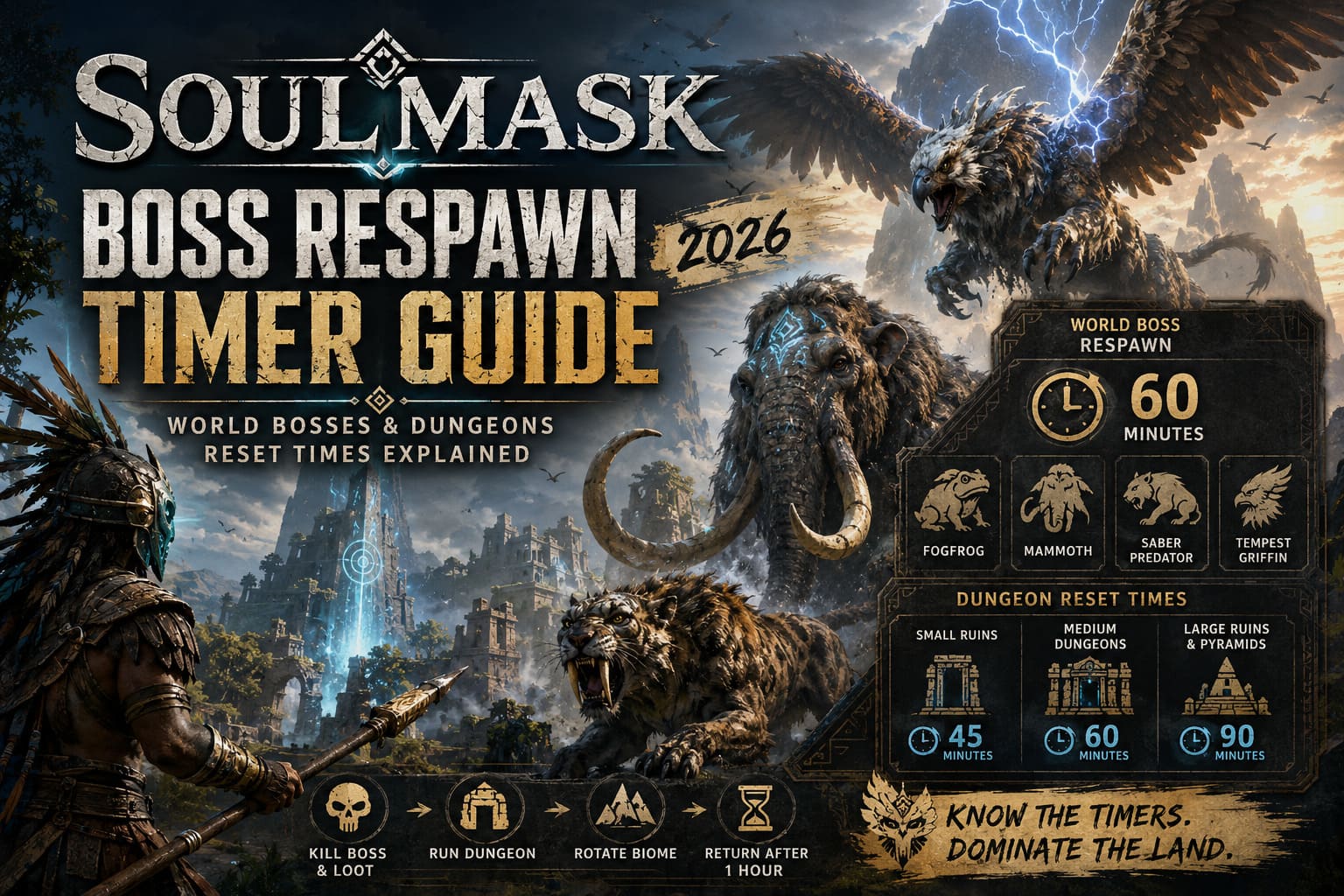
World Boss Respawn Timer in Soulmask

Now for the important part.
After dozens of boss runs, the most reliable timer for open-world apex bosses is still:
| Boss Type | Average Respawn |
|---|---|
| Open-World Apex Bosses | 60 Minutes |
| Elite Predator Variants | Around 60 Minutes |
| Rare Biome Bosses | 60 Minutes |
This timer begins the moment the boss dies — not when you leave the area.
That distinction matters.
Bosses That Follow the 1-Hour Rule
Several major bosses consistently follow the same cooldown behavior, including:
- Fogfrog
- Mammoth
- Saber Predator
- Tempest Griffin
These encounters are designed to slow down progression intentionally. If bosses instantly respawned, players would completely bypass the intended gear curve within a few days.
Honestly, compared to other survival games I’ve played, Soulmask’s one-hour timer feels fair. It’s long enough to encourage exploration, but short enough that active players can build efficient farming loops.
The Hidden Proximity Rule Most Players Ignore
This is where many farming runs break.
If players remain too close to the arena after killing the boss, respawns can delay or behave inconsistently.
Based on testing and community discussion, staying within roughly 60–100 meters of the spawn zone can interfere with the reset process.
This becomes even worse if:
- structures are built nearby,
- mounts remain parked in the arena,
- or clan members idle inside the zone.
What I Personally Recommend
After every boss kill:
- Fully harvest the carcass.
- Open all nearby relic containers immediately.
- Leave the biome entirely.
- Teleport somewhere else.
- Return only after the cooldown finishes.
The game clearly prefers unloading inactive regions before refreshing major enemies.
Dungeon and Ancient Ruins Reset Timers
Open-world bosses are only half the endgame grind.
The real progression wall comes from:
- Ancient Ruins,
- Holy Ruins,
- and Pyramid dungeons.
These contain some of the best materials in the game, especially for mask upgrades and advanced crafting unlocks.
Unlike open-world bosses, dungeon cooldowns scale based on difficulty.
Dungeon Respawn Table
| Dungeon Type | Reset Timer |
|---|---|
| Small Ruins | 45 Minutes |
| Medium Dungeons | 60 Minutes |
| Large Ruins & Pyramids | 90 Minutes |
One important detail many players misunderstand:
The final reward chest shares the same cooldown as the dungeon boss.
So even if regular enemies respawn earlier, the actual valuable loot room may still remain empty.
That explains why some players think their dungeon is “bugged” when in reality the reward timer simply hasn’t completed yet.
Best Farming Rotation for Endgame Players

Sitting at one arena waiting for a respawn is probably the least efficient thing you can do in Soulmask.
The game rewards movement.
After experimenting with routes for a while, this is the farming cycle that consistently gave me the best results.
My Preferred Rotation
Step 1 — Kill an Open-World Boss
Start with something fast and reliable like:
- Fogfrog,
- Saber Predator,
- or Mammoth.
Harvest everything immediately.
Step 2 — Move Into a Medium Dungeon
Medium dungeons are perfect filler content because they usually take:
- 20–30 minutes,
- provide decent materials,
- and naturally consume part of the world boss cooldown.
Step 3 — Rotate Into Another Biome
Travel somewhere completely different and clear another apex boss.
This keeps:
- inventory flowing,
- crafting materials stacking,
- and downtime almost nonexistent.
Step 4 — Return After One Hour
By the time:
- inventory management,
- repairs,
- crafting,
- and biome travel are finished,
your first boss is usually ready again.
This creates an almost endless loop without wasted idle time.
Soulmask Mysterious Merchant Location Guide: Where to Find the Wandering Trader
Solo Play and Private Server Tricks
If you play solo, the default timers can honestly feel a little excessive.
Thankfully, Soulmask gives players quite a bit of server customization.
Important Server Settings
Several settings directly affect respawn behavior:
| Setting | Effect |
|---|---|
| Dynamic Respawn | Enables flexible enemy refreshes |
| NPC Respawn Multiplier | Speeds up enemy return rate |
| Time Flow Multiplier | Accelerates world progression |
| Server Reset Cycles | Impacts camp restoration |
Increasing NPC respawn values dramatically speeds up farming.
For private groups, I actually recommend slightly boosted respawn settings. Soulmask has a huge map, and excessive waiting can eventually hurt pacing.
The Fast Solo Reload Method
There’s also a trick many solo players use.
And yes — surprisingly — it still works fairly often in 2026.
The Method
- Kill the boss.
- Move far away from the arena.
- Log out completely.
- Reload the world.
Sometimes the local world state refreshes instantly and forces the boss to respawn immediately.
It doesn’t work every single time, but it’s reliable enough that many experienced solo players still use it.
Personally, I suspect this happens because the local save reload forces a clean entity reconstruction.
My Overall Thoughts After Heavy Endgame Farming
After grinding countless bosses across multiple survival games, I actually think Soulmask handles respawns better than most titles in the genre.
The timers are long enough to:
- prevent complete progression abuse,
- encourage map exploration,
- and keep rare materials valuable.
But they’re also short enough that organized players can create smooth farming routes without feeling trapped in endless downtime.
The key is understanding that Soulmask is designed around rotation farming, not stationary farming.
Once you stop waiting at arenas and start chaining bosses together across the map, the entire endgame suddenly feels far more rewarding.
Final Tips for Efficient Soulmask Boss Farming
Before you start your next farming session, remember these simple rules:
- Never wait directly inside a boss arena
- Always rotate between multiple regions
- Use dungeons as cooldown fillers
- Harvest bosses completely before leaving
- Manage inventory during travel downtime
- Consider private server tuning for solo play
Mastering these systems turns Soulmask from a slow survival grind into a highly optimized progression experience.