Moo Who Beginner Guide: Top Tips, Tricks, and Strategies to Survive the Farm
There are multiplayer games that reward mechanical skill, games that reward strategy, and then there are games that basically ask, “How convincing is your cow impression under pressure?” That is the wonderfully ridiculous idea behind Moo Who?, the multiplayer social stealth game from SAT Productions.
The setup sounds simple enough. Players enter a chaotic farm, some become Animals hiding among AI-controlled livestock, while others take the role of Hunters trying to identify and eliminate the human-controlled creatures. The catch is what makes the whole thing work: Animals cannot simply hide silently forever. The game periodically forces them to make the appropriate animal sound using their real microphone.
That single mechanic changes everything.
You can have the perfect hiding spot, move like an NPC, and completely fool a Hunter for several minutes. Then the sound-pressure mechanic kicks in, you panic, produce the world’s worst attempt at a sheep baa, and suddenly the entire lobby knows exactly where you are.
I love that kind of design. It creates those stupidly funny multiplayer moments that you actually remember after the match ends.
This beginner guide breaks down the mechanics that matter, the habits that separate believable Animals from obvious players, and the Hunter techniques that can turn a random shot in the dark into a reliable elimination.
Understanding How Moo Who? Actually Works
Before worrying about advanced mind games, get comfortable with the basic structure of a match.
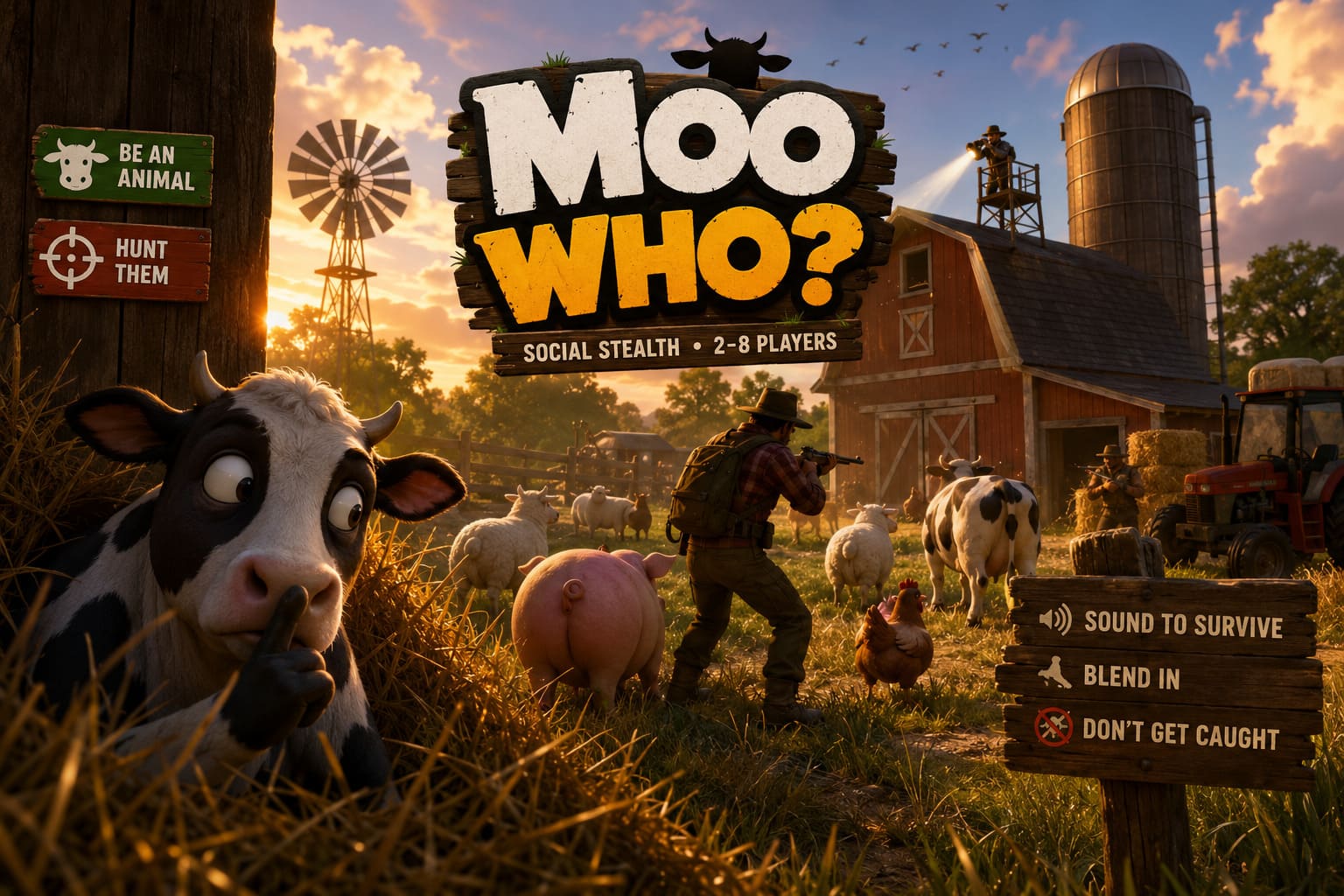
Moo Who? supports 2 to 8 players, with players divided between Animals and Hunters. Animals are attempting to survive while blending into AI-controlled farm animals. Hunters have weapons and must identify which creatures are controlled by real players.
| Role | Main Goal | Biggest Advantage | Biggest Weakness |
|---|---|---|---|
| Animals | Survive until the timer ends | Numbers, AI herd camouflage, deception | Sound-pressure mechanic |
| Herd NPCs | Provide believable cover | Predictable movement | Completely controlled by AI |
| Hunters | Eliminate human Animals | Weapons, observation, audio clues | Limited ammunition and penalties |
The important part is that Hunters cannot simply spray bullets into the herd. Shooting innocent NPC animals carries a serious penalty, meaning careless players can sabotage their own team.
For Animals, the opposite problem exists. You need to behave like an NPC while also responding to a mechanic specifically designed to expose players who remain too passive.
That creates a constant tug-of-war between acting naturally and reacting like a human.
Animal Strategy: Stop Playing Like a Gamer
This is probably the hardest lesson for new players.
When most gamers feel threatened, they immediately do gamer things: sprint away, spin the camera around, jump, crouch behind something, or stare directly at the enemy.
Don’t.
If you’re playing an Animal, your greatest weapon is boring behavior.
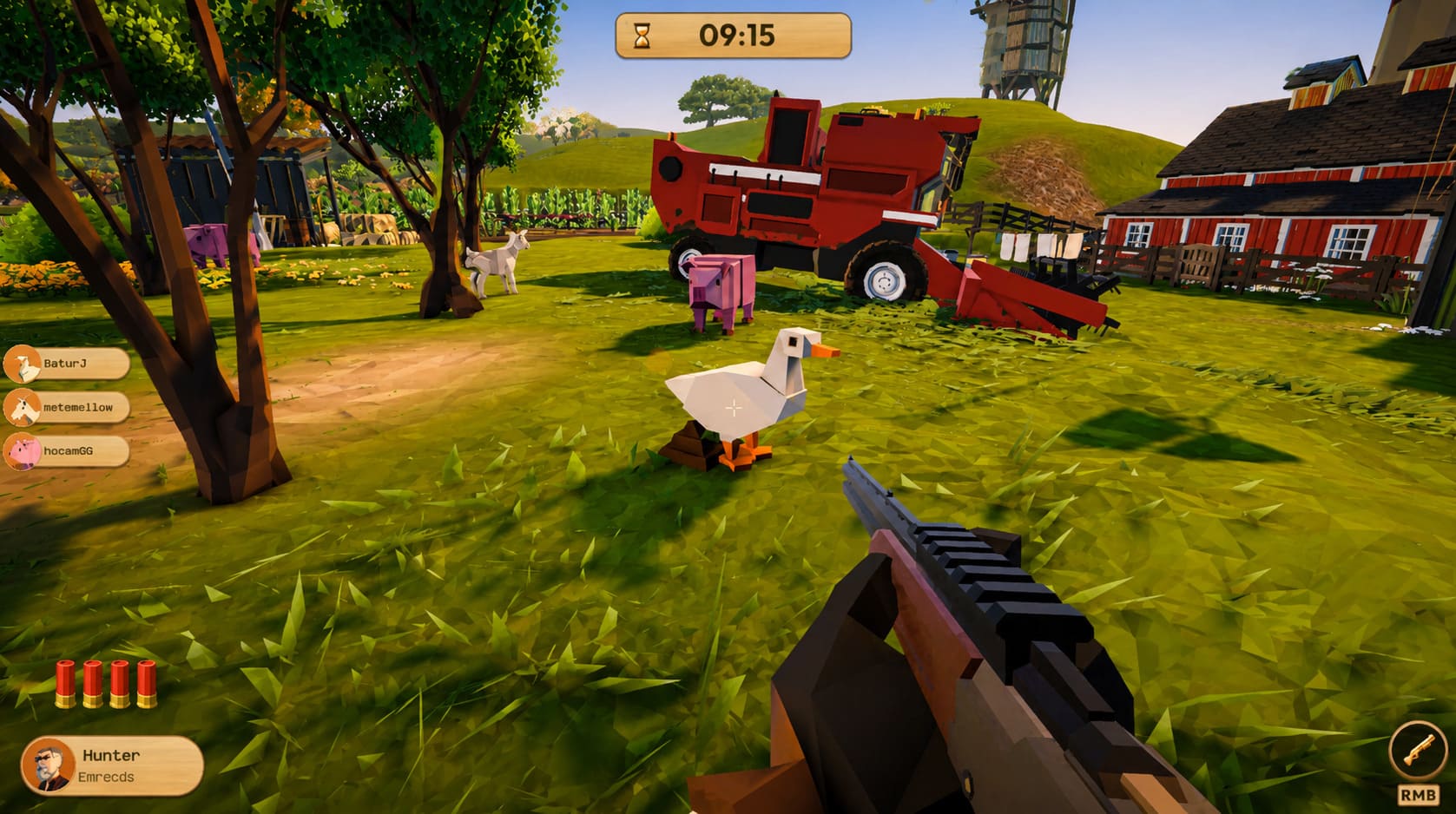
Copy the Herd Instead of Hiding From It
AI animals tend to have predictable movement behavior. They walk, stop, change direction, idle around familiar areas, and interact with the environment in ways that are much less erratic than human players.
Your goal isn’t necessarily to find the darkest corner of the map.
Your goal is to become the most uninteresting animal in the herd.
Walk at roughly the same pace as nearby NPCs. Match their direction whenever possible. Avoid sudden turns. Don’t repeatedly check whether the Hunter is watching you.
One of the easiest ways to expose yourself is to behave like someone who knows they’re being watched.
If a Hunter looks toward your group, resist the urge to immediately react.
A real NPC doesn’t get nervous because a Hunter is staring at it.
You shouldn’t either.
Master the Animal Sounds
The microphone mechanic is where Moo Who? becomes completely different from a traditional hide-and-seek game.
Your sound doesn’t have to be a perfect professional impression. What matters more is timing, confidence, and context.
If you’re supposed to sound like a cow, don’t spend five seconds thinking about the perfect moo while standing in front of a Hunter. That hesitation is far more suspicious than an imperfect sound.
A confident, appropriately timed noise can be surprisingly convincing.
Use the Herd’s Noise as Cover
Pay attention to the animals around you.
If several NPCs are making sounds naturally, that is an excellent opportunity to contribute your own noise without creating an obvious audio fingerprint.
You can also try to time your vocalization immediately after another animal sound.
This creates an audio mess that makes it harder for a Hunter to determine which creature produced the suspicious noise.
That doesn’t mean you should scream into your microphone constantly. In fact, excessive noise can make you stand out just as badly as silence.
Think of your microphone as another movement mechanic.
Good timing beats constant activity.
Don’t Panic When the Flies Appear
Miss the sound-pressure window and the game can punish you with a cloud of buzzing flies around your character.
This is basically the game’s giant neon sign saying:
“HEY HUNTER, LOOK HERE.”
If the flies appear, your first instinct will probably be to sprint.
That’s exactly what I would avoid.
A sudden burst of movement can confirm what the Hunter already suspects. Instead, try to move toward the densest nearby herd. If several creatures are packed together, the Hunter may have difficulty immediately identifying the exact target.
It isn’t guaranteed to save you, but turning a clear target into a messy cluster is better than running across an open field like you’ve just been caught stealing a tractor.
Hunter Strategy: Think Like a Detective
Playing Hunter isn’t simply about having a weapon. In a good match, your eyes and ears are more valuable than your ammunition.
The strongest Hunters aren’t constantly shooting.
They’re watching.
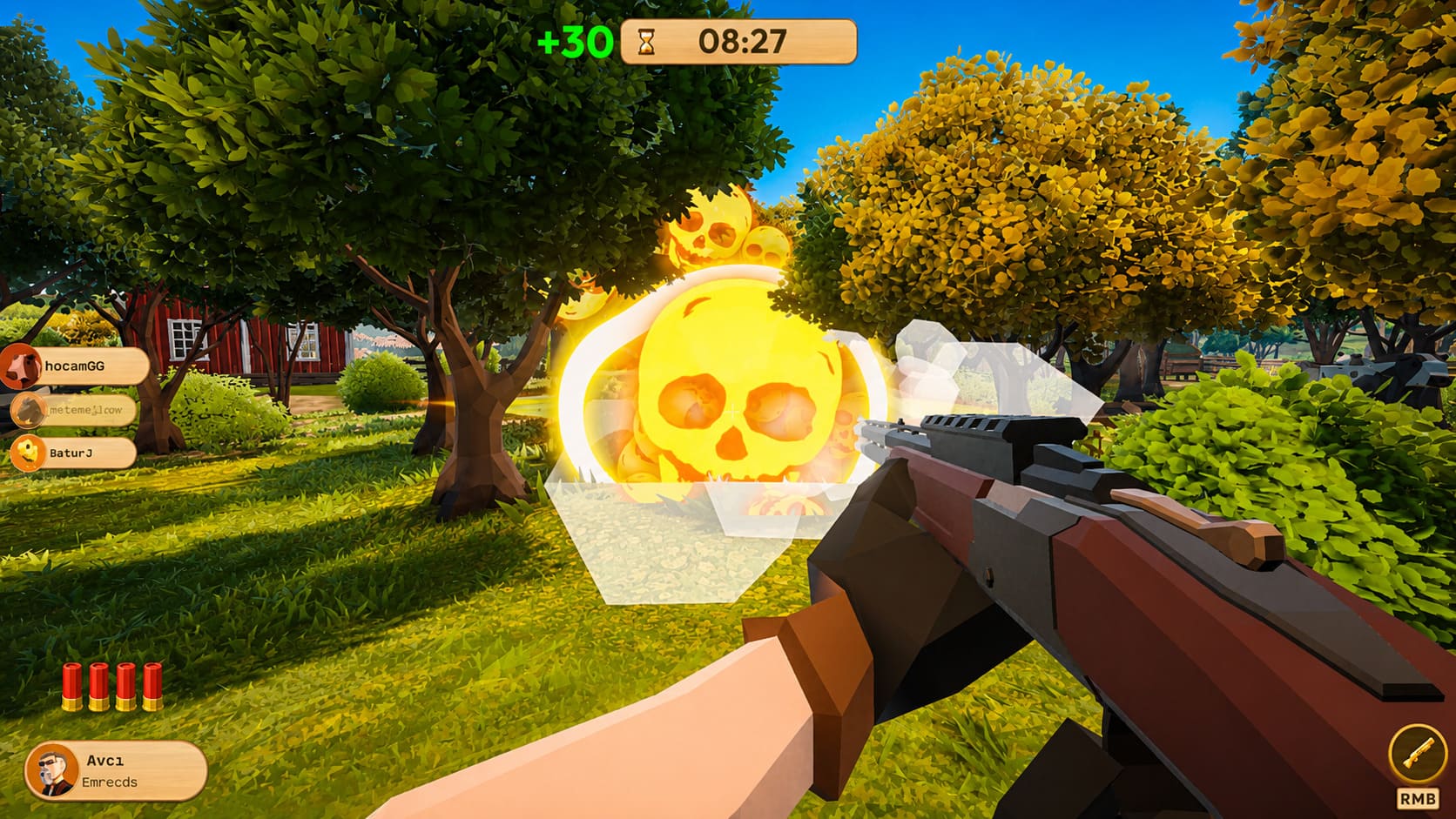
Identify Human Movement
AI animals tend to have predictable movement behavior.
Human players don’t.
Watch creatures approaching fences, walls, buildings, tractors, and other pieces of environmental geometry. Humans may hesitate, collide with objects, make unnecessary corrections, or suddenly change direction.
An animal that gets stuck against a corner for a moment isn’t automatically a player, but it’s absolutely worth watching.
The same goes for creatures that suddenly accelerate, stop for no obvious reason, or behave differently from the rest of their species.
Don’t shoot the first suspicious animal. Follow it.
That extra few seconds of observation can turn a guess into a much safer identification.
Use Audio Like a Weapon
A decent headset can make a huge difference.
Moo Who? relies heavily on proximity and spatial audio, so don’t treat animal noises as random background sound. Try to establish where the sound originated and compare it with what you can actually see.
A suspiciously loud animal noise coming from an unexpected location can reveal a player who is trying to hide behind a building or another obstruction.
Real microphones can also produce subtle sounds that AI-generated animal behavior won’t naturally create. Breathing, environmental microphone noise, or other tiny inconsistencies can give experienced Hunters something to investigate.
You don’t need to identify every sound instantly.
Instead, build a mental map of where the suspicious audio is coming from.
The Bait-and-Wait Trick
This is one of my favorite Hunter tactics because it weaponizes human impatience.
Walk toward a herd and deliberately stare at the animals for a few seconds.
Then turn around.
Walk behind a building or another obstruction where the Animals can no longer easily track you.
But don’t actually leave.
Wait.
Watch the herd from a safe angle.
Human players who believe the danger has passed will often relax. That’s when they make mistakes. Someone may suddenly sprint, reposition, rotate their character unnaturally, or move away from the group.
The Hunter doesn’t need to force the mistake.
Sometimes you just need to give the Animal enough confidence to make one.
Ammo Management Is Not Optional
Hunters have limited ammunition, and innocent NPC kills can seriously damage your chances of winning.
This makes trigger discipline one of the most important skills in the entire game.
Never fire because an animal “feels suspicious.”
Instead, stack evidence.
Look at its movement.
Listen to its sounds.
Check whether it reacts strangely to your presence.
Watch what happens during the sound-pressure phase.
Then make the shot.
A single carefully chosen elimination is far more valuable than firing several rounds into a herd and discovering that you just killed the wrong animals.
Team Coordination for Hunter Squads
If you’re playing with several Hunters, communication can dramatically improve your coverage.
Don’t have everyone chase the same suspicious herd.
Divide the map into sections and give each player an area to monitor. One Hunter can patrol the outer perimeter, another can watch buildings and choke points, while another checks larger livestock groups.
This also creates opportunities for cross-confirmation.
If one Hunter hears something suspicious, another player can approach from a different angle rather than immediately firing.
Two Hunters observing one target can be powerful. Four Hunters staring at the same chicken while the rest of the farm is completely unattended is just comedy.
Best Beginner Tips for Animals and Hunters
Once you’ve played a few matches, these smaller habits start making a surprisingly large difference.
For Animals
- Match the environment. If particular animal types naturally gather in certain areas, staying where you logically belong makes your disguise more believable.
- Avoid the map edges. Players often gravitate toward fences and corners because they feel safe there. Experienced Hunters know this.
- Don’t stare at Hunters. Looking directly at danger for too long is a very human habit.
- Use vocal chaos intelligently. If another player is being investigated, well-timed noise can make audio tracking more difficult.
- Calibrate your microphone. A microphone that fails to register your sound can trigger the fly penalty even when you’re genuinely trying to comply.
For Hunters
- Watch before shooting. Suspicious behavior is a reason to investigate, not automatically a reason to fire.
- Study pathfinding. Humans are messy. AI tends to be predictable.
- Check the perimeter. Amateur Animals frequently assume the outside edges are safer.
- Use bait. Pretending to leave can encourage human players to reveal themselves.
- Track audio carefully. Don’t just listen for animal noises; listen for where they come from.
Lord of Mysteries MMORPG Global Release Date & 2026 Launch Roadmap Explained
The Biggest Mistakes New Players Make
The funny thing about Moo Who? is that many beginner mistakes come from completely normal gaming instincts.
Animals run when they’re scared.
Hunters shoot when they’re suspicious.
Both instincts can get you killed.
For Animals, panic is the enemy. Running, turning rapidly, constantly checking the Hunter, and making strange movements can instantly destroy an otherwise convincing disguise.
For Hunters, impatience is the enemy. Wasting ammunition on uncertain targets can be much more damaging than allowing a suspicious Animal to remain alive for another few seconds.
The best players learn to suppress those instincts.
That’s where the game starts getting genuinely interesting.
How to Play Moo Who? Online with Friends: 2026 Social Stealth Guide
Final Verdict: Embrace the Chaos
Moo Who? is built around a simple but extremely effective idea: make players behave like animals while forcing them to communicate like humans.
That contradiction creates the game’s best moments.
As an Animal, you need patience, timing, confidence, and enough acting ability to make your movement look completely uninteresting. As a Hunter, you need discipline, observation, audio awareness, and the self-control not to empty your weapon into the nearest suspicious cow.
My biggest piece of advice is simple: don’t try to play perfectly. Play believably.
A slightly imperfect animal sound delivered naturally can work better than a technically impressive impression delivered at the wrong moment. A Hunter who waits five seconds for confirmation can outperform the player who fires instantly at every suspicious movement.
Once you stop treating Moo Who? like a traditional shooter or hide-and-seek game, the whole experience clicks.
Read the herd.
Control your movement.
Listen carefully.
Manage your ammunition.
And when that sound-pressure meter starts ticking down, for the love of all things farm-related, have your best moo ready.