Rock Bottom Guide 2026: Resource Farming and Skill Tree Meta
When I first launched Rock Bottom, I expected another casual incremental mining game that I’d leave running in the background while answering chat. Instead, several hours disappeared before I even realized it. The deeper I dug, the more obvious it became that this isn’t a game about clicking faster—it’s about building an economy that keeps getting stronger while every expedition becomes more efficient than the last.
After spending plenty of time experimenting with different upgrade paths, watching experienced players, comparing community discoveries, and testing ideas during my own streams, I eventually found a progression style that felt consistently rewarding. Some strategies looked powerful at first but slowed me down later, while others seemed boring early on yet became the foundation for huge resource gains.
If you’re starting your adventure or wondering why progression suddenly feels painfully slow, this guide covers the approach that has worked best for me.
Why Resource Efficiency Matters More Than Raw Speed
One mistake I see many new players make is assuming that faster mining automatically means faster progression.
It doesn’t.
The real progression system in Rock Bottom revolves around efficiency. Every mining trip should produce enough materials to finance multiple permanent upgrades instead of simply filling your inventory with resources you cannot process.
The moment I stopped chasing every shiny ore vein and started planning each expedition around efficiency, my overall progression accelerated dramatically.
Instead of asking:
“How can I mine faster?”
Ask yourself:
“How can every run become more profitable than the previous one?”
That mindset completely changes how you approach the game.
My Preferred Route Through the Underground
Every biome encourages a different playstyle, and forcing one strategy through the entire game usually ends in wasted time.
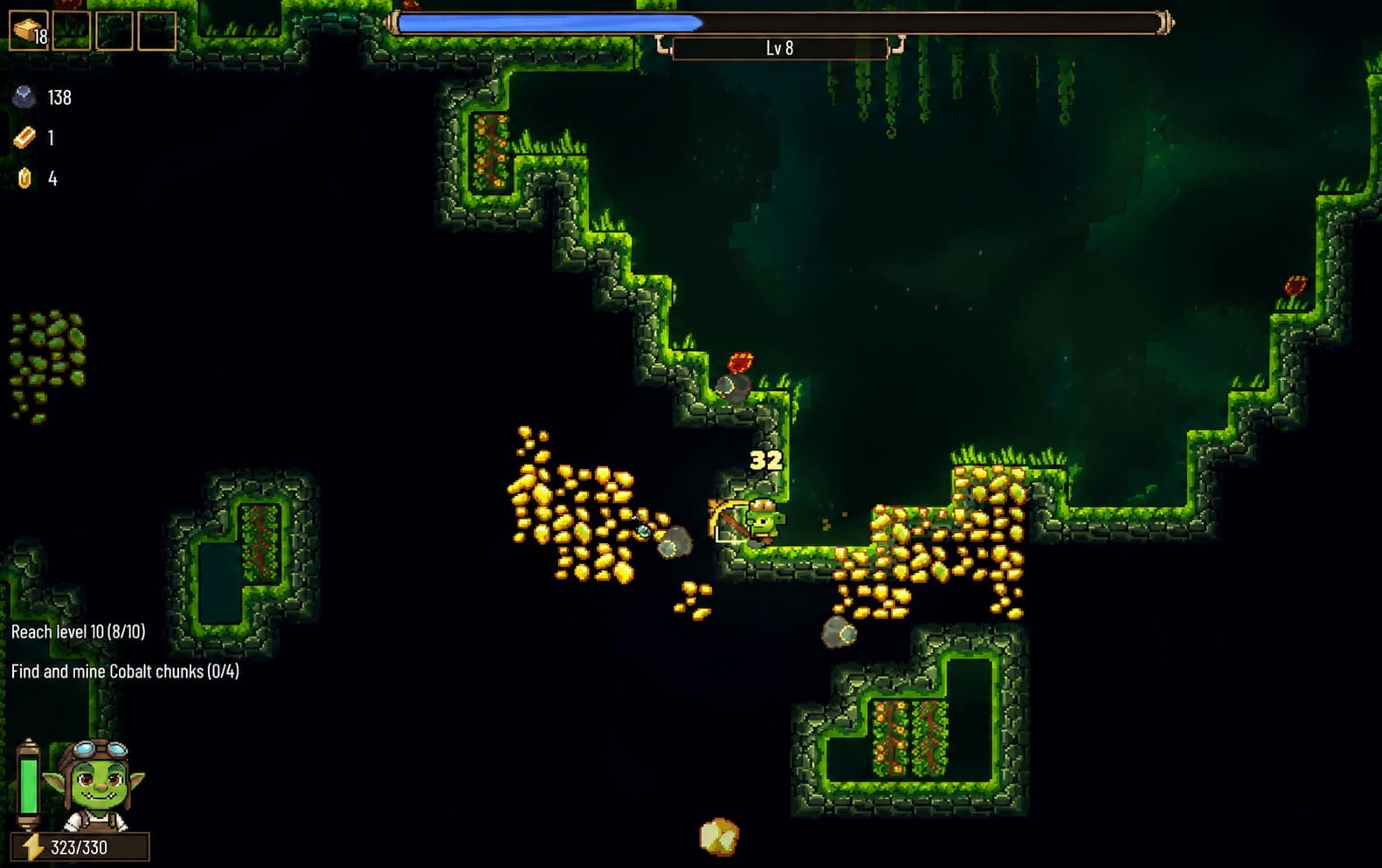
Early Layers: Build the Foundation
The first areas might look simple, but they’re surprisingly important.
Many players immediately rush toward every rare ore they can find, believing rarity equals value. I actually had better results doing almost the opposite.
During my early runs I focused on clearing dense stone clusters while collecting iron whenever it naturally appeared nearby.
Why?
Because early upgrades require huge amounts of common resources.
Running across the map for one isolated ore node often costs more time than clearing several nearby rock formations.
At this stage I recommend prioritizing:
- Stone clusters
- Nearby Iron deposits
- Fast cave clearing
- Short return trips
Nothing flashy—but incredibly effective.
Mid Game Is Where the Real Fun Begins
Once stronger abilities become available, Rock Bottom completely changes its rhythm.
Instead of breaking blocks one by one, you’re suddenly deleting entire sections of the cave with powerful abilities.
This is where the game became addictive for me.
Area damage abilities dramatically increase the amount of ore collected during every run.
Large Iron formations that previously took forever suddenly disappear in seconds.
One lesson I learned fairly quickly:
Mining speed is usually more valuable than additional raw damage.
If each swing feels slow, increasing damage often doesn’t solve the problem.
More swings per second almost always translates into smoother resource collection.
Don’t Ignore Mobility
A surprising number of valuable resources spawn in awkward locations.
Having stronger movement tools often saves far more time than another small damage increase.
Whenever mobility upgrades became available, I noticed that my average farming run became much cleaner.
Instead of carefully climbing every obstacle, I could simply reach difficult deposits immediately.
Less downtime.
More mining.
More profit.
It sounds simple, but those saved seconds add up over dozens of expeditions.
The Smeltery Is the Real Progression Gate
If there is one system capable of slowing your progress more than anything else, it’s the smeltery.
I learned this the hard way.
At one point I had mountains of ore sitting in storage while waiting forever for processing to finish.
That’s when it became obvious:
Mining isn’t the bottleneck.
Processing is.
The solution isn’t glamorous, but it works.
Focus on improving:
| Upgrade | Why It Matters |
|---|---|
| Storage Capacity | Accepts larger mining hauls before filling completely. |
| Processing Speed | Converts ore into valuable bars much faster. |
| Input Capacity | Reduces unnecessary inventory management between runs. |
| Automation | Keeps production flowing while you’re already back underground. |
Once those upgrades reached comfortable levels, my gameplay loop became dramatically smoother.
My Favorite Gameplay Loop
After dozens of hours experimenting, I naturally settled into a routine that consistently produced strong results.
It looked something like this:
- Dive underground with abilities fully available.
- Focus on dense resource clusters instead of isolated deposits.
- Fill inventory efficiently.
- Return before wasting time wandering.
- Load every resource into the smeltery.
- Spend processing time purchasing permanent upgrades.
- Repeat.
This cycle keeps downtime extremely low.
One of the biggest mistakes I made early on was simply standing around waiting for bars to finish processing.
Those minutes are much better spent improving your build.
My Skill Tree Priorities
The permanent upgrade tree can feel overwhelming.
There are lots of tempting damage bonuses.
I ignored many of them.
Instead, I invested in upgrades that improved every future expedition.
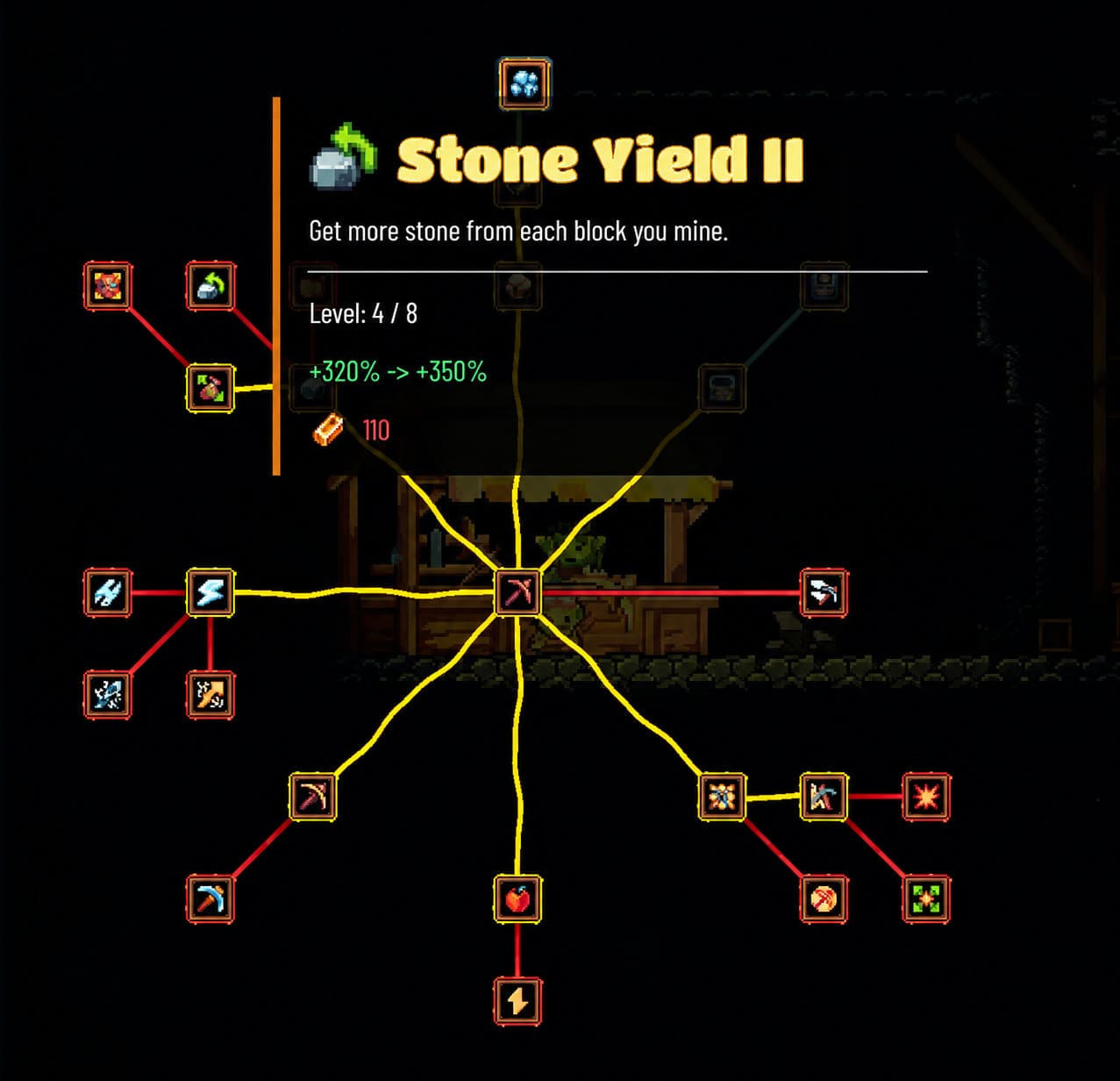
Stage One: Economy Comes First
These upgrades don’t produce impressive screenshots.
They produce long-term progression.
My priorities were:
- Stone production
- Mining speed
- Resource bonuses
- Additional drop opportunities
Everything else became easier once these upgrades were established.
Stage Two: Explosive Farming
Eventually the game opens much stronger offensive options.
This is where clearing efficiency skyrockets.
Large groups of blocks disappear almost instantly, making Iron farming significantly faster.
At this point I also started investing more heavily into movement improvements.
Being able to reach resource clusters quickly is an underrated advantage.
Stage Three: Scaling for Late Game
The deepest layers introduce incredibly durable blocks.
Raw damage alone starts feeling inefficient.
Critical hit upgrades become much more attractive because they continue scaling alongside your growing economy.
My late-game priorities became:
- Higher critical chance
- Increased critical damage
- Better bar value
- Stronger economy multipliers
Those upgrades created noticeable improvements every single run.
Small Tricks That Save A Lot of Time
Some quality-of-life mechanics don’t look important until you begin using them regularly.
These became part of my routine.
- Check resource previews before entering a stage. Knowing what materials appear inside each layer prevents unnecessary farming.
- End expeditions manually. If your inventory is already full, there’s usually little reason to remain underground. Returning early often produces higher resources per minute.
- Manage crafting quantities carefully. Large stacks disappear surprisingly fast if you’re not paying attention. Taking a few extra seconds before crafting expensive materials can save hours of farming later.
Mistakes I Wish I Had Avoided
Looking back, several decisions slowed my progress considerably.
The biggest ones were:
- Investing heavily into damage before fixing the smeltery.
- Ignoring mining speed upgrades.
- Chasing every rare resource instead of clearing dense clusters.
- Staying underground long after my inventory was already full.
Each mistake looked reasonable at the time.
Together they probably cost me several hours of progression.
Is There Really One Best Build?
Not exactly.
That’s actually something I appreciate about Rock Bottom.
Different upgrade paths remain viable depending on your playstyle.
Some players enjoy maximizing automation.
Others prefer active ability rotations.
Personally, I enjoy a balanced approach where automation supports my mining instead of replacing it.
It keeps every expedition engaging while still allowing the economy to scale naturally.
Final Thoughts
Rock Bottom surprised me in the best possible way. On the surface it looks like another incremental mining game, but after spending enough time underground, you begin to appreciate how interconnected every progression system really is.
If I could give only one piece of advice, it would be this:
Treat every upgrade as an investment, not a reward.
The strongest players aren’t necessarily mining the fastest—they’re building systems that make every future expedition more profitable than the last.
Focus on improving your economy before chasing massive damage numbers, upgrade your smeltery before it becomes a problem, and don’t underestimate the value of mobility and mining speed. Once those foundations are in place, the deeper layers become far less intimidating, and watching your resource totals climb into the millions becomes incredibly satisfying.
I’ve played plenty of incremental games over the years, and very few have managed to keep me saying, “Just one more run,” as often as Rock Bottom has. If the developers continue expanding the progression systems and underground biomes, I can easily see this becoming one of the standout indie mining games of the year.