Why the ESA Called Private Minecraft Servers Piracy and How the Gaming Community Is Reacting
The gaming world doesn’t usually agree on much, but every once in a while something happens that unites players, modders, server admins, and even veteran developers in collective disbelief. The recent testimony from the Entertainment Software Association (ESA), where private servers for games like Minecraft and Call of Duty were described as “illegal” and compared to a “black market,” became one of those moments. For someone who has spent years inside survival servers, modded communities, and competitive multiplayer ecosystems, this situation feels less like legal clarity and more like a fundamental misunderstanding of how modern gaming actually functions.
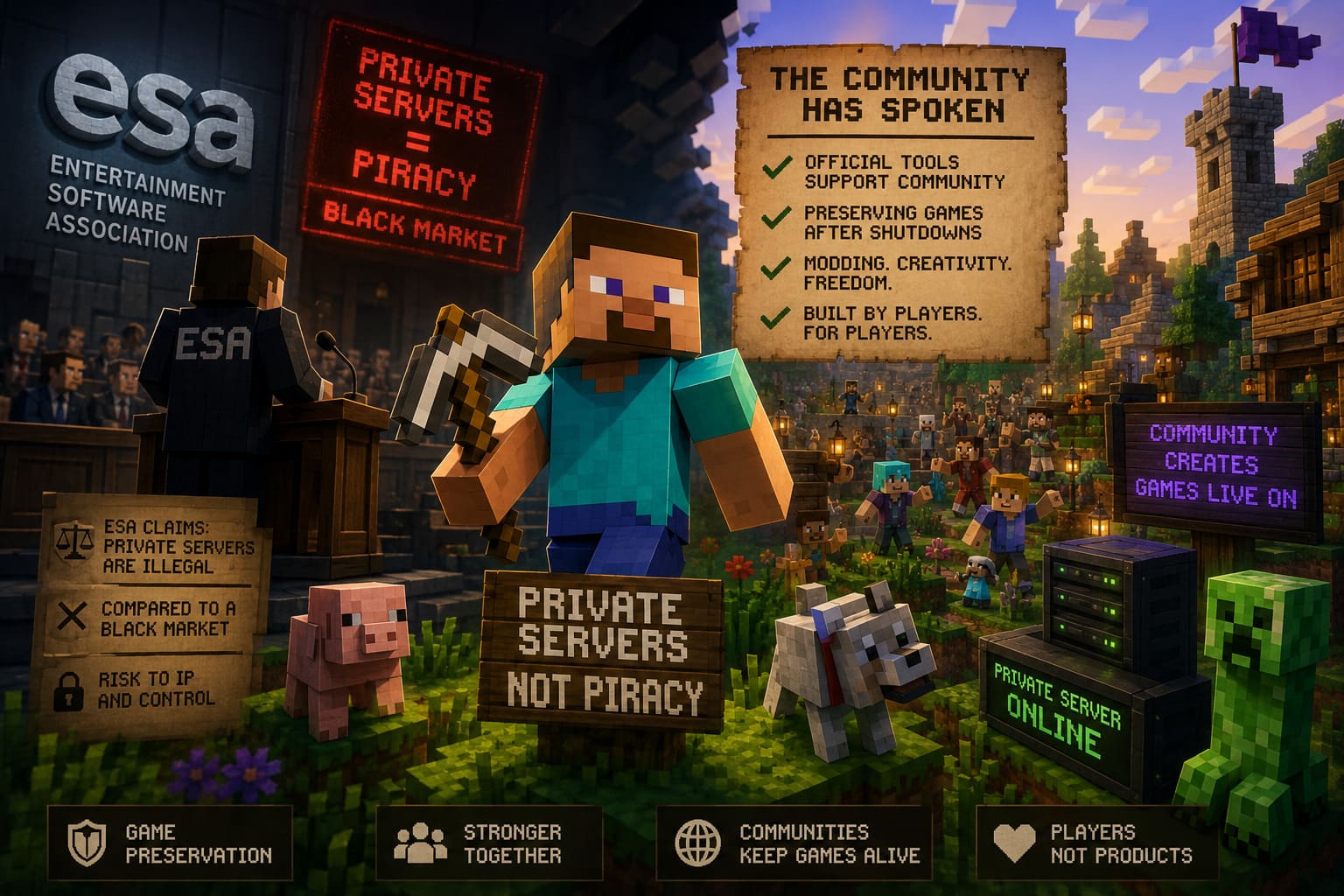
At the center of the controversy was a California legislative hearing focused on game preservation and consumer rights. The discussion around the “Protect Our Games Act” was already emotionally charged because it directly addressed a growing concern in the industry: what happens when publishers shut down official servers and effectively erase paid games from existence? This is not theoretical for players anymore, since multiple online titles have already disappeared after server shutdowns.
Xbox Layoffs 2026: Why Unionized Game Devs are Fighting Microsoft’s “Bloodbath” Restructuring
When Corporate Language Collides With Player Reality
During the hearing, ESA Vice President Jennifer Gibbons stated that community-run servers are “unauthorized” and should be treated as piracy. When pressed further, she reportedly agreed that such servers could be considered a form of “black market” activity. That single moment quickly spread across gaming forums, YouTube commentary channels, and industry analysis platforms, triggering widespread confusion and criticism.
From a player’s point of view, this framing feels disconnected from how these games are actually built. In the case of Minecraft, for example, official server software is distributed freely by Mojang, and players are encouraged to create their own worlds and communities. The idea that running this software in a private environment suddenly becomes “piracy” is what makes the argument so controversial and difficult to accept for most of the community.
Why the Community Reaction Escalated So Quickly
The backlash wasn’t just emotional—it was highly technical. Players, server administrators, and modders quickly pointed out that private servers are not fringe activity but a foundational part of multiplayer gaming. Many modern games rely on community-hosted environments to extend their lifespan far beyond official support cycles.
- Official server tools are often freely available to players
- Private servers preserve games after official shutdowns
- Modding ecosystems depend on decentralized hosting
- Many multiplayer titles were originally designed around peer-to-peer systems
For long-time players, the idea that these systems could be labeled “illegal” feels like a rewriting of gaming history itself. Community infrastructure has always been part of multiplayer culture, from early LAN parties to massive modern survival worlds.
The Reality of Private Servers vs Corporate Framing
The core tension in this debate comes from the difference between legal framing and practical reality. The ESA’s argument focuses on intellectual property control and unauthorized use of copyrighted assets. However, this interpretation becomes complicated when applied to games that explicitly provide tools for community hosting.
Comparison Between Perspectives
| Topic | ESA Position | Player Reality |
|---|---|---|
| Private Minecraft Servers | Considered unauthorized or piracy | Supported via official tools |
| Community Hosting | Seen as unregulated risk | Core part of multiplayer gaming |
| Game Preservation | Not guaranteed via community systems | Often depends on them |
| Player Ownership | Controlled by publishers | Expected by consumers |
This disconnect is the main source of frustration. Players are not attempting to bypass systems; they are attempting to preserve access to content they have already purchased and invested time into.
Why Game Preservation Became the Bigger Issue
While the ESA statement triggered the controversy, the deeper issue is game preservation. The “Stop Killing Games” movement has gained momentum because modern gaming increasingly depends on centralized servers. When those servers are shut down, entire games become unplayable, regardless of whether users still own them.
This has already happened multiple times across the industry. Multiplayer titles with strong communities have been rendered inaccessible overnight due to server closures. In this context, private servers are not seen as piracy but as survival mechanisms for preserving digital culture and gaming history.
A growing sentiment within the community reflects a broader philosophical question: if a game stops functioning the moment a company disables its servers, did the player ever truly own it?
Developer Voices and Industry Pushback
Within the wider industry, reactions to the ESA framing have not been universally supportive. Independent developers and community-focused studios have long embraced modding and private hosting as part of their game ecosystems. In many cases, these communities significantly extend the lifespan and cultural relevance of games.
Content creators and analysts have also pointed out a recurring pattern in lobbying discussions: the use of extreme legal terminology like “piracy” or “infringement” to simplify complex technical realities for policymakers. While effective in a legislative setting, this approach often distorts the actual mechanics of how games function in practice.
The ESA’s Walkback and Public Relations Shift
Following the backlash, the ESA issued revised statements to gaming outlets, softening its earlier language. Instead of directly equating private servers with piracy, the organization shifted toward concerns about intellectual property enforcement and platform control.
They emphasized risks related to safety, moderation, and lack of publisher oversight, particularly in environments accessible to younger players. While these concerns are not entirely without merit, critics argue that they do not justify categorizing community-hosted servers as inherently illegal activity.
The revised messaging appeared more like damage control than clarification, especially after clips from the hearing circulated widely online and sparked public criticism.
The Bigger Picture: Control vs Community
At its core, this debate reflects a growing ideological divide in the gaming industry. On one side, publishers are increasingly moving toward always-online ecosystems, live-service models, and monetization-driven platforms. On the other side, players are pushing for ownership, longevity, and preservation rights.
From personal experience across countless community servers, the difference is clear. One environment feels temporary and tightly controlled, while the other feels alive, shaped by players who actively care about the world they are building together. That contrast is what makes this debate feel so significant beyond just legal terminology.
Final Thoughts
Labeling private servers as “piracy” may hold weight in a narrow legal interpretation, but it fails to reflect how modern multiplayer gaming actually operates. These servers are not underground markets—they are foundational structures that keep games alive long after official support ends.
Ultimately, this controversy highlights a growing disconnect between corporate policy and player reality. As the industry continues to evolve toward centralized control, the demand for community ownership and preservation is only becoming stronger.