Hell Let Loose Vietnam Flamethrower Class Unlock Guide: Ultimate Leveling Strategy
If there is one weapon that immediately makes a Vietnam War shooter feel different, it is the flamethrower. Rifles, machine guns and grenades are expected in a game like Hell Let Loose: Vietnam, but the moment someone starts pushing through a jungle trail with a stream of fire in front of them, the entire fight changes. People stop peeking windows. Defenders abandon trenches. Somebody on the other side usually starts screaming for a sniper.
That is exactly why the flamethrower is such an attractive unlock. It is not just another weapon with slightly different statistics. It completely changes how you approach close-range combat, fortified positions and jungle engagements. The problem is getting there. If you level the required role by simply playing normally and chasing kills, you are signing yourself up for a painfully long grind.
After spending a ridiculous amount of time with tactical shooters, I have learned one thing: the fastest way to unlock a specialized weapon is rarely the most obvious way to play the game. In Hell Let Loose: Vietnam, logistics and role mechanics can be far more valuable for progression than trying to top the kill feed every round.
How to Fix Hell Let Loose: Vietnam UE5 Crash on Startup: Complete PC Troubleshooting Guide
Why the Flamethrower Matters So Much in Vietnam
The flamethrower makes particular sense in the Vietnam setting. The battlefield is full of thick vegetation, narrow jungle paths, trenches, defensive positions and areas where enemies can disappear from view almost instantly. A rifleman can spend half a minute trying to identify a shooter hidden behind foliage. A flamethrower player has a much simpler question: “Is that hiding spot close enough to burn?”
That doesn’t make the weapon overpowered. Quite the opposite. The flamethrower is extremely specialized, and using it badly is one of the quickest ways to become the most obvious target on the map. Your range is limited, your movement has to be deliberate, and once you start firing, everyone nearby knows exactly where you are.
| Flamethrower Strength | Why It Matters |
|---|---|
| Area denial | Forces defenders away from tight positions and chokepoints. |
| Close-range clearing | Excellent against enemies packed into trenches, rooms and tunnels. |
| Psychological pressure | Players react very differently when fire starts entering their position. |
| Fortification clearing | Can help your squad remove heavily defended positions quickly. |
| Ambush potential | Extremely dangerous when used from jungle cover or confined terrain. |
There is a catch, though. You cannot treat this thing like an assault rifle with a funny muzzle effect. Open fields and exposed rice paddies are basically death sentences for a flamethrower operator. If you walk into an open area without smoke, cover or friendly support, an enemy rifleman can put you down before you ever get close enough to use your weapon.
How to Unlock the Flamethrower in Hell Let Loose: Vietnam
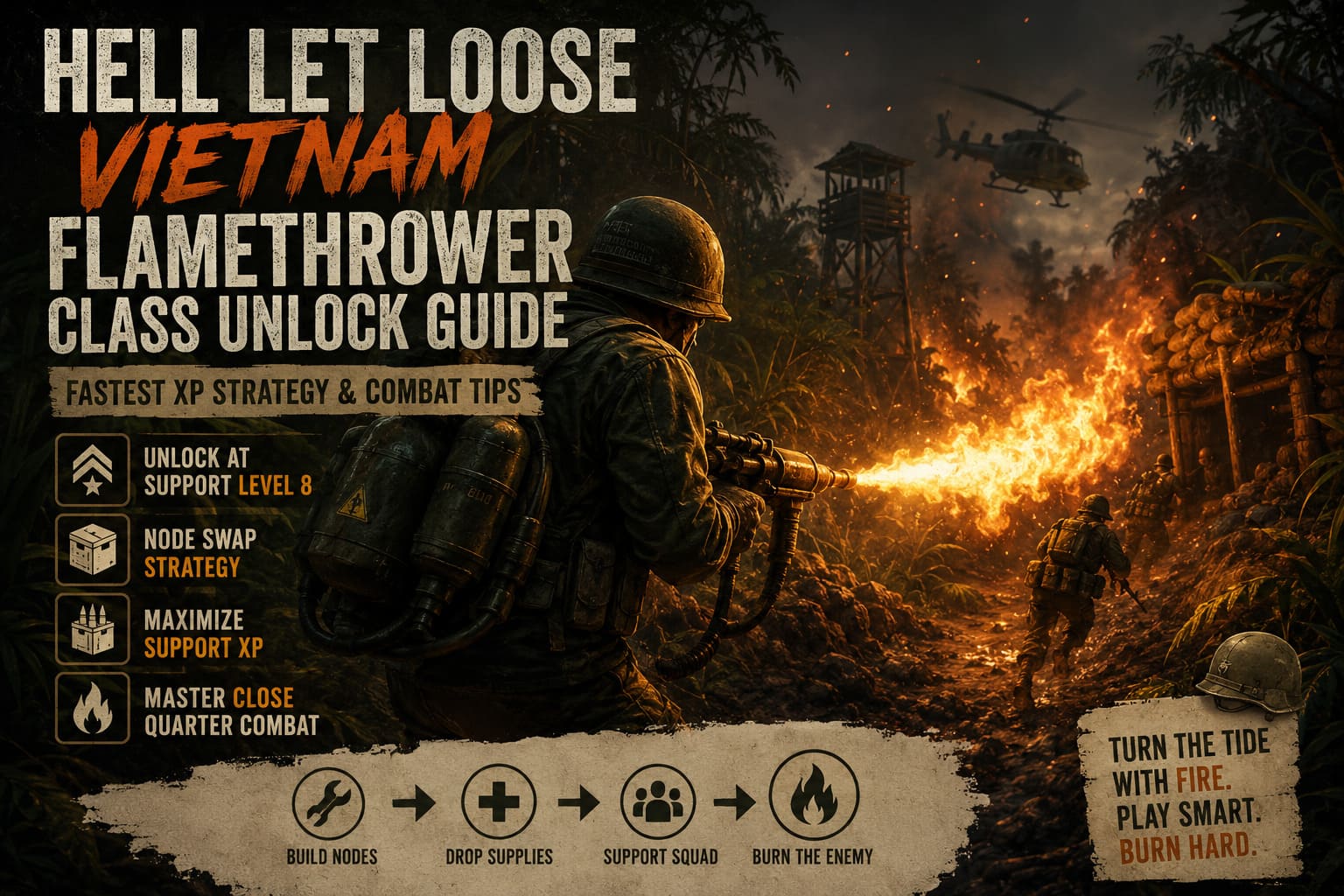
According to the progression described in the source material, the flamethrower is tied to the Support role progression, with the required loadout becoming available around Support Level 8. That means the grind is not simply about earning general player XP. You need to generate role experience efficiently while actually contributing to your team.
This distinction matters more than it might seem. If you spend every match running around looking for kills, your progression can feel painfully slow. Tactical shooters punish reckless aggression, and Hell Let Loose has never been the kind of game where you can reliably farm dozens of kills every few minutes.
That is why I would not recommend approaching the flamethrower grind as a conventional combat grind. Play the game’s logistics system instead.
The Fastest Flamethrower XP Method: Engineer Node Swapping
The most interesting leveling trick described by the community is the so-called Node Swap Strategy. The basic idea is simple: start the match in Engineer, construct your resource nodes, then switch to the role you actually want to level.
It sounds strange if you have never played around with the game’s support mechanics. Once you understand how passive resource generation works, though, it becomes one of those strategies that makes you wonder why you were grinding the slow way in the first place.
Step 1: Start as Engineer
At the beginning of the match, select Engineer rather than immediately choosing Support. You want to establish your passive income before committing the rest of the match to the role you are leveling.
Get access to supplies through your squad or logistics resources and find a reasonably secure location in friendly territory. Do not build your nodes somewhere that looks convenient but sits directly in the path of an enemy recon squad. A dead Engineer produces exactly zero useful progression.
Step 2: Build Your Resource Nodes
Your goal is to construct the available resource nodes: Manpower, Munitions and Fuel. Get the blueprints down, finish construction and make sure everything is functioning before you switch roles.
This is the boring part, but it is also the part that pays off over time. Once your nodes are generating resources, you have effectively created a passive XP engine that can continue working while you spend the rest of the match playing Support.
Step 3: Redeploy and Select Support
Once your Engineer work is finished, redeploy and switch into Support. This is the critical part of the method. You are no longer wasting the entire match building infrastructure; you are now playing the role you need to level while benefiting from the groundwork you established earlier.
A long match is especially valuable here. If the server battle turns into one of those exhausting 90-minute slugfests where both teams refuse to give up ground, your passive progression has plenty of time to accumulate.
Step 4: Keep Playing the Role
Do not simply sit in spawn expecting the flamethrower to unlock itself. Use the Support role properly. Drop supplies, stay near your squad, help establish defensive positions and keep the frontline supplied.
The beautiful thing about this method is that the activities you should already be doing as Support can stack on top of your passive progression. You are not really choosing between “grinding XP” and “playing the objective.” The best approach lets you do both.
How to Get Even More Support XP
Node swapping gives you a strong foundation, but there are several ways to squeeze more value out of every match. The biggest mistake is treating Support as a glorified walking ammo box. The role can generate considerably more value when you actively pay attention to what your squad is trying to accomplish.
- Use supply trucks whenever the situation calls for them. Moving supplies toward the active frontline can generate useful progression while helping Engineers and Squad Leaders establish positions.
- Drop your supply boxes regularly. Do not carry them around for twenty minutes waiting for the “perfect” moment. If your squad is actively fighting around a defensive position, your supplies can be much more valuable on the ground.
- Stay close to players who consume resources. Anti-tank players, machine gunners and other specialists can turn your support equipment into real battlefield value.
- Play around objectives. A Support player wandering through empty jungle is earning far less practical value than one operating around an important capture point.
Personally, I prefer this approach because it makes the grind feel less like a chore. You are still doing the things a Support player should be doing. The difference is that you are deliberately positioning yourself where your actions produce the most progression.
How to Actually Use the Flamethrower Once You Unlock It
Unlocking the weapon is only half the battle. The first few lives with the flamethrower can be brutal if you approach it like a normal infantry weapon. The range is limited, and the operator is extremely vulnerable when crossing open terrain.
The sweet spot is close, complicated terrain. Jungle paths, trenches, buildings, riverbeds and fortified compounds are where the weapon starts making sense. You want situations where the enemy cannot simply back away and shoot you from fifty meters.
Smoke grenades are incredibly important. If your squad is trying to cross an exposed section of ground, do not sprint ahead because you are excited to burn something. Wait for smoke, move with your team and use the terrain to hide your approach.
Think Like an Ambusher, Not a Frontline Rifleman
The flamethrower rewards patience. Let your riflemen make contact first. Once the enemy is distracted, move into a position where you can attack from the side or through a narrow entrance.
This is where the weapon becomes terrifying. A defender hiding inside a confined position has fewer escape routes, and fire can turn that position into a nightmare almost instantly. You are not trying to win a long-range gunfight. You are trying to create a situation where the enemy’s positioning becomes a liability.
Where the Flamethrower Struggles
There are plenty of situations where I would rather have a conventional rifle in my hands. Open fields are the obvious example. If the enemy has a clean line of sight and you have to cross a large exposed area, the flamethrower’s damage potential means very little if you cannot get within effective range.
| Situation | Recommended Approach |
|---|---|
| Dense Jungle | Excellent terrain for ambushes and surprise attacks. |
| Trenches | Strong choice for clearing defenders at close range. |
| Urban Compounds | Very effective when enemies are concentrated indoors. |
| Open Rice Fields | High risk due to long enemy sightlines. |
| Long-Range Engagements | Avoid them; use cover and reposition. |
Another problem is tunnel vision. Once you start firing, it is easy to become obsessed with clearing one doorway while an enemy rifleman is moving around behind you. Always have someone watching your back. A flamethrower supported by a rifleman is dramatically more dangerous than a lone operator wandering around by himself.
My Advice for the Flamethrower Grind
If your only objective is unlocking the weapon as quickly as possible, don’t spend every match chasing kills. Start with the Engineer node setup, switch into the required progression role, and then spend the rest of the game generating legitimate Support value.
More importantly, don’t let the grind make you forget why you are playing Hell Let Loose: Vietnam in the first place. This is a tactical shooter, not an XP-clicking simulator. If your squad needs supplies, deliver them. If an objective needs defending, stay there. If your Commander needs logistics, help.
The flamethrower should feel like a reward for understanding the game’s systems rather than something you desperately grind while ignoring the battlefield. Once you finally get it, the best moments will not come from a random kill in the jungle. They will come from pushing into a fortified position with your squad, hearing the enemy scramble for cover, and realizing that the weapon you spent hours unlocking is finally being used exactly where it belongs.
Final Thoughts
The flamethrower is one of those weapons that can be spectacular in the right hands and almost useless in the wrong ones. Its limited range and obvious visual signature demand patience, teamwork and good positioning, but those limitations are exactly what make successful attacks so satisfying.
For the unlock grind, the smart play is to take advantage of the game’s role and logistics mechanics instead of mindlessly farming combat kills. Build your nodes, swap into the role you need to level, stay active around your squad and let long matches work in your favor. Then, once the flamethrower is finally yours, forget about the XP bar and start learning when not to pull the trigger.
That last part is probably the hardest lesson. In a game where everyone is trying to survive the next bullet, the flamethrower is at its best when you make the enemy walk into the fire on your terms.