The Mound: Omen of Cthulhu PC System Requirements – Can You Run It?!
As someone who streams horror and co-op games almost every week, I’ve learned one thing: not every “scary” game actually gets under your skin. Some rely on jump scares, others on dark corridors and cheap tricks. But The Mound: Omen of Cthulhu?
This one already feels different just from the concept and technical breakdown.
I’ve been going through the system requirements and gameplay details like I’m preparing for an actual expedition rather than just another 2026 release.
And honestly, the deeper I look, the more this feels like a game designed for chaos, not comfort.
How to Fix Windrose Low FPS After Patch: Performance & Lag Guide (2026)
A Jungle That Feels Alive (And Probably Hates You)
This isn’t just an exploration game set in a jungle. It’s a living, reactive environment that seems built to destabilize you.
You and your squad drop from a ship into a cursed jungle where nothing stays consistent. The environment reacts to sound, movement, and—most importantly—your sanity level. That alone makes it feel less like a traditional survival horror game and more like an unpredictable psychological experiment.
From a streaming perspective, this is exactly the kind of system that creates organic moments. No scripted scares. Just unpredictable breakdowns of reality.
Release Date and Platforms
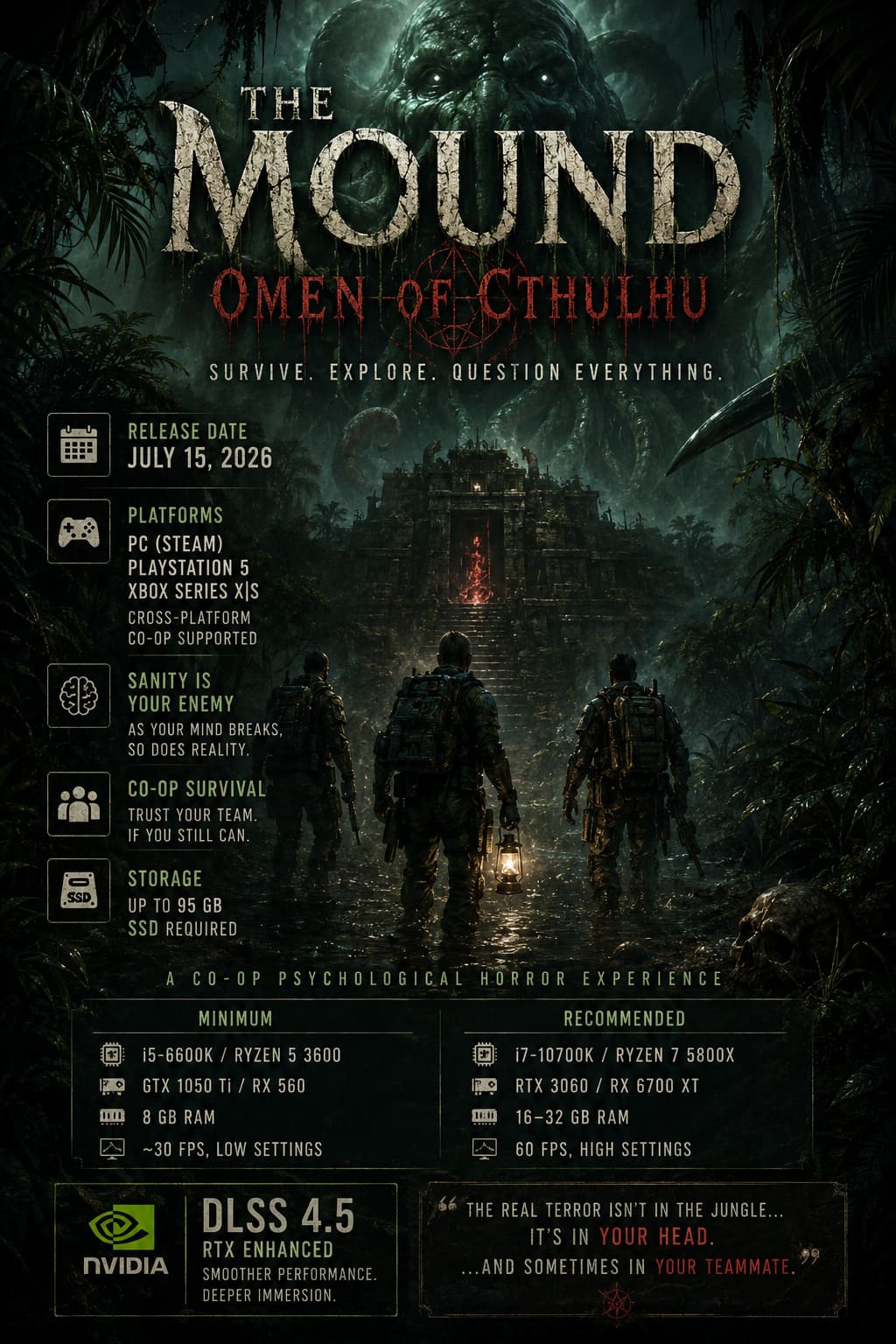
The game is scheduled for release on July 15, 2026, launching simultaneously across multiple platforms.
Available Platforms
PC (Steam), PlayStation 5, Xbox Series X|S
It also includes full cross-platform co-op support, which is a major win for any co-op focused horror title. No more worrying about platform restrictions when assembling a full squad.
PC System Requirements Breakdown
Let’s talk hardware expectations, because this game is clearly not lightweight.

Minimum System Requirements
These specs represent the bare minimum for entry-level gameplay.
- OS: Windows 10 64-bit
- CPU: Intel i5-6600K / Ryzen 5 3600
- RAM: 8 GB
- GPU: GTX 1050 Ti / RX 560
- Storage: 75–95 GB SSD recommended
- DirectX: Version 12
At this level, you’re looking at roughly 30 FPS on low settings. But given how important visuals are to gameplay clarity, this is likely the version where the game becomes more confusing—and arguably more unsettling.
Recommended System Requirements
This is where the game is intended to be experienced properly.
- OS: Windows 10/11 64-bit
- CPU: Intel i7-10700K / Ryzen 7 5800X
- RAM: 16–32 GB
- GPU: RTX 3060 / RTX 4060 / RX 6700 XT
- Storage: 95 GB SSD
At this level, players can expect stable 60 FPS gameplay with significantly improved visuals and environmental clarity. This matters because the game heavily relies on subtle visual cues tied to sanity mechanics.
System Comparison Overview
| Setting | CPU | GPU | RAM | Performance |
|---|---|---|---|---|
| Minimum | i5-6600K / Ryzen 5 3600 | GTX 1050 Ti / RX 560 | 8 GB | ~30 FPS, Low Settings |
| Recommended | i7-10700K / Ryzen 7 5800X | RTX 3060 / RX 6700 XT | 16–32 GB | 60 FPS, High Settings |
DLSS 4.5 and RTX Enhancement
One of the most interesting technical features is the support for DLSS 4.5. This includes advanced frame generation and improved reconstruction techniques designed to stabilize performance in visually complex scenes.
This is particularly important because the game is built around visual distortion: flickering shadows, shifting foliage, and hallucination-like effects triggered by sanity loss.

For RTX 40 and 50 series users, this means smoother performance even during the most chaotic sequences. In a game where perception is already unreliable, stable performance becomes part of the immersion.
Gameplay Mechanics: Survival Meets Psychological Breakdown
1. Risk vs Reward Exploration
The core loop is simple: go deeper into the jungle, get better loot, and risk losing everything. The longer you stay, the more the jungle “wakes up.” Noise, time, and progression all increase danger levels.
2. Sanity System
This is the defining feature of the game. As sanity decreases, perception becomes unreliable.
Players may see enemies that aren’t real, miss actual threats, or even misidentify teammates. At higher levels of insanity, friendly fire becomes a genuine risk due to hallucinations.
This creates one of the most unpredictable co-op systems in modern horror design.
3. Cooperative Dependency
Resources are limited, forcing players to share equipment and make group decisions constantly. Communication is essential, but trust becomes increasingly fragile as the sanity system escalates.
This often leads to situations where survival depends not only on skill, but on whether the group can still trust their own perception.
Storage and Performance Considerations
The game requires up to 95 GB of SSD space, which is not just about texture quality. It suggests heavy real-time asset streaming and dynamic world changes.
This is especially important because the jungle environment is not static. It reacts to player behavior, meaning assets must load quickly to maintain immersion during transitions and hallucination events.
Slow storage would likely break the intended experience during critical gameplay moments.
Streamer Perspective: Why This Game Has Potential
From a content creation standpoint, this game has strong potential for emergent storytelling.
- Unpredictable co-op interactions
- Hallucination-driven confusion
- Friendly fire incidents caused by perception errors
- Constant “what just happened?” moments
These systems naturally create highlight-worthy moments without scripted events. That’s exactly what makes a horror game successful on streaming platforms.
Final Thoughts
The Mound: Omen of Cthulhu is shaping up to be more than just another co-op horror title. It’s clearly designed around psychological pressure, unreliable perception, and group dependency.
Technically, the requirements suggest a mid-to-high-end PC experience for optimal performance, especially if you want to fully experience the sanity mechanics without performance issues interfering with immersion.
Whether it becomes a cult hit or a technical cautionary tale will depend heavily on optimization at launch. But conceptually, it has all the ingredients for a standout co-op horror experience in 2026.
If everything works as intended, this might be one of those games where the real enemy isn’t in the jungle—it’s in your own head, and sometimes in your teammate standing right next to you.