Wanderburg Fortress Upgrade Guide: How to Maximize Your Castle Size and Dominate the Map
Wanderburg is one of those games that immediately makes you stop and think, “Why haven’t I played something like this before?” As someone who spends a lot of time jumping between new releases, roguelikes, strategy games, and anything with an unusual gameplay hook, I really appreciate when a game isn’t afraid to do something completely different. Wanderburg takes the familiar survival and roguelike formula and puts it inside a gigantic medieval fortress that actually moves around the world.
Instead of controlling a tiny hero running around a dangerous map, you’re effectively driving a growing castle. You eat through villages, smash structures, destroy enemy fortresses, collect resources, install weapons, and gradually turn a pathetic wooden vehicle into a ridiculous rolling war machine. It’s chaotic, funny, surprisingly strategic, and, in my opinion, one of the game’s biggest strengths is how satisfying the castle feels as it gets larger.
If you’re trying to figure out how to increase your fortress size in Wanderburg, this guide covers the progression system, the upgrades worth chasing, the modules I prefer, and the mistakes I think are easy to make during a run.
Why Fortress Size Matters So Much in Wanderburg
At first, the size of your castle might seem like a visual gimmick. It isn’t. As your fortress grows, your entire approach to a run changes. A larger chassis gives you more room for modules, more structural durability, and a bigger presence on the battlefield. Eventually, you’re not simply surviving enemies anymore — you’re becoming the thing other enemies should be afraid of.
| Fortress Growth | What It Gives You | My Take |
|---|---|---|
| Larger Chassis | More room for weapons and support modules | Essential for long runs |
| Higher Hull Capacity | More room for mistakes and collisions | Extremely valuable |
| Bigger Devouring Area | Easier consumption of objects and targets | Great for farming resources |
| Higher Structural Tier | Access to stronger progression possibilities | A major mid-run priority |
The downside is that a huge castle is also a huge target. Enemy projectiles have more surface area to hit, and tight sections of the map can become awkward when your fortress occupies half the screen. That’s why I never treat castle size as the only stat worth upgrading. Mass without mobility can turn a powerful build into a slow-moving disaster.
How to Grow Your Fortress During a Run
The most important thing to understand is that Wanderburg rewards active play. Sitting back and waiting for enemies to come to you isn’t the way I’d recommend playing. The game practically begs you to drive around and consume everything that looks remotely edible.
1. Eat Villages, Farms, and Everything Else You Can
This is probably my favorite part of Wanderburg. You see a village running away from you, and instead of feeling guilty about destroying it, your first thought becomes, “How many experience points is that worth?”
Fleeing villages, farms, livestock, windmills, and other environmental objects can all contribute to your progression. During the early portion of a stage, I strongly recommend looking for areas with a high concentration of these targets. Don’t waste the first few minutes wandering through empty terrain.
Early consumption is incredibly important because it lets you reach stronger structural tiers before the game starts throwing more serious threats at you. In other words, the sooner you become big, the easier the rest of the run becomes.
2. Hunt Enemy Fortresses
Once your castle has enough firepower, start looking for enemy strongholds. Rival castles and defensive structures are much more dangerous than random environmental targets, but they also provide much better rewards.
I like to think of these encounters as checkpoints. If I can destroy an enemy fortress without losing a huge chunk of my health, that’s usually a sign that my build is developing correctly. If I’m barely surviving every encounter, I usually need to stop chasing size for a moment and improve my damage, defense, or mobility.
Destroying powerful enemies can provide substantial experience, gold, and valuable progression rewards. More importantly, these fights can help push you toward the higher structural tiers that make a late-game castle feel completely different from the starting vehicle.
3. Spend Your Gold With a Plan
Gold is another resource that is incredibly easy to waste. When the game gives you several upgrade options, it’s tempting to pick whatever sounds strongest immediately. I try to resist that habit.
If my castle is already doing plenty of damage but struggles to survive, another offensive upgrade may not be the answer. Likewise, if I’m extremely durable but moving like a brick, I don’t necessarily need another armor-related improvement.
Look for upgrades that solve the biggest weakness in your current build. And whenever you see a particularly powerful high-rarity module that fits your strategy, seriously consider taking it instead of stacking several mediocre improvements.
The Weapons I Like Using on a Growing Castle
Wanderburg becomes much more interesting when your fortress starts collecting different weapons and support systems. There isn’t one universal setup that I would call perfect, but some modules stand out to me because they complement the game’s movement-heavy design extremely well.
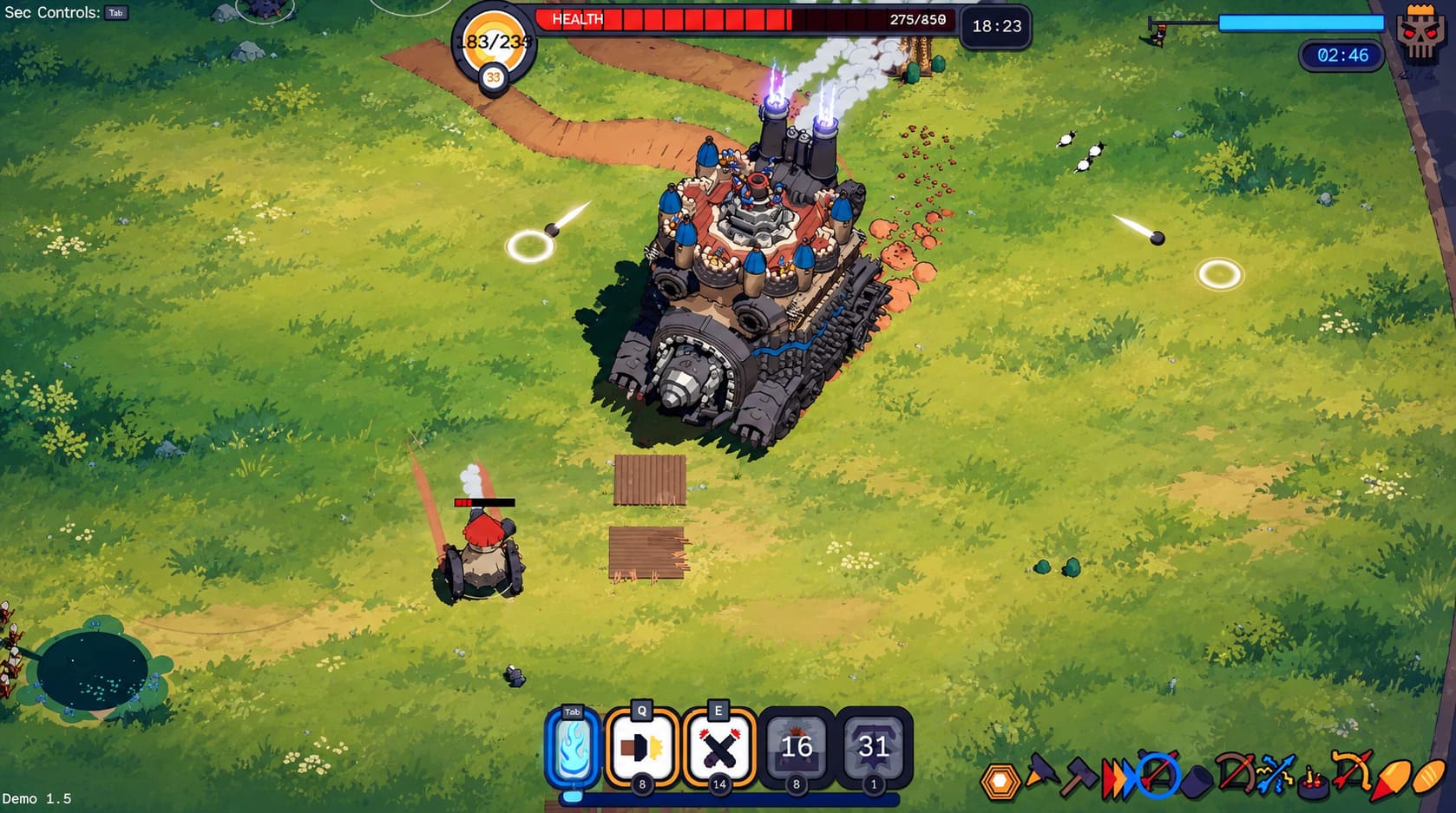
Battle Ram
The Battle Ram is probably my favorite choice when I want to play aggressively. It turns the fortress itself into a weapon, which feels exactly right for Wanderburg.
When combined with movement speed, the ram can transform collisions into devastating attacks. Instead of carefully shooting every small enemy, you can simply line up your approach and smash through weaker fortresses.
If you’re building around the Battle Ram, don’t ignore movement upgrades. A massive castle moving quickly is significantly more dangerous than a massive castle crawling across the map.
Heavy Cannons
Heavy Cannons are the reliable option. They’re straightforward, powerful, and useful against enemies you don’t necessarily want to ram head-on.
I especially like improving their firing capabilities because automatic or faster attacks allow the castle to keep dealing damage while I’m concentrating on movement and positioning. That makes the overall build feel much smoother.
Top Mortars
Mortars are excellent when the battlefield gets crowded. Their high-arcing attacks let you hit targets from a different angle and deal with groups that are annoying to approach directly.
They’re particularly useful when stationary defenses or clustered enemies start making direct routes dangerous.
Mine Layers
Mine Layers are a fun defensive choice, especially when enemies are constantly chasing you. Dropping explosives behind the castle can punish anything that tries to follow.
Just remember where you placed them. I’ve always found that self-inflicted explosions are considerably less impressive than destroying an enemy fortress.
Don’t Forget the Support Modules
Weapons get most of the attention, but support crews can completely change how comfortable a run feels. This is where I think Wanderburg’s build system becomes more interesting than it initially appears.
- Archers: A dependable source of automatic ranged damage and a solid option when you need consistent protection.
- Carpenters: Fantastic for longer runs because their repair capability helps offset the damage your giant fortress inevitably takes.
- Fire Wizards: Excellent for creating dangerous damage zones and putting pressure on tougher enemies.
- Magma-based modules: Strong elemental options that can complement heavy offensive builds and help burn through durable targets.
Personally, I tend to value Carpenters more than they initially look on paper. When you’re constantly driving through enemies, structures, and environmental hazards, passive repairs can save a run that would otherwise collapse because you couldn’t find enough healing.
Size and Speed Should Work Together
This is probably the biggest strategic lesson I’d give to anyone trying to build the largest possible fortress. Don’t become obsessed with size while completely ignoring movement.
A giant castle with terrible acceleration and mobility can become a liability. You have a huge hitbox, you’re easier to hit, and getting around environmental hazards becomes much harder.
On the other hand, combining a large chassis with strong movement speed creates a completely different experience. Your castle becomes a mobile battering ram capable of covering huge portions of the map while consuming resources and smashing smaller enemies.
If I’m running a Battle Ram setup, movement speed and nitro-related upgrades become especially attractive. The faster you can reposition, the more opportunities you have to turn your fortress’s mass into offensive power.
Meta-Progression: Making Future Runs Easier
Like any good roguelike, Wanderburg doesn’t simply throw away everything when a run ends. Your physical castle may reset, but the progress you make between runs can give future attempts a significant advantage.
This is important because it means a failed run isn’t necessarily wasted time. Even if you don’t reach the maximum fortress size, you can still come away with resources and unlocks that improve your next attempt.
Specialized Captains
Captains can fundamentally alter the way you approach a run. Some provide powerful passive bonuses but introduce restrictions that force you to rethink your normal strategy.
The Count, for example, can reward environmental consumption with additional maximum health. The trade-off is that traditional health restoration boxes aren’t available, which completely changes how carefully you need to manage damage.
I really like systems like this because they encourage different playstyles instead of making every run feel identical.
New Chassis and Vehicles
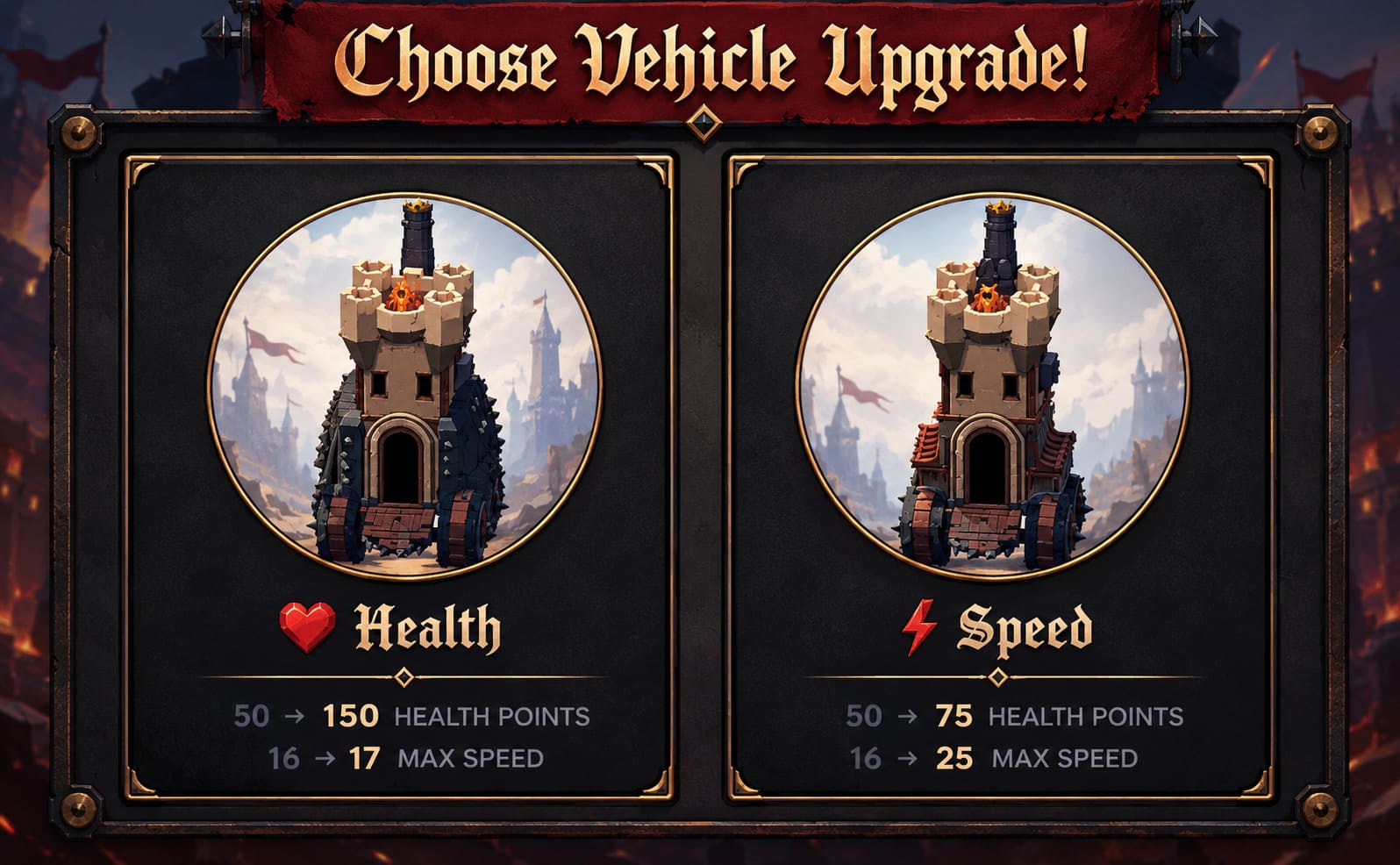
As you progress through the game and unlock additional biomes and challenges, you can gain access to alternative vehicle frameworks. These aren’t simply cosmetic replacements for your original castle.
Different chassis can change your starting health, speed, and overall development potential. Unlocking a new vehicle therefore feels more meaningful than simply getting another skin — you’re effectively getting another way to approach the entire game.
Permanent Artifacts
Artifacts are another major part of long-term progression. Depending on what you unlock, they can provide permanent bonuses that remain useful across future runs.
Extra-life effects are particularly valuable because they can give you another chance after your fortress reaches zero health. Other artifacts can improve gold acquisition, reduce cooldowns, or strengthen supporting units.
Wanderburg Village Devouring Guide: How to Consume Villages Fast and Grow Your Mobile Fortress
My Strategy for Reaching a Huge Fortress
If my goal is specifically to reach the largest castle size possible, I don’t play Wanderburg like a traditional defensive roguelike. I play aggressively, but intelligently.
- Farm dense areas early. Consume as many villages, farms, windmills, and other easy targets as possible.
- Build enough damage to handle stronger enemies. Size is useless if you can’t defend the castle once the difficulty ramps up.
- Prioritize high-quality upgrades. Rare, Epic, and Legendary options can be much more valuable than repeatedly taking small common improvements.
- Add mobility to your giant fortress. Speed becomes increasingly important as your hitbox grows.
- Use support modules to cover weaknesses. Repairs, ranged defense, and elemental damage can make an aggressive build much safer.
The important thing is to keep moving. Wanderburg rewards players who understand that the map itself is part of their progression system. If you’re constantly consuming targets and collecting resources, your fortress can snowball surprisingly quickly.
How to Fix Wanderburg Black Screen on Launch: Complete PC Troubleshooting Guide
Final Thoughts
What I enjoy most about Wanderburg is that fortress growth doesn’t just feel like watching numbers go up. You can actually see your vehicle transform during a run. You start with something that looks barely capable of surviving, and eventually you’re driving around in a ridiculous medieval monster covered in weapons, crews, armor, and destructive machinery.
For me, the best approach is a balance between consumption, combat, size, and mobility. Eat everything you can early, use your growing strength to hunt stronger enemies, spend gold intelligently, and don’t allow your castle to become so large that it loses all maneuverability.
And honestly, don’t be afraid to experiment. One run might revolve around a Battle Ram and insane movement speed, while another might turn into a heavily armored fortress supported by Carpenters, Archers, and elemental weapons. That’s where Wanderburg really shines for me. The game gives you a bizarre moving castle and then basically asks, “How ridiculous can you make this thing?”
My advice? Go big, keep moving, eat everything in your path, and build a fortress that looks completely unreasonable by the time the run reaches its final stages. That’s when Wanderburg is at its most fun.