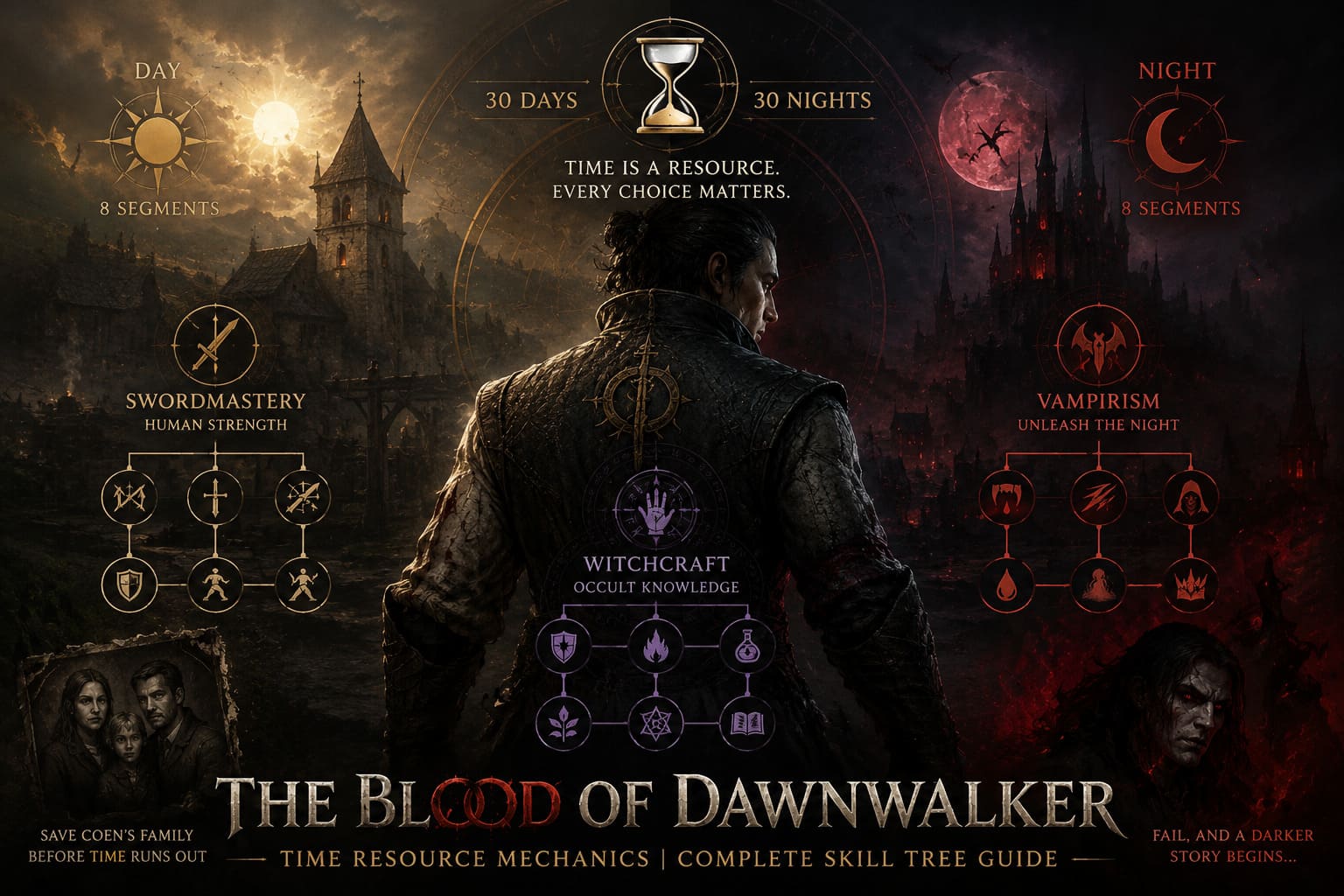
The Blood of Dawnwalker Time Resource Mechanics: Complete Skill Tree Guide
The Blood of Dawnwalker is doing something I genuinely love seeing in RPGs: it is taking a system we normally ignore and putting it directly in our face. Time is not just a background clock here. It is a resource, a limitation, and eventually one of the most important parts of your build.
Developed by Rebel Wolves and published by Bandai Namco Entertainment, The Blood of Dawnwalker drops players into a brutal 14th-century Southeast European setting during the Black Death, where human survival is already hanging by a thread and vampires are making the situation considerably worse. You play as Coen, a Dawnwalker who exists between two worlds. During the day he retains his human side, while nighttime turns him into a dangerous vampire.
That dual identity is not just a cool character concept. It controls how you play, which abilities you use, how you build Coen, and even how you spend the limited time available to you.
Your central objective is brutally simple: save Coen’s family from the vampire lord Brencis before the 30-day and 30-night window is exhausted. The interesting part is that the game does not simply throw a ticking clock over everything you do. Instead, time advances primarily when you make meaningful commitments.
That distinction completely changes how I look at progression. Exploring the world, wandering through the countryside, traveling between locations, and getting into random fights do not automatically burn through the clock. The real danger comes from the choices you decide are worth your time.
Why Time Is More Important Than Experience
Most RPGs train us to think in a very predictable way: kill enemies, earn XP, unlock skills, become stronger, repeat. The Blood of Dawnwalker throws a nasty little wrench into that formula.
You still have skill points and powerful abilities, but some of the best progression options require something much more valuable than XP: actual time from Coen’s limited lifespan.
Advanced abilities can carry a time cost represented by an hourglass icon in the interface. When you choose one of these upgrades, you are not simply pressing a button and spending a few skill points. You are effectively telling the game, “Yes, this ability is worth losing part of my remaining day or night.”
That is a fantastic idea because it makes character progression feel dangerous. I have played plenty of RPGs where unlocking a legendary skill feels like checking another box on a menu. Here, a major upgrade can make me stop and think about what I am sacrificing.
The day and night cycle is divided into eight segments for daytime and another eight for nighttime. High-level progression can consume one or several of those segments depending on the ability.
| Progression Element | What It Represents | Why It Matters |
|---|---|---|
| Skill Points | Standard character progression | Used for unlocking abilities and talents |
| Day Segments | Human-side progression time | Required for certain Swordmastery and Witchcraft upgrades |
| Night Segments | Vampiric progression time | Required for powerful Vampirism abilities |
| 30-Day Limit | Main narrative deadline | Determines how much time you can devote to everything else |
This creates a fascinating problem: getting stronger can actively make your situation worse. You might unlock an incredible combat technique, but you have also potentially lost opportunities to investigate a village, help an important faction, uncover information about Brencis, or push a family-related quest forward.
The Three Skill Trees in The Blood of Dawnwalker
Coen’s progression is divided into three major paths: Swordmastery, Witchcraft, and Vampirism. The first two represent his human capabilities, while Vampirism takes over when night arrives.
The important thing is that these trees are not completely isolated from the game’s larger time economy. Every serious investment needs to be considered against the clock.

1. Swordmastery – Building the Daytime Warrior
Swordmastery is the obvious choice for players who want Coen to feel like a traditional action-RPG warrior. It focuses on directional melee combat, parrying, stamina management, physical movement, and getting maximum value out of close-range encounters.
The early abilities are relatively straightforward, improving things like attack speed, stamina efficiency, and posture damage. The more interesting stuff appears higher in the tree, where advanced combat techniques start demanding time investments.
Counter-Riposte Mastery is the kind of ability that immediately grabs my attention. It expands the perfect-parry window and can automatically transition into a devastating unblockable thrust. The catch is that Coen needs to find a specialized combat manual before he can learn it, and mastering the technique costs two daytime segments.
Whirling Cleave takes a more aggressive approach. This active ability lets Coen perform a sweeping 360-degree attack capable of dealing with groups of weaker human or plague-infested enemies. It costs one daytime segment, making it considerably easier to justify early in a playthrough.
Then there is Bladestorm Stance, an elite martial technique designed for players who want to turn Coen into a complete melee monster. It boosts directional attack speed while reducing stamina depletion for a limited duration. The price is steep: three daytime segments.
Three segments might not sound terrifying on paper. Once you start thinking about the deadline, though, it hurts. That is a substantial portion of a day’s progression being traded for one combat upgrade.
2. Witchcraft – Human Magic With a Price
Witchcraft is where the human side of Coen becomes considerably stranger. Rather than relying exclusively on steel, this tree gives him access to occult abilities that can be used during the daytime.
The abilities revolve around magical sigils, defensive barriers, offensive spells, and alchemical knowledge. If Swordmastery is about solving problems with a sword, Witchcraft is about setting the problem on fire before it gets close enough to stab you.
Sigil of Protection provides a defensive barrier capable of absorbing incoming physical and elemental damage. It costs one daytime segment to master.
Channeled Incineration is much more aggressive. Coen projects a continuous beam of occult fire that burns through enemy defenses and applies lasting damage over time. Learning the technique requires two daytime segments.
Elixir Alchemy is the utility option and may become one of the most valuable choices for players who like preparation. It allows Coen to create stronger healing potions and combat stimulants from rare herbs. The research and experimentation required cost two daytime segments.
Personally, this is the tree I would be most careful about overspending in. Utility skills can be incredibly tempting because they improve almost everything you do, but every segment used for experimentation is still a segment that cannot be spent elsewhere.
3. Vampirism – The Monster Comes Out at Night
When darkness arrives, Coen’s gameplay changes dramatically. Vampirism is built around supernatural movement, blood-based attacks, stealth, executions, and brutal close-range abilities.
This is also where the progression system gets especially interesting. Some vampiric abilities require specific manuals, while others involve consuming the blood of ancient vampires. In other words, unlocking them can involve more than simply finding a skill node and paying the required points.
Shadow Step is a perfect example of why the vampire tree can feel so different. Coen can dissolve into mist and teleport short distances, allowing him to reposition behind enemies or reach rooftops and otherwise inaccessible areas. Mastering this transformation costs two nighttime segments.
Blood Siphon gives Coen a ranged way to drain the life from staggered or unsuspecting enemies. It restores health and refills his Blood Hunger meter, making it particularly useful during extended fights. The cost is one nighttime segment.
Dread Presence is the more psychological option. The ability projects an aura of fear around Coen, disrupting nearby human enemies and making them more vulnerable to executions. It requires three nighttime segments.
That three-segment price is significant, but there is an argument for it. If you are building around nighttime dominance, an ability like Dread Presence can potentially improve the effectiveness of your entire vampiric playstyle rather than simply adding another attack to your hotbar.
Time Costs and the Problem With the “Perfect Build”
Here is where I think The Blood of Dawnwalker becomes genuinely clever.
The game makes it extremely difficult to create a character who is amazing at everything without consequences. You can absolutely build a hybrid Coen, but your progression choices compete with the same finite narrative window.
Imagine spending daytime segments on Swordmastery, then using more time to learn Witchcraft, followed by nighttime investments in Vampirism. On paper, that sounds fantastic. In practice, you may have burned through a huge amount of your available progression time before realizing that the story has moved on without you.

That is the point.
The game does not want you to unlock everything. It wants you to decide what matters.
That makes build planning much more interesting than simply looking up a “best build” and copying somebody else’s skill order. The best build depends heavily on what you want to accomplish during your particular playthrough.
How Time Can Change the Story
The 30-day deadline is not just a decorative narrative device. The decisions you make with your time can change the world around Coen.
If you spend too much time improving your character, important opportunities can disappear. Side quests may be missed. Factions can develop without your involvement. Distress calls can go unanswered. Information about the vampire lords can remain undiscovered.
And the biggest consequence is obvious: Coen may fail to save his family.
Interestingly, reaching the end of the 30-day window does not simply produce a generic “Game Over” screen. Instead, the story can move into a darker direction. If Coen’s family is killed, the narrative can become a revenge-driven journey rather than the original rescue mission.
That is an unusually strong incentive to replay the game. Your failure is not necessarily the end of your story. It can become a different version of the story.
Dialogues, faction relationships, alliances, encounters, and endgame situations can all be affected by what you prioritized.
Best Way to Manage Time and Build Coen
If you are approaching your first playthrough, I would resist the temptation to grab every shiny high-tier ability you discover. The hourglass icon should make you stop and ask one question: “Is this upgrade worth losing part of my remaining schedule?”
These are the strategies I would consider first:
- Specialist Build: Concentrate on one primary tree and minimize time spent on unrelated progression. A dedicated Swordmastery build, for example, can keep nighttime segments available for exploration, stealth, and vampire encounters.
- Balanced Hybrid: Invest selectively in both human and vampire abilities. Pick only the upgrades that directly support your preferred combat style rather than trying to complete every tree.
- Vengeance Build: Deliberately sacrifice the original rescue objective and spend your early game becoming as powerful as possible. This approach embraces the darker consequences and turns the campaign into a hunt for revenge.
The game’s ability to automatically switch Coen’s equipment and ability presets between day and night is particularly useful here. You can prepare separate setups for his human and vampire forms instead of constantly rebuilding your loadout every time the sun goes down.
The Blood of Dawnwalker Combat Guide: 10 Essential Tips to Master the Blade and Cursed Magic
Which Time Investment Should You Prioritize?
| Playstyle | Priority Tree | Time Strategy | Best For |
|---|---|---|---|
| Melee Warrior | Swordmastery | Spend daytime segments selectively | Players who love parries and aggressive sword combat |
| Occult Fighter | Witchcraft | Invest in high-value spells | Players who prefer ranged and magical solutions |
| Night Hunter | Vampirism | Protect nighttime segments for major upgrades | Stealth and supernatural combat fans |
| Hybrid | All Three | Only buy abilities with clear synergy | Players who want flexibility |
| Vengeance | All Three | Spend aggressively and accept narrative consequences | Players chasing maximum power and alternate outcomes |
The Blood of Dawnwalker: Can You Ally with the Vampire Lords? Choice and Consequence Guide
My Take on the Dawnwalker Time System
After looking at the mechanics as a complete system, the thing I find most exciting about The Blood of Dawnwalker is that progression itself becomes a meaningful choice.
In most RPGs, becoming stronger is almost always the correct answer. If a legendary ability costs experience, you eventually buy it. There is rarely a reason not to.
Here, the strongest ability might actually be the wrong choice.
Spending three nighttime segments on a devastating vampire perk could make your next dozen encounters much easier. But what if those three segments were also enough to reach an important location, help a faction, discover a crucial clue, or push the family storyline forward?
That is the kind of decision I want from a dark fantasy RPG.
The Blood of Dawnwalker turns the 30-day limit into something more than a countdown. It becomes the foundation of the game’s progression philosophy. You are constantly deciding whether the next upgrade, quest, investigation, relationship, or exploration opportunity deserves a piece of Coen’s remaining life.
And honestly, I think that is much more interesting than having another RPG where I eventually unlock every skill and become an unstoppable god with nothing left to worry about.
The smartest Dawnwalker players will not necessarily be the ones with the most abilities. They will be the ones who understand when not to spend time.
Every sword technique has a price. Every spell has an opportunity cost. Every vampiric transformation takes something from the clock. By the time the final days arrive, your character should feel like the product of dozens of deliberate decisions rather than a checklist of completed skill nodes.
That is the real time-management challenge in The Blood of Dawnwalker: you are not simply building Coen. You are deciding what kind of story he has enough time left to live.