Wanderburg Game 2026: Ultimate Randwerk & Sidekick Publishing Roadmap Guide
If you’ve spent enough time with indie games, you eventually learn to recognize the ideas that sound completely ridiculous on paper but somehow become incredibly addictive once you get your hands on them. Wanderburg is absolutely one of those games. Randwerk, the studio behind Abriss, is taking the familiar ingredients of roguelites, tactical combat, destruction, and base building, throwing them into a medieval blender, and coming out with something that feels surprisingly fresh.
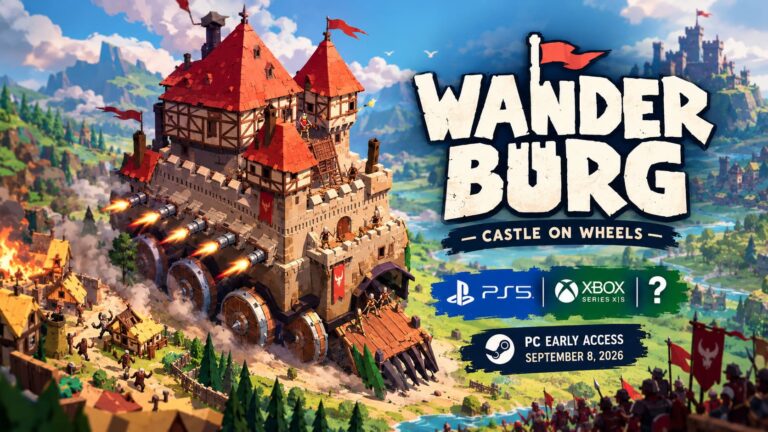
The basic pitch is almost comically simple: you control a gigantic castle on wheels and roam across a hostile medieval world, destroying fortresses, consuming resources, and continuously expanding your mobile stronghold. That sounds like a novelty that should wear thin after an hour. After seeing what Randwerk is building, though, I’m not convinced it will.
There is something deeply satisfying about watching a tiny rolling fortress gradually turn into an absurd mechanical monster. Every new weapon, tower, module, and structural addition changes the silhouette of your castle and, more importantly, changes how you approach combat. This isn’t just another game where bigger numbers eventually replace smaller numbers. Your castle physically becomes the build.
Best Wanderburg Steam Deck OLED Settings: Ultimate Performance & Battery Guide
What Makes Wanderburg Different?
The easiest way to describe Wanderburg is tower offense instead of tower defense. Traditional tower-defense games usually ask you to protect a fixed location while enemies come marching toward you. Here, the situation is flipped completely.
You are the thing everyone needs to worry about.
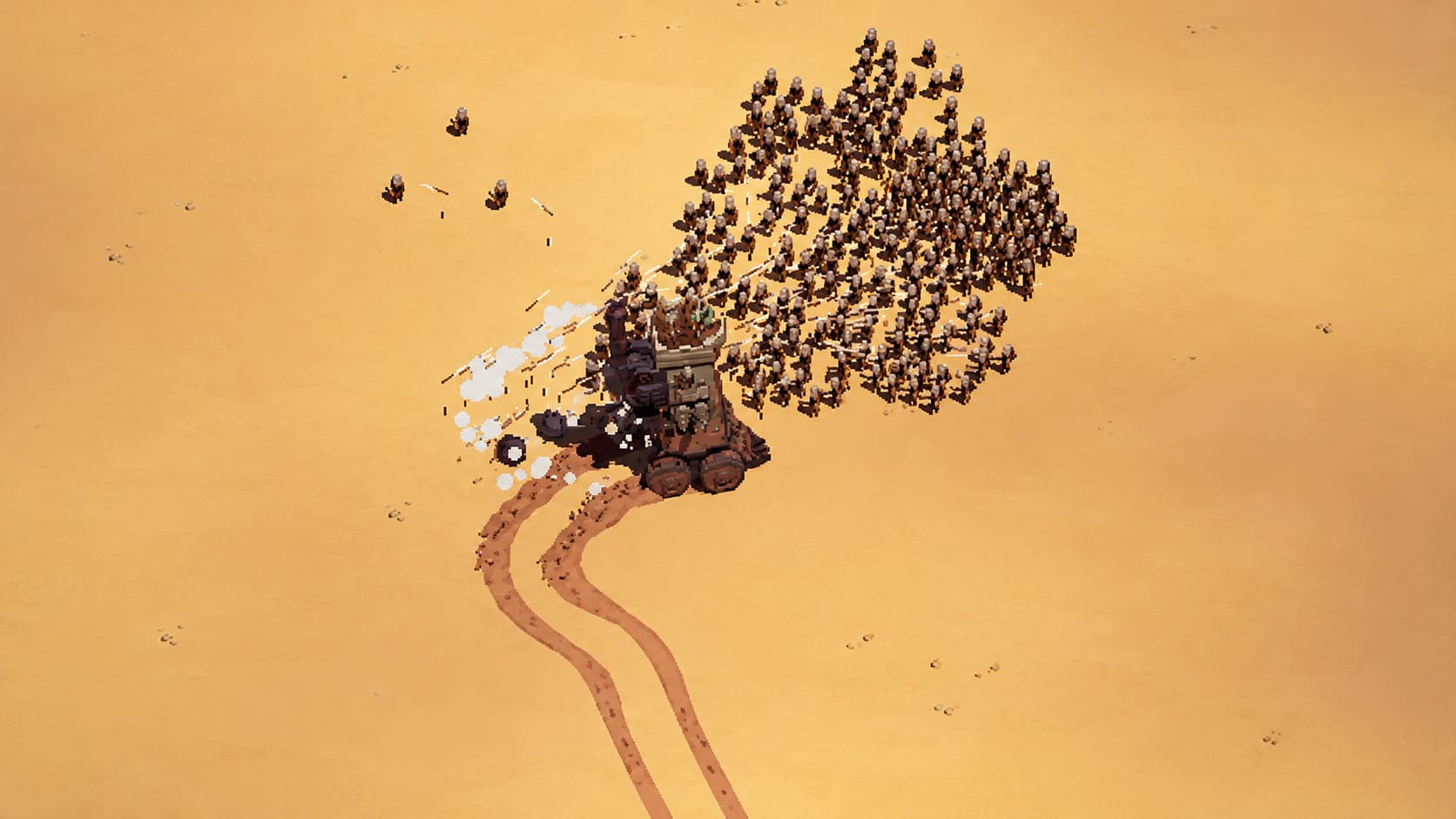
Your mobile fortress travels through a procedurally generated medieval landscape while hostile strongholds, armies, villages, and environmental obstacles constantly interfere with your plans. Rather than waiting behind walls, you actively hunt targets and decide which locations are worth attacking.
That creates a very different rhythm from conventional strategy games. You aren’t simply asking, ‘Where should I place my defenses?’ You’re asking which fortress should be attacked next, whether your current build can survive the encounter, whether you need more mobility or firepower, and whether a particular resource is worth risking your entire run for.
I particularly like that philosophy because it gives movement an actual strategic purpose. Your castle isn’t just a glorified cursor moving around a map. Where you go and what you attack directly determines how your build develops.
Your Castle Is Basically Your Character Build
This is probably the feature that caught my attention most.
In many roguelites, your character becomes stronger through passive bonuses, weapons, stats, and temporary upgrades. Wanderburg takes that concept and makes it visible. Your entire fortress evolves during a run.
You might begin with a relatively modest structure containing only a handful of useful components. A few successful encounters later, the thing can start looking like a medieval industrial accident.
Steam-powered siege weapons, ballistas, magical towers, defensive structures, and other modules can be combined into increasingly complicated configurations. The result isn’t just statistical progression; the physical shape and function of your castle changes as you play.
That matters because visual feedback is a huge part of the game’s appeal. Watching your creation grow from a scrappy little fortress into a gigantic rolling war machine gives every successful encounter a tangible payoff.
And let’s be honest, there is something hilarious about the idea of driving an enormous castle directly toward enemies who probably realize far too late that they have made a terrible mistake.
Wanderburg Early Access Release Date
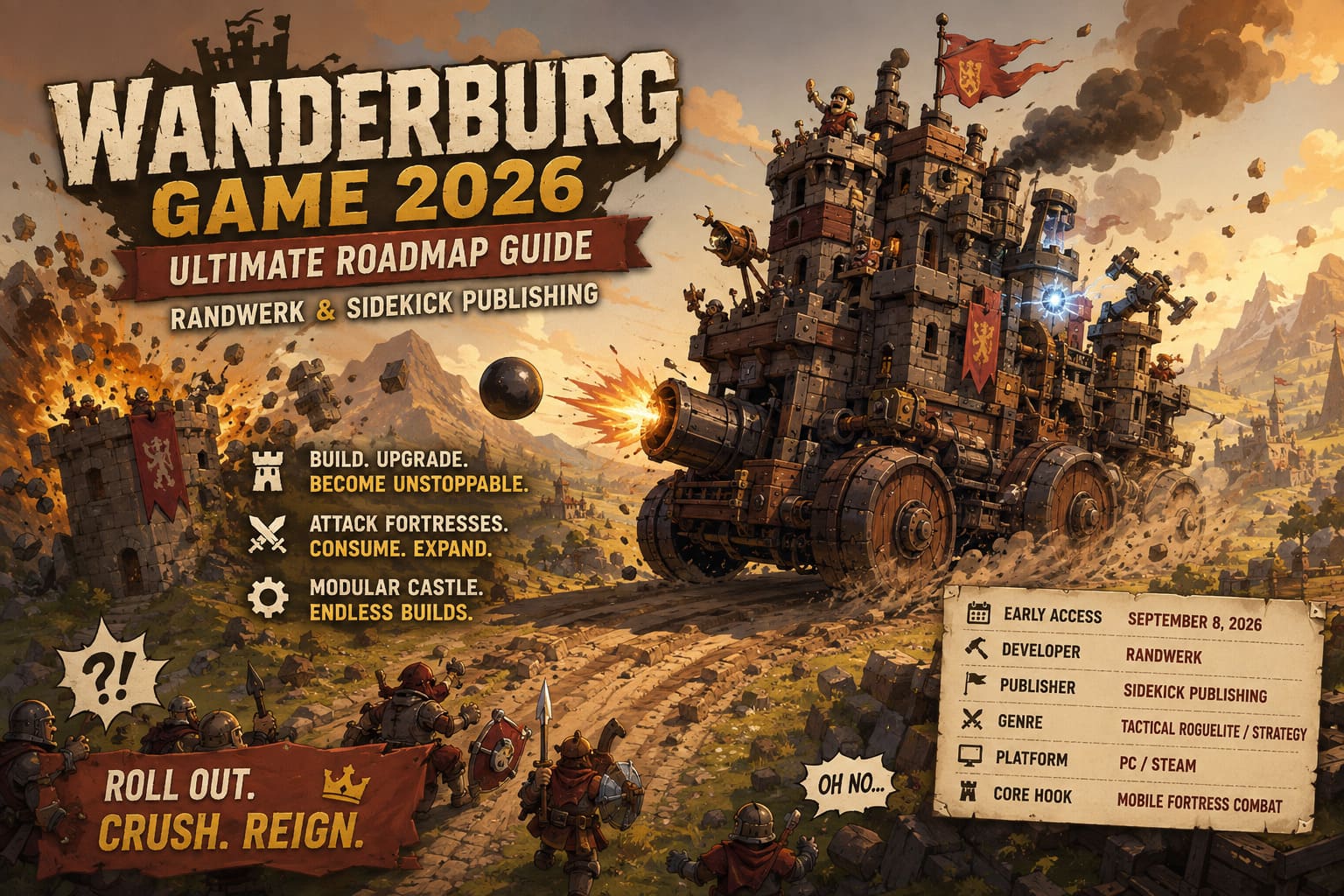
According to the current development roadmap, Wanderburg is scheduled to launch into Steam Early Access on September 8, 2026.
That Early Access approach makes a lot of sense for a game like this. Roguelites live or die by balance, progression pacing, build variety, and replayability. Those are notoriously difficult things to get perfect without a large number of players breaking the game in ways developers never anticipated.
And players absolutely will break it.
Give a community a system with modular weapons and stacking synergies and someone will inevitably discover a completely ridiculous combination that melts everything on screen. Personally, that’s exactly the kind of nonsense I want from a game like Wanderburg.
The early-access period should give Randwerk plenty of opportunities to monitor which builds dominate, which upgrades nobody uses, and where players are getting frustrated.
| Wanderburg Detail | Current Information |
|---|---|
| Developer | Randwerk |
| Publisher | Sidekick Publishing |
| Genre | Tactical Roguelite / Strategy |
| Early Access | September 8, 2026 |
| Platform Focus | PC / Steam |
| Core Hook | Mobile Fortress Combat |
| Progression | Modular Castle Building |
Sidekick Publishing’s Role
Randwerk isn’t handling the game’s wider publishing push alone. Sidekick Publishing is helping bring Wanderburg to a broader audience, with a strategy that puts creators and community engagement heavily into the spotlight.
That’s an interesting partnership for this particular game because Wanderburg looks almost tailor-made for streaming and short-form gaming content.
Think about it from a viewer’s perspective. Someone starts a run with a tiny medieval fortress. Thirty minutes later, that same player is driving a gigantic castle packed with weapons while dozens of projectiles fly across the screen.
That’s instantly understandable even if you’ve never played the game.
A strong visual hook is incredibly valuable in today’s gaming landscape, and Wanderburg has one without needing complicated marketing language. ‘I built a castle on wheels and turned it into a monster’ is practically a YouTube thumbnail waiting to happen.
More Weapons Should Mean More Crazy Builds
The modular arsenal is one of the areas I’ll be watching most closely during Early Access.
The starting selection already revolves around familiar medieval warfare ideas, but the potential becomes much more interesting once weapons start interacting with each other. A roguelite becomes considerably more entertaining when you’re not merely collecting stronger equipment but actively hunting for combinations.
Imagine creating a fortress that specializes in lightning attacks, stacking modules that amplify electrical damage. Another run could focus on long-range artillery, while a different build might turn your castle into a heavily armored close-range bruiser.
The most exciting possibilities come from specialized builds rather than universal upgrades.
If every weapon eventually becomes interchangeable because one combination is simply mathematically superior, the system will lose much of its charm. Randwerk needs to maintain enough trade-offs that players can experiment without feeling like they’re deliberately handicapping themselves.
That’s a tricky balancing act, but it’s also where the long-term replayability of Wanderburg could come from.
New Biomes Could Change Everything
A procedural world is only as interesting as the decisions it forces you to make.
If every area is essentially the same landscape with different colors, players will figure it out quickly. The more interesting direction is giving individual environments mechanical identities.
Mountain regions, for example, could restrict movement and make certain castle configurations awkward. Swamps could interfere with mobility and force players to rethink heavy structures. Ancient ruins could introduce unusual hazards or enemies that don’t behave like standard medieval armies.
This would make the environment part of the build puzzle.
A castle that dominates on open plains might struggle badly in cramped terrain. Suddenly, mobility becomes as important as firepower, and players have another reason to think about the shape of their fortress instead of simply piling on the strongest weapons.
That’s the kind of design choice I love in strategy games because it prevents a single optimal solution from taking over everything.
The Big Question: What Happens at the End of a Run?
This is where Wanderburg has something to prove.
The early and mid-game loop sounds extremely promising, but roguelites need a satisfying endgame to keep experienced players around. Once you’ve figured out the basic systems and built some ridiculous castles, there needs to be a reason to keep pushing.
The roadmap points toward larger threats and more ambitious encounters, including powerful roaming fortresses that can serve as major challenges for highly developed builds.
That could be fantastic.
A massive enemy fortress appearing somewhere beyond the normal route gives players something to chase instead of simply wandering until the run ends. If defeating these enemies also provides permanent progression, rare blueprints, or new starting options, the system could create a strong reason to attempt increasingly ambitious runs.
The best roguelites make failure feel useful. Even when you lose, you should walk away thinking about what you’ll try differently next time.
Wanderburg has the foundation for that kind of loop.
Community Feedback Could Make or Break It
Early demos and playtests have already given players an opportunity to point out some rough edges. The biggest concerns appear to revolve around progression clarity, tutorials, interface readability, and performance when the player’s castle becomes enormous.
The UI issue is especially important.
When your fortress contains a ridiculous number of modules, players need to understand exactly what each component does and how different systems interact. If important information gets buried beneath visual chaos, experimentation becomes frustrating instead of rewarding.
Performance is another obvious concern.
A huge moving fortress firing multiple weapons while enemies, projectiles, destruction effects, and environmental systems are active sounds like exactly the sort of scenario that can make a PC start sweating. Late-game optimization will be critical, particularly if Randwerk wants players to create enormous castles without watching their frame rate collapse.
From my perspective, these are acceptable problems for Early Access, provided the development team treats them as priorities rather than cosmetic complaints.
What I Want to See From Wanderburg
If Randwerk can keep expanding the systems without turning the game into an unreadable mess, Wanderburg has serious potential.
I’d love to see even more meaningful differences between castle architectures. Give me builds that feel genuinely weird. Let one player create a slow artillery fortress while another builds a ridiculously fast glass cannon covered in magical weapons.
I’d also like the game to embrace its destructive side even harder. The combination of physics-based destruction and a growing mobile fortress is begging for spectacular moments where an attack goes completely off the rails.
And please, Randwerk: don’t make every run too clean.
Some of the best roguelite memories come from ridiculous mistakes, desperate victories, and builds that absolutely should not work but somehow do.
Final Verdict: Wanderburg Deserves Your Attention
There are plenty of roguelites coming out every year, and most of them rely on familiar formulas. Wanderburg immediately stands out because its central idea is so easy to understand and so difficult to confuse with anything else.
You build a castle. The castle moves. You attack other castles. Your castle gets bigger.
That’s the elevator pitch, but underneath it sits a potentially deep tactical system involving modular construction, resource management, combat positioning, procedural exploration, and roguelite progression.
The September 8, 2026 Early Access launch should be the real test. Randwerk will need to balance the weapons, improve the onboarding, optimize massive castles, and keep adding reasons for experienced players to start another run.
If the studio gets those pieces right, I can easily see Wanderburg becoming one of those indie games where you sit down intending to play for twenty minutes and suddenly realize you’ve been experimenting with castle builds for three hours.
For me, that’s the strongest sign of a good roguelite.
Wanderburg isn’t interesting because it’s another medieval strategy game. It’s interesting because it turns the fortress itself into the hero, the weapon, the build, and the playground. That’s a genuinely cool idea, and I’m very curious to see how far Randwerk takes it.