The Blood of Dawnwalker NPC Guide: Every Major Character & Faction Explained
There are plenty of dark fantasy RPGs where NPCs exist mainly to give you a quest, point toward the next dungeon, or repeat the same three lines of dialogue whenever you walk past them. The Blood of Dawnwalker looks like it wants to do something much more dangerous.
Rebel Wolves’ RPG throws Coen into Vale Sangora, a remote region of the Carpathian Mountains where vampires have taken advantage of a devastated human population. War, plague, hunger, fear, and supernatural politics have turned the valley into a place where nobody can afford to sit still for too long.
And that is exactly what makes the characters interesting.
The game’s famous 30-day countdown isn’t just there to make you rush through the main story. It gives every relationship a sense of pressure. Help one person and you might lose the opportunity to help another. Kill someone who seemed insignificant and discover later that they were connected to an entirely different quest. Become too comfortable with your vampire powers and suddenly the people who trusted Coen may start looking at him very differently.
As someone who spends far too much time in RPG worlds, this is the part of The Blood of Dawnwalker that interests me most. A huge map is nice. Fancy combat is nice. But give me NPCs who can actually remember what I did and react to it, and suddenly I’m paying attention.
So, here is my breakdown of the major Blood of Dawnwalker characters and factions, and why they matter.
Coen of Laslea: The Dawnwalker Caught Between Two Worlds
Everything starts with Coen, a young man from the village of Laslea whose normal life collapses after vampires attack his home and take members of his family.
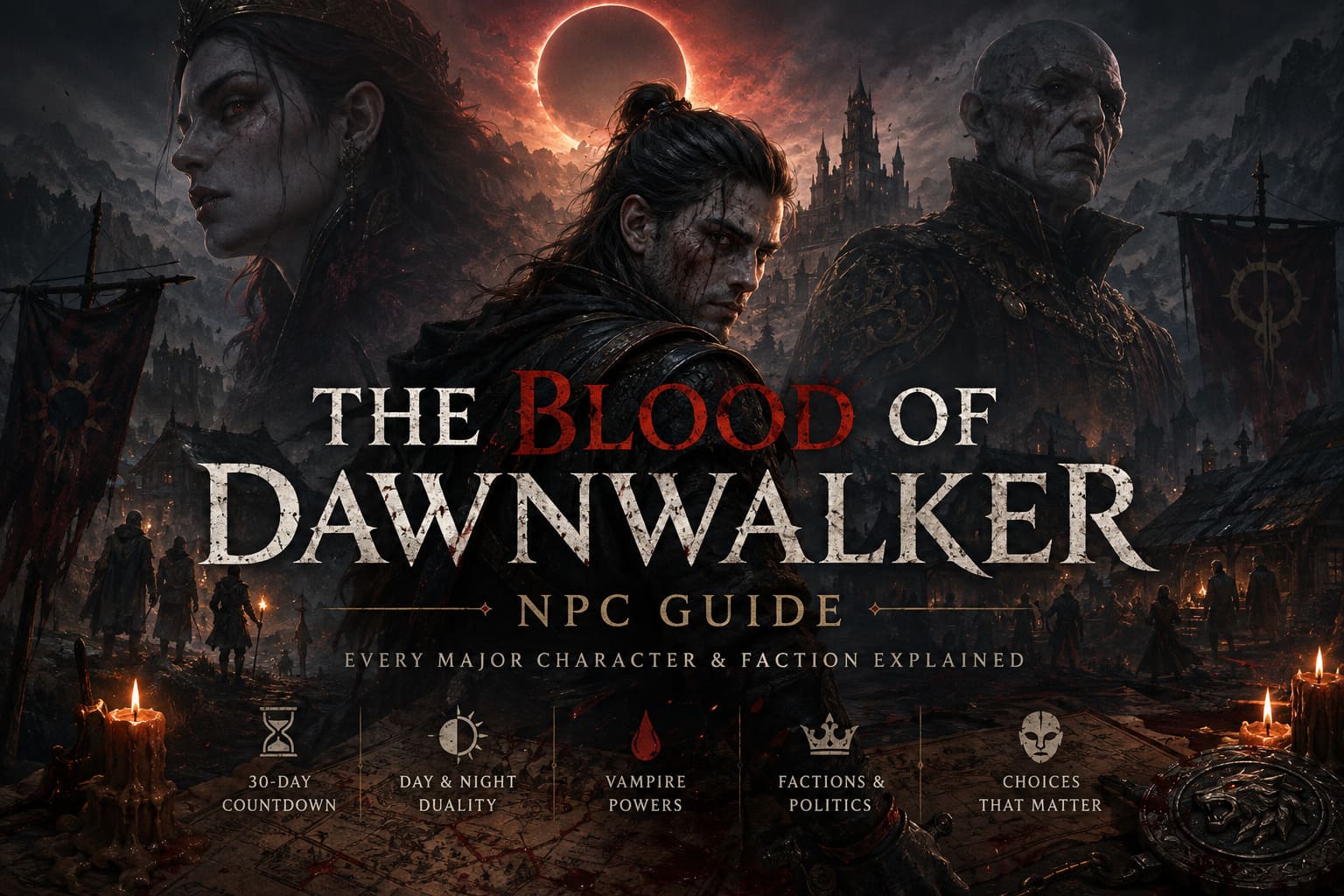
Coen is transformed into something unusual: a Dawnwalker, a human-vampire hybrid who exists between two worlds.
During daylight, his human side remains dominant. When darkness arrives, however, the vampire inside him becomes much more powerful, giving him access to supernatural abilities and blood-based powers.
That day-and-night split is more than a cool gameplay gimmick. It creates an interesting identity problem for the protagonist.
Do you use your vampire abilities because they are the smartest way to survive? Or do you deliberately limit yourself because you are terrified of becoming the same kind of monster that destroyed your family?
Personally, I think this is one of the strongest ideas in the game. RPG morality systems often feel like a menu where you simply select “good” or “evil.” Coen’s situation sounds much more uncomfortable because the evil option can also be the practical one.
And with only 30 days to work with, practicality matters.
The Major Characters of Vale Sangora
The people around Coen are divided between vampire rulers, human resistance groups, survivors, opportunists, and family members caught in the middle.
| Character | Role | Why They Matter |
|---|---|---|
| Brencis | Vampire ruler | Central figure of the Vrakhiri hierarchy |
| Xanthe | Ancient vampire | Powerful antagonist with her own storyline |
| Bakir | Vampire lord | Represents political tension within vampire society |
| Lunka | Coen’s sister | One of the most important family targets |
| Yanna | Coen’s sister | Human resistance and family storyline |
| Ambrus | Resistance survivor | Mentor and source of combat knowledge |
| Lacra | Occult figure | Connected to witchcraft and supernatural powers |
| Anca | Human community leader | Helps survivors and develops human support |
| Marat | Resistance warrior | Favors direct attacks against vampires |
| Rodrig | Rogue wanderer | Information broker with questionable loyalty |
Brencis: The Vampire Power Behind the Valley
If there is one vampire who represents the new order of Vale Sangora, it is Brencis.
He isn’t simply a bloodthirsty monster running around killing villagers. His threat comes from organization and control. The Vrakhiri have established a hierarchy, and Brencis sits near its center, treating the surviving human population as something that can be controlled and exploited.
That distinction matters.
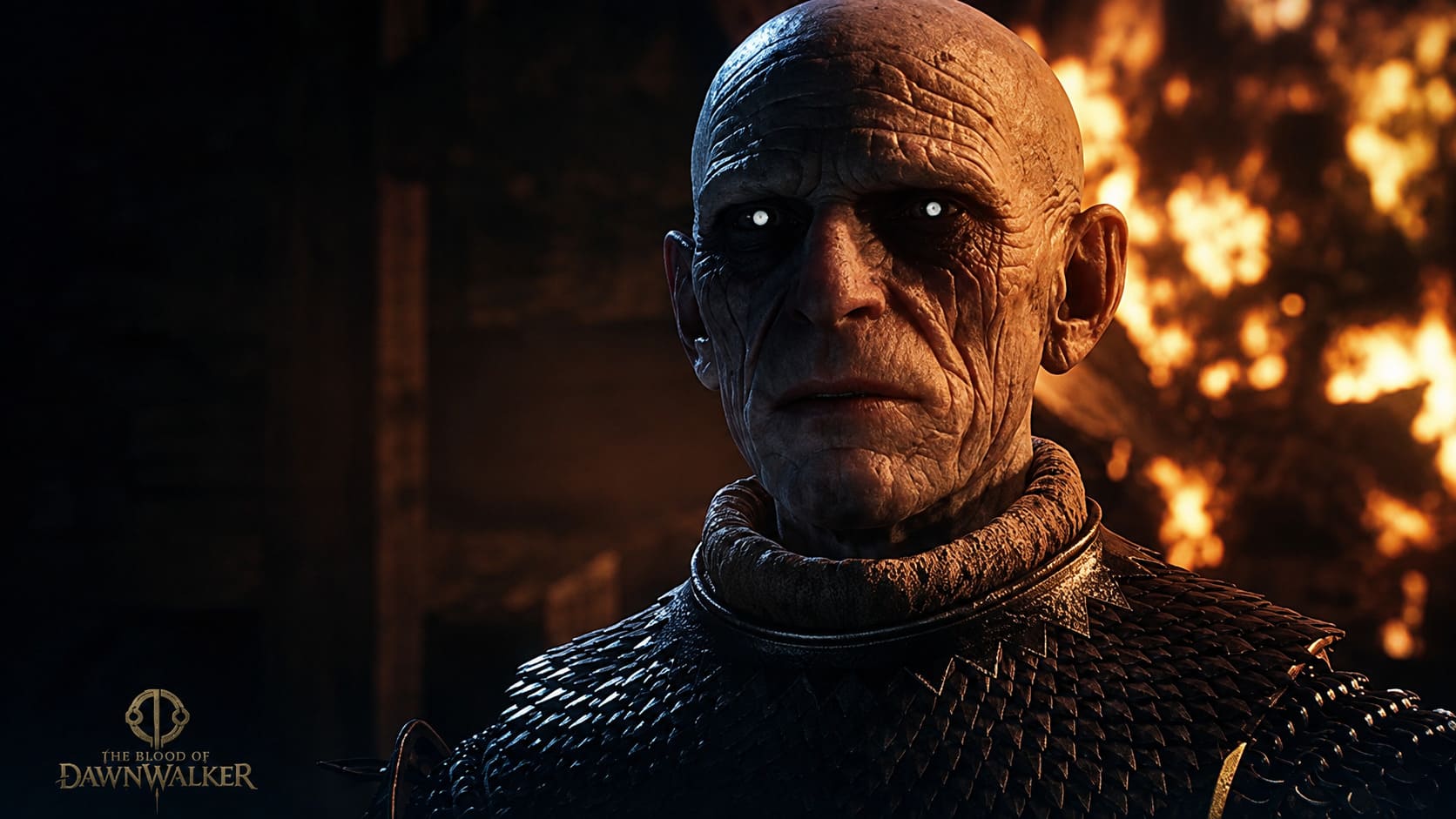
A chaotic vampire villain is easy to understand. A vampire ruler who thinks his brutal system is perfectly reasonable is much more interesting.
Brencis is closely tied to the larger political conflict, and his influence stretches well beyond individual battles. Coen isn’t simply trying to put a sword through his chest. Depending on how you approach the game, you may have opportunities to undermine his authority, manipulate rival factions, or attack the system holding the valley together.
That is exactly the kind of RPG villain I prefer.
Xanthe: Easily One of the Most Interesting Vampires
Xanthe, known as the Dark Mistress, immediately establishes the difference between Coen and the older vampires.
Coen may have supernatural potential, but Xanthe has experience, power, and centuries of knowledge on her side. An early confrontation with her makes that imbalance very clear.
What I like about Xanthe, though, is that she apparently isn’t just another boss waiting at the end of a hallway.
Her relationship with Coen can develop depending on the way you play.
One particularly interesting element is Infamy. Coen can build a reputation through darker and more unpredictable actions, and those choices can influence how Xanthe views him.
This creates a fun contradiction.
You may want to become more feared because it gives you influence with certain characters, while simultaneously damaging relationships with people who still see Coen as human.
For me, that is much more appealing than a traditional reputation bar where everyone simply loves or hates you.
Bakir and the Cracks Inside Vampire Society
Bakir occupies a different position within the vampire hierarchy.
Where Brencis represents centralized control, Bakir is connected to the ambitions and internal conflicts of the vampire nobility. His interest in ancient secrets gives Coen another potential avenue for manipulating the enemy from within.
And honestly, I hope the game leans heavily into this.
The best RPG factions are rarely completely united. If every vampire automatically agrees with Brencis, the political side of the story becomes predictable. But if rival vampire nobles have their own agendas, Coen can potentially turn those ambitions against one another.
Sometimes the best weapon isn’t a sword.
Sometimes it is convincing two enemies that they hate each other more than they hate you.
Lunka and Yanna: The Family Story
The central motivation behind Coen’s journey remains deeply personal.
Lunka, Coen’s younger sister, is one of the most important family members caught in the vampire conflict. Her connection to the supernatural events surrounding Vale Sangora makes her more than simply a hostage waiting to be rescued.
The pressure surrounding her also fits perfectly with the game’s countdown system. Every day Coen spends pursuing another objective could potentially mean less time to reach his family.
Then there is Yanna, Coen’s older sister.
Yanna represents another side of the human struggle. She isn’t simply waiting for Coen to arrive. Her attempts to resist her captors and survive inside the vampire-controlled world make her part of the wider resistance story.
This is where the 30-day mechanic could become genuinely painful.
In a normal RPG, I can wander off for six hours to collect herbs, clear random camps, and solve someone’s goat problem before returning to the main quest.
Here, every distraction potentially has a cost.
Ambrus, Lacra, and the Human Resistance
The human side of Vale Sangora isn’t represented by one giant rebellion with a convenient headquarters. Instead, survivors are scattered across the region, trying to stay alive while resisting vampire control.
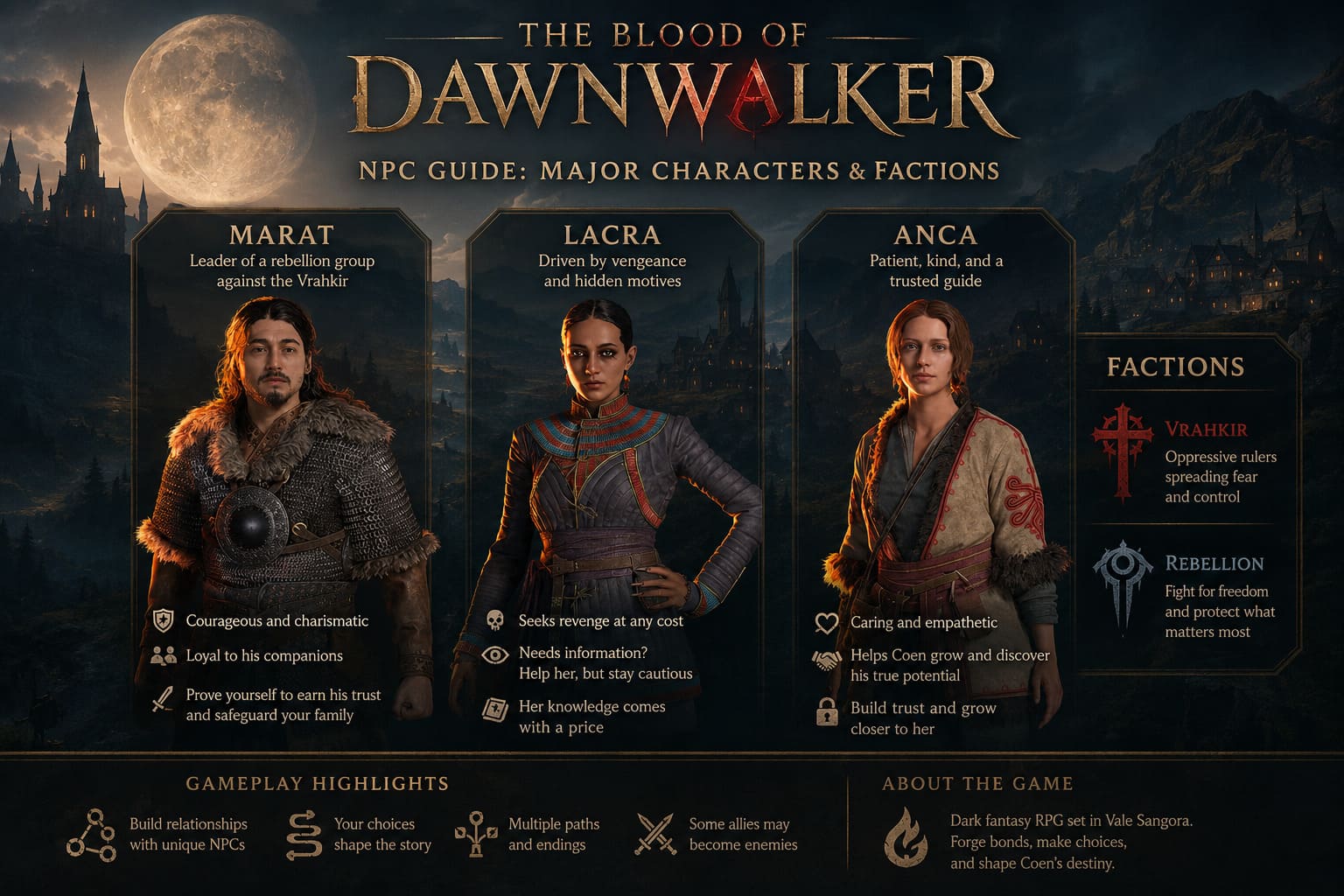
Ambrus serves as an important survivalist and mentor figure. He helps Coen understand combat, wilderness survival, and the weaknesses of vampire forces.
There is also an obvious source of tension here: Ambrus doesn’t have to trust Coen.
From his perspective, a half-vampire walking into a human resistance camp is not exactly reassuring.
That distrust is important because Coen’s actions can determine whether people continue to see him as a human fighting monsters or as another monster pretending to be useful.
Lacra moves the story toward the occult side of the setting. Her knowledge of witchcraft, ancient traditions, and supernatural forces gives Coen another potential route toward understanding his transformation.
I particularly like characters like Lacra in dark fantasy RPGs because they can make the supernatural feel like part of the world rather than just another skill tree.
Anca and the People Trying to Survive
Not every important character needs to be a warrior.
Anca represents the ordinary people trying to keep communities alive while the valley falls apart.
Food, medicine, water, shelter, trade — these things sound mundane next to vampire lords and blood magic, but they are exactly what make a fantasy world feel believable.
Helping Anca and the settlements around her can improve Coen’s standing among human survivors and potentially open access to useful resources, safe locations, and additional opportunities.
This is also where I think player reputation can become surprisingly important.
If Coen starts behaving like a predator, why would ordinary people continue helping him?
That question is much more interesting than simply giving the player a bigger reputation number.
Marat: When Diplomacy Isn’t Enough
Marat takes the more direct approach.
He is a hardened warrior who believes the vampires need to be attacked rather than negotiated with. His missions revolve around dangerous targets such as vampire commanders and supply operations.
If you’re the type of RPG player who sees a hostile fortress and immediately thinks, “I wonder if I can clear that entire place before dinner,” Marat’s storyline should be right up your street.
His approach also creates a nice contrast with characters who rely on stealth, politics, or survival.
Rodrig: Never Assume the Rogue Is Your Friend
Then there is Rodrig, one of those characters I automatically distrust in RPGs.
He is a wanderer and information broker who knows things that other characters don’t. He can potentially provide valuable information about both human resistance groups and vampire movements.
The problem is simple: Rodrig’s loyalty has a price.
If you make promises and fail to deliver, there may be consequences. Someone like Rodrig doesn’t need to defeat Coen in combat. He can simply sell information to someone who wants Coen dead.
These characters are great because they force the player to think about reputation outside of obvious morality choices.
Why NPCs Could Be the Real Star of Dawnwalker
The most exciting part of The Blood of Dawnwalker isn’t necessarily the number of NPCs. It’s what happens when those NPCs are allowed to matter.
The game’s reactive design is built around the idea that characters can respond to your actions rather than simply waiting for you to select the correct dialogue option.
- NPCs being killed permanently
- Relationships changing based on Coen’s behavior
- Reputation and Infamy affecting interactions
- Vampire powers influencing how humans perceive Coen
- Characters reacting to events they have witnessed
- Questlines changing when important people die
The possibility of permanently losing characters is especially interesting.
I’m a huge fan of RPGs that let the world punish bad decisions. If an important NPC can die because I ignored their problem for too long, that makes the world feel far more dangerous than a game where every quest giver politely waits for me forever.
Blood Hunger Could Change Conversations
One of the more unusual ideas surrounding Coen is the relationship between blood hunger and social interactions.
Coen isn’t simply a vampire with a collection of combat abilities. His hunger can become a genuine problem.
If he is starving, approaching an important NPC could become dangerous. Instead of calmly choosing a dialogue response, Coen’s instincts may interfere with the situation.
That creates a fascinating possibility: you could accidentally destroy a relationship or questline simply because you failed to manage your character properly.
I love this kind of design.
It means character management isn’t something you do exclusively inside an inventory screen. Your physical condition can influence the story itself.
How to Fix The Blood of Dawnwalker Crashing and Not Launching on PC
The 30-Day Clock Changes Everything
The biggest difference between The Blood of Dawnwalker and a conventional open-world RPG may ultimately be time.
You don’t have an infinite amount of it.
That changes how I would approach Vale Sangora. Instead of asking, “How do I complete every quest?” I’d be asking:
“Which problems matter enough to spend one of my remaining days on?”
That is a much harder question.
| Player Choice | Possible Consequence |
|---|---|
| Help human settlements | Greater trust and access to resources |
| Embrace vampire abilities | More power but potential loss of human trust |
| Build Infamy | Stronger relationship with darker characters |
| Ignore a family objective | Risk losing a major story opportunity |
| Kill or abandon an NPC | Future quests may change or disappear |
| Manipulate vampire factions | Potentially weaken the ruling hierarchy |
The Blood of Dawnwalker: PS5 vs Xbox Series X Performance and Graphics Analysis
Final Thoughts: Vale Sangora Should Remember You
What has me most interested in The Blood of Dawnwalker isn’t simply the vampire setting. We’ve seen plenty of vampire RPGs. What could make this one special is the feeling that Vale Sangora actually remembers what the player did.
Coen isn’t walking through a theme park where every character waits patiently for the hero to arrive.
He’s entering a place that is already falling apart.
Brencis wants control. Xanthe represents ancient vampire power. Bakir has his own ambitions. Resistance leaders want Coen’s help but may not trust his blood. His family is running out of time. Opportunists like Rodrig are watching for weaknesses.
And Coen himself is becoming something neither side completely understands.
That is the setup I want from a dark fantasy RPG.
I don’t need every NPC to have a 40-hour storyline. I just want the important characters to feel like people with their own agendas, rather than quest dispensers wearing medieval clothes.
If Rebel Wolves can make those relationships as reactive as the game’s premise suggests, then the NPCs of Vale Sangora could end up being one of the strongest reasons to replay The Blood of Dawnwalker. The real challenge won’t be simply surviving the vampires.
It will be deciding what kind of person Coen becomes before those 30 days run out.