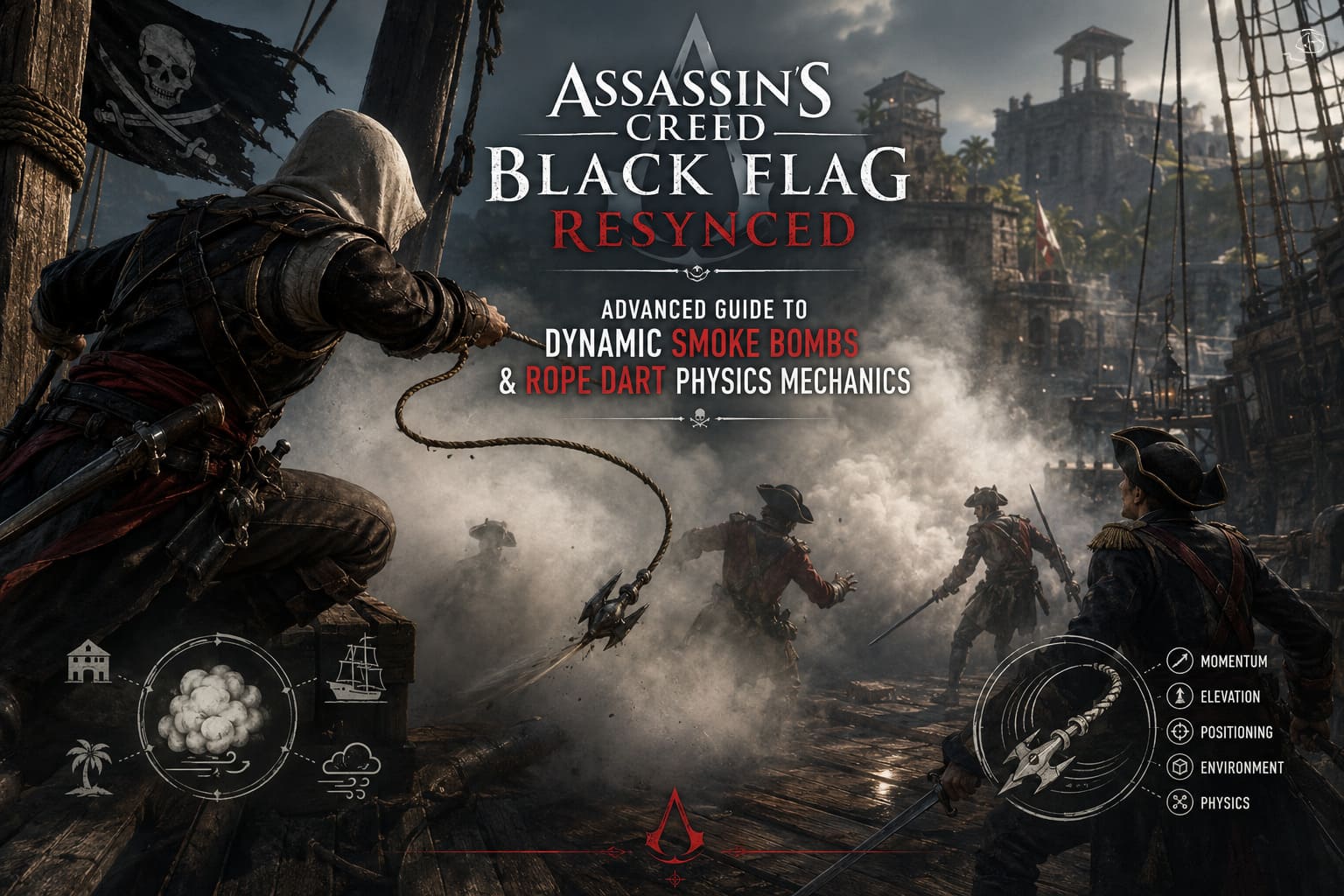
Assassin’s Creed Black Flag Resynced: Advanced Guide to Dynamic Smoke Bombs & Rope Dart Physics Mechanics
When Ubisoft first revealed Assassin’s Creed Black Flag Resynced, my reaction wasn’t focused on graphics. Sure, improved visuals are nice, but we’ve seen countless remasters and remakes over the years that looked prettier while playing almost exactly the same. What immediately caught my attention was something far more important: the complete redesign of Edward Kenway’s stealth toolkit.
After digging through gameplay footage, developer showcases, and community discussions, it’s becoming increasingly clear that Black Flag Resynced isn’t simply upgrading textures. Ubisoft appears to be rebuilding the very foundation of how stealth encounters function. Two systems in particular stand out above everything else: the new dynamic smoke bombs and the heavily expanded rope dart physics mechanics.
As someone who has spent hundreds of hours in the original Black Flag since 2013, I honestly think these changes have the potential to transform the game from a fantastic pirate adventure into one of the most interesting stealth sandboxes Ubisoft has ever created.
Why the Original Systems Needed an Upgrade
Let’s be honest for a moment.
The original smoke bombs in Black Flag were effective, but they were also incredibly simple. You dropped one at your feet, a fixed cloud appeared, enemies became helpless, and you escaped or eliminated them. It worked, but it rarely encouraged creativity.
The rope dart suffered from a similar issue.
Although it became one of Edward’s most iconic weapons, many of its uses were tied to scripted animations. The tool looked cool, but players had limited control over how it behaved once deployed.
From everything shown so far, Resynced seems determined to remove those restrictions.
Instead of predetermined outcomes, the game appears to encourage experimentation through physics-based interactions.
And that’s exactly the direction I wanted Ubisoft to take.
Dynamic Smoke Bombs Feel Like a Real Evolution of Stealth Gameplay
The biggest surprise for me is how much attention has been given to smoke behavior.
In most stealth games, smoke functions as a simple status effect. Throw it, enemies lose sight, and that’s the end of the story.
Black Flag Resynced appears to treat smoke as an actual environmental element.
Rather than generating a perfect circular cloud, the smoke reportedly reacts to surrounding structures, narrow passages, open spaces, ship decks, and changing weather conditions. That means every deployment can produce a different outcome depending on where and when you use it.
Imagine throwing a smoke bomb into:
- A narrow corridor inside a fort
- The lower deck of an enemy warship
- A crowded plantation warehouse
- A windy dockside checkpoint
Each environment influences the cloud differently.
That alone creates a level of unpredictability that simply didn’t exist in the original game.
Why This Matters
Stealth becomes far more interesting when players must consider environmental factors.
Instead of asking:
“Do I use a smoke bomb here?”
You’ll be asking:
“Where should I throw it for maximum effect?”
That distinction might sound small, but it fundamentally changes player decision-making.
I especially like the idea that enclosed areas create denser smoke concentrations. If the system works as advertised, indoor infiltration routes could become dramatically more strategic than before.
The Rope Dart Finally Looks Like the Weapon It Was Always Meant to Be
If the smoke bomb redesign impressed me, the rope dart overhaul genuinely got me excited.
The rope dart has always been one of the coolest Assassin weapons ever created.
Yet despite its popularity, players rarely had much influence over how it operated.
Resynced seems ready to change that.
The new version reportedly treats the rope as a physical object rather than a simple animation trigger. That means positioning, momentum, elevation, and environmental geometry all influence the outcome.
As a longtime stealth fan, this is exactly the kind of feature I love seeing.
Games become memorable when systems interact naturally rather than relying on scripted sequences.
Potential Rope Dart Advantages
- Pulling enemies into concealment
- Using elevation to increase takedown efficiency
- Creating creative ambush scenarios
- Manipulating enemy positioning
- Combining verticality with stealth eliminations
The more I learn about the system, the more it reminds me of immersive sandbox games where players create their own solutions instead of following predefined paths.
Predator Hangs Could Become More Rewarding Than Ever
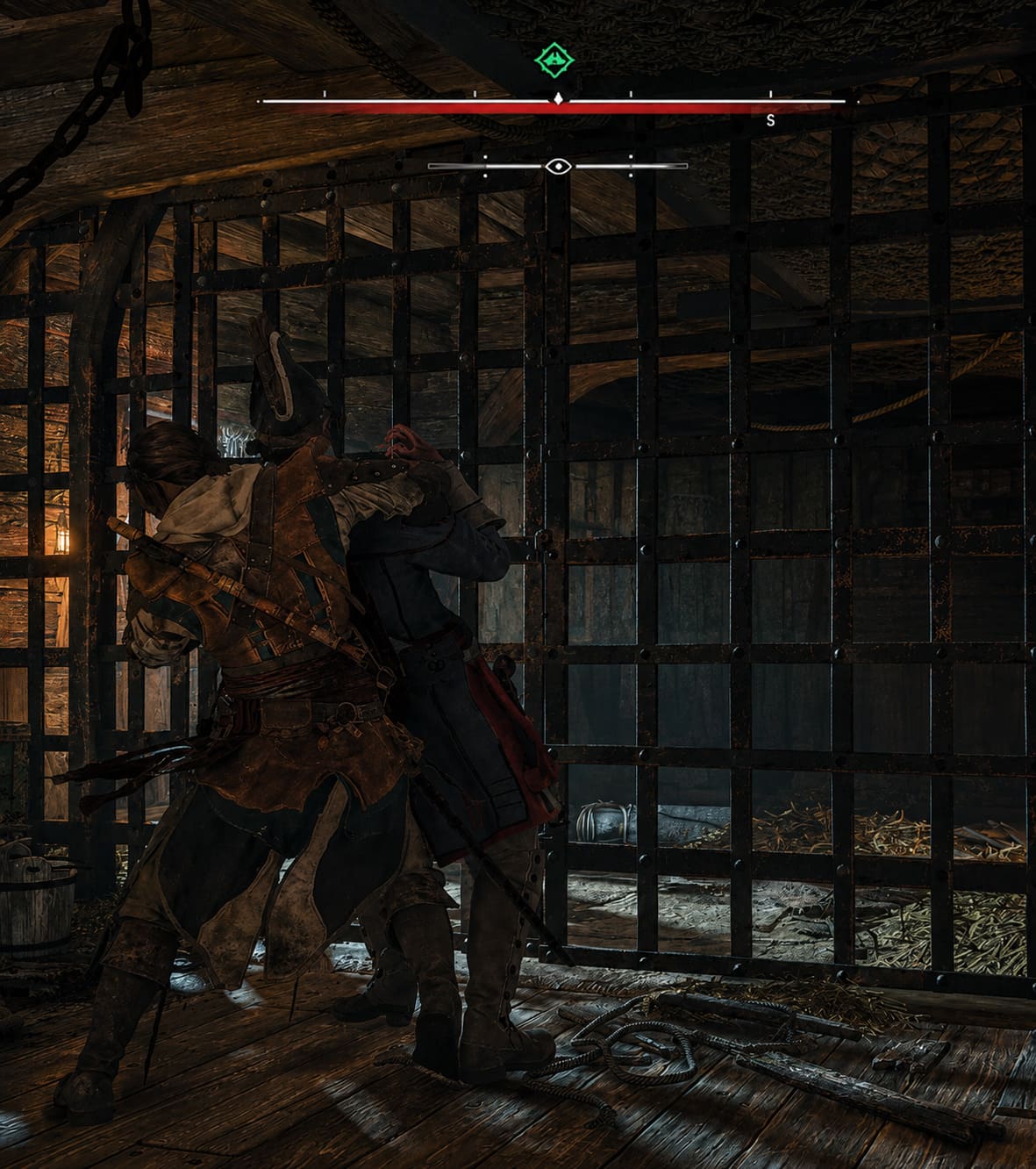
One of the most iconic kills in Assassin’s Creed history is the Predator Hang.
In the original Black Flag, these executions looked fantastic but eventually became predictable.
The Resynced version appears far more dynamic.
Instead of pressing a button and watching an animation play out, players reportedly need to consider:
- Positioning
- Height
- Timing
- Movement direction
- Weight distribution
If these mechanics are implemented properly, every Predator Hang could feel earned rather than automatic.
That’s an important distinction.
When a game rewards skillful setup and execution, players naturally become more invested in the stealth experience.
Comparison: Original Black Flag vs Black Flag Resynced
| Feature | Original Black Flag | Black Flag Resynced |
|---|---|---|
| Smoke Bomb Behavior | Static area effect | Dynamic environmental simulation |
| Enemy Reactions | Standard stun effect | Context-sensitive responses |
| Rope Dart Functionality | Mostly scripted | Physics-driven interactions |
| Predator Hangs | Automated execution | Momentum-based setup |
| Environmental Influence | Minimal | Major gameplay factor |
| Player Creativity | Limited | Significantly expanded |
Looking at these differences side by side, it’s easy to understand why many fans are calling this project far more than a visual remake.
Combining Both Systems Creates the Real Magic
The most exciting aspect isn’t the smoke bomb system.
It isn’t the rope dart system either.
It’s how they appear to work together.
This is where I think Black Flag Resynced could truly separate itself from previous Assassin’s Creed titles.
Picture a heavily guarded outpost.
You deploy a smoke bomb into the center of a patrol route.
Visibility collapses.
Guards begin reacting to the expanding cloud.
During the confusion, Edward reaches an elevated position.
A rope dart launches from the darkness.
Moments later, an officer disappears into the air while nearby soldiers remain unaware of what happened.
That’s the kind of emergent gameplay scenario that players remember long after finishing the story.
It’s not about following scripted stealth puzzles.
It’s about creating your own solutions.
And honestly, Assassin’s Creed has needed more of that for years.
Assassin’s Creed Black Flag Resynced Steam Deck: Best Settings & Performance Guide (2026)
Why This Matters for the Future of Assassin’s Creed
One thing I’ve noticed over the past decade is that Ubisoft often introduces interesting ideas but doesn’t always push them as far as fans would like.
Black Flag Resynced feels different.
The focus appears to be on deeper systems rather than surface-level improvements.
If successful, these mechanics could influence future entries across the entire franchise.
Imagine:
- More advanced environmental stealth
- Expanded physics-based tools
- Dynamic AI reactions
- Greater player freedom
- Emergent mission outcomes
Those are the kinds of innovations that keep long-running franchises fresh.
Assassin’s Creed Black Flag Resynced: How to Execute Dual Blade Running Assassinations
My Final Thoughts
As someone who still considers Assassin’s Creed IV: Black Flag one of the best entries in the entire series, I approached this remake with cautious optimism.
The original game remains special because it balanced naval combat, exploration, and stealth better than most Assassin’s Creed titles.
What excites me about Black Flag Resynced is that Ubisoft doesn’t seem content with simply preserving that experience.
Instead, the developers appear to be asking an important question:
What would Black Flag look like if it were designed with modern technology from the ground up?
The answer appears to be a far more dynamic, reactive, and player-driven stealth sandbox.
If the final release delivers on the promise shown so far, dynamic smoke simulations and advanced rope dart physics could become the standout features of the entire remake.
For veteran assassins returning to the Caribbean and newcomers stepping into Edward Kenway’s boots for the first time, Black Flag Resynced may end up being far more than a nostalgic revisit.
It could become the definitive version of one of Ubisoft’s greatest adventures—and potentially set a new benchmark for stealth gameplay within the Assassin’s Creed franchise itself.