Project Zomboid Build 42 Battle Milk Meta Explained and Patch Changes
If you’ve spent enough time in sandbox survival games like Project Zomboid, you already know that players will eventually push every system to its absolute limit.
Sometimes it’s crafting loops, sometimes it’s combat exploits, and sometimes it turns into something as absurd as a dairy-based “combat drink” that briefly becomes the most efficient survival method in the game.
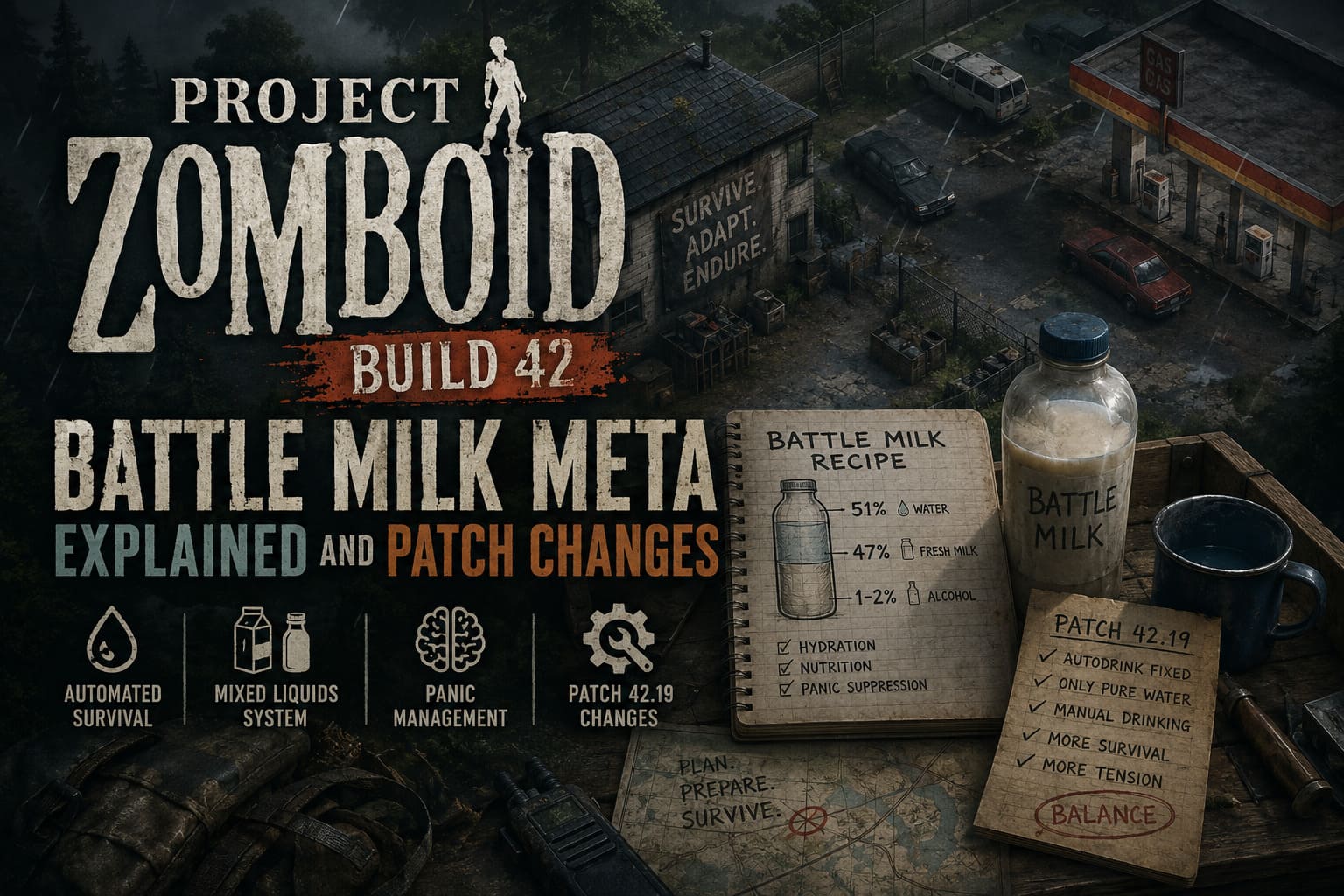
That strange moment in the Build 42 unstable branch was known as Battle Milk. It wasn’t an official mechanic, not a designed feature, and definitely not something the developers intended to define high-level combat.
Yet for a short period, it became one of the most discussed meta strategies in the community.
Is Project Zomboid Build 42 Stable Out? Release Date, Status, and How to Play
What Was Battle Milk?
Battle Milk (also called Combat Milk or Fight Juice) emerged from the expanded fluid mixing system introduced in Build 42. The system allowed players to combine liquids in containers, each retaining partial properties of its ingredients.
Players quickly discovered that mixing liquids in specific ratios could create extremely efficient survival drinks. The most widely used formula became:
Classic Battle Milk Composition
- Approximately 51% water for hydration recognition
- About 47% fresh milk for calorie density and nutrition
- 1–2% alcohol for panic suppression effects
The result was a single container that could handle multiple survival needs at once: thirst, hunger, and panic management. It effectively condensed several survival systems into one passive mechanic.
Gothic 1 Remake 100% Completion Guide: Achievement & Quest Checklist
Why Players Used It in Combat
The real power of Battle Milk wasn’t raw statistics. It was automation.
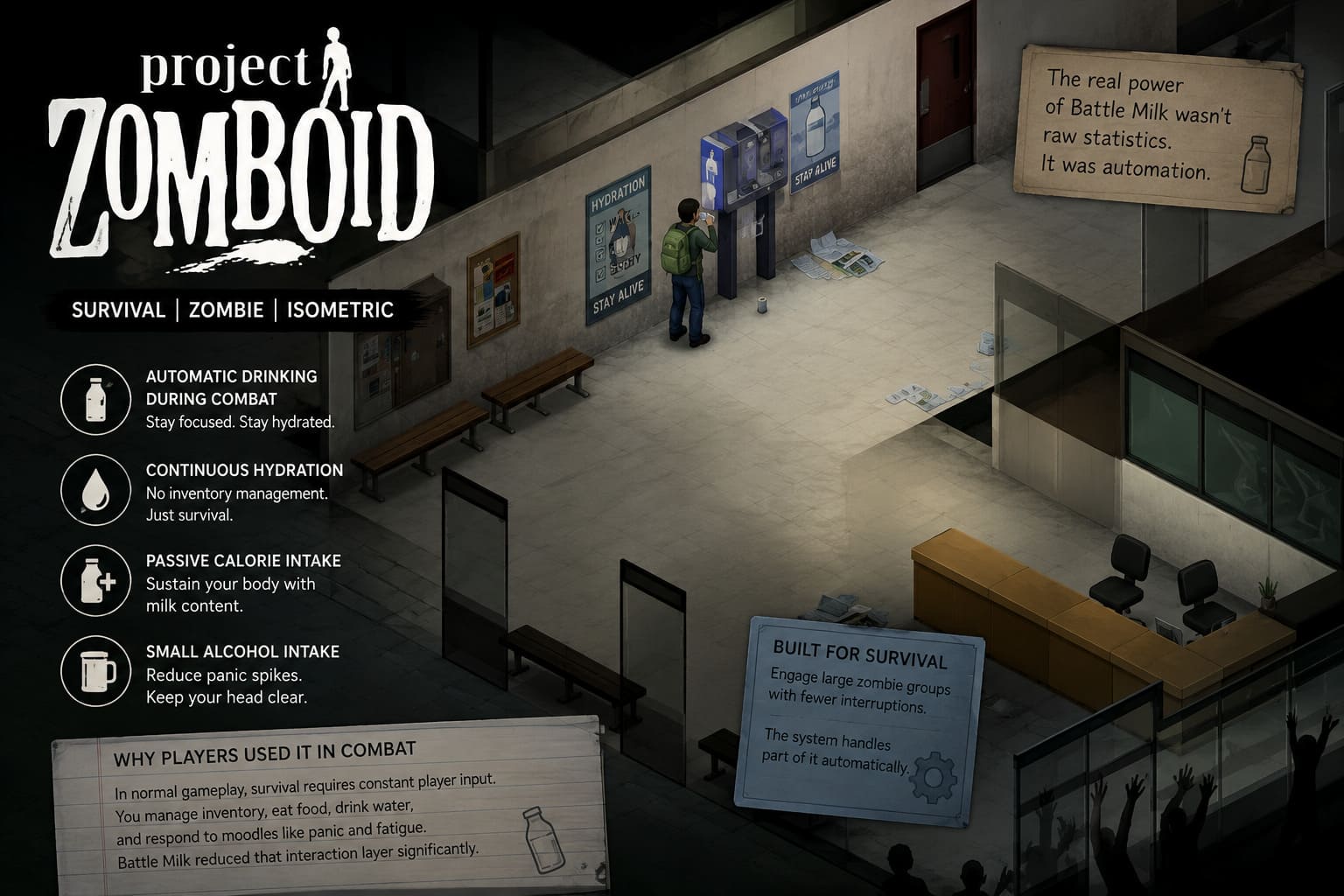
In normal gameplay, survival requires constant player input. You manage inventory, eat food, drink water, and respond to moodles like panic and fatigue. Battle Milk reduced that interaction layer significantly.
Main Advantages in Practice
- Automatic drinking during combat situations
- Continuous hydration without manual inventory management
- Passive calorie intake from milk content
- Small alcohol intake reducing panic spikes
This created a situation where players could engage large zombie groups with fewer interruptions. Instead of stopping to manage survival stats, the system handled part of it automatically.
Why It Became a Problem
As powerful as it was, Battle Milk introduced a fundamental design issue: it removed pressure.
Project Zomboid is built around tension. Every action carries risk, and every mistake can spiral into death. By automating survival needs, Battle Milk reduced that tension significantly.
Instead of carefully managing hunger, thirst, and panic during combat, players could rely on a single optimized solution that handled everything passively. Over time, this made high-risk encounters noticeably easier and less meaningful.
The Build 42.19 Patch: Quiet but Impactful
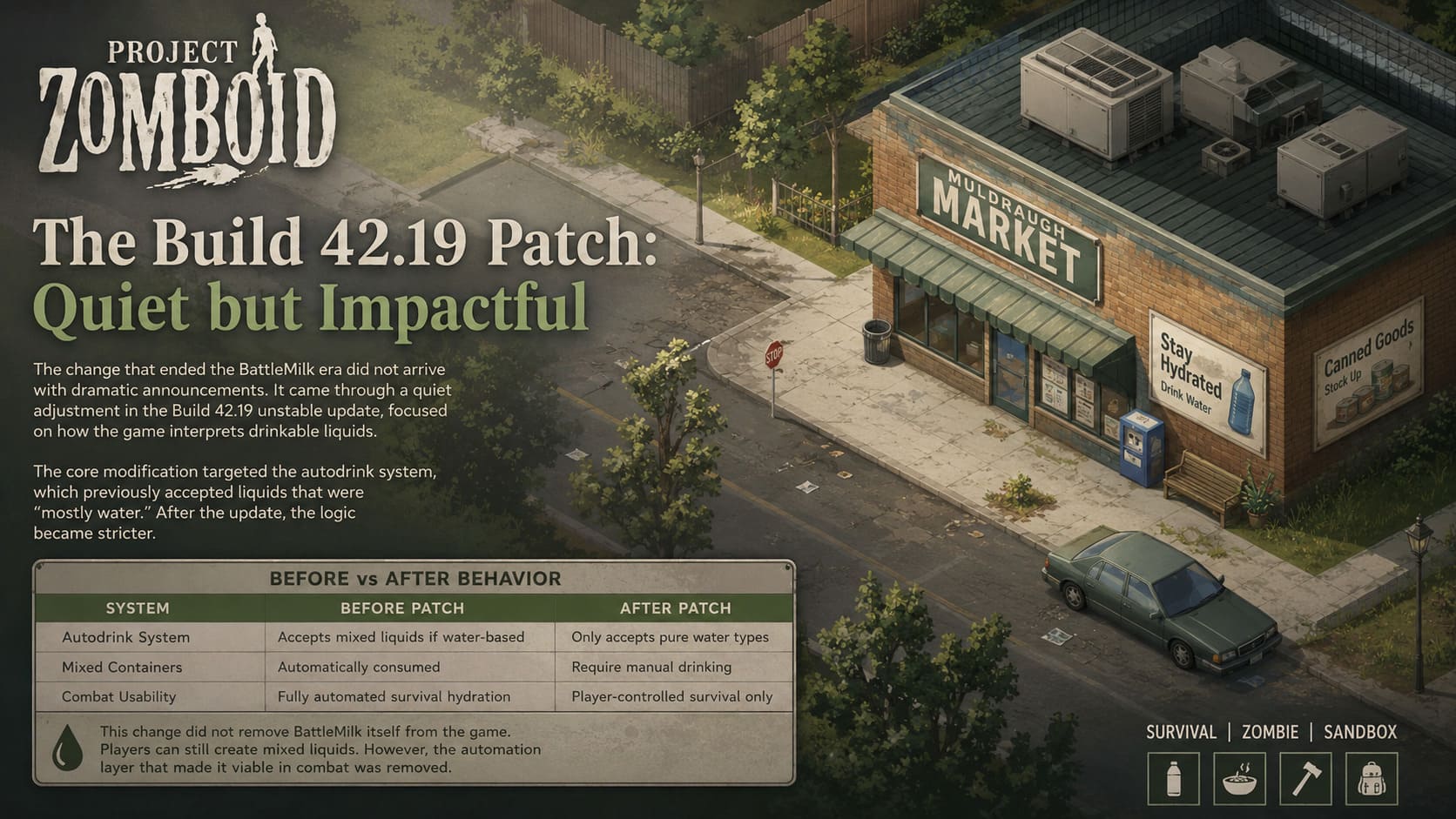
The change that ended the Battle Milk era did not arrive with dramatic announcements. It came through a quiet adjustment in the Build 42.19 unstable update, focused on how the game interprets drinkable liquids.
The core modification targeted the autodrink system, which previously accepted liquids that were “mostly water.” After the update, the logic became stricter.
Before vs After Behavior
| System | Before Patch | After Patch |
|---|---|---|
| Autodrink system | Accepts mixed liquids if water-based | Only accepts pure water types |
| Mixed containers | Automatically consumed | Require manual drinking |
| Combat usability | Fully automated survival hydration | Player-controlled survival only |
This change did not remove Battle Milk itself from the game. Players can still create mixed liquids. However, the automation layer that made it viable in combat was removed.
What Changed for Players
The biggest impact of the patch is not the removal of the item, but the removal of convenience during high-pressure situations.
Now, drinking mixed liquids requires manual interaction. That means players must open inventory menus, select items, and consume them while exposed to danger. In practice, this makes using complex mixtures during combat significantly riskier.
Current Survival Adjustments
- Beta-blockers are now the primary panic control tool
- Veteran-style builds reduce reliance on consumables
- Base management focuses more on food preparation than combat drinks
- Milk is used primarily for long-term nutrition instead of combat use
Instead of relying on automated buffs, players return to slower, more deliberate survival strategies.
Community Reaction: Humor and Acceptance
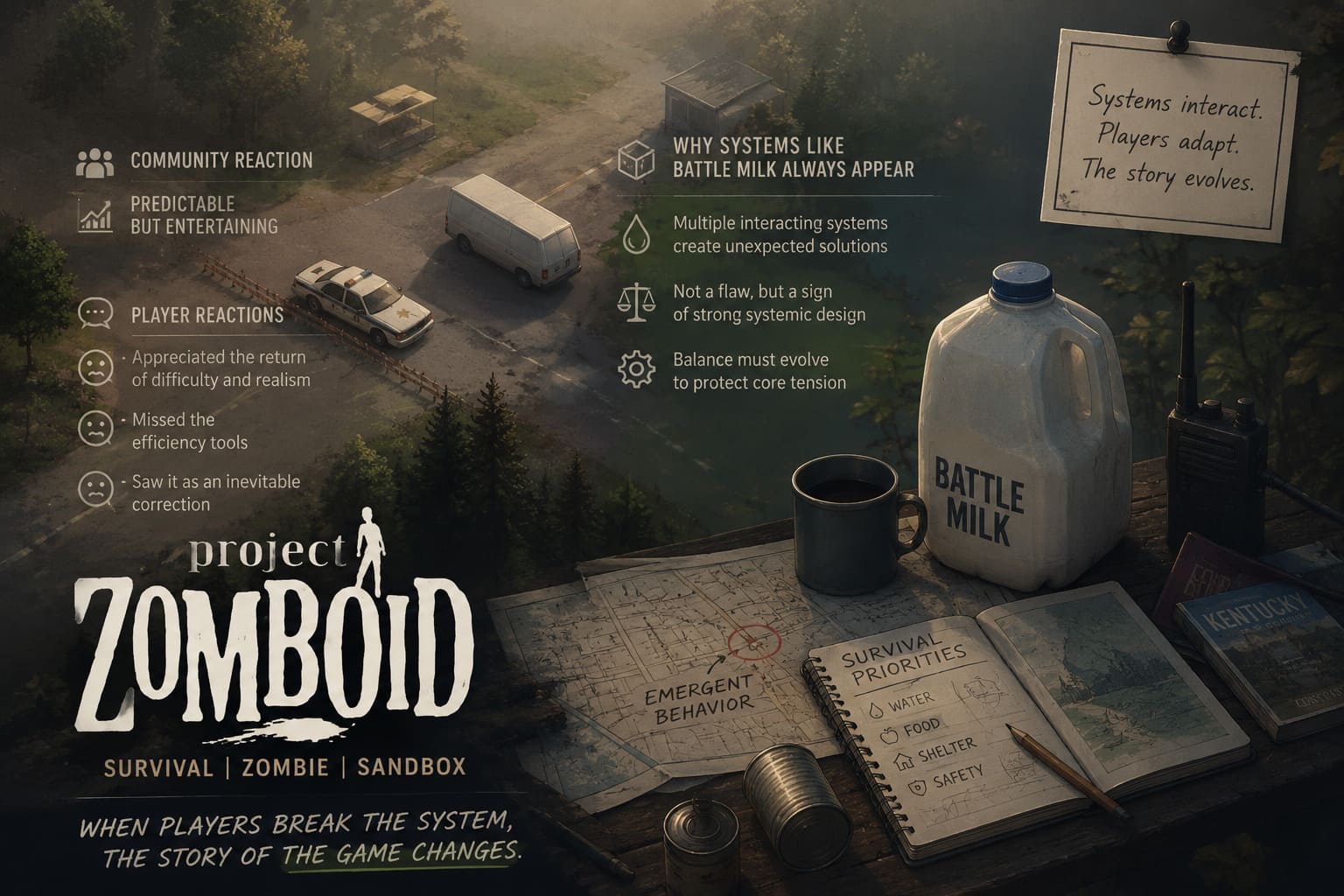
The community reaction was predictable but entertaining. Some players were disappointed, especially those who enjoyed optimizing the system. Others treated it as a humorous chapter in the game’s ongoing evolution.
Across forums and social discussions, the reaction generally fell into three categories:
Player Reactions
- Casual players appreciated the return of difficulty and realism
- Optimization-focused players missed the efficiency tools
- Veteran players saw it as an inevitable correction
Content creators also pointed out that while Battle Milk was fun, it undermined the core survival tension that defines the game’s identity.
Why Systems Like Battle Milk Always Appear
Battle Milk is not an anomaly. It is a predictable outcome in deep simulation games.
When a game allows multiple interacting systems—liquids, nutrition, mood effects, automation—players will eventually discover combinations that bypass intended limitations.
This is not necessarily a flaw. It is a sign of strong systemic design. However, it also means developers must occasionally step in to restore balance when emergent behavior undermines core gameplay tension.
Conclusion: The End of a Strange Meta
Battle Milk represents one of those unique moments in gaming where creativity and system complexity collide. It was funny, efficient, and briefly dominant, but it also removed too much of the survival challenge that defines Project Zomboid.
The Build 42.19 changes did not erase creativity. They simply reintroduced friction. Players can still experiment, still optimize, and still discover new strategies—but they can no longer automate survival through a single overpowered mixture.
In the end, Battle Milk was never meant to last. It was a temporary expression of how far players can push systems before the game pushes back.