Ore Factory Squad Resources Full List: Guide to All Ores, Processing Chains, and Products (2026)
When I first jumped into Ore Factory Squad, I expected another factory simulator where the biggest challenge would be arranging conveyor belts efficiently. After spending dozens of hours with games like Factorio, Satisfactory, Techtonica, Hydroneer, and Foundry, I thought I had already seen every possible variation of mining and automation.
I was wrong.
What surprised me most about Ore Factory Squad isn’t simply its production chains. It’s the feeling that every expansion has to be earned. Digging through destructible terrain, discovering valuable ore pockets, and slowly transforming a chaotic excavation site into a perfectly organized industrial complex creates a progression loop that’s incredibly satisfying.
If you’re just starting your factory or you’re already chasing high-value contracts, understanding how resources connect with each other is far more important than simply collecting everything you find. Here’s my complete overview of the game’s resource system, along with a few personal observations that made my own factory much more efficient.
Why Resources Matter More Than Mining
One mistake I made during my first several hours was treating every ore as something worth selling immediately.
That works—for a while.
Eventually you’ll realize the game rewards processing, not collecting.
Raw materials generate quick cash, but refined products and assembled industrial goods are where the real profits begin. Every production upgrade multiplies the value of your resources, which is why building efficient production lines becomes the heart of the experience.
Unlike many automation games where expansion feels predictable, Ore Factory Squad constantly pushes you to rethink your layouts as new materials become available.
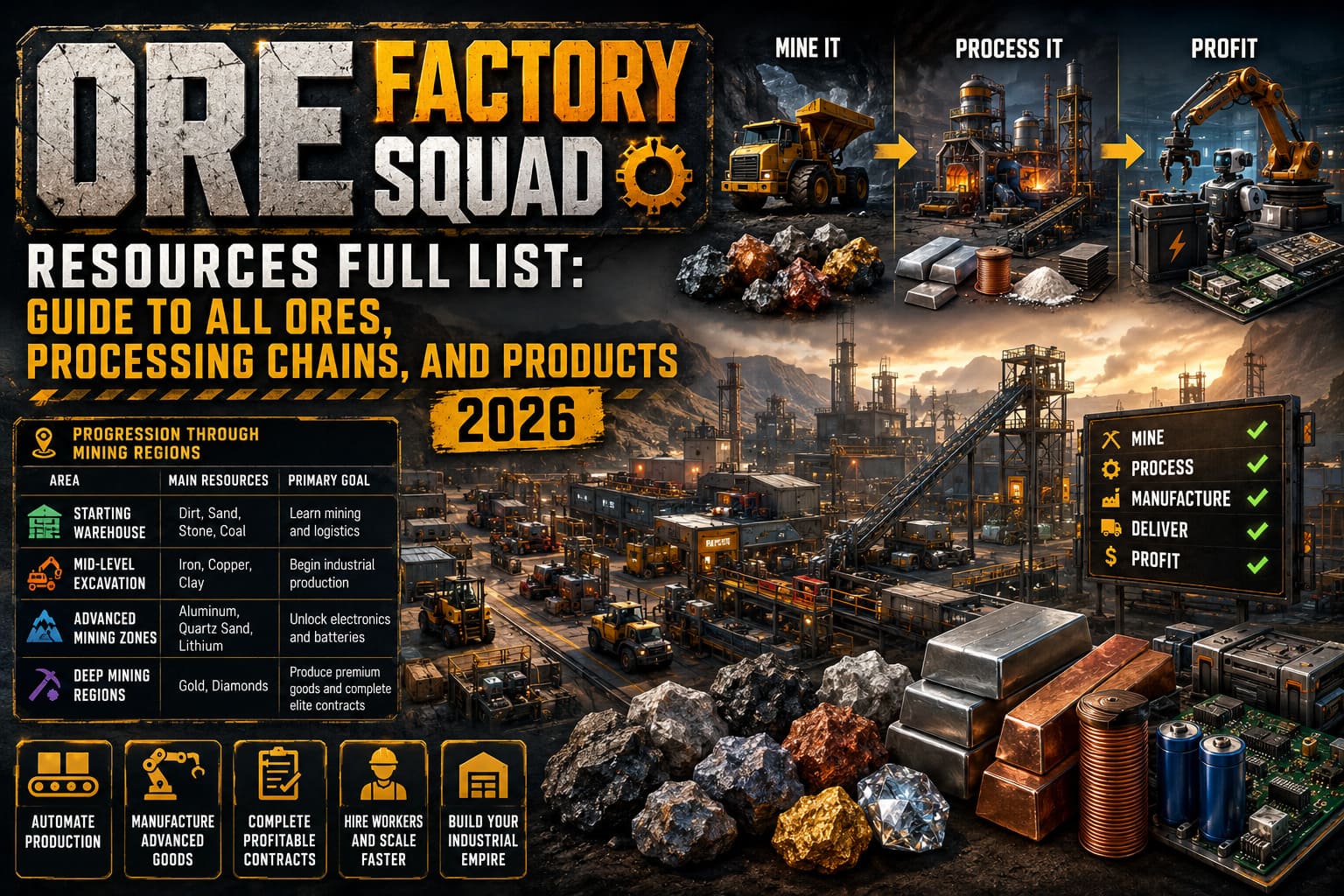
Progression Through Mining Regions
The game gradually opens access to richer underground deposits instead of overwhelming players with dozens of resources immediately.
| Area | Main Resources | Primary Goal |
|---|---|---|
| Starting Warehouse | Dirt, Sand, Stone, Coal | Learn mining and logistics |
| Mid-Level Excavation | Iron, Copper, Clay | Begin industrial production |
| Advanced Mining Zones | Aluminum, Quartz Sand, Lithium | Unlock electronics and batteries |
| Deep Mining Regions | Gold, Diamonds | Produce premium goods and complete elite contracts |
Each new region introduces tougher underground terrain, meaning your old tools quickly become inefficient. Upgrading mining equipment feels necessary rather than optional.
Every Important Raw Resource
Some materials appear everywhere, while others require serious exploration before you’ll encounter them.
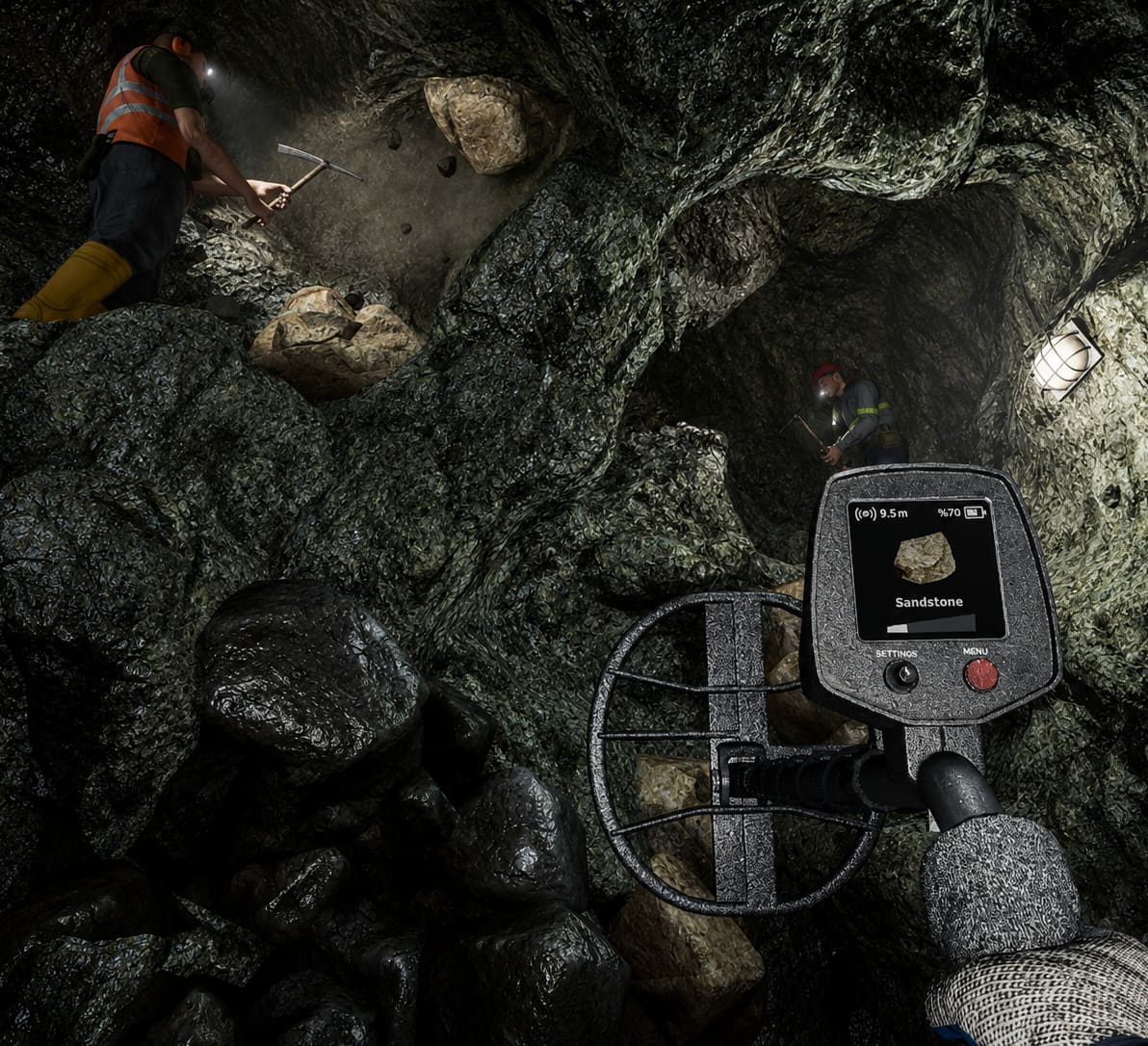
Dirt
Nobody gets excited about Dirt, but you’ll move an enormous amount of it.
It mostly exists to clear space for future production lines, although early-game players can still earn a little extra income by selling excess stock.
Sand
Sand becomes much more valuable than it initially appears.
Besides basic construction, it eventually feeds several manufacturing chains, making it worth storing instead of dumping for quick money.
Gravel
Gravel acts as one of the game’s core construction materials.
Once concrete production begins, you’ll notice demand rising surprisingly fast.
Stone
Stone is everywhere during the opening hours.
After processing, it becomes one of the essential ingredients for building larger industrial facilities.
Coal
Coal powers your early operation.
Until electricity becomes your primary energy source, keeping a healthy coal reserve prevents production from grinding to a halt.
Iron Ore
Iron is where automation truly begins.
Nearly every major expansion eventually depends on iron products.
Without enough iron, you’ll constantly find yourself waiting for construction materials.
Copper Ore
Copper becomes increasingly important once electrical systems enter the picture.
Every conveyor upgrade, electronics component, and wiring project seems to consume more copper than expected.
Aluminum Ore
Lightweight but incredibly useful.
Once aluminum production starts, many advanced machines suddenly become available.
Clay
Clay isn’t glamorous, but it’s critical for producing stronger construction materials.
Ignoring it early often means returning later specifically to collect more.
Quartz Sand
One of the more specialized resources.
Its primary purpose is producing silicon, which opens the door to advanced electronics manufacturing.
Lithium Ore
Lithium completely changes late-game production priorities.
Without it, battery production simply isn’t possible.
Crude Oil
Oil introduces an entirely different branch of manufacturing.
Plastic production becomes one of those systems you underestimate until almost every advanced recipe begins requiring it.
Gold Ore
Gold isn’t just valuable—it also appears in several premium manufacturing chains.
Finding a rich gold deposit always feels rewarding.
Diamond Ore
Diamonds represent the highest tier of mining.
They’re rare, difficult to reach, and incredibly profitable once properly processed.
Processing Resources Into Valuable Materials
Mining only represents the first half of the gameplay loop.
Factories transform ordinary ores into materials worth serious money.
| Raw Material | Processing | Result |
|---|---|---|
| Stone | Crusher | Crushed Stone |
| Sand | Refining System | Refined Sand |
| Clay + Stone | Kiln | Cement |
| Iron Ore + Coal | Blast Furnace | Iron Ingots |
| Copper Ore | Furnace | Copper Ingots |
| Aluminum Ore | High-Temperature Furnace | Aluminum Ingots |
| Quartz Sand | Arc Furnace | Refined Silicon |
| Crude Oil | Refinery | Industrial Plastic |
| Lithium Ore | Chemical Refinery | Refined Lithium |
| Gold Ore | Furnace | Gold Bars |
| Diamond Ore | Washplant & Cutter | Polished Diamonds |
This is where Ore Factory Squad starts feeling much deeper than a standard mining simulator.
Instead of producing one finished item from each resource, many processed materials become ingredients for even more complicated products.
That layered progression kept me interested far longer than I expected.
High-End Manufactured Products
The most profitable factories rarely sell raw metals.
Instead, they assemble complete industrial products.
Some of the most valuable include:
- Iron Rods
- Iron Plates
- Copper Wire
- Electrical Cabling
- Aluminum Sheets
- Industrial Electronics
- Advanced Battery Packs
- Warehouse Robots
- Heavy Structural Components
These products require multiple production stages, meaning one interruption somewhere upstream can slow your entire factory.
That’s where smart logistics become essential.
Logistics Become the Real Game
If I had to describe Ore Factory Squad in one sentence after many hours of playing, I’d say it’s less about mining and more about preventing traffic jams.
Every successful production chain depends on materials arriving exactly where they’re needed.
I learned fairly quickly that manually transporting pallets might work during the opening hours, but it becomes exhausting once multiple factories operate simultaneously.
Conveyors, splitters, automated sorting systems, and storage organization eventually save far more time than building another mining drill.
One of my favorite moments came when an entire production line—from iron ore extraction to finished structural plates—ran without any manual input. Watching dozens of interconnected machines work together never really gets old.
Contracts Are Worth More Than Quick Sales
New players often sell everything they mine.
I did exactly the same thing.
It’s useful for buying early equipment, but eventually contracts become dramatically more profitable.
Instead of asking for simple ores, larger contracts request refined products, electronics, batteries, and other manufactured goods.
The payouts increase enough that building dedicated production lines becomes the obvious long-term strategy.
In other words:
- Selling raw materials keeps your factory alive.
- Selling processed goods helps it grow.
- Completing contracts turns it into an industrial empire.
Hiring Workers Changes Everything
Solo play remains enjoyable for quite a while, but eventually your operation simply grows too large.
This is where AI workers become surprisingly useful.
I found it much more efficient to let miners continuously collect resources while handlers managed transportation tasks.
That left me free to redesign conveyor systems, expand production, and optimize factory layouts instead of constantly driving forklifts across the property.
It’s one of those quality-of-life systems that doesn’t sound exciting until you’ve experienced how much smoother large-scale production becomes.
Ore Factory Squad Dig Sites Guide: Complete 4 Sites & Ore List (2026)
My Advice for New Players
After spending plenty of time experimenting—and making more mistakes than I’d like to admit—there are a few habits I’d recommend developing early.
| Tip | Why It Helps |
|---|---|
| Don’t sell every raw resource | Many become essential later. |
| Expand conveyors early | Manual transport quickly becomes inefficient. |
| Build storage near production | Reduces unnecessary travel time. |
| Prioritize iron production | Most upgrades require it. |
| Stockpile coal early | Prevents early power shortages. |
| Automate repetitive jobs | Lets you focus on expansion. |
Perhaps the biggest lesson is not to rush.
Ore Factory Squad rewards careful planning much more than rapid expansion. A smaller, efficient factory consistently outperforms a massive but disorganized one.
Final Thoughts
After playing countless mining and automation games over the years, I genuinely think Ore Factory Squad finds a comfortable middle ground between accessibility and complexity.
It doesn’t overwhelm newcomers with hundreds of crafting recipes immediately, yet it provides enough production depth to keep experienced factory-building fans engaged for dozens of hours.
What kept bringing me back wasn’t discovering another rare ore—it was improving yesterday’s production line. Every redesigned conveyor, every optimized smelting setup, and every perfectly balanced manufacturing chain felt like solving another engineering puzzle.
If you enjoy games where efficiency matters just as much as exploration, Ore Factory Squad offers a rewarding progression system built around mining, logistics, and industrial expansion. Learn how each resource fits into the bigger production network, resist the temptation to sell everything raw, and invest in automation as early as possible. By doing so, you’ll spend less time hauling crates across the warehouse and more time watching a thriving factory run almost entirely on its own—and that’s where the game truly shines.