Moo Who? Multiplayer Co-Op Guide: Tips, Tricks, and Strategies to Survive the Herd
Moo Who? is one of those multiplayer games that sounds ridiculous when you explain it to someone and becomes surprisingly intense once you actually play it. SAT Productions has built a social stealth game around a wonderfully simple idea: hide inside a herd, imitate an animal with your real voice, and pray that the person holding the shotgun cannot tell which cow, chicken, pig, or sheep is actually a player.
I have played plenty of social deduction games, but Moo Who? feels different because the microphone is part of the gameplay rather than just a way to talk to your friends. You are not simply pretending to be an animal visually. You have to sell the performance.
That creates some genuinely funny moments. It also creates situations where a single bad movement, poorly timed sound, or nervous reaction can completely expose you.
With matches supporting up to eight players, the farm can become absolute chaos. Some players become animals hiding among NPC herds, while others take the role of hunters. Animals have to survive until the timer expires. Hunters have limited ammunition and need to identify real players without wasting shots on innocent AI animals.
After spending time looking at how the mechanics work and thinking about what actually matters during a match, I would say this: Moo Who? rewards players who slow down and pay attention much more than players who try to play it like a traditional action game.
Here is how I approach both sides of the farm.
How Moo Who? Multiplayer Actually Works
At the beginning of a match, players are assigned roles. Animal players are placed among groups of NPC creatures, while hunters are given the tools needed to search the map.

The important detail is that you are not just hiding behind an object. Your character needs to behave like the animals around it.
If you are playing as a cow, you need to stay with cows. A chicken standing in the middle of a cattle herd is obviously suspicious, but even the correct animal can give itself away by moving incorrectly.
NPC animals generally follow predictable routines. They walk along established paths, stop periodically, and perform their normal grazing or idle animations.
Human players are much less predictable.
That difference is where most of the game’s mind games begin.
| Mechanic | Animal Players | Hunters |
|---|---|---|
| Main Objective | Survive and remain undetected | Identify and eliminate players |
| Biggest Threat | Suspicious movement and microphone mistakes | Wasted ammunition |
| Important Skill | Mimicry and patience | Observation and audio awareness |
| Useful Tool | Herds and environmental cover | Directional audio and positioning |
| Common Mistake | Moving too much | Shooting without confirmation |
The microphone mechanic is especially important. Your assigned animal has its own sound, and you need to reproduce it using your real microphone.
So yes, you really do have to moo, cluck, oink, or baa.
And surprisingly, that becomes one of the most stressful parts of the game.
The Golden Rule for Animal Players: Become Boring
My number one piece of advice for animal players is simple:
Do less.
Do not constantly run around. Do not spin your camera every second. Do not try to outsmart the AI with complicated movement.
Watch the NPC animals around you.
Pick one creature and study it.
Notice how long it walks before stopping. Notice whether it turns sharply or gradually. Watch what happens when the herd reaches a particular part of the map.
Then copy that behavior.
The reason this works is that hunters are looking for abnormalities. They are not necessarily searching for a specific player. They are searching for the animal that behaves differently from everything else.
If ten cows are walking in roughly the same direction and one suddenly sprints away, that cow might as well have a neon sign above its head.
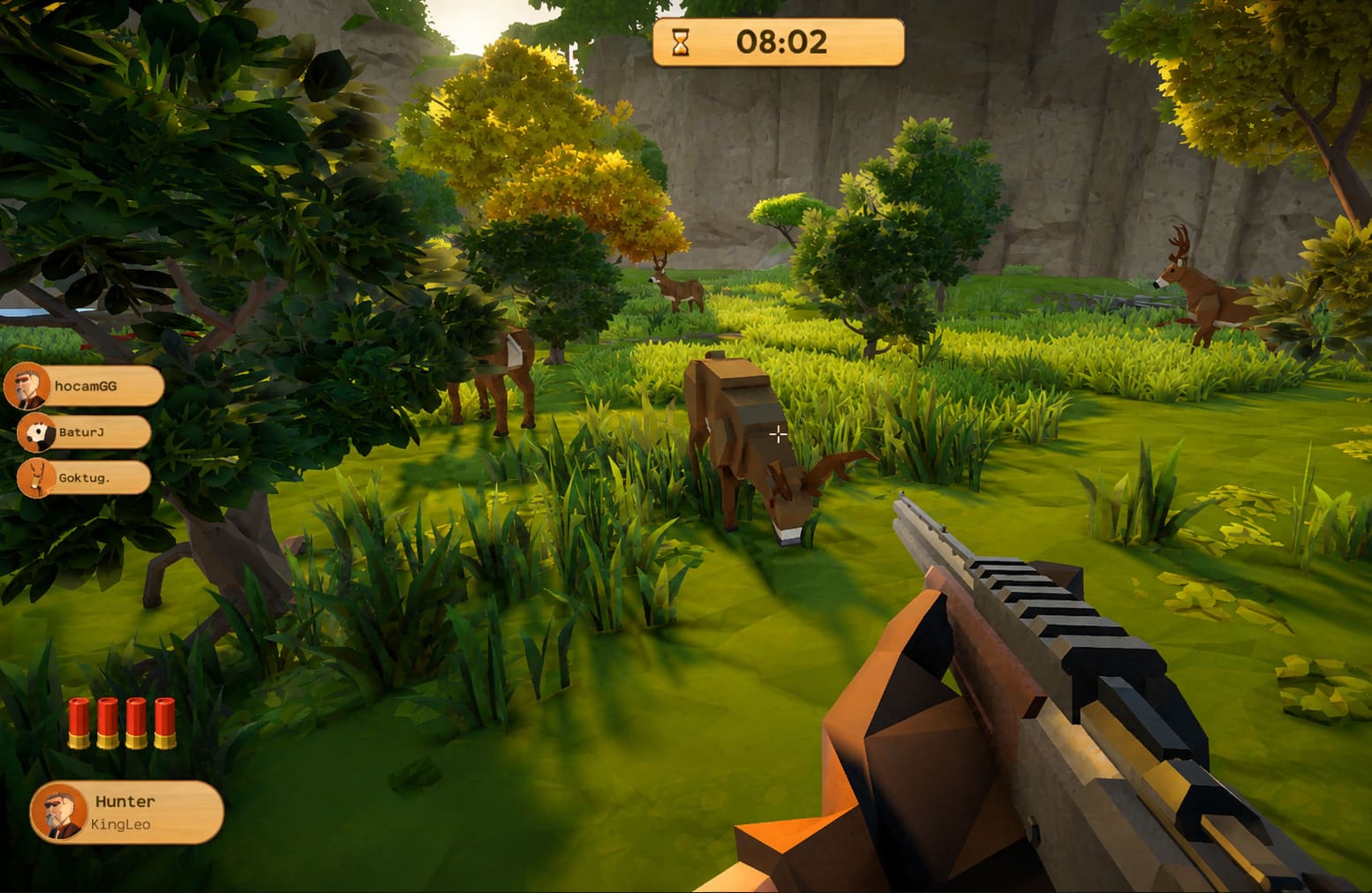
Movement Mistakes That Give You Away
- Sudden 180-degree turns.
- Unnecessary sprinting.
- Walking directly into other NPC animals.
- Constantly changing direction.
- Stopping in locations where NPCs never stop.
- Following a hunter while staring directly at them.
- Running immediately after hearing a suspicious sound.
That last one is particularly important.
A hunter may not know where you are. But if you hear a gunshot and immediately panic-run across the field, you have just provided the information they needed.
Sometimes the best reaction is no reaction at all.
Mastering the Microphone
The voice system is what makes Moo Who? genuinely interesting.
Your animal sound needs to feel natural enough that a hunter cannot immediately distinguish you from the NPC creatures.
You do not need to scream into your microphone. In fact, I think that is one of the easiest ways to make yourself suspicious.
Keep your sounds relatively short and controlled.
If you are surrounded by chickens, listen first. Wait for the NPC sounds to blend together. Then make your own cluck at a similar moment.
This creates an audio wall that is much harder to analyze.
### Use the Herd as Audio Cover
This is one of the strongest techniques available to animal players.
Do not treat NPC sounds as something you need to compete with. Use them as camouflage.
If several animals start making noise at once, that is usually your safest opportunity to respond.
The same idea applies to pitch and rhythm. A completely unnatural sound can stand out even when the timing is perfect.
If the surrounding NPCs are producing short, high-pitched sounds, a long and exaggerated version from you may sound wrong immediately.
You are not trying to perform for an audience.
You are trying to sound forgettable.
The Fly Mechanic Can Ruin Your Entire Plan
One of the most dangerous mechanics for silent players is the fly indicator.
If you remain quiet for too long, flies can begin appearing around your character. For a hunter scanning the map, that can be an enormous clue.
This means hiding by simply muting your microphone is not a reliable strategy.
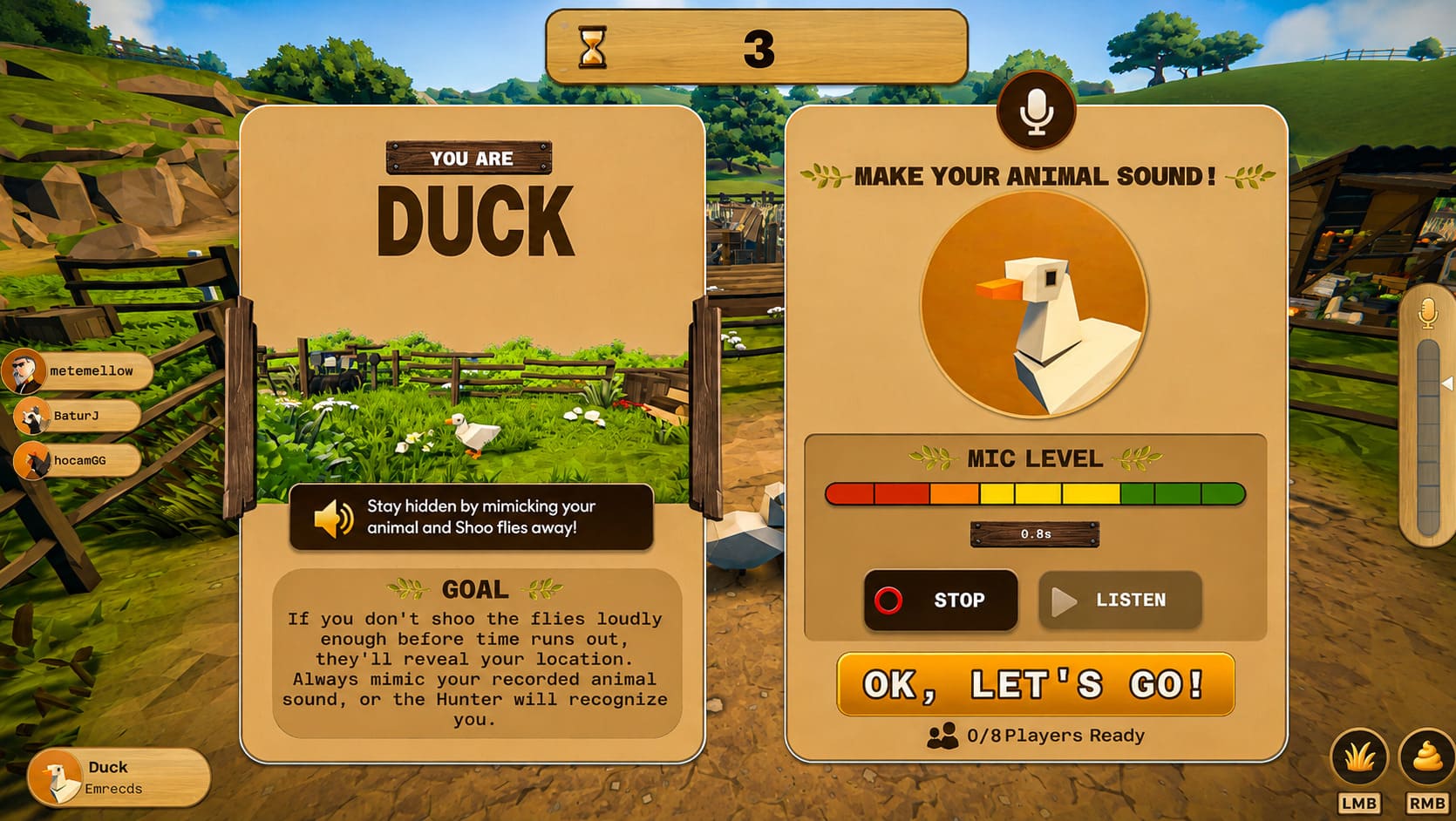
You need to manage your silence.
If you notice the fly effect beginning, make your animal sound before the hunter gets a chance to investigate. Ideally, do it while the hunter is focused somewhere else.
There is a psychological element here that I really like. The game forces you to balance being quiet enough to avoid attention while being active enough to avoid the game’s own detection system.
That tension is where the best matches happen.
How I Would Play as a Hunter
Playing hunter is almost the opposite experience.
You have power, but you do not have unlimited freedom.
Your ammunition is limited, and firing at innocent NPC animals can punish you. That means every shot should feel like a decision rather than a reflex.
The worst hunter habit is running around and shooting at anything that looks remotely suspicious.
You will waste your ammunition incredibly quickly.
Instead, slow down.
Listen.
Watch.
Wait.
Headphones Are Practically Mandatory
If you want to become a good hunter, directional audio is one of your biggest advantages.
Use headphones whenever possible.
Listen for animal sounds that appear slightly different from the surrounding NPC audio. A player’s microphone may have different characteristics from the game’s native animal sounds, and small inconsistencies can become useful clues.
You should not rely on audio alone, though.
The strongest evidence usually comes from combining sound with movement.
For example, if you hear a strange moo and then notice one cow suddenly changing direction, you have a much stronger lead than you would from the audio by itself.
Watch for Bad AI Behavior
Hunters should learn the NPC routines just as carefully as animal players do.
This is where experienced hunters have a major advantage.
Look for creatures that:
- Turn more sharply than nearby NPCs.
- Stop in unusual locations.
- Bump into other animals.
- Suddenly accelerate.
- Follow a player-like path instead of an AI route.
- React to your presence in a strange way.
- Make sounds that do not match the surrounding herd.
One strange behavior is not necessarily enough to shoot.
Two or three unusual behaviors from the same animal?
Now I would start paying serious attention.
Pressure Players Into Making Mistakes
You do not always need to shoot immediately.
Sometimes the best hunting strategy is simply to stand near a suspicious animal and wait.
Players become nervous when they know they are being watched.
That nervousness produces mistakes.
They might suddenly run.
They might turn toward you.
They might make their animal sound at the wrong time.
They might attempt to move back into the herd and accidentally collide with another NPC.
This is why patience is such a powerful hunter skill.
You are not just searching for evidence.
You are creating situations where evidence appears naturally.
Never Waste Ammunition on a Guess
This deserves its own section because I have seen this mistake in almost every game with limited resources.
If you have only a few shots, every bullet matters.
Do not fire because an animal “feels suspicious.”
Instead, gather multiple clues.
Ask yourself:
Did it move incorrectly? Did its sound seem unusual? Did it react to me? Did it separate from the herd? Did I actually see something that an NPC would not normally do?
If the answer is yes to several of these, your shot becomes much more justified.
If the answer is simply “that cow looked weird,” keep watching.
Co-Op Strategies for Groups
Moo Who? becomes even more interesting when players coordinate.
If multiple hunters are working together, dividing the map into sectors is much better than having everyone chase the same suspicious animal.
One hunter can monitor the cattle area while another checks the chicken coop. A third player can patrol routes between the main areas.
This gives the team broader coverage and makes it harder for animals to simply relocate whenever a hunter walks away.
For animal players, communication needs to be more careful.
If voice chat is available, discussing plans openly can accidentally create problems depending on the match setup. Keep your coordination short and deliberate.
One of the funniest strategies is a deliberate distraction.
If your teammate is being investigated, you can create a suspicious sound somewhere else and potentially pull the hunter away.
But there is a catch.
A distraction is only useful if you are prepared to become the next suspect.
I would only use this tactic when my own position is already safe.
Best Settings for Moo Who?
Because the microphone is directly connected to gameplay, spend a few minutes configuring your setup before joining serious matches.
Start with microphone calibration.
You want the game to recognize your voice reliably without picking up every tiny background sound.
Lower unnecessary background noise if possible. A mechanical keyboard, desk fan, phone notification, or noisy room can interfere with your experience.
I also recommend prioritizing game effects over background music.
You want to hear:
- Animal noises.
- Footsteps.
- Hunter movement.
- Environmental sounds.
- Directional audio cues.
Music can be enjoyable, but when you are trying to identify one suspicious sound inside a herd, every bit of useful audio matters.
How to Fix CICADAMATA Crashing on Startup on PC (2026 Guide)
My Favorite Strategy: Play the Psychology
The best thing about Moo Who? is that it is not really about perfect aim or perfect voice acting.
It is about convincing another human being that you are an NPC.
That means psychology matters.
As an animal, ask yourself what a hunter expects a player to do. Then avoid doing it.
As a hunter, ask yourself what a nervous player is likely to do. Then create pressure and wait.
This is why I think experienced social-stealth players will have a lot of fun here. The mechanics are simple, but the situations they create can become surprisingly deep.
One round might be completely chaotic. Everyone runs around screaming, hunters fire too early, and the farm turns into a disaster.
The next round can become almost silent.
One suspicious cow.
One hunter standing twenty meters away.
Nobody moves.
Then somebody makes the wrong moo.
Bang.
That is Moo Who? at its best.
Final Verdict
Moo Who? is much more than a joke built around animal noises. The microphone mechanic gives the social stealth formula a distinctive identity, while the limited ammunition forces hunters to think before they shoot.
If you are playing as an animal, focus on patience, AI movement patterns, herd positioning, and smart microphone timing. Do not panic when a hunter gets close. Looking normal is usually more valuable than trying to escape.
If you are playing as a hunter, slow down and observe. Listen carefully, study NPC behavior, watch for flies, and never waste ammunition on a weak suspicion.
Most importantly, learn to manipulate attention.
That is the real skill ceiling.
You are not simply hiding.
You are controlling what the other players believe.
And after a few matches, you will realize that the funniest part of Moo Who? is not the fact that everyone is making farm animal noises.
It is watching a perfectly calm group of cows suddenly turn into the most suspicious herd in gaming because one player forgot how to walk like an NPC.