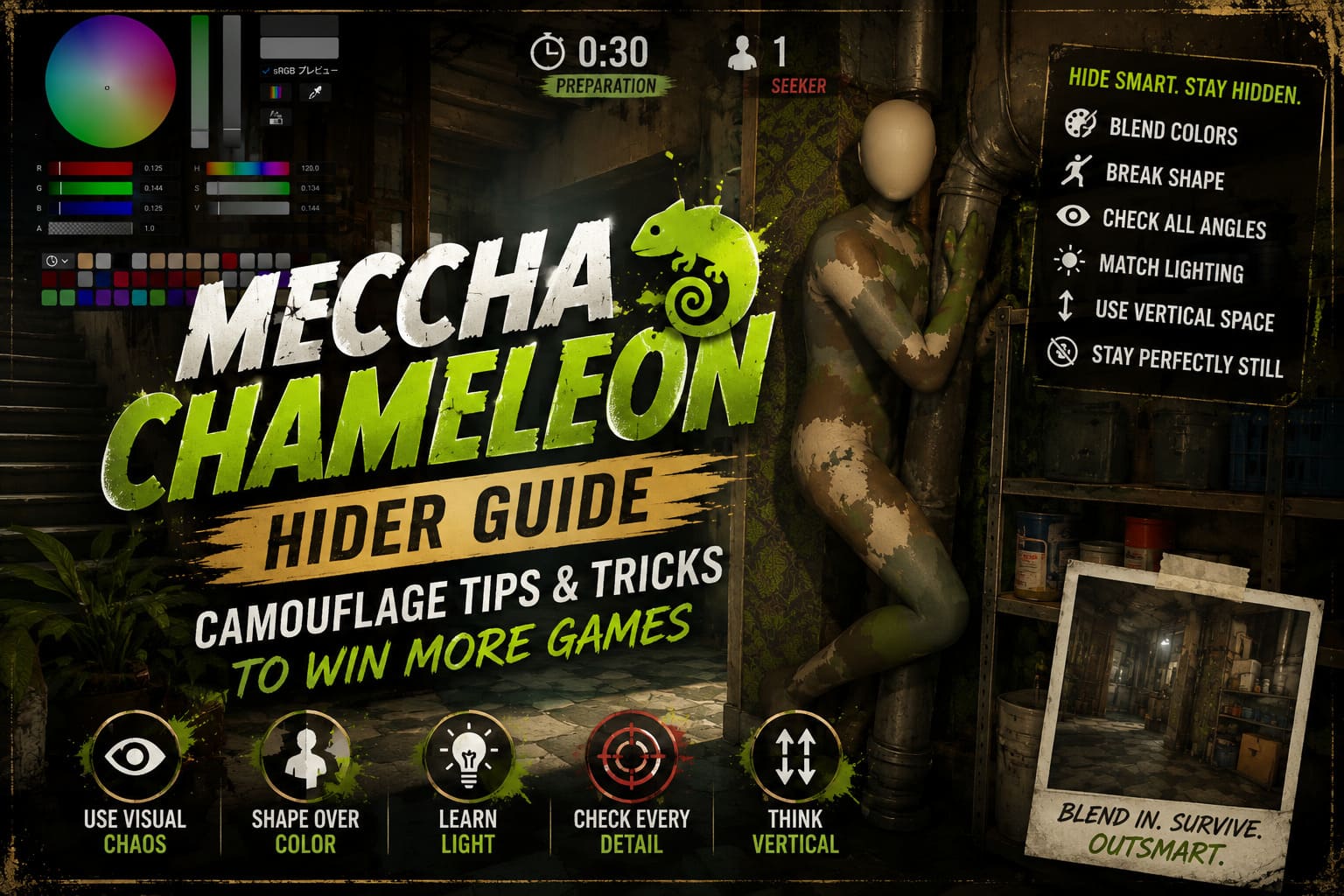
MECCHA CHAMELEON Hider Guide: Camouflage Tips and Tricks to Win More Games
When I first launched MECCHA CHAMELEON, I expected another fun little multiplayer party game that would keep me entertained for a few evenings before disappearing into my Steam backlog. After hundreds of hours spent across Prop Hunt clones, stealth games, survival titles, and competitive multiplayer experiences, I thought I had already seen every variation of the hide-and-seek formula imaginable.
I was wrong.
MECCHA CHAMELEON takes a familiar concept and transforms it into something surprisingly creative. Instead of becoming a chair, a lamp, or some random object scattered across the map, every player begins as the exact same white humanoid figure. The challenge is not choosing the right prop. The challenge is becoming the prop.
At first, the painting system looks like a simple gimmick. After a few matches, however, it becomes clear that the entire game revolves around understanding color, shape, lighting, positioning, and human psychology. The best hiders are not necessarily the fastest players. They’re the players who understand how people actually search for targets.
After spending countless matches experimenting with different strategies, observing skilled players, and testing risky hiding locations, I’ve found several techniques that dramatically increase survival rates.
Why Most New Hiders Get Eliminated So Quickly
The biggest mistake I see from beginners is treating MECCHA CHAMELEON like a traditional hiding game.
Most players immediately run around the map searching for some magical secret corner. They spend almost all of their preparation time exploring and then panic when they realize they still need to paint themselves.
The result is predictable.
The hunt begins and they’re standing there with unfinished camouflage, bright white limbs exposed, or a rushed paint job that looks convincing only from a single angle.
The preparation phase is actually one of the most important parts of every round.
My personal approach is simple:
- Find a general hiding zone immediately.
- Commit to a location quickly.
- Spend most of the remaining time refining camouflage.
- Use the final moments for inspection and adjustments.
A perfect hiding spot means nothing if your disguise isn’t finished.
Stop Hiding Against Plain Walls
This might be the most common trap in the game.
Many players find a flat gray wall, copy the color exactly, and assume they’re invisible.
In reality, flat surfaces often make detection easier.
Human vision naturally detects outlines and silhouettes. When your character stands against a clean, uniform background, even tiny imperfections become noticeable. Slight differences in lighting, shadows, or texture instantly reveal that something doesn’t belong.
I’ve survived significantly longer by doing the opposite.
Instead of choosing clean surfaces, I actively seek visual chaos.
Some of the best locations include:
- Crowded storage areas
- Kitchens packed with objects
- Industrial pipe sections
- Decorative walls
- Areas filled with mixed colors and shapes
Busy environments force seekers to process more visual information. That extra cognitive load creates opportunities for mistakes.
Shape Is More Important Than Color
This is the lesson that completely changed how I play.
Many players spend all their effort matching colors perfectly while completely ignoring their character’s shape.
The problem is that humans are incredibly good at recognizing human silhouettes.
Even if your colors are flawless, a standing human figure still looks like a standing human figure.
That’s why posing matters so much.
Whenever possible, I try to:
- Break the natural body outline.
- Create unusual angles.
- Mimic environmental objects.
- Blend limbs into nearby geometry.
A strange shape with slightly imperfect colors often survives longer than perfect colors wrapped around an obvious human figure.
Quick Comparison
| Strategy | Effectiveness | Difficulty | Recommended |
|---|---|---|---|
| Perfect Color Matching Only | Medium | Easy | No |
| Shape Manipulation Only | Medium | Medium | Sometimes |
| Color + Shape Combination | Very High | Medium | Yes |
| Random Hiding | Low | Easy | Never |
Learn to Paint Light, Not Just Surfaces
One thing I absolutely love about MECCHA CHAMELEON is how much lighting matters.
Most players sample a wall color and apply it across their entire body. Unfortunately, real environments don’t work that way.
Every room contains highlights, shadows, reflections, and directional lighting.
If a bright lamp illuminates one side of an area, your camouflage should reflect that.
When I started treating my character like a three-dimensional object instead of a painted mannequin, my survival rate noticeably improved.
I now look for:
Bright zones
- Lighter colors
- Reduced saturation
- Soft highlights
Shadow zones
- Darker shades
- Stronger contrast
- Deeper color tones
The goal is to make your model feel like it belongs inside the environment rather than sitting on top of it.
The Silent Killer: Unpainted Areas
If you’ve ever been discovered and had absolutely no idea why, there’s a good chance this was the reason.
Tiny white gaps are responsible for countless eliminations.
Common locations include:
- Elbows
- Knees
- Armpits
- Ankles
- Back of the neck
- Underside of feet
A camouflage job that looks perfect from the front may completely fall apart from the side.
Before every round starts, I always rotate my camera around my character and inspect every angle.
It takes only a few seconds and saves countless matches.
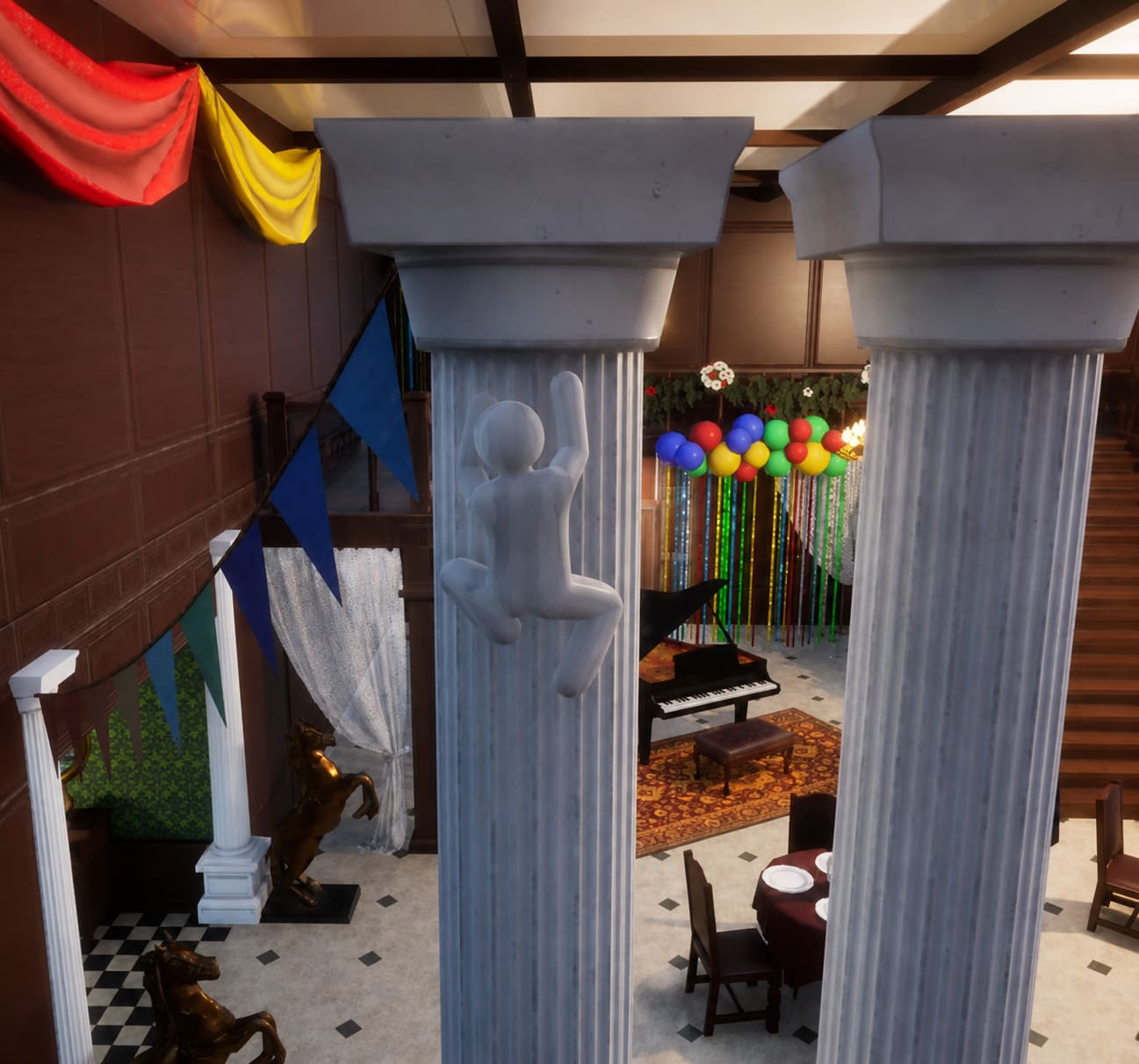
Vertical Hiding Is Criminally Underrated
One pattern I’ve noticed after watching many seekers is that most players search horizontally.
Their cameras stay near eye level.
This creates opportunities.
Some of my most successful hiding spots have been:
- Under furniture
- Low shelves
- Ceiling supports
- Structural beams
- Elevated ledges
- Hidden upper corners
Many seekers never fully check above or below their natural viewing angle.
Even average camouflage becomes significantly stronger when combined with unusual vertical positioning.
Understanding Seeker Psychology
Eventually, MECCHA CHAMELEON becomes less about camouflage and more about psychology.
The strongest hiding spots aren’t always the most hidden.
In fact, some of my best rounds happened in locations that seemed ridiculously obvious.
Why?
Because experienced seekers often overthink.
They expect players to hide in complicated places.
They expect secret corners.
They expect hidden rooms.
As a result, they sometimes ignore locations that are directly in front of them.
I call this the “too obvious” effect.
If your camouflage is exceptional, standing in plain sight can occasionally be safer than hiding in a dark corner.
It’s risky, but surprisingly effective.
Don’t Panic During Searches
This advice alone can dramatically improve survival.
When a seeker enters your room and starts shooting nearby, your instinct is to move.
Resist that urge.
Many seekers intentionally fire randomly into suspicious areas hoping to trigger panic reactions.
The moment you move, the hunt is over.
I’ve watched countless players reveal themselves simply because they became nervous.
If the seeker hasn’t actually identified you, staying perfectly still is usually the stronger decision.
Movement attracts attention far faster than imperfect camouflage.
Pattern Matching Wins Games
One advanced technique I rarely see beginners use involves continuing environmental patterns across your character.
For example:
- Tile floors
- Striped walls
- Checkered surfaces
- Decorative trim
Instead of simply matching colors, extend the existing design through your body.
A stripe should continue naturally across your arms.
A checkerboard pattern should remain aligned with the floor.
Broken patterns instantly attract attention because the human brain is extremely sensitive to inconsistencies.
When done correctly, pattern continuation can make a player almost disappear.
My Personal Hider Checklist
Before every round begins, I mentally review the same checklist:
- Did I choose a busy environment?
- Does my pose break the human silhouette?
- Have I checked every angle for white gaps?
- Does my lighting match the room?
- Am I using vertical space effectively?
- Does my camouflage blend with nearby patterns?
- Am I prepared to stay perfectly still if a seeker approaches?
Following these steps consistently has improved my performance more than any single trick or exploit.
MECCHA CHAMELEON Strategy Guide: How to Win as Hider and Seeker (2026)
Final Thoughts
MECCHA CHAMELEON succeeds because it rewards creativity instead of memorization. Unlike many multiplayer games where success comes from mechanical skill alone, this game constantly encourages experimentation, observation, and adaptation.
After spending a significant amount of time with the game, my biggest takeaway is simple: the best hiders don’t think like players. They think like environmental artists.
Every wall, shelf, shadow, texture, and light source becomes part of a larger puzzle. The players who understand that concept quickly evolve from easy targets into nearly invisible masters of deception.
If you’re tired of getting discovered within the first minute, stop focusing exclusively on colors. Study shapes. Study lighting. Study human behavior. The moment you start blending all three together, MECCHA CHAMELEON becomes a completely different game—and surviving until the end of the round suddenly feels far more achievable.