Is Sally Face Episode 1 Worth Playing in 2026? Retro Review and Status Report
I spend a ridiculous amount of time playing games. Give me a huge modern release with a massive world, ray tracing, cinematic animation, and enough visual effects to make my graphics card question its life choices, and I’m usually happy.
So when I went back to Sally Face Episode 1 in 2026, I honestly expected it to feel like a product from another era.
It didn’t.
If anything, the contrast was almost funny. After spending hours in enormous modern games that sometimes look indistinguishable from each other, here comes this strange little 2D adventure about a blue-haired kid wearing a creepy prosthetic face, wandering around a miserable apartment building.
And somehow, it has more personality than a lot of games that cost ten times as much to make.
That is probably the biggest reason I think Sally Face Episode 1 is still worth playing in 2026.
It isn’t technically impressive by today’s standards. It doesn’t try to compete with modern blockbusters. Instead, it has something much harder to manufacture: a very specific identity.
What Exactly Is Sally Face Episode 1?
For anyone coming to the series for the first time, Episode 1, “Strange Neighbors,” is the opening chapter of the Sally Face story.
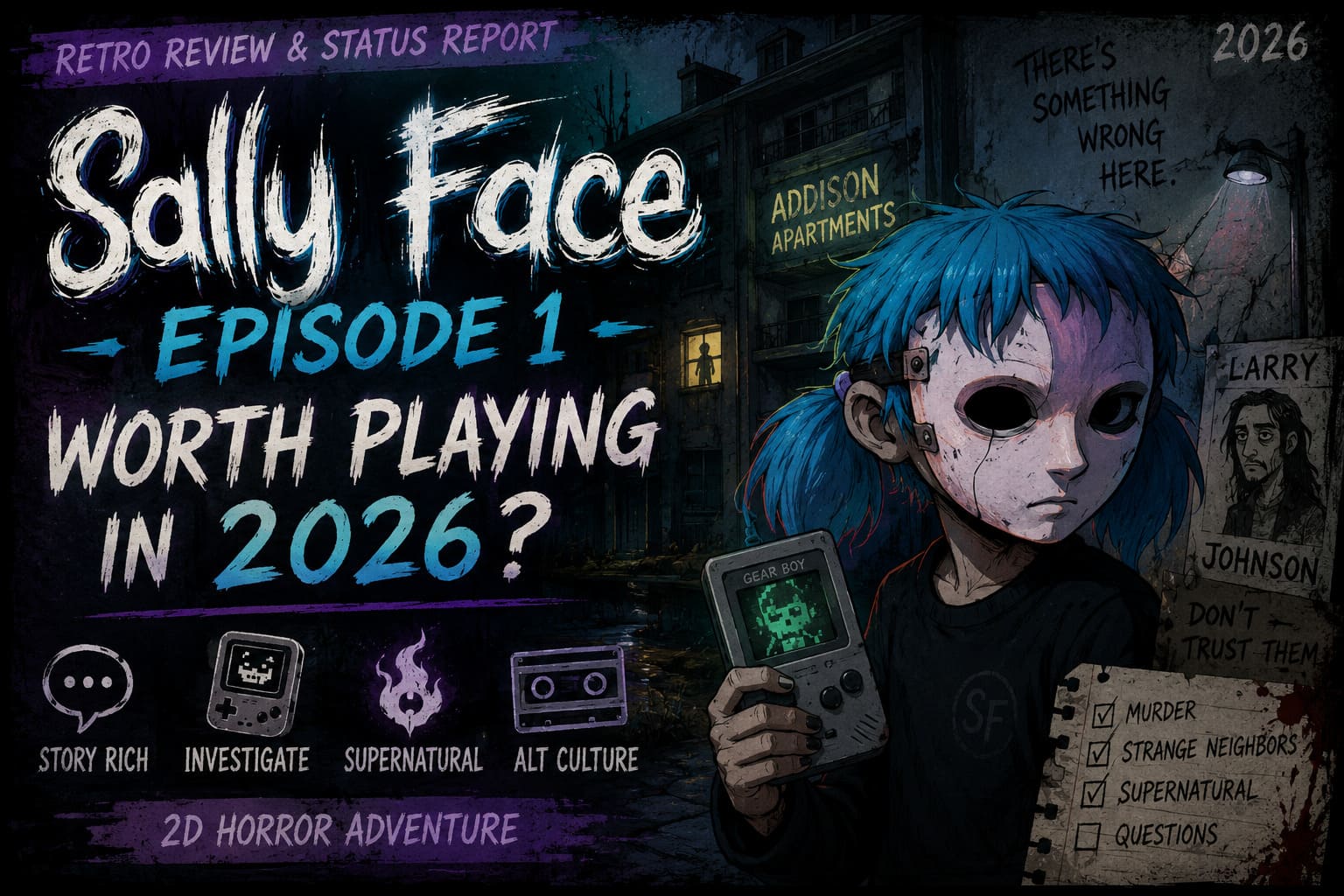
You play as Sal Fisher, a young boy who wears a distinctive prosthetic mask after suffering a traumatic event in his childhood. Sal and his father move into the strange Addison Apartments, where Sal quickly discovers that the building is anything but normal.
There’s a murder.
There are suspicious neighbors.
There are supernatural elements.
And then there’s Larry Johnson, one of the best characters introduced in the first episode and easily the person I was most interested in whenever he appeared on screen.
The important thing is that Episode 1 isn’t trying to explain everything.
It’s basically the game’s way of saying:
“Here are some weird people, some disturbing things, and a bunch of questions. Good luck.”
And honestly? I love that approach.
My Quick Rating
| Category | My Score |
|---|---|
| Story & Atmosphere | 9/10 |
| Visual Style | 9/10 |
| Music & Sound | 9/10 |
| Gameplay | 7/10 |
| Replay Value | 7/10 |
| Overall | 8.5/10 |
The numbers aren’t scientific, obviously. This is a streamer review, not a laboratory experiment. But they reflect how I felt after playing it again.
The Art Style Has Aged Better Than I Expected
This was probably my biggest surprise.
Usually, when I revisit an older indie game, I can immediately see where the years have been unkind. Resolution, animation, interfaces, lighting and character models can make something feel much older than it actually is.
Sally Face doesn’t really have that problem because its rough, hand-drawn presentation is part of the point.
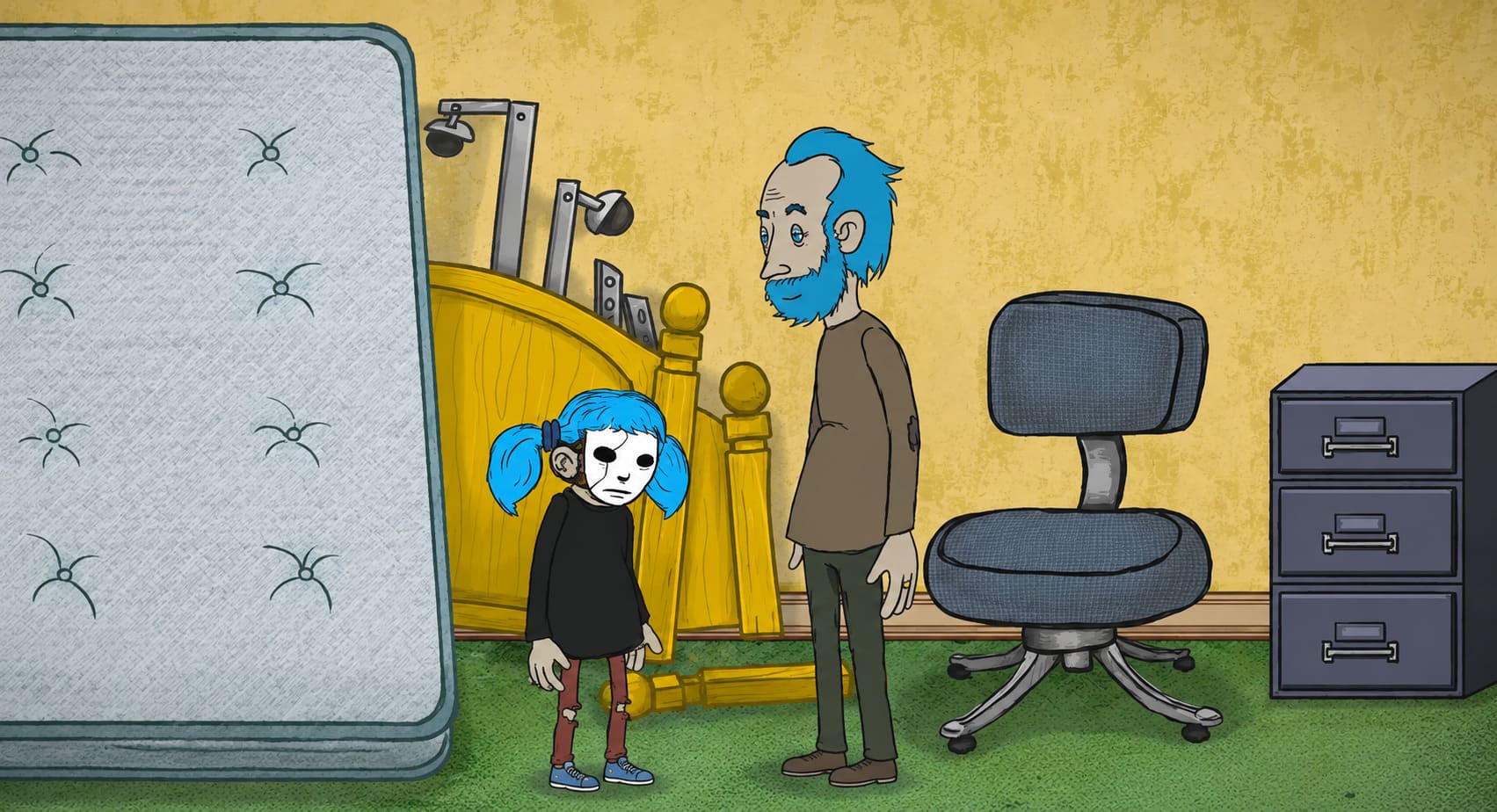
The characters look strange.
The environments look grimy.
The colors are deliberately muted.
And almost everything has this slightly uncomfortable feeling, like you’re looking at a cartoon that shouldn’t exist in a children’s television block.
Sal himself is obviously the centerpiece. The blue hair and pale mask create an instantly recognizable silhouette, and the mask gives him an unsettling appearance without making him feel like a conventional horror protagonist.
That’s important.
Sal isn’t some macho action hero walking into a haunted building with a shotgun.
He’s just a kid trying to understand what’s happening around him.
That makes the disturbing moments hit differently.
And in 2026, I actually think the visual style works better than it did when the game was surrounded by other indie releases using similar technology.
Modern graphics have become so polished that an intentionally rough visual style can be incredibly refreshing.
Sally Face doesn’t look expensive.
It looks authored.
There’s a difference.
The Music Does More Work Than You Might Expect
I also have to talk about the soundtrack because it deserves more attention.
The music gives Sally Face a very particular underground feeling. There’s an obvious connection to alternative and metal culture, especially through characters like Larry, and the soundtrack helps establish the world without constantly screaming “THIS IS HORROR.”
That’s something I appreciate.
A lot of horror games rely on predictable tricks. Quiet room. Strange noise. Loud sting. Monster.
Sally Face is more interested in creating a mood.
You’ll spend time walking through an apartment building while music and environmental sounds make the place feel increasingly uncomfortable. Then you’ll have a conversation with a character, and suddenly the game feels almost like a strange coming-of-age story.
That tonal shift is one of its strengths.
It’s creepy, but it’s also weirdly cozy at times.
And then it reminds you that something is seriously wrong.
That balance is difficult to get right.
The Gameplay Is Simple — Maybe Too Simple
Now for the part where I stop praising everything.
Sally Face is not mechanically sophisticated.
If you’re expecting a modern adventure game with deep systems, sophisticated stealth, combat, physics puzzles, or dozens of branching gameplay mechanics, you’re going to be disappointed.
The basic formula is straightforward:
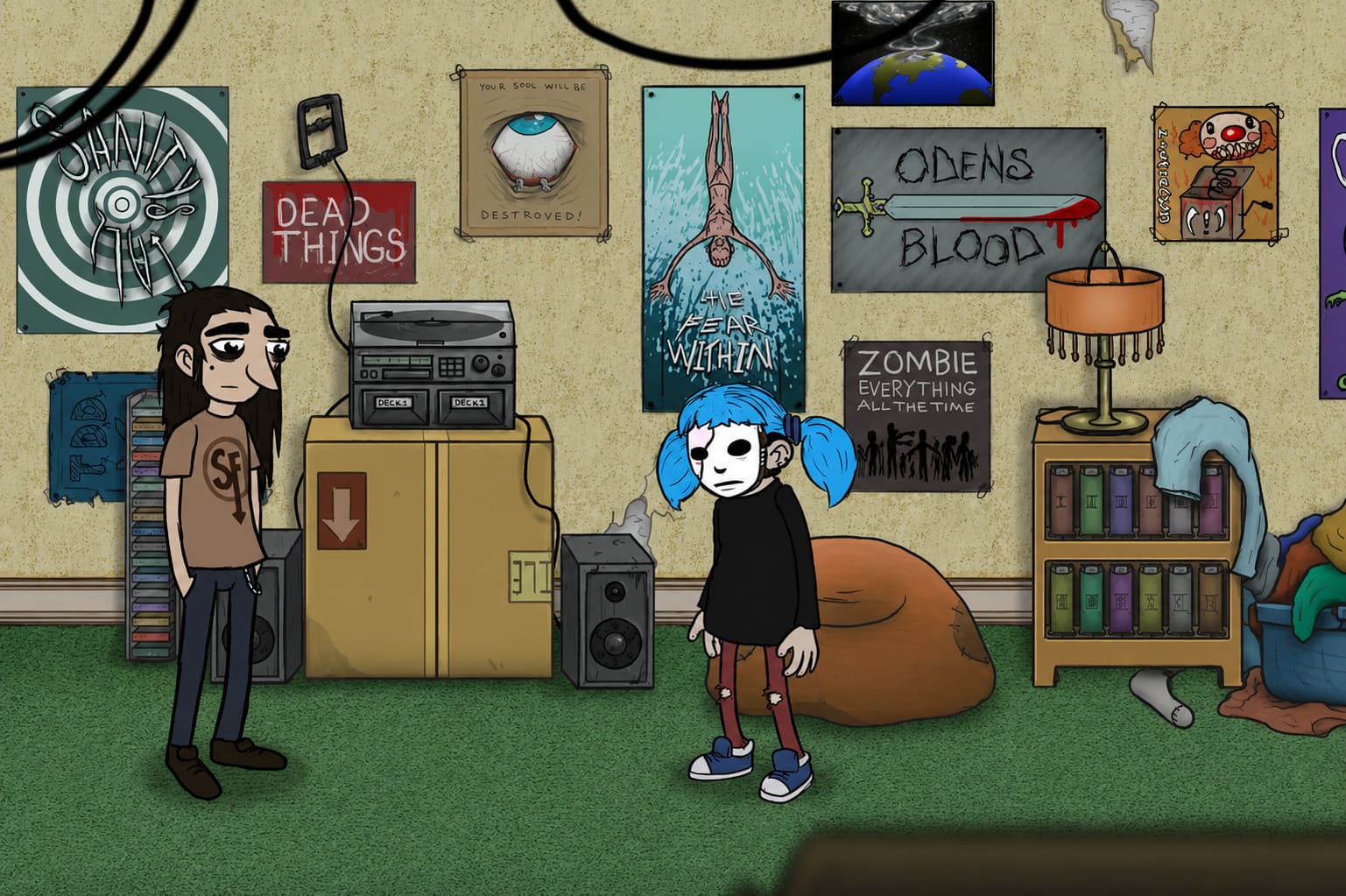
- Explore the apartment complex.
- Talk to characters.
- Examine objects.
- Collect items.
- Use items in the right places.
- Investigate strange events.
- Discover more of the story.
That’s basically it.
For me, that’s perfectly acceptable because the story is clearly the priority.
But I can absolutely understand someone playing it in 2026 and thinking, “That’s it?”
The game also doesn’t always hold your hand. Some of the optional interactions and hidden details require curiosity rather than simply following the obvious objective.
And that’s where I think the game becomes much more interesting.
If you rush through it, you’ll get the basic story.
If you poke around, revisit areas and talk to people more than once, you start noticing the little pieces that make the world feel larger.
The Gear Boy Is One of My Favorite Ideas
One of the coolest concepts introduced in Episode 1 is Sal’s Gear Boy, a modified handheld gaming device that can interact with supernatural elements.
It’s a great example of Sally Face taking something familiar and turning it into something unsettling.
A handheld console normally means fun.
Here, it becomes a tool for investigating paranormal activity.
There are also retro-style minigames connected to it, which fit the game’s aesthetic surprisingly well.
It isn’t some revolutionary gameplay system, but it gives the episode another layer of personality.
And that’s really what Sally Face does best.
It takes ordinary things and makes them feel slightly wrong.
The Biggest Problem: Episode 1 Is Very Short
Here’s the catch.
You can finish Episode 1 pretty quickly.
For a player who focuses on the main path, you’re looking at roughly one to two hours depending on your pace and how much you explore.
Personally, I don’t see that as a major negative.
I’d rather play a focused two-hour experience that leaves an impression than spend fifteen hours completing meaningless objectives.
But there is one problem.
The episode ends right when you’re starting to get invested.
That’s intentional, of course. Sally Face was designed as an episodic story, so Episode 1 is effectively the opening chapter rather than a complete standalone narrative.
Still, if you buy it expecting a full horror adventure, you might finish it and immediately think:
“Wait… that’s where we’re stopping?”
Yes.
That’s where we’re stopping.
And if you like the characters and mystery, you’ll probably want to continue immediately.
Is Sally Face Actually Scary?
This is another area where I’d set expectations.
I wouldn’t describe Sally Face Episode 1 as a traditional horror game.
There isn’t constant danger. You’re not spending the entire game running away from monsters. It doesn’t rely on combat or jump scares to keep you nervous.
I’d call it psychological and atmospheric horror.
The unsettling part comes from the characters, the implications behind certain events, the strange imagery, and the feeling that something is wrong beneath the surface.
It’s closer to the kind of horror that makes you curious than the kind that makes you throw your controller.
And personally, that’s my preferred type.
The game wants you to ask questions.
Why is this happening?
Who can Sal trust?
What’s really going on in the building?
What are these supernatural events connected to?
And, perhaps most importantly, how much of what you’re seeing should you actually believe?
Those questions are what kept me playing.
Why It Still Works In 2026
Here’s the interesting part.
If Sally Face were released today with completely different graphics, it might actually lose some of what makes it memorable.
The roughness is part of its charm.
The strange character designs are part of its charm.
The awkward environments are part of its charm.
The uncomfortable soundtrack is part of its charm.
In an industry where games are becoming increasingly expensive and visually spectacular, Sally Face is a reminder that presentation doesn’t have to mean graphical realism.
A strong art direction can last longer than cutting-edge technology.
And I think that’s why the game continues to attract new players years after its original release.
You can look at a screenshot of Sally Face and immediately know what game you’re looking at.
That’s valuable.
Who Should Play Sally Face Episode 1?
I’d recommend it if you enjoy:
- Psychological or atmospheric horror
- Story-heavy indie games
- Point-and-click adventures
- Distinctive hand-drawn art
- Strange characters and mysteries
- Games where exploration and dialogue matter more than action
- Titles like Undertale, OMORI, or Night in the Woods
I’d be more cautious if your favorite games are primarily about combat, exploration on a massive scale, or complicated gameplay systems.
This is a story-first experience.
The gameplay supports the narrative rather than competing with it.
My Biggest Advice: Don’t Rush It
If you decide to play Sally Face Episode 1, don’t treat it like a checklist.
Don’t just run from objective marker to objective marker.
Talk to people.
Look around.
Interact with things that seem insignificant.
Pay attention to the dialogue.
Try the Gear Boy.
Explore the apartment.
The first time I played it, the biggest appeal wasn’t necessarily solving the central mystery. It was seeing how all these strange little details connected.
That’s the kind of game Sally Face is.
It rewards curiosity.
And because Episode 1 is short, there’s really no reason to rush through it.
Final Verdict: Should You Play Sally Face Episode 1 In 2026?
Absolutely.
I came back to Sally Face expecting nostalgia to do most of the work.
Instead, I found a game that still has a remarkably strong identity.
It’s short. It’s weird. Its gameplay is basic. Some of its controls and interactions can feel dated. And the ending practically demands that you continue into the next chapter.
But none of those things erase what makes the game special.
Sally Face Episode 1 has personality.
That’s the word I’d use above everything else.
I’ve played technically incredible games that I forgot about a week later. Sally Face isn’t like that. Its characters, art style, music and unsettling atmosphere stick in your head.
And that’s an achievement.
If you’re coming to the game for the first time in 2026, don’t expect a modern AAA horror experience. Don’t expect cutting-edge graphics or complex mechanics.
Instead, expect a short interactive graphic novel with a creepy sense of humor, memorable characters, a surprisingly effective soundtrack, and a mystery that gets considerably stranger the deeper you go.
For me, Episode 1 is still an easy recommendation.
It’s not the biggest game.
It’s not the most technically impressive game.
It isn’t even the most mechanically ambitious indie adventure I’ve played.
But after all these years, I can still remember the feeling of walking through Addison Apartments and thinking:
“Okay… something here is seriously not right.”
And honestly, that’s exactly the feeling a game like Sally Face should leave you with.
Final Score: 8.5/10
If you’re a fan of story-driven indie horror and you’ve somehow never played Sally Face, 2026 is a perfectly good time to finally see what all the weirdness is about.