Hell Let Loose Vietnam vs Arma Reforger: Which Hardcore Tactical Shooter Wins in 2026?
If you have spent enough time with hardcore shooters, you eventually learn one uncomfortable truth: “realistic” can mean completely different things depending on the game. One title might throw you into a massive firefight where every squad has a job and every death hurts, while another can make you spend twenty minutes moving ammunition before you even see the enemy. That difference is exactly what makes Hell Let Loose: Vietnam and Arma Reforger such an interesting comparison.
Both games are built around teamwork, communication, lethal gunfights, vehicles and the general idea that running around like a one-man action hero is a fantastic way to get shot. But their gameplay loops are miles apart. After playing plenty of tactical shooters over the years, I would not tell someone that one is simply “better.” The more useful question is: what kind of military shooter do you actually want to play?
Hell Let Loose Vietnam Stuttering Fix: Best Graphics Settings for High FPS and Visibility
Hell Let Loose: Vietnam Wants You in the Fight
Hell Let Loose: Vietnam takes the familiar structure of the franchise and moves it into one of the most difficult environments imaginable for a military shooter: the jungles, rivers, rice paddies and muddy battlefields of Vietnam. Expression Games is working with Unreal Engine 5, and the goal is pretty obvious from the moment you look at the game’s battlefield design. This is not supposed to feel like a clean arena where you can easily understand where every enemy is coming from.
The jungle is supposed to make you nervous. You can hear something moving through vegetation, catch a glimpse of a muzzle flash, and suddenly the entire squad is pinned down by fire that seems to be coming from nowhere. Personally, that’s one of the things I find most appealing about the Vietnam setting. It creates a completely different rhythm from the open European battlefields associated with the original Hell Let Loose.
The American side gets access to overwhelming firepower, helicopters and river-based assets, while the NVA relies much more heavily on concealment, mobility and knowledge of the terrain. That asymmetry is important because it prevents both sides from simply feeling like cosmetic variations of the same army.
The tunnel system is particularly interesting. Instead of treating the map as a collection of obvious routes between objectives, underground positions can create opportunities for surprise attacks and unexpected flanks. A squad that assumes the enemy is trapped in front of them can suddenly discover that someone has appeared behind their position.
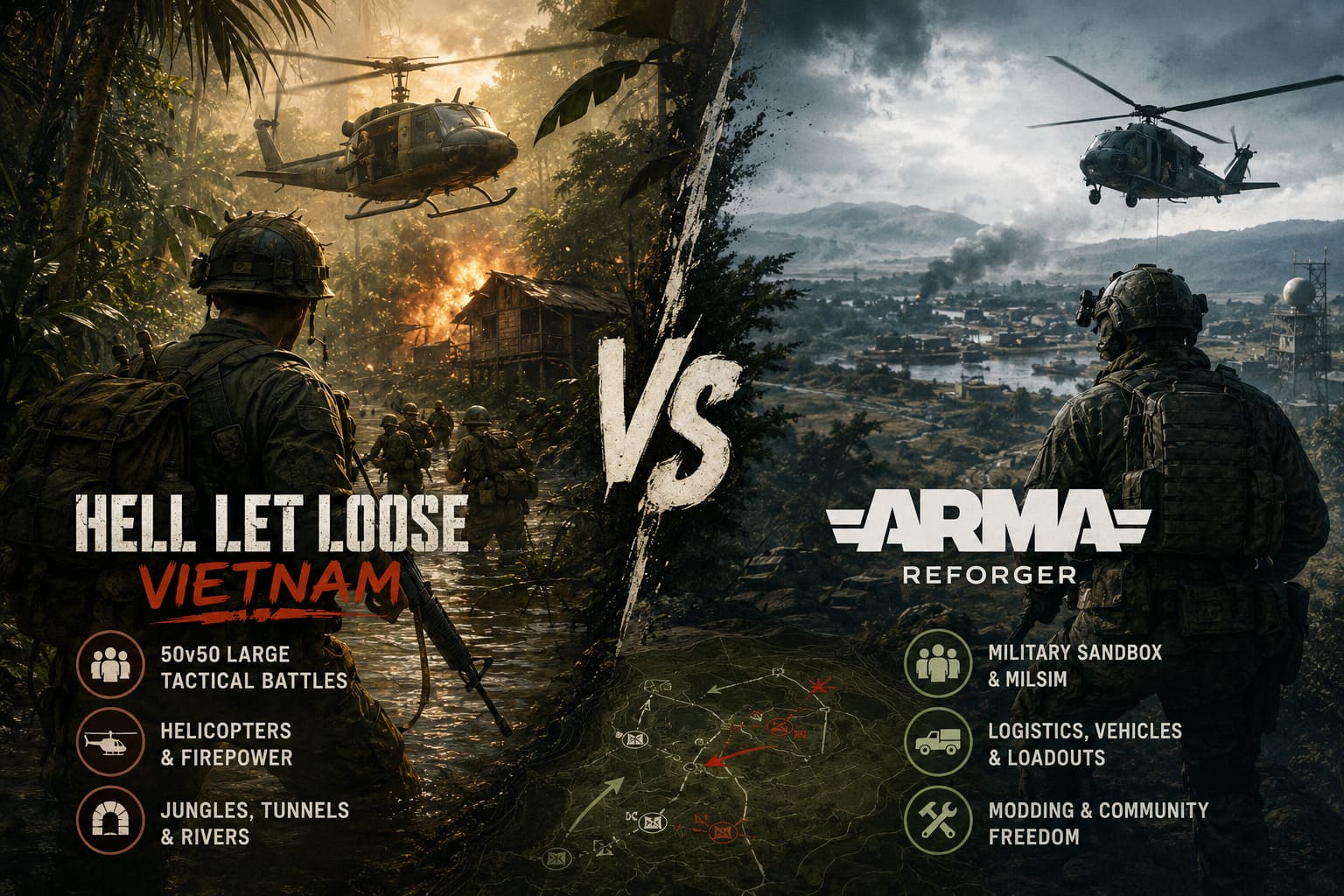
Why the 50v50 Structure Works
The biggest strength of Hell Let Loose: Vietnam is its ability to create huge battles without turning every match into complete chaos. With large teams divided into specialized roles and squads, you usually know what your immediate objective is. Squad leaders, commanders, support players and combat roles all contribute to the larger battle rather than simply competing for kills.
That structure also makes the game easier to approach than a full military simulation. You still need communication and map awareness, but you don’t need a private military handbook beside your keyboard. When your squad establishes a good forward spawn and starts pushing through a contested area, the game can produce some ridiculously tense moments.
And yes, sometimes you will spend five minutes crawling through mud just to get deleted by someone you never saw. That’s part of the package.
Arma Reforger Is Playing a Completely Different Game
Arma Reforger comes from a different school of thought. Bohemia Interactive’s military sandbox is less interested in delivering a perfectly controlled multiplayer match and much more interested in giving players the tools to create their own battles.
That distinction becomes massive once you start playing seriously. Reforger doesn’t feel like a traditional shooter with some simulation mechanics attached. It feels like a military sandbox that happens to contain shooting. You can organize logistics, move supplies, establish positions, coordinate vehicles, operate aircraft and spend an absurd amount of time planning an assault that might last only a few minutes once the bullets start flying.
That sounds slow because it is slow. But for the right player, that slowness is the entire point.
Vietnam content also benefits enormously from the game’s modding ecosystem. Instead of being locked into one historical interpretation, players can jump between community-created scenarios and servers that radically change the experience. One evening can involve Vietnam-era combat, while the next can put you into an entirely different military setting.
Gameplay Pacing: One Hour of Hell or Three Hours of War?
This is where I think the choice between the two games becomes much easier.
Hell Let Loose: Vietnam respects your time more. You join a server, choose a role, find your squad and immediately have a clear idea of what you’re supposed to accomplish. Matches can still become exhausting, especially when both teams are locked around the same objective, but the overall experience has a defined beginning, middle and end.
The spawn system also keeps the action moving. Outposts and Garrisons allow squads to return to the battlefield without turning every death into a logistics exercise. You still need to protect those positions, but the game wants you back in the fight.
Reforger is far less forgiving about this. If your squad pushes too far without proper logistics, you’re going to feel it. If the nearest transport is miles away, you may genuinely spend a significant chunk of your session just getting back to the fight.
For some players, that would be enough to uninstall the game. For milsim fans, it’s exactly what makes a successful operation feel meaningful.
| Feature | Hell Let Loose: Vietnam | Arma Reforger |
|---|---|---|
| Core Experience | Hardcore Tactical Shooter | Military Sandbox / Milsim |
| Typical Pacing | Fast To Moderate | Slow And Methodical |
| Battle Structure | Large Structured Matches | Open-Ended Operations |
| Squad Coordination | Extremely Important | Essential For Serious Operations |
| Logistics | Important But Streamlined | Deep And Often Essential |
| Modding | More Controlled | Major Part Of The Experience |
| Best For | Players Wanting Intense Tactical Battles | Players Wanting Full Military Simulation |
Weapons, Vehicles and the Feeling of Combat
There is something satisfying about how Hell Let Loose handles battlefield chaos. The combination of squad communication, artillery, aircraft and infantry creates constant pressure. In Vietnam, helicopters add another layer to that formula because they aren’t simply vehicles you look at from a distance. Their ability to move troops around the battlefield can completely change how an attack develops.
River combat also gives the game another tactical dimension. Waterways aren’t just pretty scenery. They can become transportation routes, dangerous chokepoints and places where a poorly planned movement turns into a shooting gallery.
Arma Reforger has a different kind of satisfaction. Its equipment feels more like part of a larger military system. You aren’t simply choosing a weapon because its stats are good. Your loadout, ammunition, equipment weight and transportation can all affect what you are capable of doing.
That extra friction is something I genuinely appreciate in Reforger, although I wouldn’t pretend it is for everyone. Sometimes I want to spend an evening carefully organizing an operation with friends. Other times I have an hour after work and just want to grab a rifle and get into a firefight. That’s where Hell Let Loose: Vietnam has the advantage.
Atmosphere: Vietnam Is All About Fear of the Unknown
Audio can make or break a tactical shooter, and Vietnam is an especially demanding setting. The soundscape needs to make players feel surrounded rather than simply informed about what is happening.
Helicopter engines, automatic rifle fire, explosions and distant combat create a battlefield that can feel completely out of control. Dense vegetation makes visual information unreliable, which means sound becomes part of your survival toolkit. You start paying attention to direction, distance and weapon signatures almost without realizing it.
Reforger approaches atmosphere differently. Its large environments and lighting systems can create incredibly convincing moments when weather, time of day and terrain all line up. A patrol through a forest at night can feel completely different from an afternoon assault across an open area.
I’ve always liked games that don’t constantly throw information at the player, and Reforger is particularly good at this. You can look across a field and genuinely have no idea whether that tiny movement in the distance is a teammate, an enemy or a bush moving in the wind.
Performance and Community Matter More Than People Think
A tactical shooter can have brilliant mechanics and still lose players if performance gets in the way. Large multiplayer battles put serious pressure on CPUs, GPUs and servers, so optimization is especially important in this genre.
Hell Let Loose: Vietnam uses Unreal Engine 5 and has the advantage of a clearly defined multiplayer framework. The established structure of the franchise also gives players a familiar ecosystem of public servers, organized groups and experienced squad leaders.
Reforger has improved considerably through ongoing updates, and its community is one of its strongest assets. The modding scene adds a ridiculous amount of replay value. When you’re bored with one scenario, you don’t necessarily need another game. You can often find an entirely different experience inside Reforger itself.
That’s a huge reason why I keep coming back to sandbox-driven games. A traditional multiplayer title gives you content. A good sandbox gives the community tools and lets players create the content themselves.
Which Tactical Shooter Should You Choose?
If you want structured multiplayer warfare, intense firefights, clear objectives and large-scale team battles, Hell Let Loose: Vietnam makes more sense. It gives you the feeling of fighting in a huge military operation without requiring you to treat every gaming session like a weekend-long military exercise.
If you want freedom, logistics, long-range engagements, detailed loadouts and unpredictable player-created operations, Arma Reforger is the stronger choice. It has a much higher learning curve, but the payoff can be incredible when a coordinated operation actually works.
For me, these games aren’t really competitors in the traditional sense. They scratch different itches. Hell Let Loose: Vietnam is the game I’d launch when I want a brutal, cinematic tactical battle where everyone has a job and the front line is constantly moving. Arma Reforger is what I’d pick when I want to disappear into a military sandbox for an evening and see what kind of ridiculous story the players create.
And honestly, that’s probably the best outcome for tactical shooter fans. We don’t need every military game to play the same way. Give me one game that delivers an explosive 50v50 jungle battle and another where my squad can spend twenty minutes arguing about ammunition before getting ambushed by a helicopter. Both experiences have their place.
Quick Verdict
| If You Want… | Pick |
|---|---|
| Large Structured Battles | Hell Let Loose: Vietnam |
| Deep Military Simulation | Arma Reforger |
| Faster Access To Combat | Hell Let Loose: Vietnam |
| Massive Sandbox Freedom | Arma Reforger |
| Community-Created Experiences | Arma Reforger |
| Focused Vietnam Warfare | Hell Let Loose: Vietnam |
My pick for most players: Hell Let Loose: Vietnam. My pick for hardcore milsim veterans: Arma Reforger. If you already know that you enjoy the slow burn of military simulation, Reforger can consume an absurd number of hours. If you want the same tactical tension in a more approachable package, Hell Let Loose: Vietnam is the easier recommendation.