WARDOGS Economy Guide: How to Buy Weapons, Manage the Buy Menu, and Build Meta Loadouts (2026)
There are a lot of things I expected from WARDOGS, but becoming financially responsible was definitely not one of them.
After spending enough time getting dropped out of helicopters, losing expensive rifles to a sniper I never saw, and repeatedly telling myself that this time I would actually play carefully, I finally started taking the game’s economy seriously. And honestly, it changes the entire experience.
WARDOGS doesn’t treat weapons and equipment like disposable loadout slots. Your gear has a price, your ammunition has a price, your armor has a price, and dying with everything equipped means watching that investment disappear. It creates a weird but surprisingly satisfying tension: sometimes the smartest weapon is the one you can afford to lose.
That’s why this WARDOGS economy guide isn’t just about which guns are strongest. It’s about understanding the buy menu, knowing when to spend, when to save, and how to build a loadout that won’t destroy your bank account after two bad deployments.
How the WARDOGS Economy Actually Works
The first mistake I made was assuming that leveling up automatically meant I could use everything I unlocked.
It doesn’t.
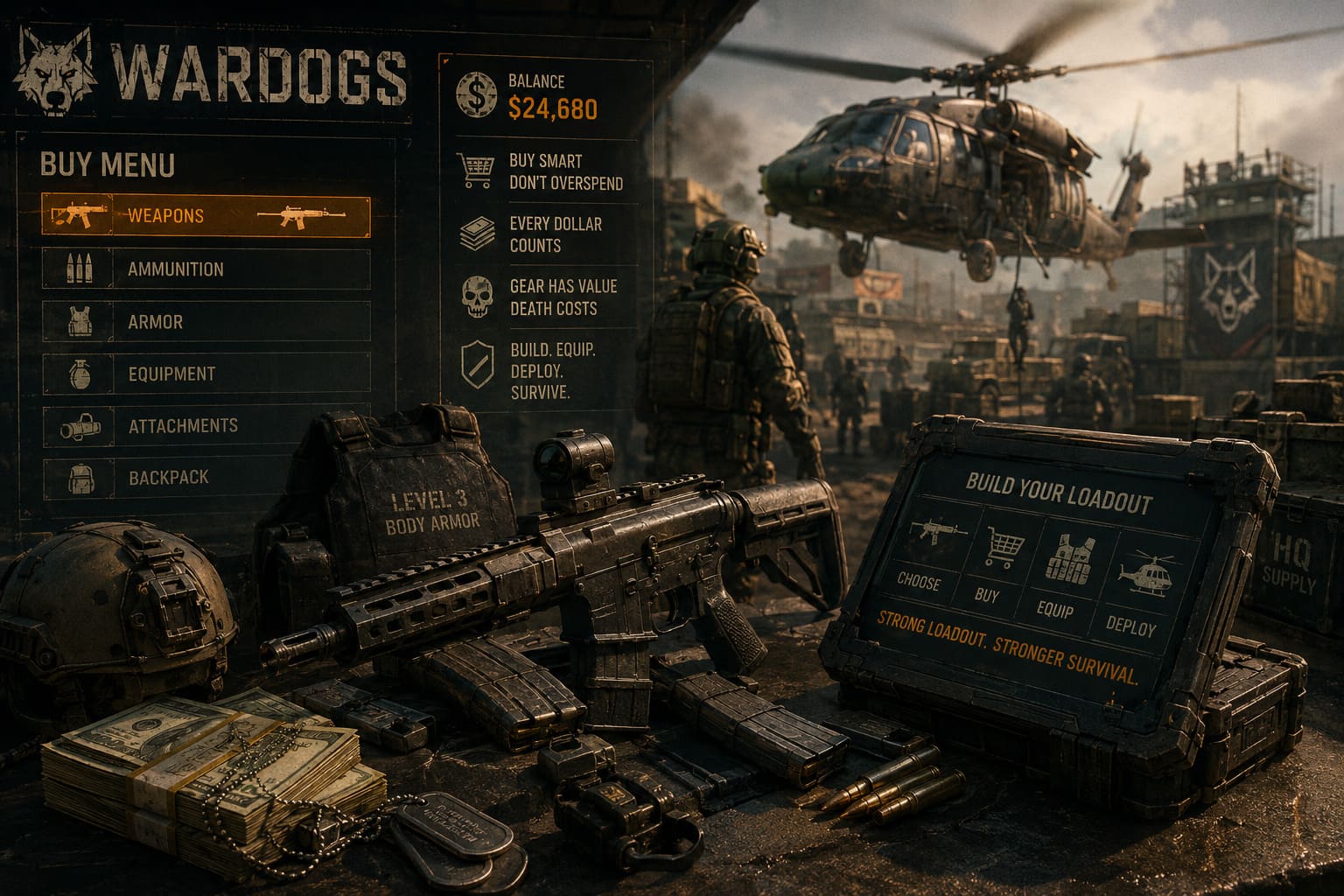
WARDOGS effectively makes you pass through two gates before certain equipment becomes part of your regular purchasing options.
The first is progression. Weapons, armor, ammunition and equipment can be locked behind your overall level or a specific class progression path. Assault, Medic, Support and Recon all have their own progression considerations.
The second gate is the cash unlock.
Even after reaching the required level, some equipment requires a permanent one-time payment before you can purchase it during deployments. After that, you still pay the normal deployment cost whenever you actually take the item into battle.
That distinction is extremely important because your bank balance isn’t just spending money. It’s also your insurance policy against a bad streak.
| Economy Element | What It Means | My Advice |
|---|---|---|
| Progression Level | Determines which equipment becomes available | Keep leveling naturally |
| Permanent Unlock | One-time payment to access certain gear | Don’t rush expensive unlocks |
| Deployment Cost | Money spent on your current kit | Keep a reserve |
| Death | Your deployed investment is lost | Don’t overspend when broke |
Death Is the Real Tax
This is probably my favorite part of the WARDOGS economy, even though it has personally punished me more times than I’d like to admit.
Imagine spending around $20,000 on a rifle, optics, armor, ammunition and attachments. You feel like a walking tank.
Then you get shot 15 seconds after leaving base.
Gone.
That makes expensive equipment feel meaningful. In most shooters, losing a fight means waiting for respawn. In WARDOGS, losing a fight can also mean losing your financial ability to fight the next one properly.
That’s why I wouldn’t recommend spending your entire balance just because you can afford a shiny new weapon.
Mastering the WARDOGS Buy Menu
The buy menu can feel unnecessarily complicated at first. I remember clicking around wondering why buying a simple magazine felt like I was navigating an accounting application.
Once you understand the structure, though, it becomes much faster.
Your faction’s main HQ is where you’ll normally prepare your equipment. Find the equipment vendor and interact with it to begin building your deployment kit.
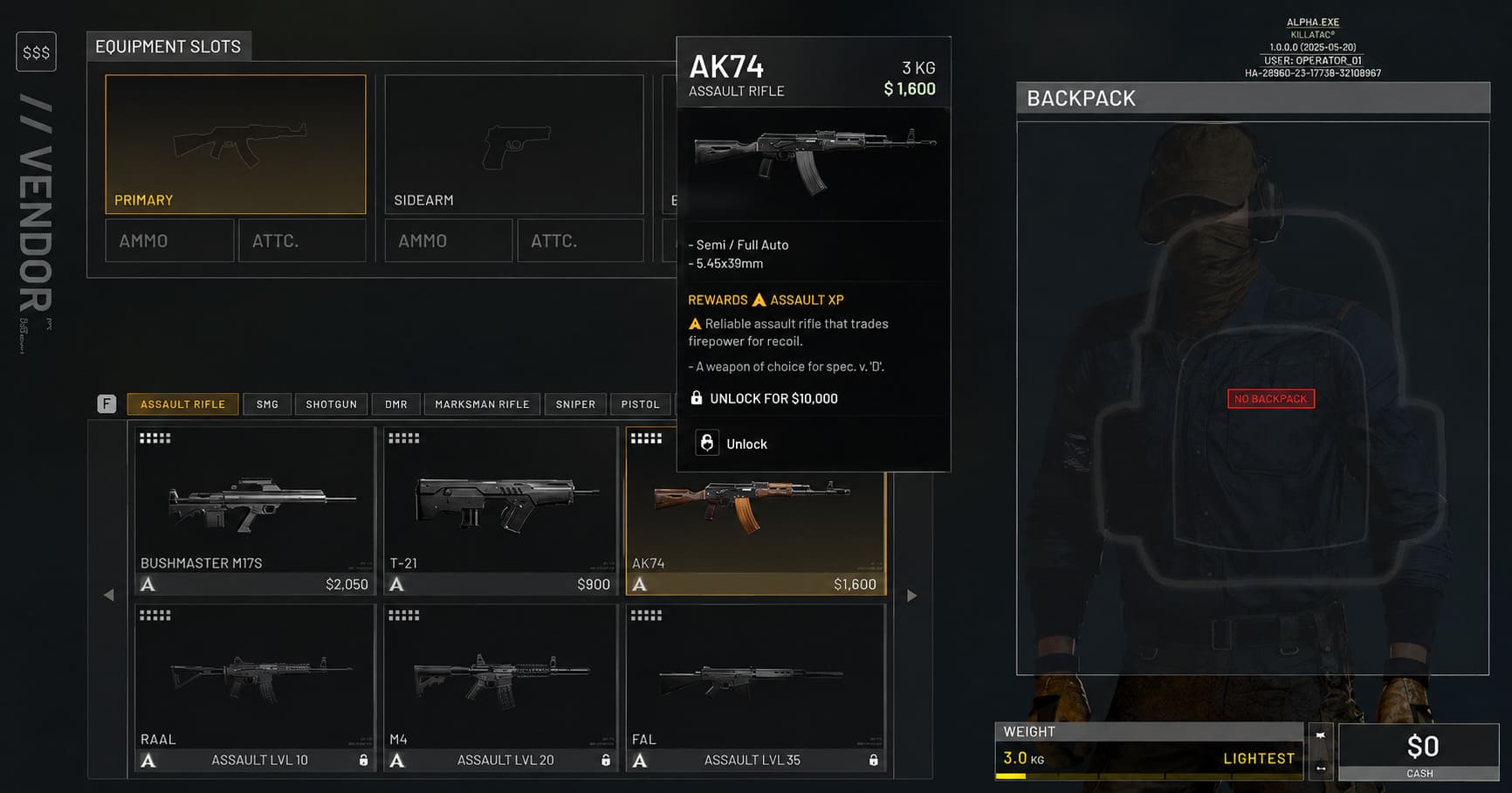
The process generally flows something like this:
- Select your weapon category.
- Pick the specific firearm you want.
- Choose the compatible magazine.
- Select your ammunition type.
- Purchase additional magazines individually.
- Put those magazines into your backpack storage.
- Configure attachments.
- Select your helmet and body armor.
- Check the final cost before deploying.
The magazine system is particularly easy to overlook.
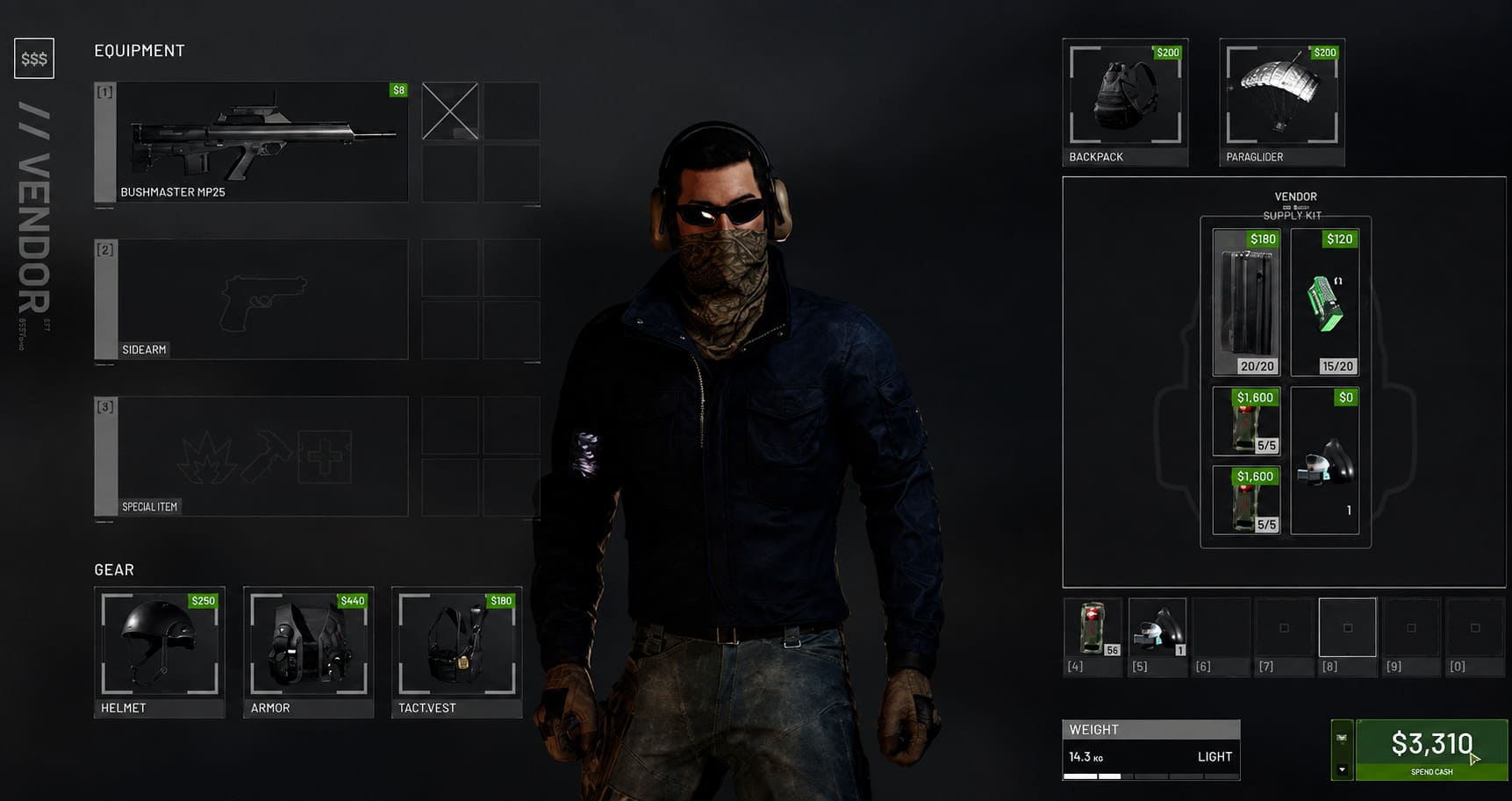
Buying a weapon doesn’t magically give you a bottomless supply of ammunition. You need to purchase the physical magazines you’ll actually carry. If you’re heading into a prolonged fight with only the magazine in your weapon, you’re basically volunteering to reload your entire financial plan halfway through the firefight.
I usually prefer carrying two or three spare magazines at minimum, depending on the weapon and role.
And yes, make sure they actually fit inside your backpack.
It sounds obvious, but WARDOGS has a way of making you learn these lessons while bullets are already flying.
Quick Rebuy Is Your Best Friend
One of the most useful features for anyone who dies frequently — so, basically every WARDOGS player eventually — is the Quick Rebuy / Rebuy Last Loadout functionality available through the vendor interface in current builds.
Instead of rebuilding the entire setup manually after every death, you can use the previous configuration to repurchase your gear.
This is fantastic because the nested buy system is fun to understand but not something I want to navigate ten times in a row.
Just remember what Quick Rebuy actually means: you’re spending the money again.
If your previous kit cost $15,000, the button doesn’t give you a discount. It simply saves you the hassle of rebuilding it.
So before smashing that button immediately after a death, check your balance.
Sometimes rebuying the full meta kit is exactly what you need. Sometimes it’s the fastest way to turn one bad death into three.
The Best Beginner Economy Strategy
When you’re starting around Level 0, I’d resist the temptation to immediately chase expensive weapons.
WARDOGS already gives you some surprisingly useful starting options.
The Bushmaster M17S / A91 family provides a practical baseline without demanding a huge investment. The A91 in particular can be a perfectly respectable early-game rifle if you’re trying to build your bank rather than flex your inventory.
Then there’s the T-21, which becomes an interesting budget upgrade once you have some money available.
What I like about the T-21 is that it doesn’t feel like a compromise weapon. You get respectable automatic fire, useful attachment options and good close-to-medium-range performance without throwing your entire economy into the trash.
| Weapon | Role | Economy Rating | Best Use |
|---|---|---|---|
| A91 | Assault Rifle | Excellent | General-purpose fighting |
| Bushmaster M17S | Assault Rifle | Excellent | Early progression |
| T-21 | Assault Rifle | Very Good | Budget aggressive loadouts |
| FAL | Assault Rifle | Expensive | Mid/Long-range engagements |
| Super-45 | SMG | Good | Close quarters |
| SVD | Marksman Rifle | Moderate | Long-range Recon |
The important thing is not necessarily choosing the strongest weapon.
It’s choosing the strongest weapon you can repeatedly afford.
That’s a completely different question.
Armor Before Fancy Attachments
If you take one thing from this guide, make it this:
Don’t spend all your money on a rifle and then show up wearing paper.
Armor has an enormous effect on how forgiving a firefight can be. A stronger weapon certainly helps you kill people, but better armor can give you the extra time needed to actually use that weapon.
A Level 3 armor vest costs around $2,000, while a Level 3 helmet is roughly $1,500.
That’s $3,500 total, which sounds like a lot when you’re starting out.
But compare that with buying a significantly more expensive rifle and then dying because the first enemy with a basic weapon landed their shots.
Personally, I’d rather run a relatively cheap firearm with good protection than carry a premium rifle while wearing minimal armor.
It’s not glamorous.
It is, however, much better for my bank account.
Ammunition: The Upgrade People Forget
Weapons get all the attention, but ammunition can completely change how a loadout performs.
FMJ is your general-purpose option. It’s dependable and suitable for normal engagements, making it the ammunition I’d use when I’m unsure what kind of fights I’ll encounter.
Hollow Point becomes more interesting against lightly armored targets. If you’re hunting unarmored players or operating aggressively against softer targets, the extra flesh damage can make it extremely effective.
Then there’s Armor Piercing.
Once AP becomes available, I’d prioritize learning when to use it rather than blindly equipping it every time. Against heavily armored players, however, the difference can be enormous.
The best ammunition isn’t always the one with the biggest theoretical damage number. It’s the one that matches the enemy you’re actually expecting to fight.
WARDOGS Meta Weapons Worth Buying
Once your economy is healthy and you’ve unlocked higher-tier equipment, you can start spending more aggressively.
Three weapons stand out to me for different reasons.
FAL — The Expensive Rifle That Actually Feels Expensive
The FAL is one of those weapons that immediately makes you respect your ammunition and recoil control.
Its high damage output makes it extremely dangerous at medium and long ranges, while the relatively manageable rate of fire gives you more control than some hyper-aggressive automatic weapons.
The downside is obvious: it costs more.
I wouldn’t recommend using a FAL while you’re financially struggling. Losing one expensive kit can force you into several low-budget deployments just to recover.
But when your bank is healthy?
It’s a monster.
Super-45 — Close-Range Violence
If the FAL is about controlled power, the Super-45 is about getting inside someone’s personal space and making them regret opening the door.
Its extremely high fire rate makes it particularly effective during urban fights, building pushes and other close-range encounters.
For Medic players who are constantly moving toward teammates, that’s especially useful.
The downside is that its strengths disappear as distance increases. Don’t take a close-range monster into a fight where everyone else has 100 meters of open ground to work with.
SVD — Recon’s Long-Range Problem Solver
The SVD fills a completely different role.
It rewards patience, positioning and accurate shots rather than spraying everything in sight. For Recon players covering approaches to an objective, it can be incredibly effective.
If you like sitting just far enough away that the enemy can’t immediately return fire, the SVD is probably going to become one of your favorite purchases.
What to Do When You’re Broke
This is where WARDOGS gets particularly interesting.
If you’ve lost several expensive kits in a row, don’t try to solve the problem by buying another expensive kit.
Change the way you make money.
Support and Medic can become extremely valuable when your bank balance starts looking depressing.
Support and Logistics
Support players can make excellent use of logistics and construction.
Grab a logistics vehicle, transport building supplies toward the frontline and help establish useful defensive positions around active objectives.
Building defenses isn’t just about making the battlefield look impressive. You’re generating progression and contributing directly to the team’s ability to hold territory.
When constructing defenses with a hammer, watch for the moving yellow X indicator on the blueprint. Hitting that point correctly speeds up construction and improves your efficiency.
It’s a tiny mechanic, but once you notice it, you’ll start seeing experienced Support players build things much faster than beginners.
Medic Is Basically a Walking Economy Machine
Medic is arguably my favorite class when I’m trying to rebuild after a disastrous run.
A successful revive can provide a substantial cash reward, with the commonly cited payout around $1,200. There are diminishing returns for repeatedly reviving the same player in a short period, so you can’t simply turn one unfortunate teammate into your personal ATM.
But during a coordinated push?
There can be plenty of opportunities.
Keep teammates alive, revive different players when possible, and stay close to the action without becoming the first person through every doorway.
There’s also an important passive element to supporting successful teammates. Keeping strong players alive can generate additional income through the game’s assist-oriented economy.
In other words, sometimes the best financial decision is making sure the guy carrying your squad doesn’t die.
Helicopter Logistics: High Risk, High Reward
If you understand the aircraft and aren’t terrified of turning a helicopter into a very expensive lawn dart, logistics flights can become another useful income source.
A Huey can transport squads toward active areas and generate deployment-related rewards.
But I wouldn’t recommend learning to fly in a live match.
Seriously.
Go to training first.
There is nothing more painful than watching an expensive transport helicopter crash because the pilot discovered what collective control does approximately three seconds before impact.
And because WARDOGS attaches economic consequences to these failures, a bad flight can hurt considerably more than your pride.
How to Fix WARDOGS High Ping and Packet Loss: Network Optimization Guide (2026)
My Ideal Budget Loadout
If I’m trying to rebuild my bank after a terrible session, I don’t chase the strongest possible configuration.
I build something boring.
And boring works.
| Slot | Budget Choice | Reason |
|---|---|---|
| Primary | A91 / T-21 | Cheap and reliable |
| Ammo | FMJ | Versatile |
| Armor | Level 2–3 | Better survival value |
| Helmet | Mid-tier | Good protection without overpaying |
| Magazines | 2–3 Spare | Enough for most fights |
| Attachments | Essential Only | Avoid unnecessary spending |
Once my balance is comfortable, I’ll start replacing individual parts rather than upgrading everything at once.
That’s another economy trick I learned the hard way: you don’t need the perfect loadout to be effective.
A good player with a sensible $5,000 setup is much more dangerous than a careless player carrying $20,000 worth of equipment.
How to Fix WARDOGS Connection Failed Error & Error 1147405308
Final Thoughts: Play WARDOGS Like Your Wallet Matters
The economy is what makes WARDOGS feel different from the average military shooter.
You aren’t simply choosing a gun.
You’re deciding how much you’re willing to risk.
That’s why I actually enjoy the game’s strange relationship between progression, money and equipment. It creates memorable moments. When you survive a massive firefight with an expensive loadout, make it back to base and realize you’ve protected your investment, it feels genuinely rewarding.
My biggest advice is simple:
- Don’t spend your entire bank balance on one deployment.
- Prioritize armor before unnecessary weapon upgrades.
- Carry enough magazines, but don’t fill your backpack with ammunition you’ll never use.
- Use Quick Rebuy when it makes financial sense.
- Switch to Medic or Support when your economy starts collapsing.
- Save expensive meta weapons for situations where their advantages actually matter.
- Learn logistics and construction if you want a reliable alternative income stream.
Most importantly, don’t let one bad death convince you that you need an even more expensive loadout.
WARDOGS rewards patience. Sometimes the smartest move is grabbing a cheap rifle, putting on decent armor, jumping back into the fight and slowly rebuilding your cash.
And honestly, there’s something satisfying about killing a heavily equipped enemy with a budget rifle after they’ve probably spent four times as much money as you did.
In WARDOGS, winning the firefight is only half the battle. Winning the economy is what keeps you in the war.
WARDOGS Has The Most Stressful Money System In Any Shooter