Guild Wars 3 Business Model Revealed: Why ArenaNet Rejected Subscription Fees and Battle Passes
As someone who has spent years inside MMORPG worlds, I’ve learned to stay cautiously optimistic whenever a new big online title is announced.
The pattern is usually predictable: big reveal, massive promises, and then some form of monetization system that slowly turns the game into a daily obligation. That’s why Guild Wars 3 immediately caught my attention when its business model started circulating after its Summer Game Fest 2026 reveal.
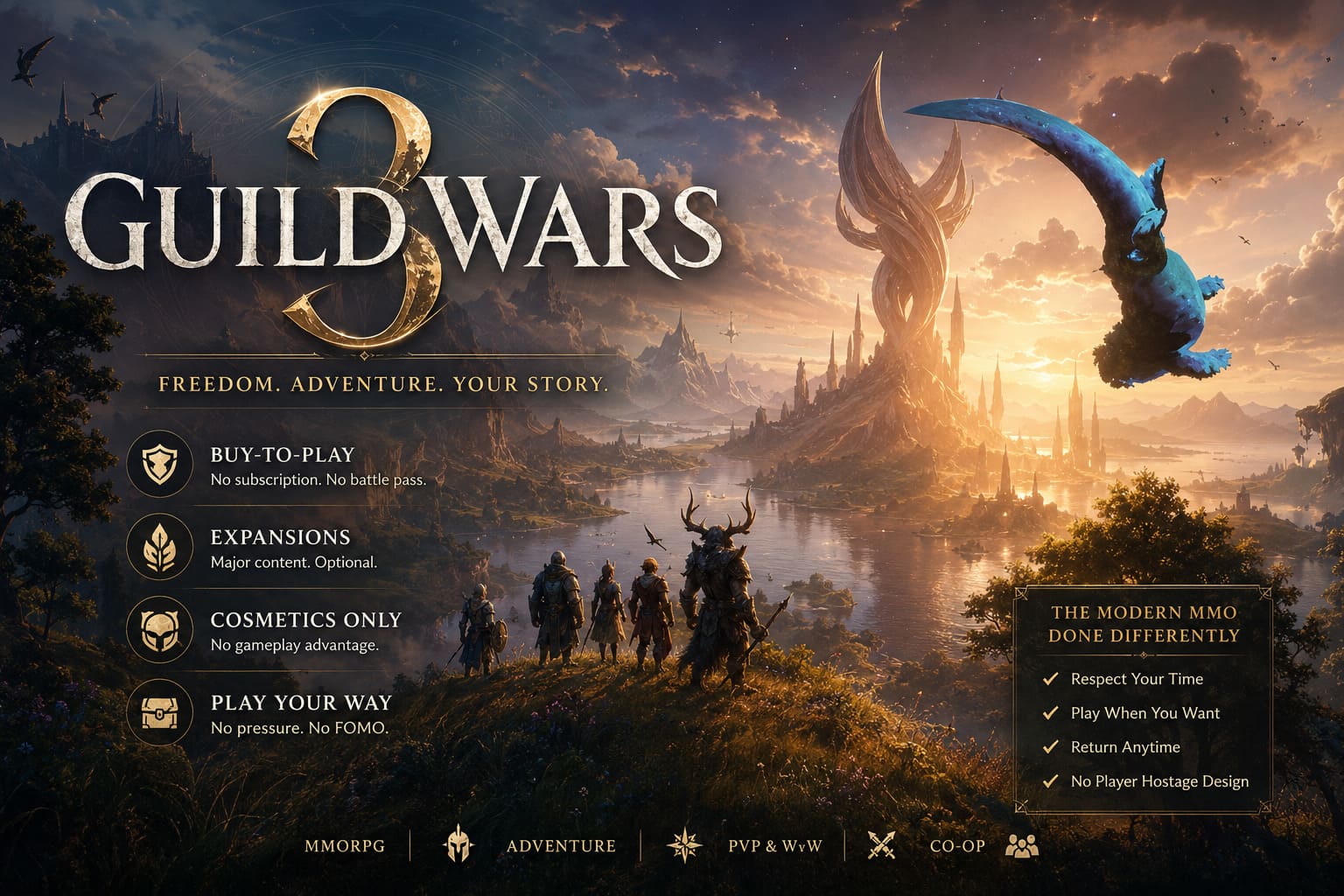
What stood out isn’t just that the game exists—it’s how it plans to exist in the modern MMO space.
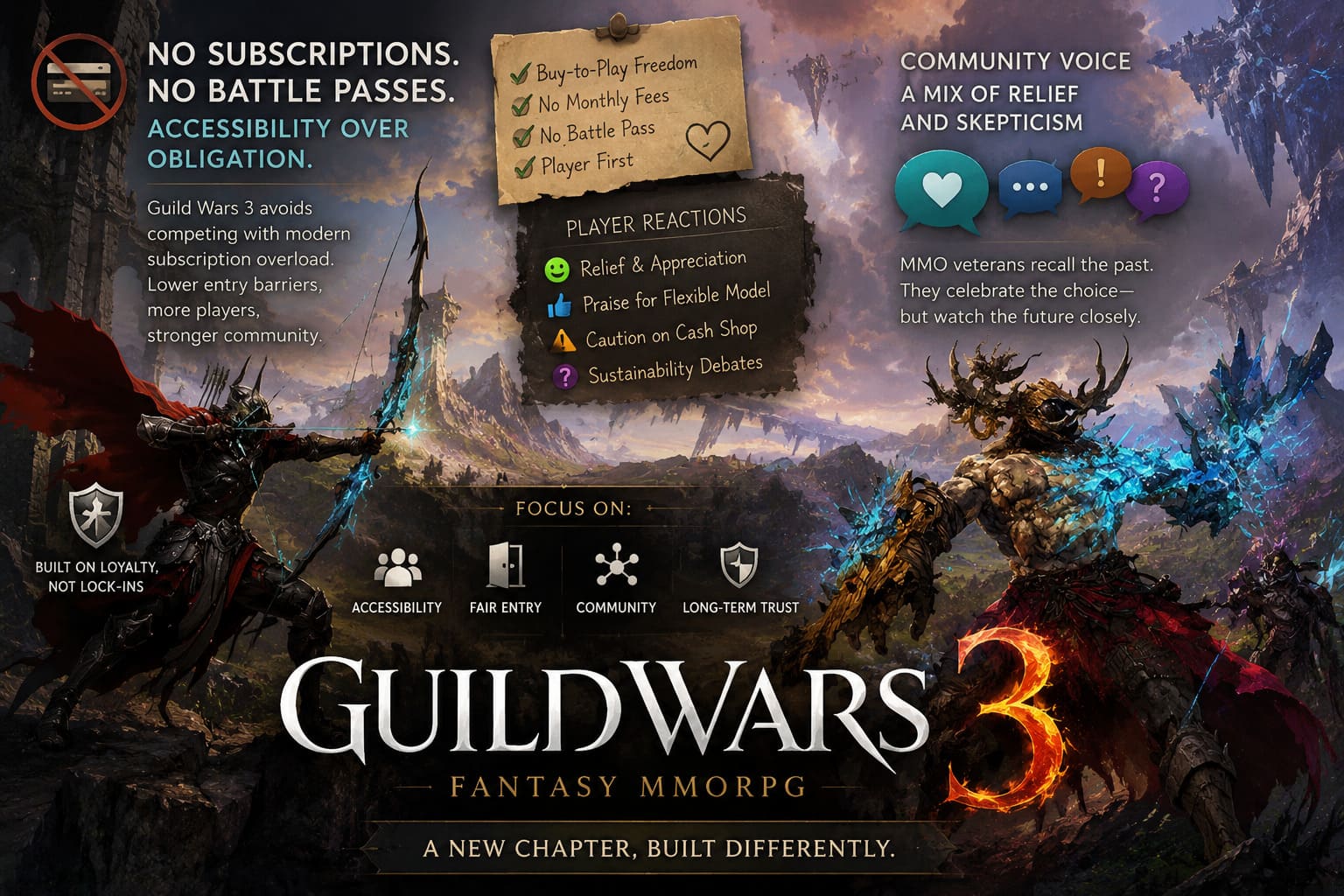
No subscription fee. No battle pass. Just a buy-to-play structure with optional expansions and cosmetics. In 2026, that already feels unusual enough to deserve a closer look.
Guild Wars 3 Coming to PS5? Release Date, Rumors, and Console Confirmation Explained
A Return to Buy-To-Play Without Modern Pressure Systems
Guild Wars 3 is being built around a simple idea: you buy the game once and you own access to it. There is no recurring subscription, and no seasonal battle pass system designed to push daily engagement through fear of missing out.
That matters more than it might seem at first glance. Modern live-service games are often structured around psychological retention loops:
- Daily login rewards that punish inactivity
- Seasonal battle passes with expiration timers
- Limited-time cosmetics tied to constant engagement
- Subscription fees that require monthly justification
Guild Wars 3 Beta Signup Guide: How to Join the 2027 Playtest
Guild Wars 3 is intentionally stepping away from all of that. Instead of building systems that demand attention, it appears to be designed around flexibility. You play when you want, stop when you want, and return without penalty.
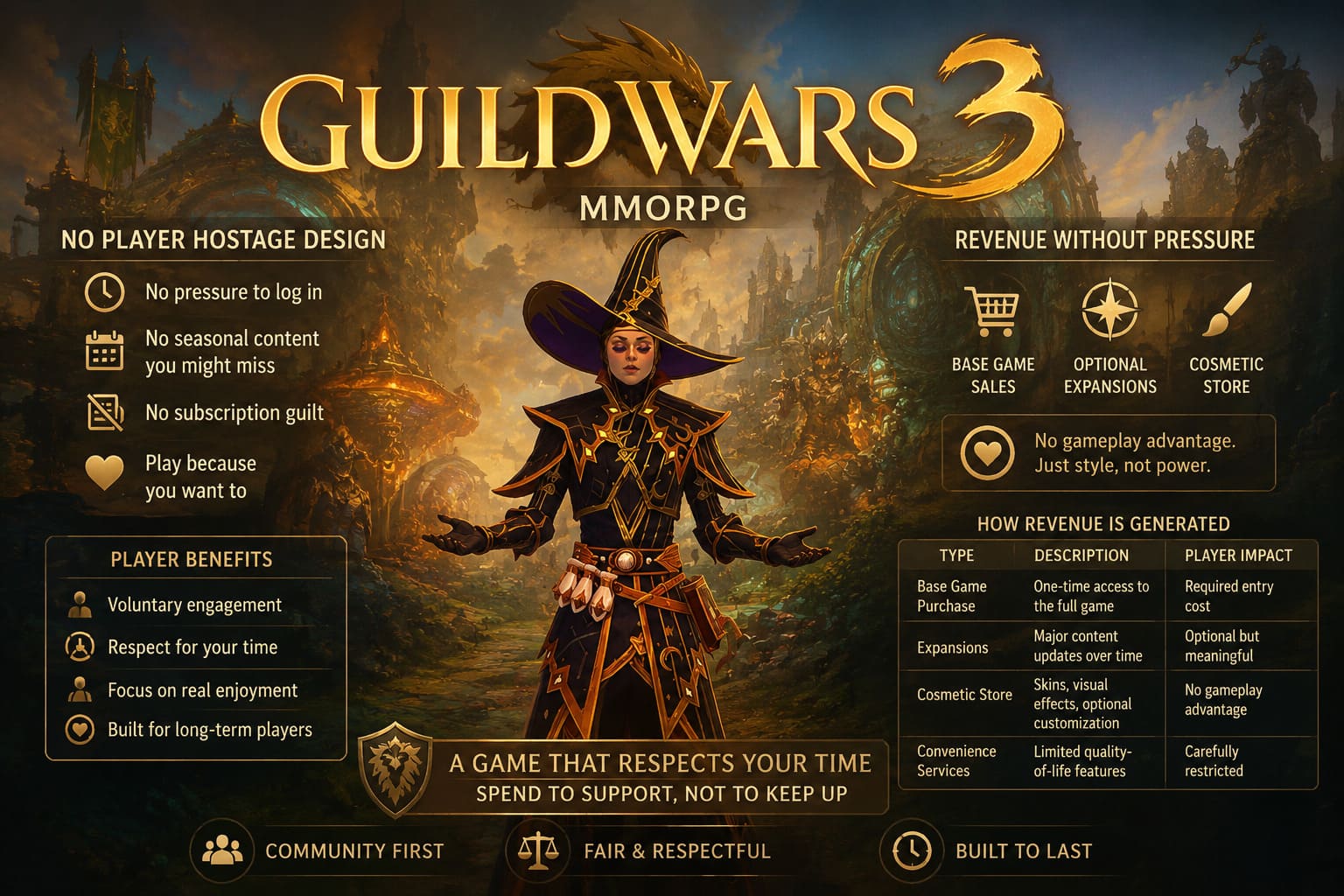
The Philosophy Behind “No Player Hostage Design”
One of the most interesting ideas coming from the developers is the rejection of what many players now call “hostage design.” This refers to systems that subtly force continued engagement even when a player isn’t enjoying the game anymore.
In Guild Wars 3, the philosophy is the opposite. The idea is that a game should not punish you for taking a break. There is no pressure to complete seasonal content before it disappears, and no subscription guilt reminding you that you’re paying for unused time.
This creates a very different emotional relationship between player and game. Instead of obligation, the focus shifts back to voluntary enjoyment. For a long-time MMO player, that is arguably the biggest selling point of all.
How Guild Wars 3 Plans to Generate Revenue
Of course, removing subscriptions and battle passes raises an obvious question: how does the game actually make money?
The current model is based on three core pillars: base game sales, optional expansions, and a cosmetic-focused in-game store. Importantly, none of these systems are designed to affect gameplay power directly.
Here’s a simplified breakdown:
| Monetization Type | Description | Player Impact |
|---|---|---|
| Base Game Purchase | One-time access to the full game | Required entry cost |
| Expansions | Major content updates over time | Optional but meaningful |
| Cosmetic Store | Skins, visual effects, optional customization | No gameplay advantage |
| Convenience Services | Limited quality-of-life features | Carefully restricted |
The key idea here is optionality. Players are not forced into recurring payments or progression systems tied to monetization cycles. Instead, spending is positioned as support for additional content or cosmetics.
Why Subscription MMOs Are No Longer the Default
Subscription-based MMORPGs used to dominate the genre. Today, they are rare and highly specific in their success. Games like World of Warcraft and Final Fantasy XIV can still sustain subscriptions because of long-established ecosystems, massive content libraries, and deeply loyal communities.
But for new MMORPGs, the equation is different. Modern players already manage multiple recurring costs: streaming services, game libraries, DLCs, and various entertainment subscriptions. Adding another mandatory monthly fee increases friction before the game is even installed.
Guild Wars 3 avoids this entirely by not competing in that space. Instead, it focuses on accessibility and lower entry barriers, which is increasingly important in a saturated gaming market.
Gothic 1 Remake Lockpicking Guide: How to Open Every Chest Without Breaking a Pick
Community Reaction: Relief and Skepticism at the Same Time
The reaction from MMO communities has been a mix of relief and cautious analysis. Many players appreciate the return to a buy-to-play structure, especially those who remember how Guild Wars 2 allowed them to step away and return without penalty.
Common community reactions include:
- Relief over the absence of subscriptions and battle passes
- Positive comparisons to Guild Wars 2’s flexible model
- Concerns about potential cosmetic store expansion
- Debates about long-term funding sustainability
Content creators and analysts also point out that while the model looks consumer-friendly, the real test will be how monetization evolves over time. MMO history shows that even fair systems can shift if financial pressure increases.
The Cosmetic Store Question
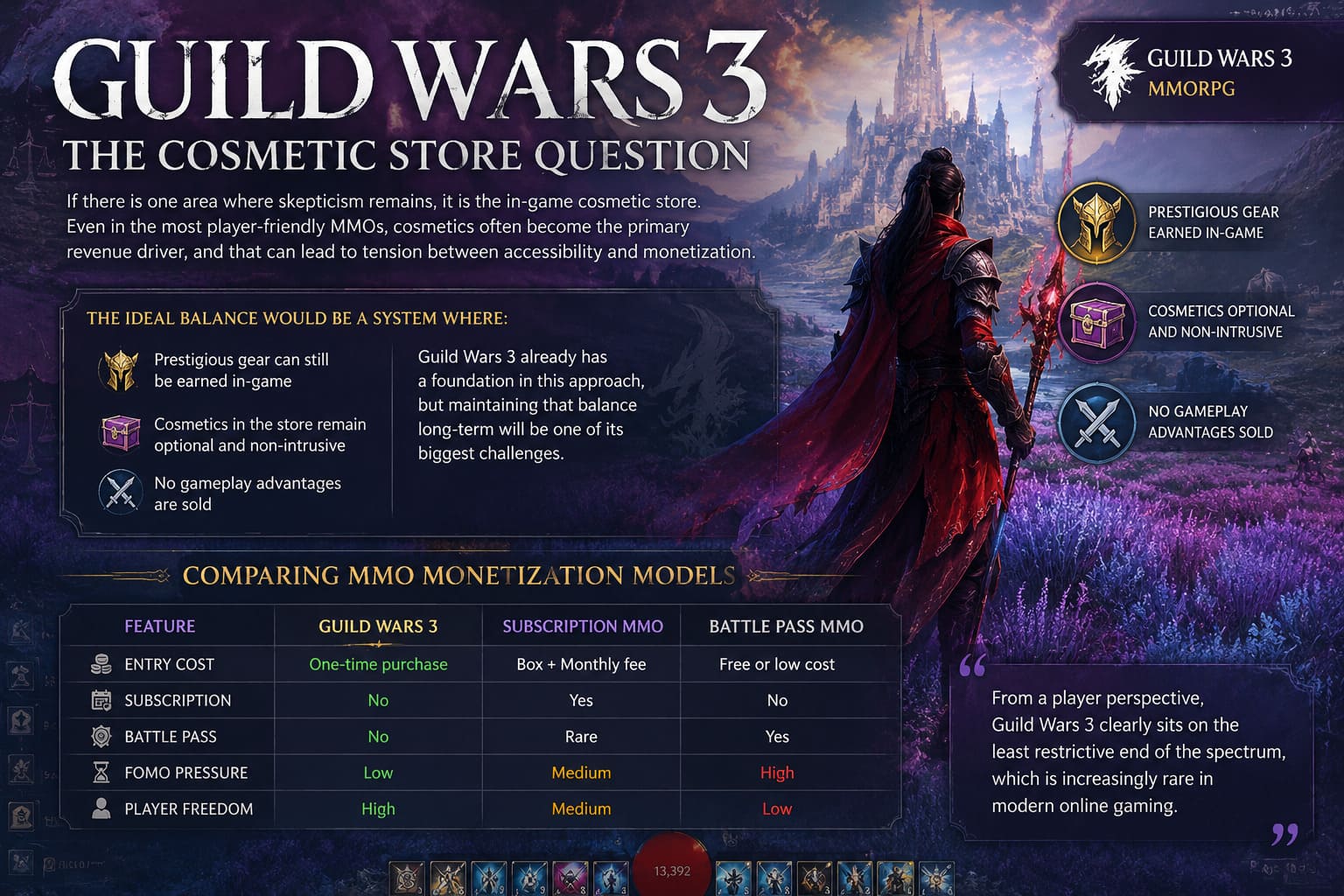
If there is one area where skepticism remains, it is the in-game cosmetic store. Even in the most player-friendly MMOs, cosmetics often become the primary revenue driver, and that can lead to tension between accessibility and monetization.
The ideal balance would be a system where:
- Prestigious gear can still be earned in-game
- Cosmetics in the store remain optional and non-intrusive
- No gameplay advantages are sold
Guild Wars 3 already has a foundation in this approach, but maintaining that balance long-term will be one of its biggest challenges.
Comparing MMO Monetization Models
To understand where Guild Wars 3 fits in the modern MMO landscape, it helps to compare it directly with other common systems.
| Feature | Guild Wars 3 | Subscription MMO | Battle Pass MMO |
|---|---|---|---|
| Entry Cost | One-time purchase | Box + Monthly fee | Free or low cost |
| Subscription | No | Yes | No |
| Battle Pass | No | Rare | Yes |
| FOMO Pressure | Low | Medium | High |
| Player Freedom | High | Medium | Low |
From a player perspective, Guild Wars 3 clearly sits on the least restrictive end of the spectrum, which is increasingly rare in modern online gaming.
Final Thoughts From a Long-Time MMO Player
I’ve seen enough MMO launches to know that promises don’t always survive the transition into live service reality. But the direction here feels intentionally grounded rather than overly ambitious in a marketing sense.
What stands out most is not just the absence of subscriptions or battle passes, but the mindset behind it. The idea that a game should respect your time even when you are not actively playing is something the MMO genre has slowly drifted away from over the years.
Of course, the real test will come later. Expansion pricing, cosmetic shop behavior, and long-term design decisions will ultimately define whether this philosophy holds or shifts under pressure.
Still, if Guild Wars 3 manages to stay true to its current model, it could become one of the few modern MMORPGs that players don’t feel burned out by—and that alone would already be a significant achievement.